
Summary
- Kaluska informatsiyna merezha LLC looks like a credible regional Ukrainian access network rather than a shell: the legal entity, public contract trail, industry association listing, ASN, RIPE registrant data, PeeringDB profile and active prefix announcements all point to an operating local ISP centered on Kalush, Dolyna and nearby settlements.
- The hard economic question is not whether customers want broadband that survives blackouts. They do. The question is whether KIM can turn that demand into enough monthly cash to pay for passive optical upgrades, backup power, spares, field labour, call-center availability and upstream diversity while keeping service affordable in a market where national fixed-internet ARPU remains low.
- The strongest evidence in KIM's favor is practical rather than promotional: PON and XGPON/XGSPON offers, low but tiered prices, explicit payment-deferral and suspension tools, public-sector internet contracts, 2026 repair jobs, RPKI-valid routing and participation at three internet exchanges.
- The weakest point is also practical: public records do not disclose KIM's audited revenue, churn, outage hours, generator inventory, debt, network topology or actual household take-up of higher-priced tiers. A good local routing record does not prove last-mile resilience in an apartment building during a long outage.
- My judgment is that KIM has a defensible local franchise if it treats continuity as a priced product and an operating discipline, not as a slogan. The view would change if repair records, outage evidence or subscriber behavior showed that customers are paying for speed while abandoning the network during disruption.
A Local Connection Becomes a Balance-Sheet Test
The most revealing customer for Kaluska informatsiyna merezha LLC is not a hyperscale enterprise, a ministry or a national media buyer. It is a Kalush household that still needs a child in an online class to stay connected when the power is off, a small shop whose card terminal and messaging channel have to work through a queue of repairs, or a school office that treats a few thousand hryvnias of annual internet service as part of basic civic continuity. That customer cannot write a blank cheque for resilience.
It can, however, distinguish between a cheap connection that disappears at the first grid event and a local provider whose support line answers, whose optical path has power discipline behind it and whose repair crew can reach the fault.
That is why KIM should be analysed less like a generic Ukrainian ISP and more like a small infrastructure utility with retail exposure. Its public tariffs run from a 1 Gbit/s GPON home internet plan at 200 hryvnias per month to 2 Gbit/s and 2.5 Gbit/s XGPON/XGSPON plans at 299 and 499 hryvnias. The company also sells internet plus television, charges for some installation and equipment items, offers router setup and equipment-replacement services, and advertises PON as a way for subscribers with their own reserve power to remain online during outages.
This is a business model with several possible margins: recurring access fees, upfront optical receiver economics, equipment sales or rentals, service calls, public-sector connections and business access. It is also a model with several cash drains: fibre build, OLT and ONU inventory, routers, vehicle time, splicing labour, power backup, transit, peering, support staff and collections risk.
The thesis is simple. KIM can survive as a meaningful regional network only if it prices reliability into the average local connection. Speed alone is too easy for larger carriers to copy and too hard for customers to verify at the advertised headline rate. Continuity is different. In wartime western Ukraine, the economically valuable connection is the one that still works when the customer has a power bank on the router, when the municipal office has a day of paperwork to finish, when a school has a remote lesson to run, and when a local business cannot wait for a national call center to route the ticket.
KIM's challenge is to turn those moments into durable willingness to pay without crossing the line where a household decides that mobile data, a national bundle or a cheaper local rival is good enough.
Identity And Control Boundary
The company boundary is unusually clear for a small regional operator. KIM's own public contract names TOV "Kaluska informatsiyna merezha," gives the Kalush address on Nezalezhnosti Boulevard, lists EDRPOU code 36382015 and identifies the provider's website, email and phone line. Third-party Ukrainian company records agree on the core facts: the company was registered on 21 April 2009, is organized as a limited liability company, lists wired telecommunications as its principal activity and has Marian Kasko as an authorized person or manager.
Clarity Project records a statutory capital of 3,000,000 hryvnias and shows a dispersed local ownership structure with several named participants rather than a single disclosed controlling owner. YouControl similarly lists the participant group and the registered legal status.
This matters because the network evidence maps back to the same operating identity. RIPE RDAP shows AS197522 under the name ISP-KIM-NET and registrant organization Kaluska informatsiyna merezha LLC, with Kalush address data and abuse contact. RIPEstat confirms that AS197522 is announced. BGP and IP intelligence pages associate the same AS with KIM's IPv4 and IPv6 resources. PeeringDB uses the English label "Kalush Information Network" for the same ASN and website. None of that proves profitability.
It does, however, reduce a common research risk in regional telecom: confusing a marketing brand, a legal entity, a reseller and a routing registrant. Here the commercial, legal and routing identities line up closely enough to treat KIM as one operating company for economic analysis.
The boundary is still not perfect. KIM's documents page lists public contracts not only for KIM but also for several sole proprietors, suggesting that the broader service ecosystem may include related or partner operators, contractors or legacy business arrangements. That is common in local access markets, but it means revenue and liability may not all sit inside the LLC. The business website also exposes residential and business surfaces, while the customer portal is restricted to users on KIM's network.
A conservative reading is that the LLC is the anchor operator, not necessarily the sole economic participant in every branded service or field activity. Any valuation or credit view would need bank statements, payroll, lease contracts, equipment debt and the split between the LLC and any associated sole-proprietor contracts before moving from operational confidence to financial confidence.
The Product Is Not Just Speed
KIM markets speed aggressively. The residential page advertises 2.5 Gbit/s Turbo at 499 hryvnias per month, 2 Gbit/s Power at 299 hryvnias, and 1 Gbit/s Premium VIP at 200 hryvnias. The plan copy also includes an important caveat: the guaranteed speed is measured at the exit from the optical terminal to the subscriber's equipment, after which performance depends on the customer's own equipment. That caveat is not a throwaway line. It is the boundary between what KIM can engineer and what the customer may experience.
A provider can build an XGPON path to a building and still be blamed for a poor Wi-Fi router, old laptop, congested household mesh or insufficient backup power.
The installation economics show the same tension. For XGPON/XGSPON optical connection, KIM lists a 1,999 hryvnia cost tied to the optical receiver while saying other work is covered by the company and offering two months as a gift. For GPON, it lists 600 hryvnias or no upfront charge if the customer signs an equipment-rental agreement and prepays two months. This is a classic access-network trade-off. Upfront charges protect the operator from low-quality demand and help fund hardware. Lower upfront charges increase adoption but push more recovery into monthly billing.
During wartime, the second model is attractive because households are cash constrained; it is also dangerous because the operator carries more capital at precisely the moment when batteries, generators, spares and imported electronics are more expensive to procure.
KIM's add-on services are therefore economically informative. Router setup from 50 hryvnias, OTT-TV setup, hot equipment replacement, routers priced in the mid-thousands of hryvnias and mesh systems near 6,000 hryvnias all point to a provider that tries to capture some value around the home network, not just the street fibre. That is sensible. In a PON-heavy network, the customer experience is often constrained by the last three meters: router quality, placement, power supply and the user's ability to keep the optical terminal alive.
If KIM can sell better equipment and service it quickly, it improves both margin and perceived resilience. If it cannot, the advertised optical upgrade becomes a source of complaints when customers discover that a gigabit plan does not automatically make a weak home Wi-Fi setup perform like a business circuit.
What PON Solves, And What It Does Not
The PON claim is the center of KIM's wartime economics. The company tells apartment customers in Kalush and Dolyna that PON is a passive optical technology and says that if the subscriber has reserve power, access to the internet can continue during electricity outages. That claim is directionally credible. Passive optical distribution reduces dependence on powered active equipment between the operator and the user.
In Ukraine's blackout context, regulators and industry observers have repeatedly highlighted PON as a more resilient fixed-access technology, with operators investing in batteries, generators and more energy-efficient networks after the severe outage experience of 2022 and 2023.
But the wording matters. KIM does not promise that the internet will work regardless of all external conditions. It says the customer needs reserve power. It also still has to power its own headend, switching, OLT, transport and upstream paths. A passive splitter in a building is useful only if the optical line is intact, the customer's terminal and router are powered, the operator's active equipment remains up, the upstream routes are available and the repair team can reach faults. PON changes the shape of the resilience problem; it does not remove it.
The margin question is whether the additional monthly revenue from customers who value blackout-tolerant service is enough to fund the operator-side obligations that customers cannot see.
Ukraine's national discussion makes this more than a marketing issue. The regulator has described inspections of operators' readiness, including generators, fuel reserves, batteries and mobile response teams. RIPE Labs has discussed initiatives that help users check provider readiness for outages and connect Ukrainian operators with donor or vendor equipment. The Internet Society has described Ukraine's internet resilience as a function of technical redundancy, Starlink backup, repair mobilization and distributed networks rather than any one magic technology.
For KIM, that means PON should be treated as one component of a continuity product. A customer who buys "internet that works without light" is effectively buying a bundle: passive access, powered core, maintained batteries, spare equipment, reachable technicians and honest communication about what still depends on the customer.
Routing Evidence: Real Network, Limited Inference
The routing record is one of the stronger parts of the file. AS197522 is active under the ISP-KIM-NET name. RIPEstat shows 5,632 announced IPv4 addresses across 24 IPv4 prefixes and eight IPv6 prefixes, with visibility to all measured RIS peers in the July 2026 snapshot. BGP tools and IPinfo show KIM-associated IPv4 ranges including 46.149.176.0/20 and 2.57.204.0/22, and RIPEstat's announced-prefix feed lists multiple /24s plus IPv6 /32s. RPKI validation for the core 46.149.176.0/20 and one of the IPv6 /32s is valid.
That does not make a network immune to outage or misconfiguration, but it indicates a provider maintaining modern route-origin hygiene.
PeeringDB adds useful operating color. The profile reports regional scope, 20-50 Gbit/s traffic, mostly inbound ratio, IPv6 support, open peering policy and three exchange points. The netixlan data shows 30 Gbit/s ports at DTEL-IX public, 1-IX UA and 1-IX EU. RIPEstat's neighbors snapshot shows 16 observed neighboring ASNs. Those data points matter because a local ISP with only one weak upstream and no peering options has a different risk profile from one with exchange participation and multiple observed relationships. KIM's record suggests it is not merely reselling a single access pipe under a local brand.
The inference must still be bounded. PeeringDB data is partly self-reported. Internet exchange port speed is not the same as sold customer capacity, committed information rate or effective throughput during regional congestion. RIPE neighbors are observed routing relationships, not contracts. A valid ROA prevents one class of route-origin error but does not protect against a fibre cut, a drained battery, a failed OLT line card or a customer building whose riser has been damaged. The routing evidence tells us KIM has a live, maintained and regionally connected network.
It does not tell us whether a particular apartment in Dolyna stays up after twelve hours of outage. The investment case needs both layers.
Unit Economics In A Low-ARPU Country
The national comparison is unforgiving. Ukraine's fixed-internet ARPU in 2025 was reported at 234.2 hryvnias per month, with fixed-internet revenue growing by 8.2 percent and xPON becoming the largest technology share. KIM's 1 Gbit/s home internet at 200 hryvnias sits below that national ARPU. Its 2 Gbit/s plan at 299 hryvnias is above it, and the 2.5 Gbit/s plan at 499 hryvnias is more than twice it. That tiering is exactly what a regional ISP needs: a defensible entry price to avoid losing households, plus higher tiers that can carry the resilience and capex burden.
The difficulty is that advertised speed can compress price discipline. If customers compare only "one gigabit for 200" against national bundles or another local provider, KIM's room to raise average revenue is limited. If customers compare "will the network work during outages, will the support line answer and will repairs happen quickly," KIM has a better chance of charging a premium. That is why the payment page matters.
It describes instant and bank-transfer payment methods, warns that bank payments can take up to three working days, encourages customers to pay three or four days before their balance expires and points to a deferral service if they miss payment. This is not glamorous, but it is the daily mechanics of cash conversion. A local ISP can have strong demand and still suffer if payments arrive late, if support staff manually reconcile transfers, or if disconnections create churn during hardship.
The public procurement record gives a second angle on pricing. Individual 2026 contracts show annual or period internet service at values such as 4,200 hryvnias, 5,760 hryvnias, 3,180 hryvnias and 2,000 hryvnias for local public institutions. These are not transformative enterprise contracts. They are small, recurring continuity contracts: school, park, municipal information center, Dolyna lycée. Opendatabot's customer summary shows larger accumulated public buyers such as Kalush cultural administration, Kalush executive committee, Tlumach lycée and Kalush primary health center, but the totals are still modest.
The economic value is not in any one tender. It is in a dense local mesh of institutions that want stable service and may prefer a provider that already knows the street, building and responsible official.
Cost And Capital: The Hidden War Inside A Cheap Plan
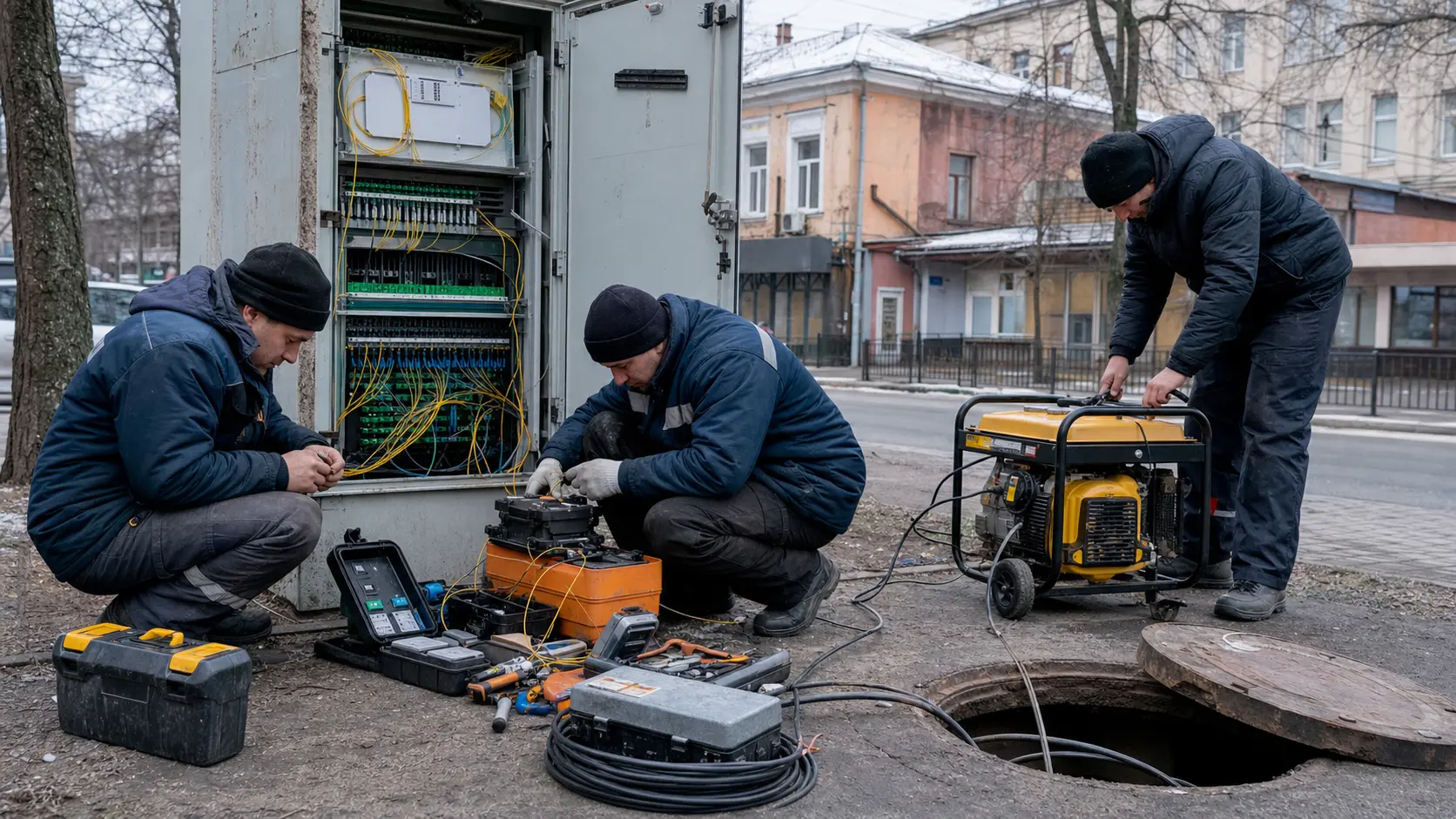
The cost stack behind a 200-499 hryvnia monthly plan is heavier than the tariff page admits. Fibre access requires materials, splicing tools, poles or ducts where available, building access, optical terminals, routers, field staff, vehicles and inventory. Blackout resilience adds batteries, chargers, generators, fuel logistics, secure storage, maintenance cycles and replacement batteries that degrade. Wartime conditions add route damage, unpredictable work windows, insurance gaps, procurement delays and the opportunity cost of skilled technicians who may be mobilized, displaced or priced upward by competing infrastructure needs.
The company's own service menu hints at that hidden cost stack. Hot equipment replacement is framed as an extended guarantee for optical receivers, ONU terminals and Wi-Fi antennas, valid for 12 months, one-time use and with master call-out paid separately. That is rational. It converts an uncertain future replacement into a priced option and reduces the shock of a full equipment purchase for the customer. But it also shows how many failure points sit at the edge of the network. If the operator gives away too much support inside a low monthly plan, field labour becomes an unpriced subsidy.
If it charges too often for visits, the customer sees resilience as nickel-and-diming. The right answer is a clear paid continuity package: better terminal, battery guidance, replacement option, realistic support SLA and transparent outage communication.
KIM's equipment storefront also illustrates the working-capital problem. A TP-Link Archer A64 at 1,550 hryvnias, an Archer AX12 at 1,699, an AX53 at 2,399 and a Deco X20 mesh package at 5,999 can improve the customer experience. They also tie the ISP to consumer-electronics supply chains and warranty expectations. A local provider that stocks hardware is partly a retailer, partly an installer and partly a credit provider if it lets customers defer or rent equipment. In an inflationary and currency-sensitive environment, that inventory cannot be treated as incidental.
The operator must either turn it quickly, price it properly or accept that hardware will consume cash that could otherwise fund batteries and route redundancy.
Public-Sector Continuity As A Franchise Signal
KIM's public-sector contracts are small, but they are strategically meaningful. A municipal information center buying 12 units of internet service for the year, a village or school address buying a single internet service, a Dolyna lycée contracting several services, or a Kalush park buying access does not make KIM a government contractor in the grand sense. It does show that the company is embedded enough to serve the public infrastructure of its geography. During disruptions, that can matter more than logo scale.
A local official with a failed link may value the provider who knows the address and can send a crew over a provider whose national brand is stronger but whose service process is remote.
The same record also prevents overstatement. The values visible in individual 2025 and 2026 procurements are often measured in hundreds or low thousands of hryvnias. A 380 hryvnia service, a 900 hryvnia repair or a 1,000 hryvnia restoration job is evidence of local work, not evidence of high-margin enterprise revenue. If KIM relies heavily on many such low-ticket public contracts, its administrative burden could be high relative to revenue. If those contracts are merely a small complement to a larger household and SME base, they are a useful reputational and utilization layer. The source record does not disclose the split.
The public procurement trail is especially useful because it supports the "local support labour" part of the story. One 2023 procurement described cabling, media-converter installation, patch-cord connection and power-supply repair for an administrative building in Mostyshche. A 2025 procurement described repair and restoration work to restore access to an internet network in Holyn. These are not abstract services. They are exactly the small, physical, technician-led tasks that determine whether a regional ISP has a service advantage. KIM's economics therefore depend on dispatch density.
The more jobs it can complete near existing routes, the more labour productivity it can preserve. The more it stretches into thinly served villages without pricing travel and spares, the more continuity turns into a margin leak.
Competition And Substitutes
KIM does not operate in a monopoly vacuum. The 2IP city provider table for Kalush lists KIM alongside Netgroup-Service, Ukrtelecom, Kyivstar, Lanet, Vega, Uarnet, Vodafone Ukraine, Lifecell and other smaller names. The review counts are not market-share data, but they show that customers perceive alternatives. Kyivstar's own public materials describe it as Ukraine's largest electronic communications operator, with more than 23 million mobile subscribers and more than 1.1 million Home Internet subscribers in the second quarter of 2025.
TeleGeography reports that Kyivstar, Volia and Ukrtelecom are leading national fixed-broadband providers by user share. These larger operators have procurement power, brand recognition, national bundles and mobile cross-sell that KIM cannot match.
Yet national scale is not always decisive in a regional access market. A large mobile operator can be the substitute of first resort during a short fixed-line outage, but mobile networks themselves depend on powered base stations, backhaul and spectrum capacity. National roaming in Ukraine has helped continuity, but it does not turn mobile into a perfect replacement for stable home or school fixed access. Ukrtelecom can offer GPON-style resilience in many markets, but its service perception varies by location.
Kyivstar can bundle mobile, fixed internet and television at a price that pressures local ARPU, but a local provider can still win on building familiarity, response time and rural reach if it executes.
KIM's own coverage signals are therefore critical. Its website exposes Kalush, Rozhniativ, Dolyna, Zhydachiv and Tlumach regional selectors and lists many settlements in the business-site footer. The PON apartment promotion is explicitly available to residents of Kalush and Dolyna multi-apartment buildings. The procurement trail includes Kalush, Dolyna, Kropyvnyk, Holyn and other nearby addresses. The competitive question is not "can KIM beat Kyivstar nationally?" It cannot.
The question is whether KIM can own enough local streets, buildings and villages with better continuity economics than a national bundle can offer at the same address. If it can, scale disadvantage is tolerable. If national GPON catches up building by building, KIM's local premium will shrink.
Unofficial Market Signals
The unofficial signals are mixed, which makes them useful. List.in.ua repeats a strong marketing-style claim that KIM offers optical energy-independent internet using XPON, GPON, XGPON and XGSPON, fast connection windows, call-center service, flexible tariffs and speeds including 1 Gbit/s, 2.5 Gbit/s and 10 Gbit/s. That is not audited evidence, but it is a public marketplace presentation of how KIM wants to be understood. The 2IP provider-review page contains praise for stable service during power cuts and quick connection, but also complaints about instability, low measured speed, poor service and limited alternatives.
The company or representative responses ask for contract numbers or addresses and point customers to support.
The right way to use those signals is neither to dismiss them nor to quote them as truth. Reviews are self-selecting and often skew toward angry or unusually satisfied users. They do, however, reveal what the battleground feels like: power-outage continuity, speed variance, repair responsiveness, perceived monopoly power and support quality. KIM's public economics should be judged against exactly those themes. If customers complain that they pay for 50 Mbit/s and see single-digit speeds, a 2.5 Gbit/s headline will not fix trust.
If customers say service works when power is off, KIM has a proof point it can convert into a premium continuity offer. If the company answers reviews with practical diagnostic requests, that is a better signal than pure silence, though it still does not prove resolution.
The social-responsibility page adds a different soft signal. KIM reports support for Ukraine's armed forces, including 2025 posts about assistance. That does not determine broadband quality, but it is part of the trust economy of a local wartime operator. Customers may prefer a provider seen as locally present and civically aligned. Investors should be careful: civic visibility is not a substitute for uptime, cash collection or debt service. It is, however, part of why a small provider can remain sticky against a national carrier. In local infrastructure markets, trust and response time can be as real as a price discount.
Regulation, Tax And The Price Of Being Formal
KIM appears in the Ukrainian regulatory context as a formal provider, not just a neighborhood network. NCEC registry materials and third-party registry pages connect the company to the provider register, and KIM's own public contract states that technical maintenance and operation are performed by KIM as a provider included in the relevant register. The broader legal framework has shifted Ukraine toward a general-authorization model aligned with European electronic communications principles, with notification-based entry, consumer rights, competition policy and regulatory oversight.
Formal status has benefits. It supports public contracting, interconnection credibility, customer trust and the ability to participate in resilience programs or industry advocacy. It also has costs. BRDO's analysis of the fixed-internet market argued that revenue dropped sharply in late 2024 after tax-service interpretations effectively disrupted simplified-tax treatment for internet providers, with reporting completeness also weakening. Whether and how that affected KIM specifically is not disclosed.
But the sector-level point matters: a local ISP's economics can be moved by tax classification, reporting duties and regulator expectations even when its physical network is sound.
The regulator's wartime stance adds another layer. Operators are expected to prepare for blackouts through batteries, generators, fuel reserves and response teams. Those expectations are reasonable from a public-interest perspective. They are not free. If Ukraine wants local networks to remain resilient, the market has to let providers recover the cost of that readiness. The danger for KIM is being squeezed between public expectation and household affordability: customers and officials demand uptime as if it were a utility obligation, while monthly access fees stay closer to entertainment pricing.
KIM's management problem is to make the resilience cost visible enough to price, but not so visible that customers conclude they are paying extra for what should already be included.
The Investment Judgment
My base judgment is constructive but conditional. KIM has enough evidence of real operation, regional embedding and network-resource discipline to deserve attention as a local continuity platform in western Ukraine. Its tariffs show a ladder that can segment households by willingness to pay. Its PON promotion directly addresses the wartime use case. Its public procurement trail shows local institutions buying access and repair. Its ASN has live visibility, RPKI-valid origins, IPv6 resources and exchange participation. Those are not trivial signs for a local ISP.
The condition is that KIM must avoid selling resilience at a loss. A provider can destroy value by promising blackout-resistant internet to win customers, then absorbing the cost of batteries, fuel, truck rolls, spares and late payments inside a 200 hryvnia monthly fee. It can also destroy value by pushing speed tiers that require customer equipment upgrades while underinvesting in support.
The sustainable strategy is more disciplined: sell a basic affordable optical plan, make the higher-speed tiers carry a clear continuity and support promise, monetize equipment without abusing trust, keep public-sector contracts dense and local, and preserve route diversity where it matters.
There is also a credible upside case. If national policy and customer behavior continue to favor xPON, if KIM can upgrade apartment buildings in Kalush and Dolyna efficiently, if higher-tier adoption rises, and if public institutions keep buying local continuity, KIM can turn its regional franchise into a durable cash engine. In that case, the company is not merely an ISP; it is a local resilience intermediary that converts household and municipal anxiety into a priced service. The scale will still be regional, but the value per retained customer can rise.
The downside case is equally clear. If customers treat all fixed broadband as interchangeable, the 200 hryvnia plan anchors the whole base. If mobile bundles or national GPON offers improve at the same addresses, KIM's price ladder compresses. If outages expose weak operator-side backup power, the PON claim becomes reputationally dangerous. If public-sector contracts remain numerous but tiny, administration and dispatch costs eat the margin. If tax or labour shocks raise costs faster than monthly fees, the network becomes a maintenance treadmill.
The company's survival is not threatened by lack of demand; it is threatened by an inability to make continuity pay.
Facts That Would Change The View
Several facts would materially change this judgment. The first is audited or at least management-verified revenue by segment: residential, business, public-sector, equipment, installation and service calls. If higher-tier plans account for a meaningful share of recurring revenue and churn is low, the case strengthens. If most customers sit on the cheapest tier and use deferral often, the case weakens.
The second is outage evidence. A reliable record of uptime during grid interruptions, generator and battery coverage for key nodes, restoration times, ticket volumes and spare-equipment turnover would be more valuable than another speed claim. If KIM can show that PON customers with home reserve power remain online through long outages, it has pricing power. If customers frequently lose service because operator-side nodes drain or upstream paths fail, PON marketing becomes fragile.
The third is route and supplier concentration. KIM's current public routing profile shows useful diversity, but the contracts behind those routes are unknown. A loss of exchange participation, upstream concentration or deterioration in RPKI and prefix hygiene would change the risk profile. Conversely, clearer redundant backhaul, documented transit contracts and additional regional peering would support a higher-quality view.
The fourth is competitive buildout. If Kyivstar, Ukrtelecom or another national carrier brings reliable GPON and bundled mobile pricing to the same apartment blocks at lower effective prices, KIM has to win on service and local support rather than speed. If national carriers leave villages and smaller buildings underserved, KIM's local dispatch and settlement knowledge become more valuable.
The fifth is labour. The company can buy routers and optical terminals if it has cash. It cannot easily replace trusted technicians who know the physical network, the municipal contacts and the rural routes. If KIM retains field staff and keeps repair windows short, the economics of local continuity improve. If labour thins out, the network may still announce prefixes while the customer experience deteriorates.
The final view is therefore not diplomatic. KIM should be treated as a real and useful regional ISP with a plausible wartime continuity franchise, but not as a proven high-quality infrastructure compounder. The evidence supports operational legitimacy and local relevance. It does not yet support financial comfort. The company must earn that comfort by showing that every resilient connection pays for the hidden system behind it: power, route diversity, spares, collections, support labour and the option value of being reachable when the easy parts of the grid fail.
The practical control metric is not maximum advertised speed; it is recoverable continuity cost per retained address. Management should know, by building cluster and settlement, how much monthly gross margin remains after upstream service, billing loss, expected support calls, equipment depreciation, backup power and technician travel. If that number is negative on the cheapest plan, the remedy is not another promotion. It is either a higher-value tier, a paid equipment bundle, tighter dispatch geography or a decision not to extend the route.
That is the discipline separating a resilient local utility from a popular but underfunded access network.
Sources
- https://www.kim.ua/about-us/
- https://www.kim.ua/
- https://www.kim.ua/internet/
- https://www.kim.ua/tb-internet/
- https://business.kim.ua/internet/
- https://www.kim.ua/promotions/pon-u-kvartyru/
- https://www.kim.ua/payment/
- https://www.kim.ua/documents/
- https://www.kim.ua/wp-content/uploads/2022/11/new-kim.pdf
- https://www.kim.ua/services/
- https://www.kim.ua/soczialna-vidpovidalnist/
- https://my.kim.ua/
- https://www.kim.ua/technical-support/
- https://www.kim.ua/faq/
- https://www.kim.ua/network-usage-rules/
- https://rdap.db.ripe.net/autnum/197522
- https://stat.ripe.net/data/as-overview/data.json?resource=AS197522
- https://stat.ripe.net/data/routing-status/data.json?resource=AS197522
- https://stat.ripe.net/data/announced-prefixes/data.json?resource=AS197522
- https://stat.ripe.net/data/prefix-overview/data.json?resource=46.149.176.0/20
- https://stat.ripe.net/data/rpki-validation/data.json?resource=AS197522&prefix=46.149.176.0/20
- https://stat.ripe.net/data/rpki-validation/data.json?resource=AS197522&prefix=2a09:dc40::/32
- https://stat.ripe.net/data/asn-neighbours/data.json?resource=AS197522
- https://www.peeringdb.com/api/net?asn=197522
- https://www.peeringdb.com/api/netixlan?asn=197522
- https://bgp.tools/as/197522
- https://ipinfo.io/AS197522
- https://ipgeolocation.io/browse/asn/AS197522
- https://inau.ua/members/kim
- https://clarity-project.info/edr/36382015
- https://youcontrol.com.ua/catalog/company_details/36382015/
- https://opendatabot.ua/c/36382015
- https://uablocklist.com/providers/kim.in.ua
- https://nkek.gov.ua/hromadskosti/publichna-informatsiia/nabory-danykh-nkek-shcho-pidliahaiut-opryliudnenniu-u-formi-vidkrytykh-danykh/reiestr-postachalnykiv-elektronnykh-komunikatsiinykh-merezh-ta-posluh
- https://data.gov.ua/en/dataset/ad65395c-55c6-4ff6-abfa-14709b66d9ae
- https://nkek.gov.ua/static-objects/nkek/uploads/public/67a/b84/842/67ab848421fd4749084122.pdf
- https://zakupivli.pro/gov/tenders/ua-2026-01-07-001134-a
- https://zakupivli.pro/gov/tenders/ua-2026-01-07-004172-a
- https://zakupivli.pro/gov/tenders/ua-2026-02-05-009052-a
- https://zakupivli.pro/gov/tenders/ua-2026-03-25-003641-a
- https://zakupivli.pro/gov/tenders/ua-2025-08-11-004549-a
- https://zakupivli.pro/gov/tenders/ua-2025-09-05-007448-a
- https://zakupivli.pro/gov/tenders/ua-2023-08-17-009776-a
- https://2ip.ua/ua/services/providers-rating?act=2&city=%D0%9A%D0%B0%D0%BB%D1%83%D1%88
- https://2ip.ua/ua/services/providers-rating?act=1&asid=197522
- https://list.in.ua/%D0%86%D0%BD%D1%82%D0%B5%D1%80%D0%BD%D0%B5%D1%82-%D0%BF%D1%80%D0%BE%D0%B2%D0%B0%D0%B9%D0%B4%D0%B5%D1%80%D0%B8/74281/%D0%9A%D0%B0%D0%BB%D1%83%D1%81%D1%8C%D0%BA%D0%B0-%D0%86%D0%BD%D1%84%D0%BE%D1%80%D0%BC%D0%B0%D1%86%D1%96%D0%B9%D0%BD%D0%B0-%D0%9C%D0%B5%D1%80%D0%B5%D0%B6%D0%B0-%D0%9A%D0%B0%D0%BB%D1%83%D1%88
- https://speedtest.net.ua/
- https://labs.ripe.net/author/eliza-rohotska/ukraine-as-a-laboratory-of-internet-resilience/
- https://pulse.internetsociety.org/en/blog/2023/02/case-study-ukraine-a-role-model-for-internet-resilience/
- https://ces.org.ua/en/connectivity-during-blackouts-liliia-malion/
- https://www.undp.org/sites/g/files/zskgke326/files/2025-07/undp_ukraine-report-mobile_connection_in_ukraine_2025-eng.pdf
- https://en.interfax.com.ua/news/telecom/1156657.html
- https://brdo.com.ua/en/news/revenues-in-the-fixed-internet-market-fell-by-30-following-the-ban-on-the-simplified-taxation-system/
- https://www.ibanet.org/ecommunications-framework-ukraine-overview
- https://www.rada.gov.ua/en/print/201005.html
- https://kyivstar.ua/about/kyivstar-today-eng
- https://resources.telegeography.com/ukraines-telecom-market-explained
Member Briefing
Deeper Profile Context
Sign in with the right membership level to unlock the full briefing and source notes.
Only for Strategic Circle
Strategic Circle
Open to all readers. Unlock profile briefings after joining and signing in.
Join Strategic CircleOnly for Leadership Alliance
Leadership Alliance
For qualified IP-asset owners and management; sign in to unlock alliance briefings.
Join Leadership Alliance