
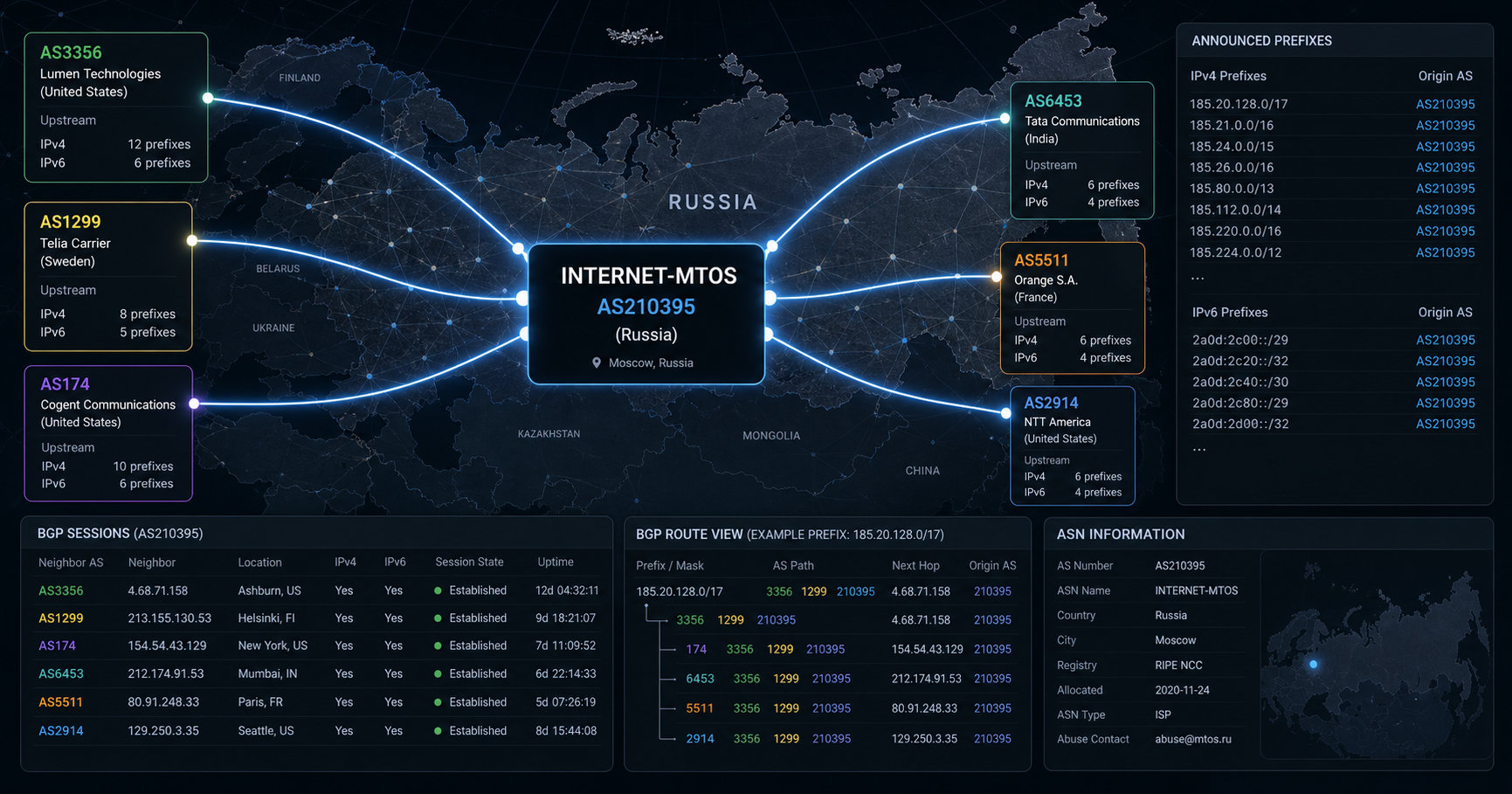
INTERNET-MTOS is the registered holder of AS210395, a Russian autonomous system visible in BGP routing. Four public infrastructure sources confirm its registry identity, country, upstreams, and prefix announcements, but no corporate website, executive names, or customer evidence has been verified. The entity's operating role can be inferred only from numbering and routing data; its business model, ownership, and human control remain opaque. Monitoring priorities include RDAP/WHOIS contact changes, prefix additions or withdrawals, and emergence of official documentation. Without such evidence, the profile is limited to registry and routing signals, and the entity should be treated as a low-visibility infrastructure marker rather than a confirmed commercial operator.
INTERNET-MTOS
INTERNET-MTOS is the registered name behind autonomous system AS210395, a Russian network operator known only through public BGP and registry data. Four infrastructure databases confirm its existence, but no corporate website, financial records, or named executives are publicly available, making it a low-visibility entity whose commercial substance and control remain opaque.
Why It Matters
Alterations to INTERNET-MTOS's routing footprint directly affect traffic engineering for dependent networks. A prefix withdrawal or upstream change can cascade through dependency models and undermine topology assumptions, making the entity a critical—if poorly understood—node in Russian connectivity analysis.
What Public Sources Show
INTERNET-MTOS is the name behind autonomous system AS210395, a Russian network operator visible only through its public routing footprint. Four infrastructure databases confirm its existence, but no corporate website, executives, or service offerings are publicly documented. It operates as a low-visibility internet resource holder, and its opaque structure makes it an uncertain node in Russian connectivity mapping.
Public RDAP and BGP monitoring platforms—BGPView, IPinfo, and BigDataCloud—list AS210395 as INTERNET-MTOS, registered in Russia. The autonomous system announces multiple IPv4 and IPv6 prefixes and peers with upstream transit providers. These records are the sole public confirmation of the entity's operational activity; they reveal nothing about its internal organization, customer base, or revenue.
The observable control surface is limited to the AS210395 registry entry, the IP prefixes it originates, and the upstream autonomous systems that provide transit. Any change to the RDAP contact details, an addition or withdrawal of a prefix, or a shift in upstream peers directly alters the entity's public footprint. There is no known physical office, corporate governance layer, or customer-facing service beyond the routing data.
Because AS210395 injects routes into the global BGP table, its behavior influences reachability for the address space it controls. Analysts who map Russian internet dependencies must treat this ASN as a potential chokepoint: a single prefix withdrawal or upstream change can redirect traffic for networks relying on those routes. Practical monitoring of this entity therefore centers on its routing signals and their implications for connectivity mapping.
The most actionable signals are updates to the RDAP or WHOIS record—a new contact, name, or country entry—which could indicate a change in administrative control. Prefix volatility, such as frequent additions or removals, may signal network reconfiguration or customer churn. A new upstream transit provider would shift the entity's dependency map.
Most critically, the appearance of a corporate website, PeeringDB page, or official registry filing would immediately increase the profile's reliability.
Without basic corporate documentation, it is impossible to determine whether INTERNET-MTOS is a commercial ISP, a captive infrastructure arm of another firm, or a private venture. No individual name appears in any public record, leaving its human authority surface completely blank. All assessments are therefore limited to routing and registry signals, and the profile should be treated as a low-confidence infrastructure marker rather than a verified company.
Operating Surface
It holds AS210395, originates IP prefixes, and connects to upstream transit providers within the Russian internet routing ecosystem. Its role is that of a network operator, but the absence of corporate documentation means that the entity's full business model, customers, and management are not publicly known.
Changes to AS210395's routing behavior or registry details can disrupt reachability and shift dependency maps for networks that rely on its address space. Monitoring this entity provides early warning of routing reconfigurations within Russian internet infrastructure, particularly given its opaque structure.
Watchpoints
INTERNET-MTOS represents a known-unknown node in Russian internet infrastructure. While its routing footprint is small, its opacity introduces risk for dependency mapping. Any sudden routing change could signal reconfiguration or ownership transfer with no corporate transparency.
Monitor RDAP/WHOIS record updates for new contacts or country changes. Track prefix announcements for volatility. Watch for appearance of any corporate documentation. Changes in upstream ASNs indicate shifting transit dependencies.
No corporate website, registry filing, or named individuals exist. Without these, the entity's legal form, ownership, and customer relationships cannot be assessed. The absence of PeeringDB, RIPE NCC member data, or local business registry entries limits the profile to a routing signal.
Sources
- Registry RDAP / WHOIS record - public-source identity and registry context for INTERNET-MTOS.
- bgpview.io - BGPView lists AS210395 as INTERNET-MTOS, shows country Russia, upstreams, and announced prefixes.
- ipinfo.io - IPinfo identifies AS210395 as INTERNET-MTOS and provides public ASN summary data including name and country context.
- bigdatacloud.com - BigDataCloud publicly labels AS210395 as INTERNET-MTOS and provides an ASN reference page that corroborates the entity name.
Signal Brief
- Signal: INTERNET-MTOS
- Signal Type: Network Infrastructure Operator
- Region:
- Market Class: Global Regional ISP Trends
Operating Footprint
- public operating records
- official service pages
- documented relationships updates
Market Context
- Alterations to INTERNET-MTOS's routing footprint directly affect traffic engineering for dependent networks. A prefix withdrawal or upstream change can cascade through dependency models and undermine topology assumptions, making the entity a critical—if poorly understood—node in Russian connectivity analysis.
- Operational relevance: Medium
- Time Horizon: Next quarter
What To Watch
- official company sources
- public registries
- operator-published records
Member Briefing
Deeper Trend Context
Sign in with the right membership level to unlock the full briefing and source notes.
Only for Strategic Circle
Strategic Circle
Open to all readers. Unlock trend briefings after joining and signing in.
Join Strategic CircleOnly for Leadership Alliance
Leadership Alliance
For operators, investors, and policy teams that need relationship evidence, failure paths, and source notes. Sign in to unlock.
Join Leadership AllianceSnapshot
It holds AS210395, originates IP prefixes, and connects to upstream transit providers within the Russian internet routing ecosystem. Its role is that of a network operator, but the absence of corporate documentation means that the entity's full business model, customers, and management are not publicly known.
Alterations to INTERNET-MTOS's routing footprint directly affect traffic engineering for dependent networks. A prefix withdrawal or upstream change can cascade through dependency models and undermine topology assumptions, making the entity a critical—if poorly understood—node in Russian connectivity analysis.
Confidence score guide
Several public sources