
Summary
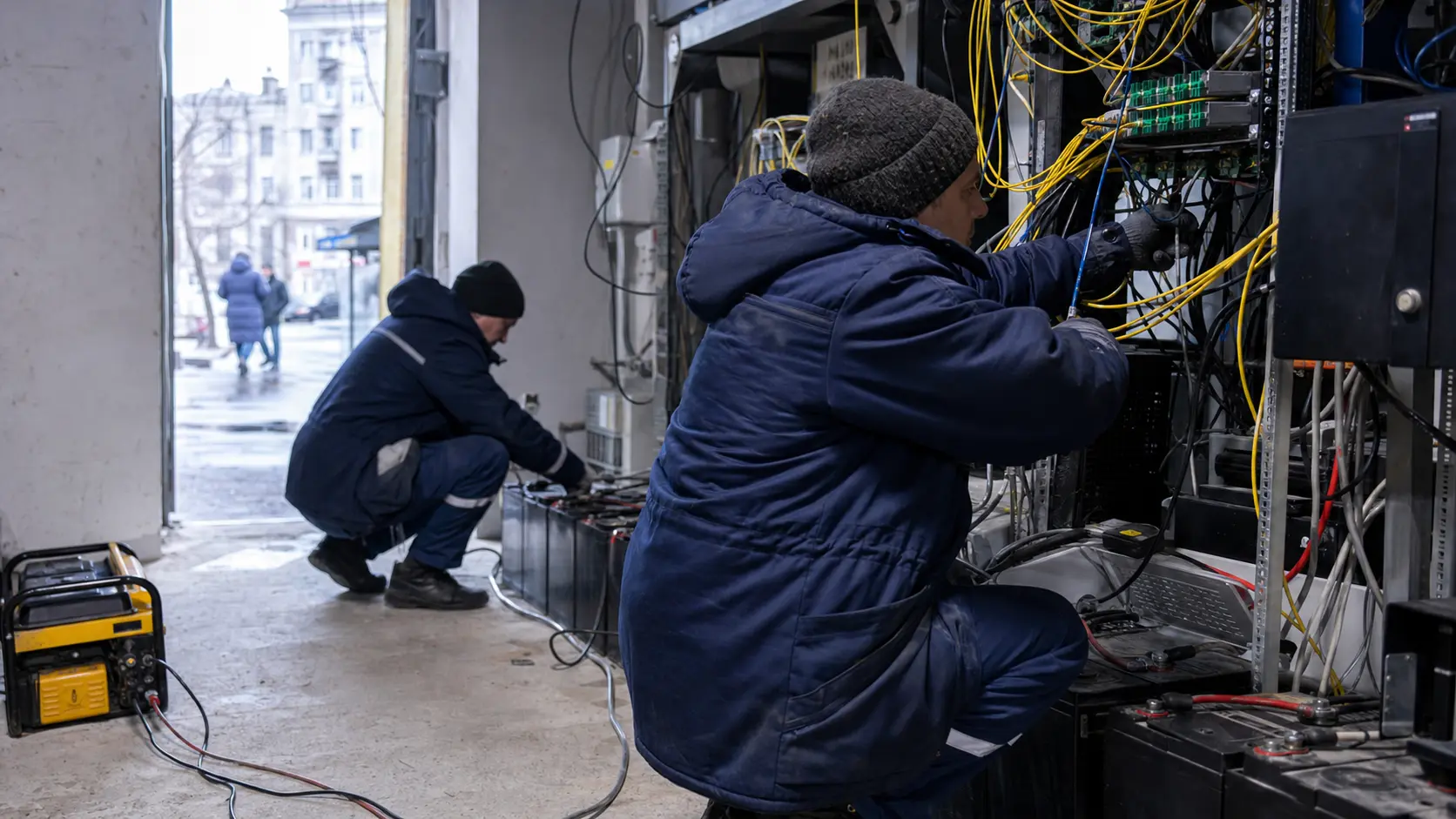
- Infocom is best understood as an enterprise continuity operator, not as a simple retail ISP. The public record points to a long-running Ukrainian corporate network built around UkrPack, AS6846, protected internet access, L2/L3 data channels, SD-WAN, VPN, DDoS mitigation, hosting, cloud storage, outsourcing and regional support. Its value is strongest when the customer needs a secure branch or service network to stay reachable during power disruption, cyberattacks and route failures.
- The economic test is whether those customers pay for the full cost of availability. Official material claims 22 regional offices, more than 1,000 active nodes, more than 9,000 points of presence, 24/7/365 support, independent power at nodes, a two-hour maximum onsite intervention for partner work and 99.95% average network availability. Those are not free marketing claims. They imply batteries, spare equipment, field staff, route diversity, carrier relationships, monitoring and security capacity that must be recovered in recurring contracts.
- The company's customer mix validates the thesis and creates concentration risk. Public procurement and registry sources show meaningful exposure to public, energy, law-enforcement, pension, employment, banking and critical-service buyers. Ukrenergo reserve-channel contracts, protected internet tenders, police and pension network tenders show demand for continuity. They also show the weak point: post-payment terms, tender pressure and buyer concentration can turn a technically valuable service into a working-capital and renewal-risk business.
Start with the protected access service
The most revealing way to analyze Infocom is to begin with a single enterprise service: protected internet access with DDoS protection and backup connectivity for an organization whose work cannot stop. A normal broadband customer buys bandwidth. A critical office buys the absence of downtime, a defined security perimeter, monitoring, a recoverable connection, a supplier that can reach a site, and an answer when the problem is neither purely local nor purely upstream.
That distinction changes the economics. Infocom's official secure-access-node service says it is meant to protect customer data and information assets from unauthorized access, external attacks and malicious software. The same official page says the service has been provided since 2015, refers to a certificate of compliance from the State Service of Special Communications and Information Protection of Ukraine, and lists 24/7/365 monitoring, attack and incident control, technical support and SLA-regulated service quality. That is a managed-risk product.
It needs security equipment, rule maintenance, logs, skilled staff, customer-specific configuration, upstream filtering, response processes and replacement gear. It cannot be priced as if it were merely a port.
Infocom's DDoS page makes the commercial logic plain. Downtime for e-commerce, banking, payment systems and government bodies creates customer loss, reputational damage and direct financial losses. A DDoS attack can exhaust software or hardware resources, or overload communication channels until a service becomes inaccessible. The company is not selling fear in the abstract. It is selling a way for customers to avoid being the party whose public-facing service fails during a campaign of traffic, malware, extortion or diversion.
The same logic appears in channel redundancy. Infocom's own redundancy page says backup channels should avoid overlapping the primary line so that both do not fail from the same technical issue or physical damage. That sentence is the core of the business. A second line that follows the same duct, depends on the same power room or terminates through the same carrier failure domain is not true redundancy. Real independence costs more. It requires survey work, carrier selection, wireless or mobile fallback, route records, failover configuration and periodic testing.
The customer may see only "backup internet." The provider sees the margin problem: the backup path must be ready even when it is rarely used.
This is why Infocom's article should not be framed as a generic regional ISP story. The company's public materials are full of enterprise services: L2/L3 data channels, corporate VPN, SD-WAN, secure internet access, DDoS protection, cloud hosting, cloud storage, outsourcing, remote hands, B-End partner service, mobile secure networking and regional support. The service mix points toward public agencies, banks, utilities, energy companies, distributed enterprises and global carriers needing local Ukrainian reach. The question is not whether the company has products.
The question is whether the contracts attach enough value to continuity to pay for the cost of keeping those products credible under disruption.
A national enterprise network, not only a local ISP
Infocom's official history gives it a stronger institutional base than many small access providers. The company says it is historically the first IT company in Ukraine and has more than 33 years of experience. It says that shortly after its establishment it began building Ukraine's first national data transmission network, UkrPack, in 1991. It says international partnerships with Datex-P in Germany and Sprint in the United States gave access to more than 120 data networks, and that Ukrainian financial institutions were connected to SWIFT through that early network context.
By 1996, the company says it had become an internet access provider. By 2000, UkrPack had expanded to 120 major Ukrainian cities. By 2009, the network had more than 700 communication nodes and had moved into MPLS, with a high-speed Kyiv city network.
Not all official history should be treated as investment proof. Companies tend to tell their past in the most flattering form. But this particular history matters because it explains the present service mix. Infocom does not present itself only as a household-access challenger. Its pages emphasize corporate networks, secure data exchange, public and financial customers, outsourcing, cloud, DDoS protection and partner connectivity. The business has the shape of a long-serving enterprise network whose routes and customer relationships accumulated over time.
The official current metrics reinforce that reading. Infocom claims 22 regional offices, more than 1,000 communication nodes, more than 9,000 points of presence and 24/7/365 technical support. Its international-partnership page says the company provides B-End services on a nationwide network, has more than 1,000 active nodes across Ukraine, can deploy last-mile service rapidly within localities, holds radio-frequency licences for long-range Wi-Fi, and can support international partners through an English-speaking 24/7 network operations center.
It also says regional offices have been operating since the 1990s and are staffed by engineering teams with hardware and SPTA sets.
Those facts matter more than an isolated speed claim. An enterprise buyer with branches across Ukraine does not only need a cheap port in Kyiv. It needs someone who can reach regional offices, solve last-mile problems, handle protected access, operate across outages and consolidate responsibility. A carrier outside Ukraine may need a local partner that can install, test and maintain a B-End service without forcing the customer to manage multiple regional contractors. A public agency may prefer a supplier with existing network familiarity and procurement history.
The legal and financial record also supports the view that this is an operating company rather than a shell around an ASN. Ukrainian registry sources identify the legal entity under USREOU code 14297222, with registration date November 4, 1993, statutory capital of UAH 30.610010 million and main activity code 61.10, wired telecommunications. Other registered activities include wireless and satellite telecommunications, security systems service, computer programming, IT consulting, computer facilities management, data processing and hosting, web portals and technical consulting.
The registered activity set is broad, but it is coherent with the official product set.
The ownership is also relevant. Opendatabot lists Controlware GmbH and Controlware Holding GmbH of Germany as 50% founders each, with Fabian Werner and Christian Werner listed as beneficial owners. Controlware's own German site describes it as a German IT solution provider and managed service provider founded in 1980, part of a group with around 1,000 employees and more than EUR 400 million in turnover. That does not mean the Ukrainian company can draw unlimited capital from Germany, and the article should not assume operational control beyond the registry evidence.
It does explain the "Ukrainian-German" identity and gives the company a plausible managed-services and enterprise-network heritage.
Ukraine.com.ua financial data shows 2025 revenue of UAH 175.653 million, net profit of UAH 18.928 million, assets of UAH 188.478 million and liabilities of UAH 14.476 million. The resulting 2025 net margin is about 10.8%, while liabilities were about 7.7% of assets. Revenue grew only about 2.1% from 2024, and net profit declined about 7.4%. Those are not hypergrowth figures. They describe a business that appears profitable but must manage costs carefully. For a continuity provider in Ukraine, that is the right caution. Availability promises can consume margin quickly when power, routes, repair and security all become more expensive.
AS6846 proves network substance, not pricing power
The strongest non-marketing evidence for Infocom's operating substance is AS6846. RIPEstat identifies AS6846 as UKRPACK Joint Ukrainan-German Enterprise "INFOCOM" LLC and shows it as announced. The RIPE DB aut-num object uses the as-name UKRPACK, organisation ORG-IJ3-RIPE and a 2026 update date. It contains a long list of import and export relationships, including entries involving Google, UA-IX, DTEL-IX, Facebook, UBNIX and many Ukrainian or customer networks. RIPEstat announced-prefix data showed 15 IPv4 prefixes and one IPv6 prefix at the observed time.
The prefix list includes large and long-standing Ukrainian address blocks such as 212.1.64.0/18 and 195.230.128.0/19, plus 195.238.180.0/22, 195.230.145.0/24 and 2a02:f1c0::/29. Hurricane Electric's BGP Toolkit cross-check reports 16 originated prefixes, 15 IPv4 and one IPv6, 25,600 originated IPv4 addresses, 46 observed BGP peers and five internet exchanges. UA-IX lists INFOCOM Joint Ukrainan-German Enterprise, LLC as a participant on AS6846 at a Kyiv site, with exchange IP 185.1.50.35. IPinfo, IPregistry and IPLocate independently connect AS6846 to Infocom and show tens of thousands of IPv4 addresses plus IPv6 allocation.
That is real network-resource evidence. A provider with AS6846, visible prefixes, IPv6, exchange participation and many route-policy entries is operating a network, not merely reselling another provider's brand. It also suggests a long tail of customers and associated networks. Hurricane Electric's peer list includes names such as Ukrenergo, the Ministry of Finance of Ukraine, the National Bank of Ukraine, Ukrposhta, the Ministry of Internal Affairs of Ukraine, Universal Bank and Ivano-Frankivsk INFOCOM. The exact nature of every visible adjacency should not be overstated.
Routing records do not equal customer contracts, revenue shares or service-level terms. But they show why Infocom's public claims about public-sector and enterprise networking are plausible.
The danger is to confuse routing substance with pricing power. AS6846 proves the company has a routed estate. It does not prove that customers pay enough for every path, prefix, helpdesk ticket, filter and regional repair. Internet addresses create value when they support paying customers, protected services, hosting, enterprise access or wholesale relationships. They create cost when they require registry maintenance, abuse handling, filtering and operations without sufficient revenue. A BGP table can look impressive while margins remain thin.
Infocom's route-policy data also shows dependency. The company has many relationships, and that is good for reachability. It also means service quality depends on upstreams, exchanges, customers, physical paths, route filters, DNS, power and customer premises equipment. A public agency experiences a service failure as one event, even if the root cause sits in a third-party carrier, a power feed, a damaged local route or a cyber incident. Infocom's economic burden is to make that complexity invisible enough for the customer, while charging enough to cover the work.
The IPv4 estate can help. Public ASN profiles show around 25,600 to more than 31,000 IPv4 addresses depending on methodology, and an IPv6 allocation. IPv4 scarcity can support hosting, enterprise connectivity, static addressing and customer network design. But address holdings are not a moat if a buyer can get equivalent service from Datagroup, Kyivstar, Ukrtelecom, a local fibre provider, a mobile operator, a satellite backup provider or a cloud provider. They are a moat only when bundled with service reliability, institutional trust, protected access and local repair.
The network evidence therefore changes the article's baseline. Infocom deserves to be analysed as a real Ukrainian enterprise network operator with a substantial routed surface. It should not be analysed as a national carrier with unlimited scale. The company has enough network evidence to be meaningful, but not enough public data to assume that every continuity promise is fully priced.
Energy turns availability into a cost center
In Ukraine, energy is not a background utility assumption. It is part of the product. Public international reporting describes repeated attacks on energy infrastructure, emergency outages, scheduled rolling electricity cuts and damage to generation, transmission and distribution facilities. The IEA's Ukraine energy security assessment describes a system that has had to restore capacity while remaining exposed to further disruption.
The UN Human Rights Monitoring Mission's update on the 2025-2026 winter describes attacks on energy facilities that triggered emergency outages, reduced generation capacity and forced scheduled rolling cuts nationwide, with civilians sometimes receiving electricity only for a few hours per day in severe periods.
For an enterprise connectivity provider, that environment changes the price of "up." A route is not usable if the active cabinet has no power. A customer access link is not useful if the router, firewall, optical terminal or local switch dies when the grid fails. A security product is weaker if monitoring equipment or logs become unreachable. A data center service is not reliable unless power, cooling and network remain available at the same time.
Infocom's official pages address the issue directly. The internet page says PON is useful in urban and suburban areas where energy-independent broadband access is required because passive optical technologies do not use additional electronics in the passive segment. That is a real design advantage. Passive optical splitters do not need grid power in the field the way active equipment does. But the company also states that user terminal equipment still needs backup power. The economic point is that PON lowers one part of the failure surface; it does not eliminate power cost.
Customer premises equipment, aggregation, routing, security appliances, server racks, monitoring systems and upstream ports still need power.
The international-partnership page goes further. It states that all network nodes are powered by independent power sources and claims 99.95% average network availability. That is a strong continuity signal, but it is also a cost signal. Independent power means batteries, UPS systems, generator access, fuel, testing, replacement cycles, space, alarms and staff. If battery autonomy is too short, the service will fail during extended cuts. If batteries are not replaced, the reliability claim erodes silently. If generators are shared, fuel supply and physical access become the bottleneck.
If node power is strong but customer-site power is weak, the service still fails from the user's perspective.
Infocom's Pilgrim product shows how expensive continuity can become at the edge. The official page describes a mobile secure networking complex with a wired or wireless VPN router, a built-in battery, two independent 2G/3G/4G modems, Gigabit Ethernet ports and optional integration with Starlink. It says Starlink can be powered from the built-in battery for up to five hours depending on battery capacity and antenna heating. That is valuable for emergency services, military command posts, police or mobile operational centers. It is not cheap availability.
It requires rugged cases, batteries, modems, antennas, router configuration, security profiles, satellite terminals, replacement batteries and support staff.
The same logic applies to wireless channels. Infocom says long-range Wi-Fi can reach tens or even hundreds of kilometers at speeds up to 150 Mbps and can serve areas where fibre is impossible or economically inefficient. Wireless can be an efficient backup, but it adds radios, masts, alignment, spectrum permissions, weather exposure, power and maintenance. A lower civil-works cost is not zero cost. The provider must price the fact that wireless may be idle most days and decisive on the day the primary path fails.
Energy therefore changes the customer's buying question. A customer should not ask only for price per megabit. It should ask how many hours the node can run without grid power, whether the primary and backup paths share a failure point, how failover is tested, who owns the terminal battery, how replacement batteries are funded, how fast technicians can reach the site, and what happens when mobile networks are congested during a blackout. Infocom's ability to answer those questions is a commercial asset. Its ability to get paid for those answers determines whether the asset creates value.
Redundancy is valuable only when it is independent
Infocom's channel-redundancy service is the clearest statement of the continuity product. The company says reliable connectivity is essential for modern organizations and that redundancy should be part of risk management. It says engineers select backup channels to avoid overlap with primary lines and reduce cases in which both channels fail from the same physical damage or technical problem. It also says wireless backup can be flexible, rapid and less expensive than building a new wired line.
That is correct, but it creates a pricing problem. True independence is costly because it requires more than a duplicate access product. It requires physical diversity, carrier diversity, power diversity, device diversity and operational diversity. A fibre backup on the same street route may be cheaper, but it can fail at the same cut. A second service from a different retail brand can still depend on the same duct, pole, building entrance, upstream exchange or data center. A mobile backup can fail from congestion or tower power during a regional outage. A satellite backup can fail from equipment, sky view, power or subscription limits.
A provider that promises real continuity has to understand and price these tradeoffs.
Infocom has the right building blocks. Its SD-WAN page says traffic can be automatically routed across available channels, including MPLS and mobile internet, improving performance and availability. Its corporate VPN and L2/L3 pages describe private networks for distributed sites. Its wireless-channel page gives a lower-civil-works option for hard-to-reach locations. Its Pilgrim device can combine mobile and satellite access. Its secure access and DDoS products can sit above these paths. The company can therefore sell a layered continuity design rather than a single access line.
The weak version of this model is a menu of disconnected products. A customer buys internet from one page, DDoS from another, a backup link from a third and cloud storage from a fourth, but no one pays for the integrated design. The strong version is a continuity contract: primary path, backup path, secure access, monitoring, incident response, local repair, power assumptions and acceptance tests are priced together. That is the difference between selling parts and selling availability.
Public procurement evidence suggests that at least some buyers understand the difference. Ukrenergo tenders in 2025 and 2026 refer to reserve channels, protected internet access, data channels for technological and corporate networks and channels to ENTSO-E-related objects. A National Police service-center tender referred to internet access with information-security incident monitoring and reserve in Kyiv. A 2026 tender referred to protected internet and DDoS services. These are not ordinary household broadband descriptions. They show demand for continuity as a purchased attribute.
Yet tenders also impose discipline on price. Buyers can specify continuity, then compare bids. In one Ukrenergo protected-access tender for Vinnytsia, another participant was rejected and Infocom won; the signed value was UAH 253,539.60. In a 2025 reserve protected internet tender, the signed value was UAH 4.513314 million. In the 2025 Ukrenergo reserve-channel tender, the signed value was UAH 24.079662 million.
These contracts are meaningful relative to a company with UAH 175.653 million of 2025 revenue, but their true economics depend on contract duration, setup costs, pass-through costs, repair obligations, acceptance terms and payment timing.
Redundancy also suffers from a perception gap. Customers remember the failover only when the primary fails. They may resist paying for a backup path that sits idle. That is why Infocom must tie pricing to business interruption cost, not to average utilization. A standby path, spare router and technician rota are like insurance. Low usage does not mean low value. But if procurement treats them as unused capacity, the provider's margin is squeezed.
Security is not an add-on in this market
Ukraine's cyber environment makes security a core operating cost. CERT-UA reported 4,315 cyber incidents in 2024, a 69.8% increase from 2023, and said attackers frequently target local authorities, government bodies, the security and defence sector, the energy sector, commercial organizations and telecommunications providers. That target list overlaps closely with Infocom's claimed and visible customer base. Public agencies, energy companies, police-related entities, banks and distributed enterprises are exactly the buyers for protected access, DDoS mitigation and secure data channels.
The company's official secure-access-node page addresses government and private-sector risk in direct terms: unauthorized interference can halt critical work processes or lead to theft or loss of confidential information. The page says the service reduces risks through perimeter protection against cyberattacks, malware and other threats, and that specialists use multi-layered security measures to detect and block threats early. It also refers to State Service compliance for the protected access node.
The documentation page separately lists a certificate for the protected internet access node, inclusion in the register of national confidential communication system operators, privacy policy and ISO 27001 certificate.
The economics of security are different from basic access. A security service needs staff who understand incidents, equipment that can filter or inspect traffic, vendor relationships, patching, updates, logs, escalation, and documentation acceptable to public or regulated buyers. It must also handle customer anxiety during attacks. When a DDoS campaign starts, the buyer does not want a theoretical SLA. It wants the site back, the traffic filtered, the incident explained and the next attack prevented. That kind of support cannot be staffed at commodity internet margins.
The official DDoS product page also makes clear why buyers pay. The consequences listed include customer loss, reputation damage, financial loss, data theft, destruction of critical information and costly restoration. A provider that can absorb or deflect attacks is selling avoided loss. But that avoided loss is hard to price in a tender because the attack that does not happen is invisible. Procurement may focus on monthly cost and compliance documents. The provider must still build for peak attack conditions.
There is a second security cost: reputation and abuse handling. A routed network with many hosted domains, enterprise links and public-sector customers will receive complaints, scanning traffic, compromised devices and incident reports. Abuse handling is rarely a headline product, but it is part of operating address space responsibly. Infocom's route estate and hosting products create this obligation. Customers buying VPS, hosting, cloud storage or secure internet access depend on the provider to manage both inbound and outbound risk.
Security can be a margin enhancer if it is bundled with protected access and private networking. A bank, public office or energy facility may pay more for a supplier that can provide connectivity and security together. It can be a margin drain if customers demand protection as a free inclusion. The decisive commercial question is how the contract separates basic internet from monitored protected access, DDoS mitigation, incident response and compliance documentation. Without that separation, the provider may win the security-sensitive customer while underpricing the security work.
Collections and procurement turn reliability into cash timing
Continuity businesses fail when cash timing is ignored. Infocom can have strong services, real routes and serious customers, yet still face pressure if major buyers pay after acceptance, if tender work requires setup before monthly payments begin, or if tax and subcontractor obligations arrive before collections. Public procurement records show why this matters.
Several Clarity Project tenders show post-payment terms. Some internet or provider-service tenders specify 100% post-payment within 10 working or banking days after service acceptance. The Ukrenergo reserve-channel tender describes 100% post-payment within 25 banking days after the buyer signs an acceptance act and after invoice and tax-invoice conditions are met. Those are normal public and corporate procurement terms. They still matter. A provider maintaining links, backup paths and security services must pay staff, carriers, equipment vendors, taxes and power costs while waiting for customer acceptance documents and payment.
This is especially important when the customer is large and the supplier is midsized. Ukraine.com.ua reports Infocom's 2025 revenue at UAH 175.653 million. The 2025 Ukrenergo reserve-channel signed contract value of UAH 24.079662 million is about 13.7% of that revenue if used only as a scale comparison. Because the contract covers a service period into 2028, it should not be treated as one-year recognized revenue. But the comparison shows that a few large continuity contracts can be financially meaningful. If one large buyer delays acceptance, changes scope, disputes a term or rebids the service, the effect is not trivial.
Opendatabot's tender data shows the same pattern from another angle. It lists 423 tenders and tender sales of UAH 167.556 million in 2025 and UAH 288.669 million in 2024. Procurement-sales data is not the same as accounting revenue, and multi-year awards can distort year-by-year comparison. Still, it shows that public procurement is a major part of the visible commercial surface.
Opendatabot's top buyers include the Pension Fund of Ukraine, State Enterprise Infotech, the State Employment Service, Ukrgasvydobuvannya, Ukrenergo, the State Statistics Service, Ukrposhta, a National Police service center, the Main Service Center of the Ministry of Internal Affairs and Volyn Regional Clinical Hospital.
That buyer list validates Infocom's public-sector continuity position. It also concentrates risk in budgets, tender cycles and public acceptance paperwork. If budget allocations shift, if a buyer changes technical requirements, if a competitor underbids, or if a contract is extended only for a short transition period, the supplier must adjust quickly. Public customers can be sticky because switching secure networks is hard. They can also be hard negotiators because procurement rules make price and documentation decisive.
The article should therefore read financial profitability with caution. A 10.8% net margin in 2025 looks respectable. It does not reveal gross margin by product, collection delay, capex, maintenance capex, battery replacement, generator cost, security staff cost, or subcontractor pass-through. A company can show profit while underinvesting in future replacement, or it can show modest profit while building a durable continuity franchise. The missing data changes the judgment.
Collections also interact with customer service. If a customer wants a protected link restored quickly, the provider must dispatch or troubleshoot first and argue about payment later. In a public-sector or energy context, refusal to support an account over paperwork can damage reputation. That gives customers implicit leverage. Infocom needs contracts that protect cash without making support fragile: clear acceptance terms, renewal dates, setup fees, pass-through clauses, change-order rules, late-payment remedies and realistic SLA exclusions for customer-side power failures.
Customer concentration is a strength until renewal day
Infocom's customer base appears stronger than that of a small consumer ISP because visible buyers include institutions for which downtime is expensive. The official VPN page says the company has built networks with up to several thousand connection points, naming the State Employment Service of Ukraine, Universal Bank, the Ministry of Internal Affairs of Ukraine and the Pension Fund of Ukraine. Public procurement records confirm historical or current exposure to the Pension Fund, Ukrenergo, National Police support bodies and other public buyers.
Opendatabot lists buyers from energy, employment, statistics, postal, police, health and public-administration contexts.
These customers support a continuity premium. A pension administration network, a police service center, an energy-system data channel or a bank branch network has a higher cost of failure than a household streaming video. The buyer may need predictable latency, private data channels, DDoS protection, secure access, compliance documents, physical repair and regional support. That is where Infocom's history and regional footprint can matter.
The same concentration can hurt. If a small number of institutional customers account for a large share of margin, the supplier's future depends on renewals, budget decisions and procurement outcomes. Public tendering also makes incumbent advantage incomplete. An incumbent can understand the network and win on continuity, but a competitor can challenge on price, documentation or alternative architecture. A customer can split primary and backup paths across providers, shift security to a managed security vendor, move workloads to a Ukrainian or European cloud, or require SD-WAN across multiple carriers.
The tender record shows both stickiness and pressure. The 2018 Pension Fund procurement for corporate data and voice network operation was a large continuity contract, with UAH 24.1722 million contracted and UAH 23.46329515 paid. Ukrenergo contracts show continued energy-sector relevance in 2025 and 2026. The National Police service-center procurement shows security monitoring and reserve access. But each of these is a discrete procurement object, not permanent ownership of a customer. The customer's need continues; the supplier must keep proving it is the best way to meet that need.
Customer concentration also affects product strategy. Infocom can earn a better return by serving customers that use multiple layers of its stack: data channels, protected internet, DDoS, backup links, regional support, hosting and outsourcing. A customer buying only a cheap internet line may not cover field and security overhead. A customer buying a national protected network can. The company's sales effort should therefore avoid treating all connections as equal. One more low-priced access line can be less valuable than a renewal of a secure multi-branch network.
There is an additional subtlety: affiliate and branch structure. Opendatabot lists branch units and ownership interests in regional or related companies. Some route prefixes and market signals refer to regional Infocom entities or partners. That can be efficient because local units know their regions and can support field work. It can also blur economics. The public reader cannot always see which entity receives revenue, carries staff, owns equipment or bears repair cost. For the parent entity, the value depends on whether affiliates strengthen coverage and profit, or fragment control and margin.
The favorable reading is that Infocom's network of branches and affiliates gives it a repair and sales footprint that national or foreign competitors cannot duplicate cheaply. The unfavorable reading is that the company must coordinate a dispersed operating surface while large buyers hold the procurement leverage. The available public facts support the first reading enough to take the business seriously, but not enough to ignore the second.
Repair access is the scarce local asset
In a disrupted network, the scarce resource is often not bandwidth. It is a technician who can reach the site, diagnose the fault, replace the device, coordinate with the building owner, prove the carrier boundary and leave the customer working. Infocom's official materials lean heavily into that local-operating asset. The contacts page lists a central office in Kyiv and branches across many regions. The international-partnership page says regional offices have engineering teams, hardware and SPTA sets. It claims maximum two-hour onsite intervention for partner services.
This matters because Ukraine's geography, war damage and power disruption make remote troubleshooting insufficient. A field site may have a failed optical terminal, dead battery, damaged fibre entrance, misaligned wireless link, failed router, inaccessible roof antenna, missing fuel, unavailable building electrician or an upstream problem that must be isolated. Customers do not want a helpdesk debate about boundaries. They want restoration.
The repair model is expensive. Regional branches require staff, vehicles, tools, test equipment, spare routers, SFPs, power supplies, batteries, antennas and local management. Spare parts tied up in regions are capital that is not earning a direct return until something breaks. The more serious the SLA, the more inventory and staffing must sit close to failure points. Outsourcing all repair can lower fixed cost, but it weakens control and response quality. Internalizing too much repair can protect service but consume margin.
Infocom's product mix suggests it needs the field capability. Wireless channels require site surveys, mounting and alignment. Pilgrim devices and backup links require configuration and testing. PON and AON access require optical work. Secure access may require customer premises equipment and firewall changes. B-End partner services require work notifications and onsite coordination. Public-sector networks require documentation and acceptance. These are not pure remote services.
The value of local repair is highest for customers who cannot switch easily. An energy-system node, public office, bank branch or police facility may not have a quick substitute if a route fails. The provider that can restore service quickly has leverage. But that leverage can be weakened if procurement does not separately value repair readiness. If the buyer sees only monthly access price, the provider is pressured to carry repair overhead inside a low access fee.
That is why Infocom should make repair economics visible in contract design. Installation and setup should not be disguised as free. Backup equipment should be priced. Site power assumptions should be written down. Replacement windows and spare-part responsibility should be explicit. Emergency dispatch outside agreed scope should have a rate card. These are not hostile terms. They are how a continuity provider avoids subsidizing the customer's operational risk.
Repair also affects alternatives. A global cloud provider can run a resilient region, but it cannot fix a Ukrainian branch's roof antenna or last-mile fibre. A mobile operator can offer backup data, but it may not integrate the customer's private network, security policies and local router. A national incumbent can have field scale, but may not match Infocom's specific legacy network knowledge for a given public customer. Infocom's local repair advantage is real if it is specific and responsive. It is weak if reduced to generic "support."
Alternatives discipline the price
Infocom's customers are not captive in the abstract. Ukrainian enterprise buyers can compare Datagroup, Kyivstar, Ukrtelecom, Vodafone Ukraine, other regional fibre providers, data-center operators, Ukrainian cloud providers, European cloud regions, satellite backup and multi-carrier SD-WAN designs. The relevant alternative depends on the workload.
Datagroup markets itself to corporate customers with data transmission, business internet, hardware DDoS protection, satellite communication, cloud services, data-center services and sectors including financial, state, energy and defence. It claims a modernized IP core and MPLS network, direct access to large content platforms, satellite capability, cloud in Ukraine and Europe, wide geographic presence and cyber protection. That is a direct alternative for enterprise network and continuity work.
Kyivstar markets VPLS and IP VPN corporate data networks, MPLS-based service, speeds from 1 Mbps to 10 Gbps, 24/7 technical support, secure channels, national and international data channels and redundancy at logical and physical levels. It can also combine fixed and LTE elements. For branch networks, that is an obvious comparison point.
Ukrtelecom markets business internet over GPON, FTTB, FTTH and xDSL, including up to 1 Gbps optical service. Its business internet page says it can organize both primary and backup data channels to support uninterrupted work. Its VPN data-channel page describes MPLS-based corporate channels from 1 Mbps to 10 Gbps and includes redundancy. As an incumbent fixed operator, Ukrtelecom is a practical option in many locations.
Data-center and cloud alternatives also matter. GigaCenter markets a Ukrainian data center with ISO 27001, PCI DSS, 24/7/365 support, a 99.982% quality guarantee and links to GigaCloud and GigaTrans. Customers can also use global cloud platforms, European regions and multi-cloud designs. If the customer's problem is server availability rather than branch connectivity, a cloud or colocation strategy may be a better substitute than buying more local access from Infocom.
Satellite and mobile are partial substitutes. A Starlink-based backup can restore a site when terrestrial links fail, but it still needs power, equipment management, security configuration and a procurement model. Mobile backup is useful where coverage and tower power hold, but mobile networks can congest during outages. Long-range Wi-Fi can solve hard-to-reach locations, but needs line of sight and maintenance. These alternatives do not eliminate Infocom's value. They make Infocom prove that it can integrate the alternatives better than the buyer can procure them separately.
The best defense for Infocom is not to claim that alternatives are weak. It is to sell an integrated continuity outcome. A buyer may be able to buy fibre from one carrier, LTE from another, Starlink from a reseller, DDoS protection from a security vendor and cloud from a data center. The cost of coordinating those parts can be high. Infocom can create value if it absorbs that coordination work and accepts responsibility for a designed service. If it only supplies one commodity component, competitors will discipline price hard.
The company's German ownership background may help in international partner work. A foreign carrier or multinational customer may value a Ukrainian partner with German ownership links, English-speaking operations, documented service processes and a national footprint. But that is not enough by itself. The customer still needs price, reach, field access, SLA credibility and security assurance. The German connection is a trust signal, not a substitute for performance.
The judgement
Infocom's economics are most defensible when the company is paid as a continuity platform for distributed enterprises and public-service buyers. The public evidence supports that interpretation. The company has a long operating history, AS6846, a visible IPv4 and IPv6 route estate, UA-IX participation, many route relationships, official secure-access and redundancy products, public procurement exposure to energy and state customers, regional branches and official claims around independent node power and local intervention.
The company is not defensible as a simple commodity-access story. If customers buy only "internet," Infocom faces strong alternatives from Datagroup, Kyivstar, Ukrtelecom, mobile operators, local fibre providers, satellite backup and cloud providers. In that market, price pressure is severe and the cost of power, security and field repair can outgrow the access fee. Infocom's edge appears when the buyer needs several services together: private data channels, protected internet, DDoS mitigation, branch reach, backup path, field support, security documentation and predictable operations.
The financials are good enough to show a functioning business, not good enough to remove risk. A 2025 revenue base of UAH 175.653 million and net profit of UAH 18.928 million suggest profitability and some resilience. Low liabilities relative to assets are favorable. But revenue growth was modest, profit declined from 2024, and public procurement exposure is large. A few major renewals or lost tenders can change the picture. Maintenance capex, security staffing, batteries, spare equipment and carrier costs are not visible in the public financial summary.
The biggest strategic requirement is pricing discipline. Infocom should not let customers bundle protected access, DDoS, backup channels, incident monitoring, field repair and power assumptions into one cheap access line. It should price the components that make continuity real: independent routes, security monitoring, equipment redundancy, site power, failover testing, emergency dispatch, documentation and reporting. If a customer wants only a basic link, it should not receive the cost structure of a critical service for free.
The second requirement is contract discipline around collections. Public and energy customers can be high-quality buyers, but post-payment terms and acceptance paperwork create working-capital risk. Large contracts should include clear acceptance mechanics, tax-invoice timing, setup payments where possible, defined service start dates, change-order rules and escalation paths. Collections are not a back-office issue when a provider is funding standby capacity and field readiness.
The third requirement is route and power transparency. The company's public claims around independent power and availability are commercially useful, but enterprise customers should demand evidence: node autonomy, battery replacement cycles, generator access, route diversity maps at the right level of abstraction, test records, outage history and failover drills. Infocom benefits if it can provide that evidence because it turns continuity from a promise into a priced asset. It suffers if the promise remains broad and the buyer pays only for bandwidth.
The conclusion is therefore favorable but conditional. Infocom has enough network, history, public customer and service evidence to be economically meaningful. It is likely more valuable as a specialist continuity and enterprise-network provider than as a generic ISP. But the same facts make the cost base heavy. Ukraine's energy disruption, cyber threat level, public-procurement dependence and field-repair burden mean continuity can destroy margin if underpriced. Infocom's best business is not more traffic at any price. It is fewer, deeper contracts where customers pay for the real cost of staying connected.
What would change the view
Several facts would improve the judgement. The first would be transparent service-quality data: outage frequency, mean time to repair, failover success, DDoS mitigation results and latency by major service class. The second would be contract evidence showing that major customers pay separately for redundancy, protected access, field support, power resilience and security monitoring rather than receiving them as unpriced inclusions. The third would be evidence that public-sector and energy customers renew on multi-year terms with acceptable margins and predictable payment behavior.
A fourth favorable fact would be visible lifecycle investment. If Infocom discloses or otherwise proves that batteries, routers, optical equipment, security appliances, monitoring systems and spare kits are being renewed on schedule, the continuity promise is more credible. A fifth would be stronger diversification: more private-sector enterprise, banking, healthcare, international-carrier and cloud customers alongside public procurement. Public-sector demand validates the service; private and international demand would reduce budget-cycle risk.
Several facts would weaken the judgement. Repeated large tender losses, falling public-procurement revenue, delayed payments, underfunded backup power, weak route diversity, high outage complaints or security incidents would all damage the continuity thesis. So would evidence that the company is relying on old network assets without funding replacement. A large decline in headcount or regional support capacity would be a warning sign because field repair is part of the product.
The most important unknown is gross margin by product. Infocom may have attractive margins on protected access, DDoS, VPN, B-End services and outsourcing, while basic access simply fills the network. Or it may be cross-subsidizing expensive continuity from contracts that procurement treats as ordinary access. Without product-level economics, the right stance is disciplined caution. The company has the right assets for Ukraine's disrupted enterprise connectivity market. It still has to prove that continuity is priced above its cost.
Sources
- https://btw.media/en/directory/joint-ukrainan-german-enterprise-infocom-llc-ua
- https://infocom.ua/
- https://infocom.ua/about/
- https://infocom.ua/business-services/telecom-services/internet/
- https://infocom.ua/business-services/telecom-services/secure-internet/
- https://infocom.ua/business-services/telecom-services/data-channels/
- https://infocom.ua/business-services/telecom-services/infosdwan/
- https://infocom.ua/business-services/telecom-services/infovpn/
- https://infocom.ua/business-services/telecom-services/pilgrim/
- https://infocom.ua/business-services/telecom-services/wireless-channels/
- https://infocom.ua/business-services/telecom-services/channel-redundancy/
- https://infocom.ua/business-services/security-services/infoddos/
- https://infocom.ua/business-services/cloud-services/
- https://infocom.ua/business-services/cloud-services/vps/
- https://infocom.ua/business-services/cloud-services/web-hosting/
- https://infocom.ua/business-services/cloud-services/cloud-storage/
- https://infocom.ua/business-services/outsourcing/
- https://infocom.ua/business-services/int-partnership/
- https://infocom.ua/about/documentation/
- https://infocom.ua/contacts/
- https://infocom.ua/home-services/
- https://opendatabot.ua/c/14297222
- https://www.ukraine.com.ua/egrpou/14297222/
- https://youcontrol.com.ua/catalog/company_details/14297222/
- https://infokom.business-guide.com.ua/
- https://opendatabot.ua/trademarks/94041585
- https://dig.ua/en/search/infocom.ua/license
- https://www.ripe.net/membership/member-support/list-of-members/ua/infocom/
- https://rest.db.ripe.net/ripe/aut-num/AS6846.json
- https://stat.ripe.net/data/as-overview/data.json?resource=AS6846
- https://stat.ripe.net/data/announced-prefixes/data.json?resource=AS6846
- https://stat.ripe.net/data/asn-neighbours/data.json?resource=AS6846
- https://ix.net.ua/user/177
- https://bgp.he.net/AS6846
- https://bgp.tools/as/6846
- https://ipinfo.io/AS6846
- https://ipregistry.co/AS6846
- https://www.iplocate.io/AS6846
- https://clarity-project.info/tender/04f4f32e1f5248a4aee5ce1de87b3a01
- https://clarity-project.info/tender/0de2a617d82a4cbf9f18f2706c21ccf6
- https://clarity-project.info/tender/2e6abdaf50cf405d9ebc0485831d81d0
- https://clarity-project.info/tender/cc101d636f48411783fee6658a7d0ab2
- https://clarity-project.info/tender/1f83afb097c7442a9d8ef36b21cccbbf
- https://clarity-project.info/tender/45e3d072dd9f49c1997ae2dcabe80efb
- https://clarity-project.info/tender/1be12e1871974a6a9eca2e7e7a9b2fa3
- https://clarity-project.info/tender/c79efee62b294e3a9569f830f665950a
- https://clarity-project.info/tender/922eccf1768c4265aa34708ce5a5a271
- https://clarity-project.info/tender/4704d98bbba340a7a0a211e0fc03daac
- https://documents.worldbank.org/en/publication/documents-reports/documentdetail/099022026094036395
- https://www.iea.org/reports/ukraines-energy-security/a-pre-winter-assessment
- https://ukraine.ohchr.org/en/Attacks-against-Ukraine-s-energy-infrastructure-and-update-on-the-human-rights-situation-in-Ukraine-1-December-2025-31-May-2026
- https://cip.gov.ua/ua/news/cert-ua-minulogo-roku-opracyuvala-4315-kiberincidentiv
- https://cip.gov.ua/ua/news/cyber-operations-rf-h1-2024-report
- https://nkek.gov.ua/pro-nkek/zvity-nkek
- https://www.datagroup.ua/en/b2b
- https://kyivstar.ua/business/products/vpn?nav_source=b2b_main_page_new
- https://ukrtelekom.com.ua/ua/internet-business
- https://ukrtelecom.ua/b2b/services/kanali-peredaci-danix-vpn
- https://gigacenter.ua/en/about
- https://www.controlware.de/en/company/about-us
Member Briefing
Deeper Profile Context
Sign in with the right membership level to unlock the full briefing and source notes.
Only for Strategic Circle
Strategic Circle
Open to all readers. Unlock profile briefings after joining and signing in.
Join Strategic CircleOnly for Leadership Alliance
Leadership Alliance
For qualified IP-asset owners and management; sign in to unlock alliance briefings.
Join Leadership Alliance