
Summary
- Indigo Tajikistan's commercial unit is a prepaid Tcell top-up or data bundle that becomes valuable only if the customer receives usable coverage after the refill, not merely a balance confirmation or a nominal gigabyte allowance.
- The buyer's direct substitutes are practical and local: a MegaFon, ZET Mobile/Beeline or Babilon Mobile SIM, Wi-Fi calling, fixed broadband, messenger-only usage, a different cash dealer, a delayed refill or no mobile data purchase at all.
- Tcell's public product pages show a wide prepaid bundle ladder, including monthly Ultra data packages from 5 GB to 50 GB, Salom+ tariff bundles, one-day data options, annual package mechanics, app-based account management and continuation services for insufficient balance.
- Delivery is expensive because Tajikistan's mobile burden is not only radio access. Coverage depends on mountain geography, power backup, fuel scheduling, core upgrades, 4G modernization, 5G preparation, international backhaul, service points and dealer/payment reliability.
- The available evidence is consistent with a large, real Tcell operating surface, but the thesis remains unproven without location-level evidence that a refill reliably converts into usable mobile data in rural districts, highways, indoor locations and overloaded urban cells.
The refill decision is a coverage test
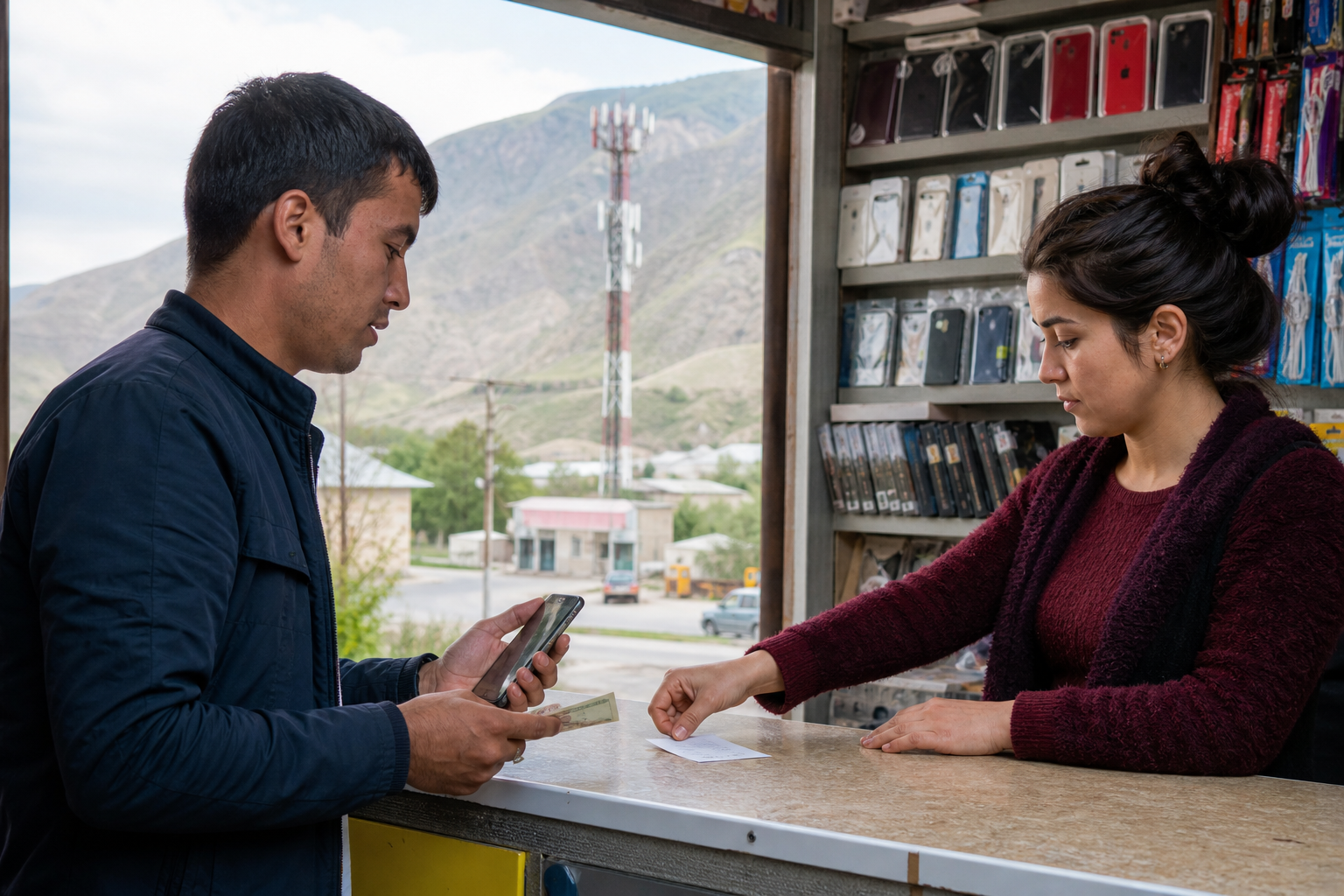
The buyer begins with a small and falsifiable decision. A prepaid customer in Tajikistan has used the last data allowance on a Tcell number and must decide whether another refill will actually work. The phone may show a familiar brand name. The Tcell app may show a balance. A dealer may be nearby. A one-day package, a 5 GB package, a 20 GB package or a full monthly tariff may be affordable enough to consider. But the real question is not whether the payment can be made. It is whether the paid account will have enough usable coverage after the refill to justify not switching to another option.
That is why Indigo Tajikistan's paid unit is best understood as a prepaid mobile top-up, a data bundle and the account relationship that surrounds it. A top-up is not just stored value. It transfers a burden from the customer to the operator. The customer wants the operator to take responsibility for radio coverage, signal stability, core network capacity, internet handoff, app and USSD activation, dealer settlement, balance recognition, customer support, power resilience and repair. If those elements come together, the refill is rational.
If they do not, the customer can buy a rival SIM, wait for Wi-Fi, place messenger calls only where a free connection is available, rely on fixed broadband at home, top up through another dealer, use a smaller emergency package or skip mobile data until the route or budget changes.
The falsifiable metric is usable coverage after refill. It should be measured as the share of recent top-up or bundle activations that can complete ordinary data tasks above a defined minimum threshold at the customer's real locations within a short window after payment. A stricter version would record whether the customer can load messaging, maps, payment, video snippets and calling apps over mobile data at home, at work, on common travel routes and in the settlement where the refill is sold. The unit is worth paying for when that share is high enough that the customer treats the next refill as a normal expense rather than a gamble.
This metric matters because Tajikistan's mobile market can make nominal connectivity look stronger than lived connectivity. DataReportal counted 10.9 million cellular mobile connections in Tajikistan in late 2025, equal to about 101 percent of the population, and said more than 91 percent of mobile connections could be considered broadband because they used 3G, 4G or 5G networks. At the same time, it estimated internet penetration at 56.8 percent and about 4.68 million people offline at the end of 2025. The country can therefore have many mobile connections while still leaving a large population outside regular internet use.
A top-up does not solve that gap by existing. It solves it only when the refill produces an active, affordable and reliable session.
The opening burden is therefore economic, not sentimental. Tcell can have brand recognition, a long operating history, a public headquarters address, service points, app links, tariffs, roaming pages and coverage maps. Those are useful starting facts. The prepaid customer still judges the next payment through experience: did the last refill work indoors, did the bundle run out early, did it reconnect as promised, did a base station overload at night, did the app show the right balance, did a route outside Dushanbe hold enough signal, and did the phone become useful when power cuts or transport delays made fixed internet unavailable?
What the customer actually buys
Tcell's own pages make the account relationship visible. The public site presents mobile connection, tariffs, roaming, service points, a support number for Tcell subscribers, a general inquiry line, the My Tcell mobile app and the ChiGap communication app. The footer identifies CJSC Indigo Tajikistan, and the public service terms describe Indigo Tajikistan as the operator providing electrical communication services under a Tajik communications license.
This is the legal and commercial frame behind a consumer refill: a subscriber account with a balance, an attached number, a tariff plan, optional services, activation commands and suspension thresholds.
The prepaid product ladder is wide enough to show that Indigo is segmenting usage, not selling one generic connection. The homepage presents Salom+ tariffs with bundled internet, messenger traffic, on-net minutes, SMS and night use. The services catalog includes Ultra data packages for social networks and messengers, with listed 30-day packages of 5 GB, 10 GB, 20 GB, 40 GB and 50 GB priced at 20, 35, 60, 100 and 120 somoni. It also lists a one-day Purple Day option with 1 GB for 5 somoni.
The annual package page, visible as a past promotion, shows additional internet packages of 1 GB, 5 GB, 15 GB and 25 GB, plus rules on monthly package provision, carryover and post-package megabyte charging. Those pages matter because they reveal the operator's economic vocabulary: allowance, validity, reconnection, automatic renewal, balance sufficiency, post-bundle charging and commands to check remaining traffic.
For the customer, those rules shape trust as much as price. If a 20 GB package is cheaper than a rival package but expires before the next cash inflow, the savings may not matter. If unused traffic disappears on package disconnection, the customer learns to manage the bundle defensively. If reconnecting to an equal or larger package adds the remaining volume and refreshes the validity period, the operator creates a reason to refill before complete exhaustion. If Wi-Fi tethering consumes the main internet package, a household using one phone as a router must treat the bundle as shared infrastructure.
If a one-day package expires at midnight, it is a tool for a temporary need, not a substitute for a household data plan.
The continuation services also show that Indigo recognizes the cliff created by prepaid charging. Connect+ is described as keeping a subscriber connected when the balance is insufficient to pay a plan's subscription fee. Temporary payment is described as a service for zero-balance subscribers to continue communication. Those offers do not prove generosity or service quality. They do prove that the moment of insufficient balance is central to the product. A prepaid operator earns loyalty by making that moment less punishing, while still collecting enough revenue to cover radio, support and interconnection cost.
The My Tcell app is part of the same paid unit. It is not a decorative channel. A subscriber who can manage services and tariffs in one app can avoid a shop visit, check remaining traffic, activate packages and receive personalized offers. The public "Chest" promotion, which encouraged users to top up 100 somoni in an app feature and receive a monthly 1 GB bonus, illustrates how Indigo tries to turn stored balance, app engagement and data incentives into a tighter account relationship. A refill that works through a dealer but fails in the app, or an app that works only when the network is already usable, weakens the same bargain.
The customer is therefore buying four things at once. First, a meter of paid entitlement: balance, bundle, validity, included minutes, included SMS and post-bundle terms. Second, a radio service that must reach the phone. Third, a payment and account mechanism that must credit the number accurately. Fourth, an operator promise that problems can be understood and repaired. When customers say a top-up is expensive or cheap, they are often compressing all four into one sentence.
The price ladder makes coverage the differentiator
The published Tcell data-package ladder gives the buyer many ways to spend small or medium amounts. A 5 GB Ultra package at 20 somoni, a 10 GB package at 35 somoni, a 20 GB package at 60 somoni, a 40 GB package at 100 somoni and a 50 GB package at 120 somoni create a clear marginal-price decision. A heavy user can see a lower price per gigabyte by moving up the ladder. A cautious user can buy a smaller package and avoid tying up cash. A one-day 1 GB package for 5 somoni suits a temporary need. A monthly tariff with messenger traffic, night use and on-net allowances suits a customer who wants more than data.
That product structure shifts the competitive question away from raw price. Once a market has multiple low-denomination bundles, the buyer asks whether the paid gigabytes can be used. A 50 GB allowance that works only near a strong urban cell is not equivalent to a smaller allowance that works along a commute, inside a rural home or at a market stall. A cheap package can be expensive if the customer must keep a second SIM for specific locations. A more expensive package can be rational if the operator's footprint makes the refill dependable where the customer actually lives.
The cost structure is hidden, but the public product rules expose some of it. Validity periods encourage predictable recharge cycles. Automatic reconnection protects recurring revenue when the balance is sufficient. Post-package per-megabyte charging monetizes overuse but can create bill shock if the customer misunderstands the rule. Carryover or remainder addition, where offered, reduces the fear of wasting a partially used bundle and encourages early renewal. App-based management reduces service-center friction. Dealer presence and online top-up partners expand the cash-in surface.
All of these are commercial tools designed to convert a one-time refill into a repeat account.
Indigo's burden is that every one of those tools has a delivery cost. A data bundle requires radio capacity, core capacity, internet capacity and support. An activation command must be recognized. A dealer or app payment must settle. A balance must update quickly enough that the customer trusts the system. A support team must explain why a package did or did not renew. A continuation service must prevent a customer from feeling cut off while still charging enough to discourage permanent underpayment. The operator does not get to sell only the gigabytes; it must operate the charging environment around them.
The bundle ladder also creates segmentation risk. A customer on a low package may experience the network mainly through throttling, post-bundle charging or emergency top-ups. A higher-spending customer may judge the network by streaming and tethering. A traveler may judge it by maps and messaging. A shop may judge it by payment terminals and supplier calls. A student may judge it by video lessons. A family may judge it by whether one phone can serve several users at night.
The same tower and the same core network must support all of these judgments, but the customer's willingness to refill depends on the use case that failed or succeeded last time.
This is why the article's metric is not "lowest price per gigabyte." The better proof is usable coverage after refill. If 80 or 90 percent of refill sessions produce dependable messaging, maps, payments and light video in the places customers actually need them, the top-up has a strong claim. If many sessions fail because of weak indoor signal, overloaded cells, delayed balance recognition, power interruptions or confusing package rules, the price ladder becomes a menu of frustration.
Coverage is the expensive part of the top-up
Tajikistan makes coverage expensive. The country is mountainous, settlement patterns are uneven, and the difference between capital-city service and regional or road coverage can be large. The official Tcell coverage map page lists cities including Dushanbe, Vahdat, Khujand, Tursunzoda, Nurek, Kulob, Isfara, Hisor and Ishkashim. That list is not a national engineering proof, but it signals that the operator is presenting coverage as a visible consumer-facing product rather than an invisible technical asset. The customer can ask whether the map, the phone and the refill agree.
Public regulator and media evidence shows why that agreement is hard. In 2023, reporting on Tajikistan's communications regulator said that much of the country's territory still relied on outdated 2G mobile connections. A 2026 Asia-Plus report on a Communications Service press conference said fixed internet speeds had improved, but slow mobile internet remained a significant issue. It also reported official plans for full 4G internet coverage across Tajikistan by 2027 and a full transition to 5G internet by 2030, with a 5G base-station plan for 65 cities and districts.
At that point, the report counted 84 operational 5G base stations, concentrated mainly in Dushanbe, with a small number in Roghun, Khorog, Bokhtar and Khujand.
Those figures do not make Indigo weak or strong by themselves. They describe the burden that every mobile operator has to carry. A prepaid refill in a country moving from 2G and 3G toward full 4G and then 5G is a promise made ahead of complete infrastructure uniformity. Customers in strong signal areas may experience the top-up as modern broadband. Customers outside those areas may experience the same brand as basic connectivity, intermittent data or no practical internet session. The commercial risk is that the customer blames the refill, not the national upgrade cycle.
ADB's 2025 Tcell Mobile Network Expansion Project is important because it confirms that expansion and modernization are not optional. The project summary and ADB announcement describe a USD 30 million equivalent local-currency financing agreement with Indigo Tajikistan to expand and modernize mobile connectivity. The project is intended to increase the number of 4G sites by modernizing existing 2G and 3G sites, raise data transfer capacity, support energy-efficient technologies and improve connectivity in underserved rural areas. It is also framed as preparing for eventual 5G in urban centers.
For the buyer, that financing is not a headline. It is an attempt to make future refills work in more places. Modernizing a 2G or 3G site to 4G can change the usefulness of a data bundle. Increasing data transfer capacity can reduce congestion. Energy-efficient equipment can reduce operating cost and improve resilience. Rural coverage can turn a SIM from an emergency voice tool into a daily data account. But the project also means the refill is funding an upgrade path. The operator must sell enough prepaid usage to justify capex, service debt and support the field organization that keeps sites working.
Power resilience is one of the clearest operating burdens. The Asia-Plus report said internet use per user had grown tenfold over five years, from 3 GB to 30 GB, increasing base-station load. It also reported that 62 percent of base stations were equipped with diesel generators and 8 percent with solar panels, with goals to raise those shares. Tcell's director-general, Ozodkhon Davlatshoyev, was quoted as saying that the lack of a clear power-outage schedule made it hard to know when and where to deliver fuel and start generators on time. That is a sharp reminder of what a mobile top-up buys.
It buys not only spectrum and software, but fuel logistics, batteries, solar panels, advance warning, technicians and enough operating discipline to keep a tower useful when electricity is unstable.
The available evidence is consistent with a company that has a real modernization path and a real coverage burden. It does not prove that every refill works everywhere. It does show why the unit economics are tougher than a tariff table suggests.
Payment and distribution decide whether coverage can be purchased
A top-up is only useful if the customer can buy it at the moment of need. Tcell's public surface includes service-center directions, app download links, USSD activation commands and support numbers. International recharge providers also advertise Tcell top-up as an instant or near-instant payment product for people sending credit into Tajikistan. Those channels widen the refill surface beyond one shop counter. They matter for families, migrants, travelers and customers who cannot easily reach an operator office.
Distribution is not the same as network quality, but it shapes perceived network value. If a customer can top up through a nearby dealer, mobile app, online service or family member abroad, Tcell has more chances to keep the account alive. If the only available dealer is unreliable, if a cash payment posts slowly, if an app fails on a weak connection, or if a customer cannot understand package renewal rules, a rival SIM becomes more attractive even before radio performance is tested. The operator's commercial moat includes the ordinary retail work of being easy to pay.
The prepaid model makes this especially sensitive. A postpaid enterprise can negotiate a contract and support process. A prepaid customer often decides in the street, at home, in a shop, on a bus route or before a trip. The account may be funded in small increments. The customer may change bundle sizes depending on cash flow. The operator must therefore manage micro-decisions at scale: enough low-cost packages to keep budget users active, enough larger packages to monetize heavy users, enough app features to reduce service-center cost, enough dealer reach to collect cash and enough support to prevent confusing charges from turning into churn.
The payment mechanism also interacts with coverage. A customer with no data left may need a USSD command or dealer refill because app-based recharge requires connectivity. A customer in a weak signal area may wait until town to refill. A customer relying on family abroad may need the number to be recognized correctly by a recharge platform. A customer whose package expires at midnight may choose a smaller one-day option only if the activation is immediate. Every failure in that chain makes the next refill less likely.
This is where Indigo's continuation products are more revealing than promotional. A service that keeps a subscriber connected when the balance is insufficient exists because the operator understands the high cost of account interruption. When the connection stops, the customer may not simply wait. The customer may borrow a phone, use Wi-Fi, switch SIMs, seek a dealer for another operator or discover that messenger-only life is enough for a day. Reducing the interruption can protect retention, but it also creates credit and abuse risk.
The service has to be designed so that shortfalls are bridged without turning the prepaid product into uncontrolled lending.
Dealer economics are harder to see publicly. The available pages do not reveal commission rates, refill failure rates, fraud losses, app conversion, churn by package or support call volumes. Those missing metrics matter. A refill business can look healthy at the tariff level while losing loyalty through small operational frictions. The strongest proof would be repeat top-up behavior by location and bundle, measured against the customer's actual ability to use the purchased data after payment.
Substitutes are local, not theoretical
The direct substitute for a Tcell refill is not only another telecom brand. It is any way the customer can avoid paying Indigo for the next unit of mobile data. In Tajikistan, the named mobile alternatives include MegaFon, ZET Mobile/Beeline and Babilon Mobile, plus smaller or specialized options depending on location. Travel and prepaid guides consistently treat those brands as the practical comparison set. The comparison is often not decided by headline price alone. Travelers and local users emphasize coverage differences, especially outside major cities and in mountain regions.
That is consistent with the economic logic: a bundle is valuable where it works.
ZET Mobile's public tariff page, for example, shows aggressive data allowances at low monthly prices, including packages with daytime and night internet allowances. Third-party travel pages describe Tajik SIM prices as broadly affordable while warning that coverage varies sharply outside city centers. Unofficial discussion sometimes praises one carrier in a particular region and criticizes another for speed or stability, but such comments are weak evidence. They are useful color because they show what customers complain about: not abstract technology, but whether a plan delivers usable data in the place they happen to be.
Wi-Fi is another substitute. In Dushanbe, hotels, cafes, offices and homes can reduce the need for mobile data. Fixed broadband can cover a household or business where installation and service quality are acceptable. Tcell itself sells TezNet home internet packages, which means Indigo can also keep some connectivity spend inside the broader brand when a customer shifts from mobile to fixed. But fixed broadband does not help a traveler, driver, field worker, student on a route, market seller away from home or rural household without a reliable line. For them, the mobile refill remains the flexible unit.
Messenger-only usage is a third substitute. If a customer mainly needs WhatsApp, Telegram, voice notes and occasional social browsing, a smaller bundle or app-specific allowance may be enough. Tcell's own product pages reflect that behavior by marketing packages around messengers and social applications. But app-specific usage can weaken full-internet monetization. If customers learn to ration mobile data around a few apps, the operator may retain the account while losing the higher-value refill.
No purchase is also a substitute. DataReportal's estimate that 43.2 percent of Tajikistan's population remained offline at the end of 2025 is a warning. Some non-use reflects age, device ownership, skills, income, geography or preference. But affordability and reliability also matter. If a customer believes the refill will not work where needed, the rational choice can be to spend the money elsewhere. In a prepaid market, churn is not always a formal cancellation. It can be a silent gap between refills.
This creates an unforgiving commercial test for Indigo. It does not have to be the cheapest operator in every bundle size. It has to make the next Tcell refill feel safer than the alternatives. That means stronger usable coverage after refill, clearer package terms, better payment reliability, fewer dead spots on common routes, and enough support that a failed activation does not become the last Tcell purchase.
Backhaul and interconnection are supporting evidence, not the story
The prepaid customer rarely thinks about backhaul, international connectivity or public internet routing. Yet these systems affect whether a bundle works. A base station with weak backhaul can show a strong signal while delivering poor data. A core upgrade can improve voice and data handling. Better interconnection can reduce congestion and latency for popular services. International routes and domestic traffic exchange shape the experience of messaging, video, payments and browsing.
The public record contains technical traces that support Indigo's existence as a visible internet network. PeeringDB lists AS47139 as Indigo Tajikistan, also known as Tcell, with CJSC Indigo Tajikistan as the long name, a network service provider type, Asia-Pacific scope and balanced traffic. BGP.Tools and RIPEstat records show public routing visibility, upstreams and peers involving networks such as Tojiktelecom, Rostelecom and Uzbektelekom. Those records are useful because they confirm that Indigo has an observable internet surface rather than only a retail brand.
They must not be overread. Public routing records do not reveal indoor coverage, cell congestion, private transport design, customer support quality, power resilience, data-bundle margin or the reliability of a specific village tower. PeeringDB is user-maintained. BGP visibility can show that prefixes are seen by route collectors, not that a prepaid customer can load a payment app after a refill. Technical records are evidence about reachability and interconnection, not the subject of the article.
More relevant to the customer is how those hidden systems appear as service. The Tajik Communications Service page on Tcell's 2023 vEPC modernization said the company was upgrading its core network to introduce VoLTE and develop 5G, with Tcell's CTO describing the work as a step toward high-speed internet and advanced services. That is closer to the refill problem. A modernized packet core can make voice over LTE, data sessions and 5G evolution more feasible. It still must be paired with radio sites, power, backhaul and support.
Trade.gov's 2026 country guide adds national context. Tajikistan has several terrestrial fiber connections through neighboring countries, a domestic fiber footprint measured in thousands of kilometers, new connectivity efforts toward China and a market with multiple mobile operators plus a national operator and licensed ISPs. The guide also notes that mobile internet speed improved in 2025 and that the government wants broader broadband coverage. For Indigo, this means wholesale and backbone conditions are changing.
Better national and cross-border connectivity can improve the delivered value of a refill, but it can also reduce scarcity rents and make users less tolerant of poor mobile performance.
The available evidence is consistent with a Tcell network that has real interconnection and modernization assets. The thesis remains unproven without user-level measurements that connect those assets to refill outcomes.
Ownership history gives patience, but not immunity
Indigo Tajikistan is not a new entrant testing a lightweight app-only model. An AKDN publication says AKFED partnered with MCT in 2001 to launch Indigo Tajikistan and that the brand changed to Tcell in 2010. It also says Tcell was then the largest mobile operator in Tajikistan by revenue and subscriber base, with more than 35 percent market share in 2010. The same historical account frames the launch as a response to poor telephone service, limited rural coverage and a need to spur competition.
That history matters because a mobile operator's advantage is cumulative. Spectrum, sites, service centers, dealer relationships, numbering, brand trust, interconnection, enterprise accounts and support routines are not built overnight. A customer who has used a number for years may prefer to keep the account active even if a rival offers a cheaper bundle. A family abroad may know how to top up the same Tcell number. A business may prefer continuity over switching. The refill business benefits from this inertia.
But history does not guarantee the next refill. The market has changed. Mobile connections are near population scale. Customers compare data packages, apps and coverage. Competitors advertise aggressive allowances. Fixed broadband and Wi-Fi reduce some mobile demand. Public policy is pushing better internet speed, wider 4G coverage and eventual 5G. A brand that once symbolized access can lose relevance if the customer's current experience is weak.
ADB's financing suggests that patient capital is still available for the upgrade cycle. Local-currency financing is especially useful because it can reduce foreign-exchange stress relative to hard-currency borrowing, though the project still depends on telecom equipment, rollout execution and future cash generation. The financing is not a subsidy for weak service. It raises the standard by making expansion promises more explicit: more 4G sites, modernized older sites, better capacity and rural improvements.
The operating question is whether Indigo can translate that investment into retention. A prepaid operator's revenue quality is visible in repeat behavior, not only subscriber counts. A customer can own more than one SIM. A connection can be active for voice but not mobile data. A number can be kept for identity while most internet use moves to another provider or Wi-Fi. The account relationship is healthy when the top-up remains the customer's first choice for ordinary mobile data, not a fallback for receiving calls.
This is why the proof metric belongs at the center. A historical market share, a modern app, a tariff ladder and an ADB upgrade all support the case. They do not replace direct evidence that recent refills produce usable coverage where customers need them.
What would prove the thesis
The strongest evidence for Indigo would be a location-weighted refill success measure. The company would show, without exposing private customer data, that a high share of customers who buy a package can complete ordinary data sessions shortly after activation in Dushanbe, secondary cities, rural districts, road corridors and harder mountain settlements. It would separate signal availability from task success. It would show whether the customer can send and receive messages, load maps, complete payments, make app calls and stream short video above a minimum threshold.
The second proof would be retention after weak-service incidents. If customers refill again after a power interruption, congestion period or package-expiry dispute, the account relationship is resilient. If refill gaps lengthen after such incidents, the operator has a quality problem even if aggregate subscriber connections remain high. The third proof would be package migration. Customers moving from small emergency bundles to regular monthly bundles indicate growing trust.
Customers moving from full bundles to one-day packages or messenger-only products may indicate income pressure, product confusion or weaker confidence in broader mobile data.
The fourth proof would be payment reliability. A refill business should know how quickly app, dealer and international top-ups credit the account; how often customers contact support after payment; and how many failed or delayed activations end in churn. The fifth proof would be network recovery. If a site loses power or a route becomes congested, the operator should know how long it takes to restore practical mobile data, not only radio service.
The public record cannot supply all of that. It can support a cautious interim view. Tcell has a broad product set, visible service infrastructure, official coverage surfaces, modernization activity, development-bank financing, a national market with rising data demand, and public internet routing evidence. Tajikistan also has known challenges: difficult geography, uneven modern mobile coverage, base-station load growth, power-supply complications, affordability pressure and several mobile alternatives.
The evidence supports the conclusion that Indigo's prepaid top-up is commercially meaningful because it bundles payment, account continuity, data allowance and mobile coverage into a repeat purchase. The public record suggests that the company is investing in the parts of the network that would make refills more useful outside the easiest locations. The available evidence is consistent with real scale and real modernization. The thesis remains unproven without granular proof that refills consistently become usable data sessions at the customer's real locations.
Final judgement
Indigo Tajikistan earns its next prepaid top-up when the refill feels like a coverage option rather than a balance gamble. The customer pays because the Tcell account is expected to work after payment, because the bundle rules are understandable, because a dealer or app can credit the number, because the radio network reaches the intended place, because the base station has enough capacity and power, and because problems can be repaired or explained. The paid unit is small, but the operating burden behind it is large.
The positive case is credible. Tcell has a long local operating history, a recognizable brand, visible consumer tariffs, app-based management, continuation services for balance shortfalls, data packages for different usage levels, home internet adjacency, official support channels and development-bank-backed mobile modernization. Regulator and market evidence show that demand for better mobile internet is rising and that national policy is pushing 4G and 5G coverage. Technical records confirm that Indigo has a visible internet network, though those records should remain supporting evidence only.
The negative case is also credible. Tajikistan's geography, power constraints, older mobile coverage, overloaded base stations, affordability pressure and intense rival SIM substitution can break the refill promise. A customer who pays for data and receives poor usable coverage does not need to understand the reason. The customer can buy a rival SIM, wait for Wi-Fi, shift to fixed broadband, ration messenger use, or simply not purchase mobile data next time. In prepaid economics, that silence is the warning sign.
The final judgement is therefore conditional. The public record suggests Indigo Tajikistan has the assets and financing path to make its mobile top-up defensible, especially if 4G modernization, core upgrades, power resilience and payment reliability improve together. But the proof is not the number of nominal gigabytes sold. It is usable coverage after refill. If recent top-up customers can reliably turn somoni into working mobile data at home, on routes, in shops, in rural districts and at the edge of the network, the refill is worth paying for.
If not, the customer will treat the Tcell balance as only one option among rival SIMs, Wi-Fi and no purchase.