
Summary
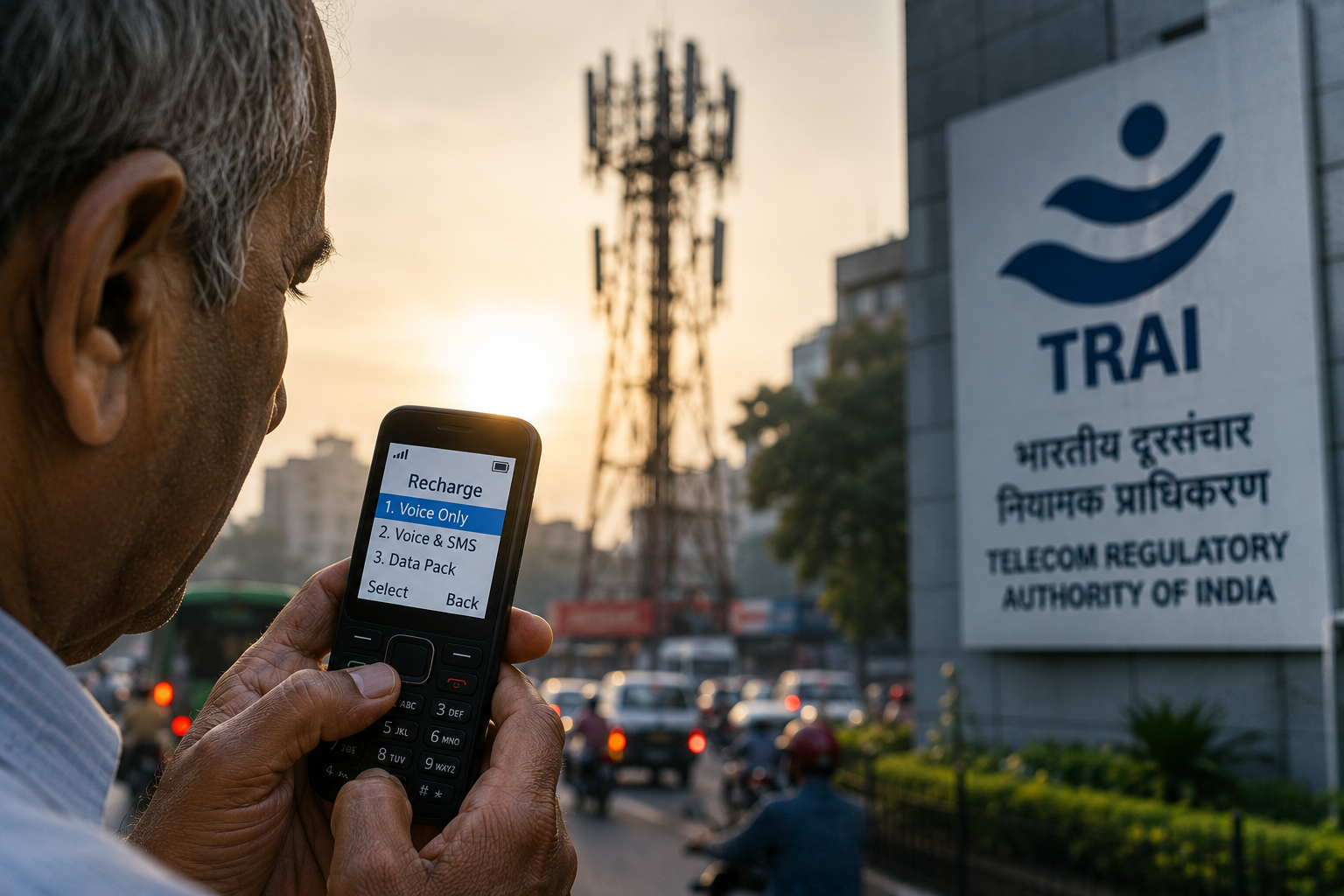
- What it says: India's telecom regulator wants operators to offer voice and SMS-only recharge options alongside bundled plans, signalling a broader policy shift towards preserving consumer choice as mobile services become increasingly data-centric.
- Main topic: Telecom spectrum and security
- Context: policy / briefing / Asia-Pacific
•TRAI requires six months notice, alternative services and transparent SIM pricing
•India balancing 5G modernisation with universal access across legacy networks
The fact
The Telecom Regulatory Authority of India (TRAI) has issued recommendations on the transition away from 2G and 3G networks as part of its broader framework for network modernisation. The regulator has advised telecom operators to provide at least six months' notice before shutting down legacy networks and to offer alternative services to affected customers.
The recommendations include guidelines on pricing transparency for SIM replacements, service continuity during the transition period and consumer protection measures for low-income users. TRAI has emphasised that the transition should not disrupt access to essential communications services, particularly for rural and semi-urban populations who rely heavily on older network technologies.
The framework applies to all major operators, including Reliance Jio, Bharti Airtel and Vodafone Idea, each of which is at a different stage of phasing out 2G and 3G infrastructure. India remains one of the largest markets globally where legacy networks still carry significant voice traffic, despite years of 4G and 5G deployment. The recommendations reflect the challenge of migrating millions of users from legacy networks. Most consumers still use 2G and 3G devices, and operators face the challenge of migrating millions of users without disrupting basic connectivity.
The assessment
India's approach to network transition highlights a broader regulatory challenge: how to manage infrastructure modernisation without leaving users behind. As telecom markets evolve, regulatory priorities are shifting from expanding connectivity to ensuring equitable access during generational technology shifts.
For operators, the six-month notice requirement and tariff protections introduce a planning constraint that could slow network retirement schedules. Reliance Jio has operated a 4G-only network since its launch, while Bharti Airtel and Vodafone Idea still maintain significant 2G and 3G infrastructure. The recommendations create a baseline expectation for consumer treatment that operators will need to factor into their modernisation timelines.
For BTW readers, India's transition model matters because it is the largest telecom market attempting 2G-to-5G migration at scale. If the six-month notice requirement and tariff protections hold, they could become a template for other emerging markets managing the same shift. The test will be whether consumer safeguards survive the commercial pressure to retire legacy networks quickly.
What to watch
Watch whether TRAI moves from recommendations to formal regulation, particularly the six-month notice requirement and tariff protections. Implementation across operators phasing out 2G and 3G networks will indicate whether consumer safeguards hold under commercial pressure.