Summary
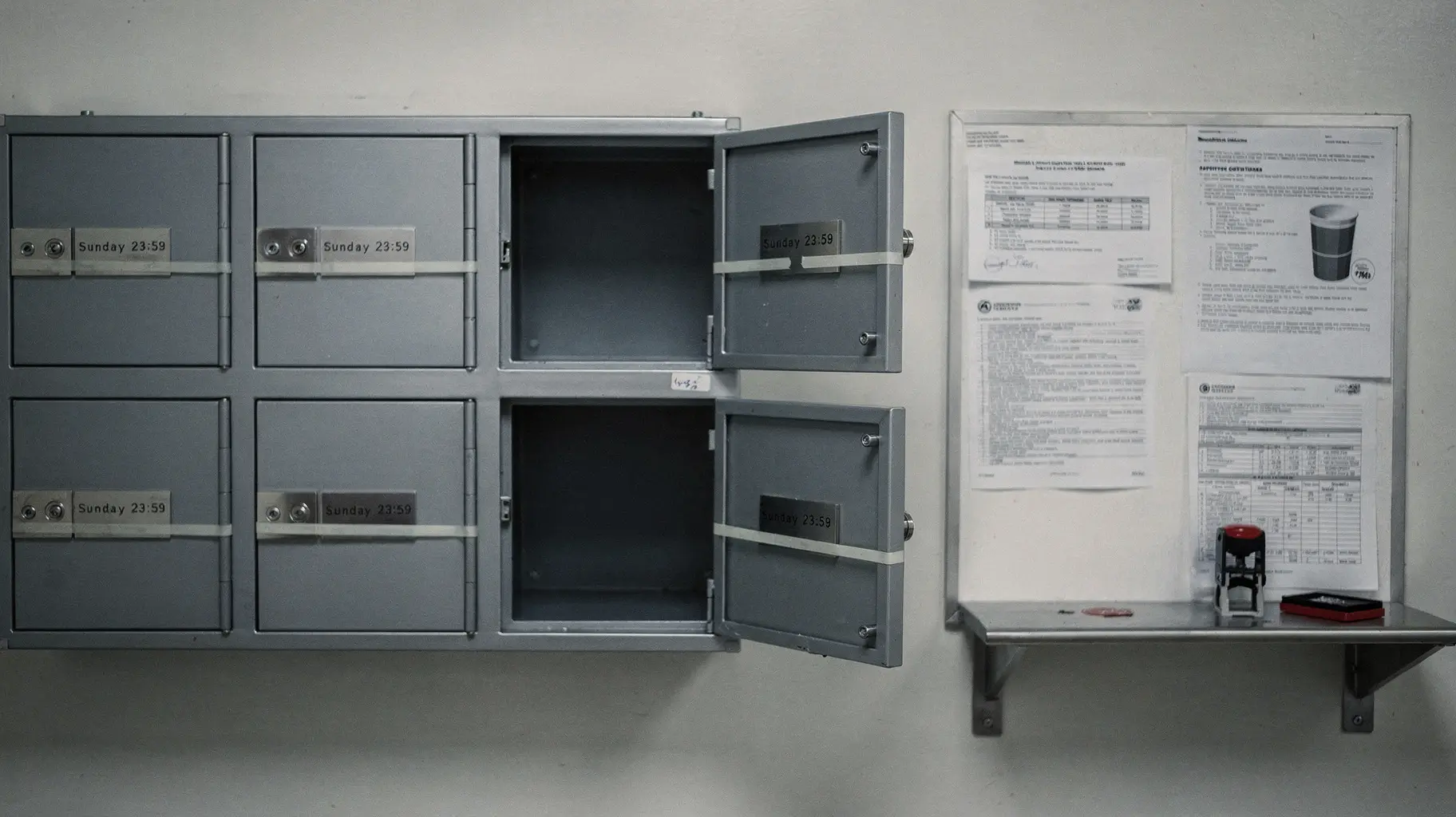
- Specification 2 of the registry agreement requires a Full Deposit with the escrow agent every Sunday by 23:59 UTC, and a Full or Differential Deposit on the other six days of the week.
- The agent verifies within 24 hours and notifies ICANN of any discrepancy; ICANN can pull every held deposit for electronic download within 24 hours of a written notice. The operator's own objection window is ten calendar days and, in the approved template, does not delay release.
- The published record shows the obligation, a list of approved custodians and a programme-level audit bucket. Nothing in the material reviewed shows a per-registry deposit, a verification outcome or a release event.
Ask an operator what happens if the registry fails, and the answer arrives as reassurance. The instrument that would have to do the work is more specific and considerably less soothing. It is a timetable.
Start with the clause that sets it. Specification 2, section 2.1, of the registry agreement reviewed here states that "Each Sunday, a Full Deposit must be submitted to the Escrow Agent by 23:59 UTC." Section 2.2 covers the rest of the week: on the other six days, "a Full Deposit or the corresponding Differential Deposit" is due to the escrow agent by the same time. The specification requires an independent escrow agent, with ICANN as third-party beneficiary, and it distinguishes the two deposit types by scope — the differential carries the transactions since the previous deposit as of 00:00:00 UTC, except on Sunday.
That is the first clock, and it belongs to the registry operator. Note what the text does not say. It does not say "regularly", or "periodically", or "as appropriate". It says Sunday and it says 23:59.
The second clock belongs to the custodian, and it is where the reassurance would have to be earned. Verification under the specification covers signature files, reassembly, decryption and format, plus an extended verification step; any discrepancy makes the deposit incomplete. The agent then has 24 hours to verify and to notify ICANN of anything wrong, and notice of a nonconforming or missing deposit carries the same 24 hours. One limit on this reading: the specification text was taken from the agreement of 1 May 2024 that incorporates it, not lifted from the base gTLD Registry Agreement template, whose own numbering was not read here.
The third clock is the one that would matter at three in the morning. The approved escrow agreement template dated 6 February 2025 requires the agent to release all deposits for electronic download to ICANN within twenty-four hours, at the registry operator's expense, either on a written operator request or on one of the enumerated ICANN written notices — with ICANN's notice electronically signed using the private key matching its OpenPGP public key. The mechanics are worked out to the deposit: the last seven days of deposits within 24 hours, then up to 24 further deposits per request within 48 hours.
Now the part worth reading twice. After release, the template gives the operator ten calendar days to file an Objection Notice. It then states that delivery of that notice "shall not delay release of any Deposits to ICANN". An objection here is a piece of paper, not a brake. The custodian keeps the clock either way.
The custodian's own account of its job is consistent, though thinner. Escrow4All's published description says it receives deposits in encrypted form, validates and verifies the submitted data, and reports to both the registry and ICANN. It is a vendor page without a publication date, so treat it as the custodian's own claim about its process rather than as an independent audit of it.
Here the distinction that carries the whole piece needs to be stated plainly. Verifying a deposit is not restoring one. The specification describes checks on the deposit's own integrity — that it decrypts, reassembles and parses — and calls a discrepancy a failure of the deposit. Whether any reviewed document describes a test in which held data is actually loaded and used is a separate question, and within the material read for this briefing, no such restore test with a published per-registry outcome appears.
The notification architecture sharpens that. The ICANN registry-interfaces draft, written by ICANN staff and published as an Internet-Draft in June 2026, requires the escrow agent to notify ICANN of every successfully processed deposit regardless of final verification status, and to send a Deposit Receipt Failure Notice where a deposit is not processed by 23:59:59 UTC on a scheduled date. Those notices are addressed to the TLD's contracting parties. They create no public reporting requirement — a drafting document, not adopted policy, but the clearest statement of direction in the set.
So where does the traffic go? The Registration Reporting Interfaces carry data escrow deposit reports and deposit notifications between registries, escrow agents and ICANN, on credentials keyed to the contracted parties. It is not a public channel, and that characterisation rests on the page's own framing rather than on a test of public access.
Which leaves the published residue, and it is thinner than the machinery. ICANN's data escrow services page lists the approved agents — Beilong Zedata, CNNIC, DENIC Services, Escrow4All, MSK-IX, NCC Group, TWNIC — together with their approved templates and the routes for changing an agent or amending an agreement. As reviewed, the page carries no table of per-registry deposit status, no verification outcome and no release event.
The January 2026 gTLD Registry Audit Report, published on 28 January 2026, is where the programme's own checking becomes visible — as a bucket. Its round launched on 28 October 2024 and ran through October 2025 across 21 gTLDs, with data escrow among the tested areas under Article 2.3 and Specification 2. The escrow finding is printed as "2 (10%)" and names no registry. One escrow-agent note records that a registry operator is consistently late in paying its fees. The report's own tally is 12 registries clean and 9 with at least one outstanding finding against the 21 audited. The final reports are confidential to the auditees; a consolidated round report is what the public gets, and the appendix lists the 21 delegated strings without mapping a finding to any of them.
Two of twenty-one, printed as a percentage, with the identities held in a file the auditee keeps. That is not a scandal — it may be exactly the right amount of disclosure for an audit round. It is an accountability boundary, and the boundary has a shape: the count is public and the case is not.
The programme is still moving, which makes the shape worth fixing now. The Governmental Advisory Committee's webinar slides on the next-round base Registry Agreement, dated 9 July 2025, place Release of Deposits at Specification 2, Part B, Section 6, and describe a proposed simplification of the failure condition that permits release — presented as a trigger simplification, with no added transparency or publication mechanism alongside it.
What this adds to what we have written before is narrow and deliberate. Our earlier reading of the emergency-backend operator counted the preparation it demands — hours per week, before an emergency begins — and stopped at the door of the recovery record. This is the instrument behind that door: the deposit the recovery would open, the custodian who checks it, and the release that puts it in ICANN's hands.
Nothing here alleges that any registry, custodian or contractor missed a deposit, failed a verification or delayed a release. The reviewed material establishes a duty and a channel; it does not establish a lapse, and the negative finding is bounded to the pages, reports and templates named above.
The control recommendation is therefore not a suspicion but a field. The programme already generates a dated deposit-and-verification result for every scheduled deposit — that is what the notification architecture is for. Publishing it per registry, alongside the audit bucket, would turn the safety net from a documented obligation into a checkable record.
The net is real. Someone ties the knot every Sunday at 23:59 UTC. What is missing is the label that tells the rest of us which knots held.
Member Briefing
Read the full trend briefing
Members read the full briefing with the source notes behind every finding.
Strategic Circle
A daily briefing in your language, built from changes we have verified.
Join for USD 20/monthCancel anytime.
Members also get the full research library, a daily briefing on the networks they follow and the private forum.