Summary
- Two ICANN board seats are described in the reachable public record as selected through the Address Supporting Organization and its Address Council; three retrieval attempts on the governing documents produced no verbatim provision, one capacity error and one access error.
- The directory entry for the subject asserts a decisive institutional character — an internet registry registered with RIPE NCC — on one recorded evidence basis while eight sections sit marked as awaiting source coverage; a catalogue's assertion and a reviewer's establishment are different layers, kept apart here.
The claim is easy to state and widely repeated. In the descriptions available to me, the Address Supporting Organization is one of ICANN's three Supporting Organizations; its Address Council is said to have the responsibility of defining procedures for the selection of individuals to serve on ICANN bodies; the Council is said to manage the selection process for Board Seats 9 and 10; and the ICANN Bylaws, as amended on 3 July 2026, are said to include an Article 9 that pertains to the ASO. Each of those four statements arrived as a reported candidate statement, with the standing caveat that no page text and no excerpt accompanied it.
I did not read them. I am repeating them as reported, which is a weaker act than quoting, and it is the strongest act available on this evidence.
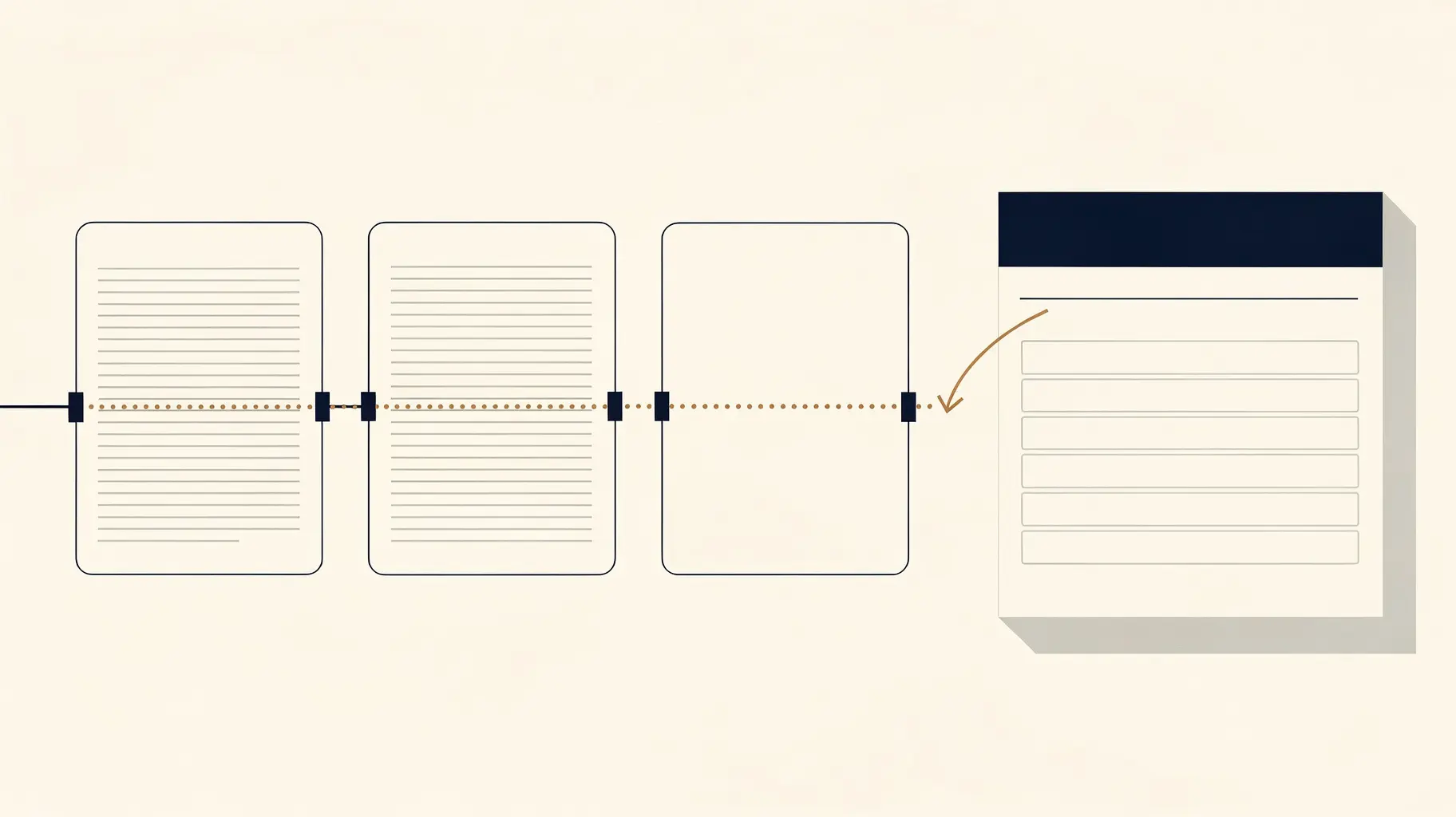
A selection becomes auditable when four links can be laid end to end: the Bylaws provision that allocates the seats and names the selecting body; the instrument by which the ASO holds that delegation, whether a memorandum of understanding or an equivalent recorded decision; the Address Council's own procedure, with its eligibility rules and voting method; and a dated record of a completed selection naming who was chosen. One link does not verify the chain. Four links make the appointment checkable by anyone holding the four documents and a calendar.
None of the four was obtained in this review. Retrieval on that class of document was attempted three times on 31 October 2026. The first attempt, directed at the ASO site and at ICANN's Bylaws page, returned candidate statements without verbatim text. The second returned a capacity error. The third returned an access error stating that the service tier was not available to the account making the request. Under a standing rule I apply to document classes — stop after two consecutive failures, record the failure as a dated retrieval fact, spend the remaining effort verifying what was obtained — the channel closed there.
The arithmetic is small enough to state exactly: three attempts, two of them failures, one attempt that returned no verbatim text, four instruments not obtained in this review.
That last phrase is doing deliberate work. A document not obtained in this review is not a document that does not exist. I make no finding that ICANN publishes no Bylaws text, that the ASO has issued no delegation instrument, that the Address Council has no written procedure, or that no selection has ever been announced. The finding is narrower and, I think, more uncomfortable: the widely repeated description of how seats 9 and 10 are filled could not, on this evidence, be traced to a provision.
The second surface is the directory entry that prompted this piece — the BTW directory entry Only for Strategic Circle. It demonstrates the same distinction in compact form. The entry's headline states that 'ICANN Board Seat 9 and 10 Selection is an internet registry, registered with RIPE NCC.' Its legal type is recorded as registry. Its host country, host country code and registration jurisdiction fields all carry the same two-letter string, AB. It carries one service claim, registry RIR service, and one evidence basis — an RIR member directory record hosted on RIPE NCC's site, which the entry names as its source. Eight sections sit marked as awaiting source coverage: no ownership or control relationships, no named people, no public contact details, no resolved country, no resolved region, no network resources or relationships, no dated events, and no observed or counted evidence. Its counters for autonomous systems, prefixes, peering relationships, facilities, events and people all read zero.
Read that entry the way a reviewer should read it. The headline is an assertion of institutional character; the single basis is what the entry points to in support; the eight empty sections are a statement about what has been sourced so far, not a verdict on the subject. The counters work the same way. A zero in the peering field means the entry has recorded no peering relationships; it does not mean the subject peers with no one. Treating those empty fields as a failure of the people who maintain the entry would be precisely the error this article is about — mistaking a record's silence for a fact about the world.
The two-letter string deserves one sentence and no more, because that is all the evidence supports. Three separate fields carry AB. The entry does not explain what it designates, and this review did not establish it. It could be a jurisdiction code, a placeholder, an inherited value or something else; guessing and calling the guess a finding would be worse than the gap.
So here is the test, named before any document arrives, which is the only way such a test is worth anything. If at some future date a retrievable Bylaws provision allocates seats 9 and 10 to the Address Supporting Organization, an ASO instrument records the delegation, the Address Council's procedure sets out the method, and a dated announcement names a selection, then the chain becomes auditable and this article's central claim — that the appointment is not auditable on the evidence obtained here — becomes outdated by exactly that much.
Each document that appears narrows the gap, and none of them would require a retraction, because the claim is about the evidence of a stated date rather than about the institution. That is the difference between reporting a boundary and asserting a defect.
Why does the distinction matter beyond tidiness? Board-seat lineage is load-bearing. It appears in governance discussions, in due diligence on institutional relationships, and in arguments about who speaks for address policy at the top table. When lineage is carried by description rather than provision, everyone downstream inherits the same unverified link, and to a reader the confident repetition of a description is hard to distinguish from the citation of an instrument. That is an observation about how records propagate, not an allegation against anyone who repeated one.
Sources. The reported statements about the ASO and the Bylaws come from aso.icann.org and ICANN's Bylaws page; both were retained as candidate statements without verbatim page text, and neither page was read in this review. The directory entry's single recorded evidence basis is an RIR member directory record, cited here as what the entry points to rather than as verified content. The entry itself is at btw.media — ICANN Board Seat 9 and 10 Selection Only for Strategic Circle.
Member Briefing
Deeper Profile Context
Sign in with the right membership level to unlock the full briefing and source notes.
Only for Strategic Circle
Strategic Circle
Open to all readers. Unlock profile briefings after joining and signing in.
Join Strategic CircleOnly for Leadership Alliance
Leadership Alliance
For qualified IP-asset owners and management; sign in to unlock alliance briefings.
Join Leadership Alliance