Summary
- The IANA IPv4 Special-Purpose Address Space keeps ten columns and not one of them names a holder, an allocation size, a fee, an expiry or a revocation path; what it prints instead is a Boolean profile per prefix.
- 100.64.0.0/10 prints Forwardable True with Globally Reachable False, and 240.0.0.0/4 prints an Allocation Date of 1989-08 for addresses that ARIN's own registry object describes as never allocated.
The page and its ten columns
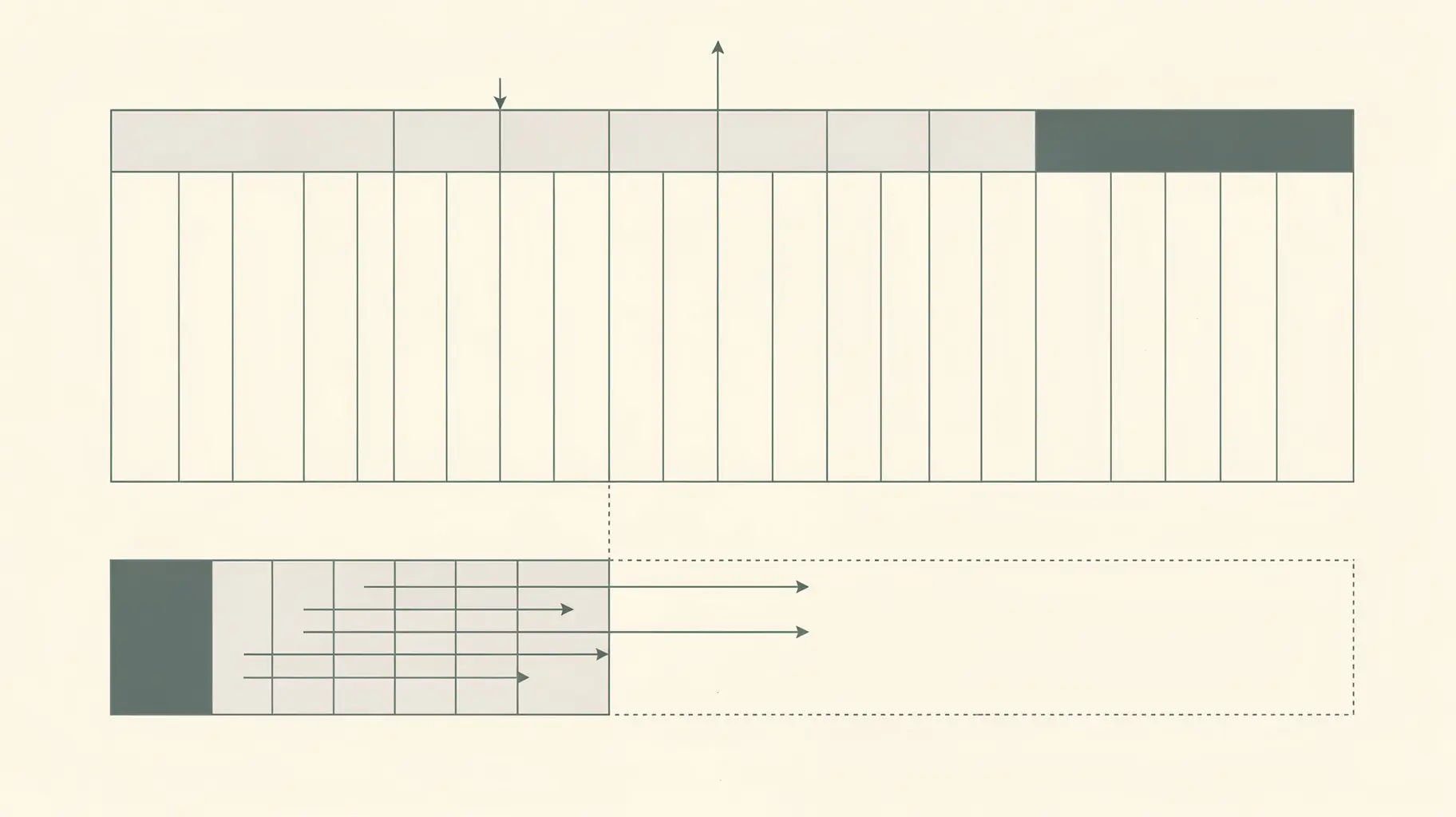
The page opens with a filing note: created 2009-08-19, last updated 2025-10-09, registration procedure "IETF Review", references to RFC 5736, RFC 6890, RFC Errata 6404 and RFC 8190 (IANA IPv4 Special-Purpose Address Space). Beneath the note sits a table with exactly ten columns — Address Block, Name, RFC, Allocation Date, Termination Date, Source, Destination, Forwardable, Globally Reachable, Reserved-by-Protocol — and 25 rows, one of which covers a pair of /32s.
It is tempting to read this page as the one place in the address system where the IETF stands as holder of record: 100.64.0.0/10 carved out in 2012 for carrier-grade NAT, 240.0.0.0/4 held back since the earliest allocation era, both attributed to a standards body instead of a member. The page does not support that reading. No column names a holder, an owner, an assignee, an allocation size, a fee, an expiry or a revocation path. The IETF appears as the procedure that governs changes to the registry and, in RFC 6890's own sentence, as the body that "occasionally reserves an address block for a special purpose".
It does not appear as a value in a cell opposite a prefix. What remains is a sharper object: a ledger that decides what a router may do with a packet, in space it never assigns to anyone.
What the Boolean cells actually assert
Five of the ten columns are switches, and the page defines each one. Source asks whether an address from the block is valid as the source address of a datagram that transits two devices; Destination asks the same for the destination address; Forwardable asks whether a router may forward such a datagram between external interfaces; Globally Reachable asks whether it is forwardable "beyond a specified administrative domain"; Reserved-by-Protocol is true where the RFC that created the block requires compliant implementations to behave specially toward its addresses (IANA registry; RFC 6890).
They are not a hierarchy of permission. The page publishes its own dependency: "If the value of 'Destination' is FALSE, the values of 'Forwardable' and 'Globally Reachable' must also be false." Three cells in such a row are therefore mechanical, and the informative cell has to be found elsewhere in the line.
The vocabulary moved once, which tells you what the ninth column was always trying to say. RFC 6890 called it "Global"; RFC 8190 (BCP 153, June 2017) replaced the term with "globally reachable" and renamed the column, because "global" sat ambiguously between allocation scope and routing reachability (RFC 8190). The values did not move. The word did.
The carve-out inside an allocation made to a registry
IANA's IPv4 Address Space registry gives 100/8 to ARIN: designation ARIN, date 2010-11, status ALLOCATED. The /10 appears only in a footnote — "100.64.0.0/10 reserved for Shared Address Space RFC 6598" — with complete registration details deferred to the special-purpose registry (IPv4 Address Space). The /8 register carries no row for the /10 at all. Mine: the carve-out is dated seventeen months after the allocation it sits inside.
ARIN's own object prints the /10 as a database entry rather than a customer: range 100.64.0.0 to 100.127.255.255, name SHARED-ADDRESS-SPACE-RFC6598-IANA-RESERVED, net type "IANA Special Use", organisation Internet Assigned Numbers Authority, registration date 2012-03-13, last updated 2024-05-24. Its comment is explicit about who is not using the space: "Traffic from these addresses does not come from IANA. IANA has simply reserved these numbers in its database and does not use or operate them" (ARIN NET-100-64-0-0-1).
Three dates crowd the same block. ARIN registers the object on 2012-03-13. IANA prints an Allocation Date of 2012-04. RFC 6598 is dated April 2012 and says what happened: "IANA has recorded the allocation of an IPv4 /10 for use as Shared Address Space", and "The Shared Address Space address range is 100.64.0.0/10" (RFC 6598). Mine: the registry-side date precedes the allocation month it is meant to record by up to four weeks.
What a carrier is granted is written in switches. Source True, Destination True, Forwardable True, Globally Reachable False. The RFC supplies the prose the registry omits: packets with Shared Address Space source or destination "MUST NOT be forwarded across Service Provider boundaries", and providers "MUST filter such packets on ingress links", with an exception for business relationships such as hosted carrier-grade NAT.
Read together, the block is valid on an interface, movable between external ports, and unmovable past a boundary the definition calls "a specified administrative domain" and the page never specifies.
The block with a date and a denial
240.0.0.0/4 prints Name "Reserved", RFC 1112 Section 4, Allocation Date 1989-08, Termination Date N/A, and then Source, Destination, Forwardable and Globally Reachable all False, Reserved-by-Protocol True (IANA registry). RFC 1112 §4 reserves Class E addresses "for future addressing modes", and the RFC Editor dates the document August 1989 (RFC 1112). RFC 6890's Table 15 prints the same cells under the caption "Reserved for Future Use" (RFC 6890).
ARIN's object for 240/4 says something else: net type "IANA Special Use", organisation IANA, a blank registration date, and a comment stating that addresses starting with 240 or higher "have not been allocated and should not be used, apart from 255.255.255.255, which is used for 'limited broadcast' on a local network" (ARIN NET-240-0-0-0-0). The word allocation therefore appears twice on the same block with opposite signs: a field that dates one, a comment that denies one. I print both and name no winner; what is documented is the divergence.
A third date joins them. The /8 registry lists 240/8 as "Future use", dated 1981-09, status RESERVED, with the WHOIS and RDAP columns blank (IPv4 Address Space). Mine: the two IANA registers date the same space eight years apart, and only the later date matches the cited RFC. In that row the dependency rule makes three of the four reachability and validity cells follow mechanically from Destination False, which leaves Reserved-by-Protocol True as the cell carrying news: IP itself must behave specially toward these addresses, whatever any registry says about allocation.
A register younger than the rows it prints
The page's created stamp is 2009-08-19. The oldest Allocation Date it carries is 1981-09; the 240.0.0.0/4 row says 1989-08. Mine: the register postdates its oldest entry by 27 years and 11 months, and that row by twenty years. RFC 6890 §2.2.1 defines Allocation Date as "The date upon which the special-purpose address block was allocated" and treats Termination Date as the field for limited-use allocations. It is a date. It is not a decision, a vote, a signature or an amending instrument, and the page prints none of those.
Boundary, once: I checked the printed month against the cited RFC's publication month for RFC 1112 and RFC 6598 only. Two other rows look mismatched against their RFCs on the printed dates; they stay unasserted here.
What the ledger does not print, and what other publishers add
No reviewed document in this set names a recipient, an allocation size, a fee, an expiry or a revocation path for either block. That is a finding about the documents read on 23 November 2026, not a claim that such an instrument does not exist.
Three other publishers supply edges. RFC 6890 states the general practice in a sentence with no object: "In order to support new protocols and practices, the IETF occasionally reserves an address block for a special purpose." ARIN's Number Resource Policy Manual, in the global IANA-to-RIR policy it republishes at §10.4, states that "The IANA inventory excludes 'Special use IPv4 addresses' as defined in BCP 153 and any addresses allocated by the IANA for experimental use"; the manual names the category generically and neither prefix (ARIN NRPM). A RIPE NCC staff reply on the RIPE Database working-group list, dated 8 October 2018, lists both prefixes among bogons, records that the space is "out of region (i.e., not allocated or delegated to the RIPE region)", says further route objects cannot be created in it, and promises bogon validation in Whois 1.93 (RIPE db-wg).
Two counts, mine, from the cells as retrieved: 24 of the 25 printed rows were legible, one row's switches having been lost in extraction and excluded rather than read as False; five rows print Globally Reachable True and seven print Reserved-by-Protocol True. The shared block is one of the five, the reserved block one of the seven. And from the prefix lengths: 240.0.0.0/4 holds 268,435,456 addresses, 100.64.0.0/10 holds 4,194,304, the ratio is 64, and together they are 272,629,760 — 6.35 per cent of 4,294,967,296.
What a stranger can reproduce
Take a printed row, apply the dependency rule, and any reader can rebuild that prefix's reachability profile without asking anyone. What no reader can rebuild from this page is a party. There is no name to invoice, no term to expire, no size to cap, no path to revoke. Authoritative registration of these prefixes sits in a table whose authority runs to behaviour.
That is the finding, and it is not a complaint. A standards body that specifies what compliant implementations must do to a packet exercises real power — narrower than title, wider than advice. The IETF directory entry records the institution; the row records the rule. An operator building a plan inside 100.64.0.0/10 is relying on that rule, and on the day someone asks who is entitled to be there, the register will have nothing to show except the switches.
Member Briefing
Read the full trend briefing
Members read the full briefing with the source notes behind every finding.
Strategic Circle
A daily briefing in your language, built from changes we have verified.
Join for USD 20/monthCancel anytime.
Members also get the full research library, a daily briefing on the networks they follow and the private forum.