Summary
- Ofcom’s final Hull review removes KCOM’s specific duty to offer regulated dark-fibre access from 1 November 2026.
- Circuits already ordered by 31 October 2026 retain transitional conditions until 31 October 2029, two years less than Ofcom proposed last December.
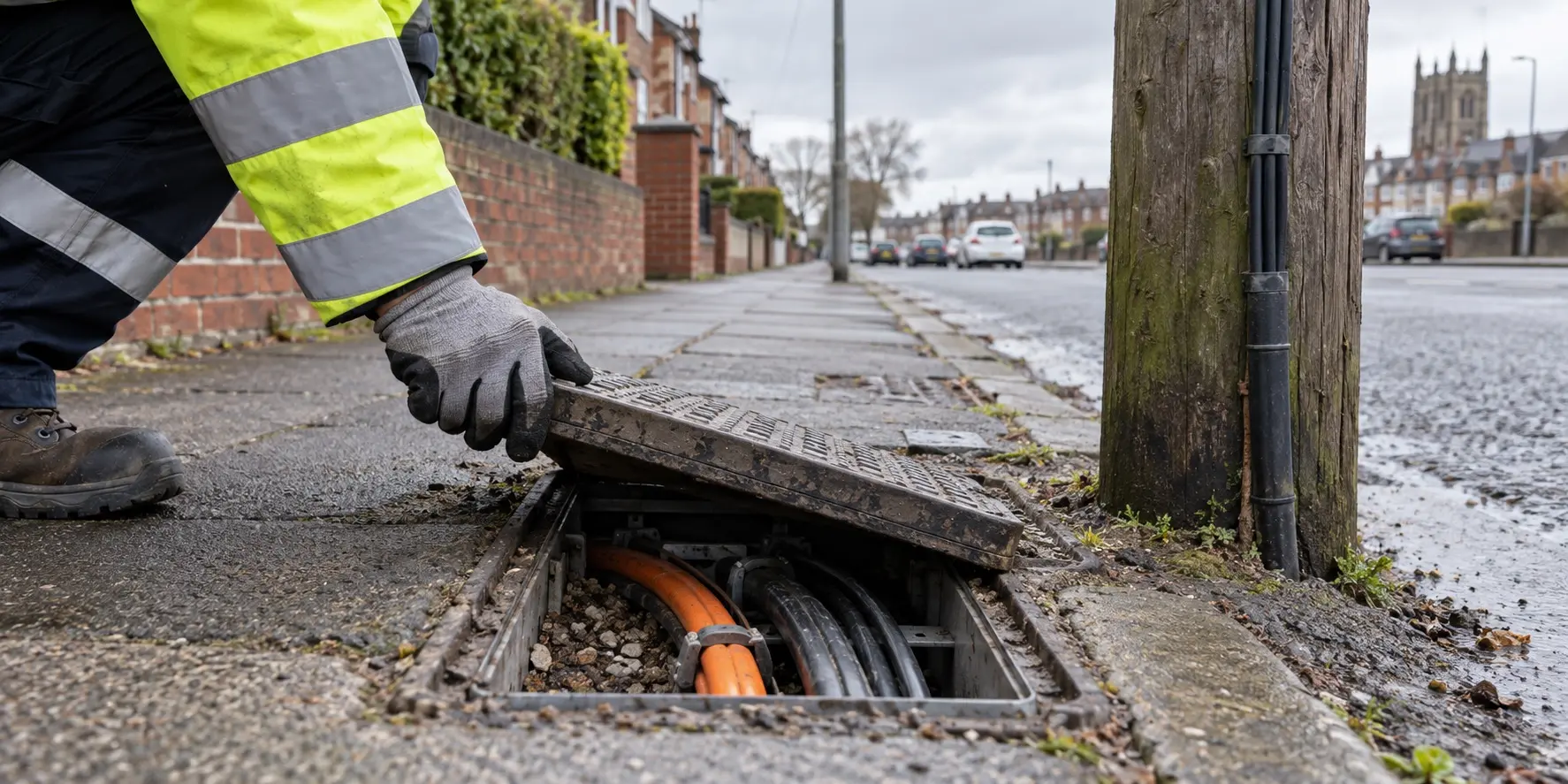
A buyer of a Hull business connection once had a regulated route to the bare fibre strand. On 1 November that route closes to new requests. Ofcom’s final review leaves three other possibilities: buy an active leased line, negotiate dark fibre commercially, or build over another network, including by using KCOM’s ducts and poles. These are different products with different investment burdens. A duct is space in the ground, not an illuminated business circuit or a guaranteed strand ready to lease.
The precise line between old and new sits in the legal instrument. “Existing Dark Fibre Circuits” are services ordered on or before 31 October 2026. The saved conditions run to 31 October 2029. Ofcom says it would not regard a future request for a regulated dark-fibre access product as reasonable and explicitly excludes requests for new forms of access during the transition. KCOM may still sell dark fibre on commercial terms. The ruling closes a regulatory entitlement, not a physical fibre route.
The bridge itself got shorter. In December 2025 Ofcom proposed five years for existing circuits. The final decision gives three, after considering responses that included KCOM’s case for a shorter period and MS3’s warning that five years would tie up contestable business connections. Ofcom says take-up of KCOM’s regulated product was extremely limited, with only a small number of circuits supplied by March 2026. The published count is redacted; the claim cannot be converted into a market-share number.
During the three years, Ofcom will continue to benchmark these circuits’ prices against equivalent Openreach dark-fibre leased-line products in LLA Area 3.
There is more network around KCOM now, but reach and sales tell different stories. Ofcom estimates that 80–89% of Hull-area premises had a choice of KCOM and at least one other network in January 2026. In March, 71–80% of premises with a fixed-broadband connection still used KCOM’s network. The first figure measures availability across premises; the second measures connections among connected premises. Together they explain the regulator’s bet: enough alternative build to remove the specific dark-fibre duty, yet enough reliance on KCOM to keep wholesale and physical-infrastructure access duties in place.
The final package imposes access to KCOM’s ducts and poles and retains regulated wholesale broadband and active leased lines. Ofcom prefers competition further upstream, where a rival controls its own fibre rather than renting a finished KCOM strand. That shifts the real work to route access, construction and customer migration. For a circuit already in service, the calendar now has a hard edge: 31 October 2029.
Sources
Member Briefing
Deeper Profile Context
Sign in with the right membership level to unlock the full briefing and source notes.
Only for Strategic Circle
Strategic Circle
Open to all readers. Unlock profile briefings after joining and signing in.
Join Strategic CircleOnly for Leadership Alliance
Leadership Alliance
For qualified IP-asset owners and management; sign in to unlock alliance briefings.
Join Leadership Alliance