
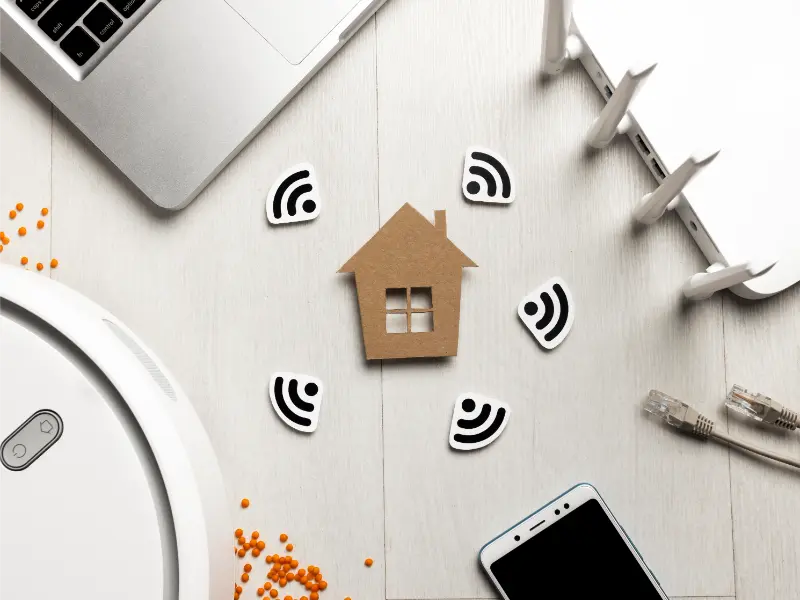
- IoT (Internet of Things) connectivity encompasses both wired (Ethernet, RS-485, RS-232, USB) and wireless (Wi-Fi, Bluetooth, LPWAN, Zigbee, satellite) methods, catering to diverse communication needs.
- Wired connections offer reliability and structured networking, while wireless options provide flexibility and mobility, ensuring seamless data exchange in various environments.
- The evolution of IoT connectivity continues to drive innovation, enhancing connectivity options and enabling efficient communication and data exchange across interconnected devices globally.
IoT encompasses the extension and broadening of the Internet, integrating various information-sensing devices with the Internet to create an extensive network. This facilitates interconnected communication between individuals, machinery, and entities regardless of time or location. The following describes several ways of connecting iot devices, including wired and wireless connections.
Wired connections
Ethernet: Ethernet, a Local Area Network (LAN) technology, facilitates data transfer between computers and devices. It is one of the most prevalent wired network technologies, employing hubs, switches, and routers to form networks based on the IEEE 802.3 standard. These networks utilise twisted-pair cables or fibre optics for device-to-host connectivity.
RS-485: RS-485 operates in a half-duplex mode, allowing one point to transmit at a time. It supports a bus-type structure with extensive reach and multiple nodes, making it ideal for networks like intercoms and alarms. This serial communication standard is commonly used in industrial control and automation systems.
RS-232: RS-232, originally designed for serial data communication between computers and peripherals, defines specifications for physical connections, data rates, and communication protocols. While suitable for point-to-point communication, it is less conducive to networking.
Also read: What is Web3 gaming?
USB: USB, a widely adopted interface, offers convenient device connectivity and can replace traditional serial connections. Many devices now support USB connections or have USB adapters for RS-485/RS-232 compatibility.
Wireless connections
Wi-Fi: Wi-Fi is ubiquitous in homes, businesses, and industries, serving as a primary networking method. Wi-Fi networks, comprising routers or access points, provide internet access to wireless devices and vary in coverage based on device power and environmental factors.
Bluetooth: Bluetooth facilitates short-range wireless communication between devices like laptops, smartphones, and wearables. Known for low energy consumption and cost-effectiveness, Bluetooth is ideal for personal area network (PAN) connections within a ten-meter range.
Low Power Wide Area Network (LPWAN): LPWAN technologies like NB-IoT and LoRa enable wide-area IoT device connectivity. NB-IoT utilises mobile base stations for communication, while LoRa operates in unlicensed bands, offering cost-effective and long-range connectivity.
Also read: What is a Web3 wallet?
Zigbee: Zigbee, suitable for indoor device connectivity, follows IEEE 802.15.4 standards for secure communication between nodes. Zigbee networks are cost-effective and commonly used in industrial automation, smart homes, and other interconnected device scenarios.
Satellite Connectivity: Satellite connections provide internet access in remote areas or specialised environments like aircraft. Ground stations communicate with communication satellites, enabling devices with satellite antennas to access internet services.
The diverse connectivity methods for IoT devices, including both wired and wireless solutions, play a crucial role in enabling seamless communication and data exchange in the IoT ecosystem. As IoT continues to evolve and expand, these connectivity options will continue to innovate, providing robust and efficient means of connecting and harnessing the potential of interconnected devices worldwide.