
Summary
- HighJump Software should be read as a warehouse execution software lineage, not as a standalone current vendor that can be evaluated only from its old brand name. Public Koerber and Infios pages support the identity path, while the live entity record still needs careful treatment.
- The product problem is not simply replacing manual warehouse labour. The harder task is coordinating receiving, put-away, replenishment, picking, packing, returns, labour guidance, exception handling and enterprise integration when the physical operation changes faster than the software configuration.
- The current record supports a strong article about software continuity, integration cost and automation limits, but it does not supply independent task-success rates. Buyers should test deployment effort, exception handling, upgrade paths and exit options before treating a broad suite as proof of lower operating cost.
Read the HighJump Software directory profile.
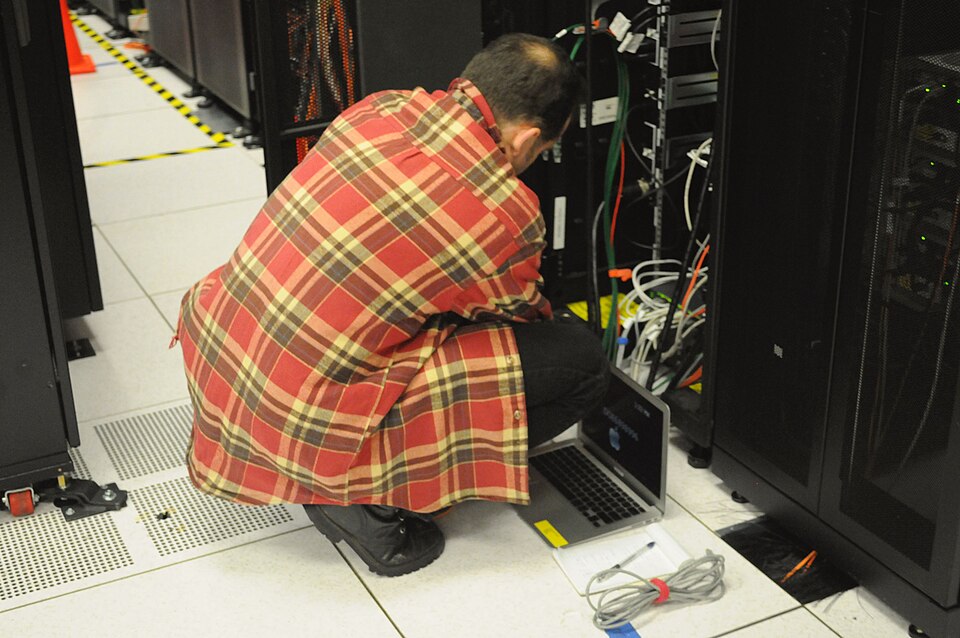
The featured photograph shows a real public technology-infrastructure scene used only as generic operations context. It does not depict HighJump Software, Koerber, Infios, their staff, their offices, their customers, their warehouse sites, their equipment or any deployment.
The first risk is identity, not functionality
HighJump is no longer best understood as a small standalone software name. The public corporate trail puts the company into a larger sequence: HighJump, Koerber Supply Chain and Infios. That sequence matters before any technical judgment is made. A warehouse management system is rarely a tool that a customer can swap out like a lightweight office application. It tends to sit between enterprise planning, transport planning, scanners, voice devices, labour rules, carrier connections, automation equipment, reporting and the physical design of the building.
If the company identity is unclear, a buyer cannot tell which organisation maintains the code, which one controls the contract, which one owns the upgrade path and which one is responsible when an exception reaches the floor.
Koerber's public acquisition record gives the foundation for that identity line. It supports the claim that HighJump became part of a larger supply-chain software business. Infios's public story then carries the lineage into a newer brand setting. The important point is not branding in itself. It is operational continuity. When a customer has written warehouse rules, integrations and training around a system, a change in parent company or brand can alter support teams, product priorities, commercial packaging and long-term roadmaps.
It can also bring useful resources: more product coverage, wider implementation capacity and a broader customer community. Both outcomes are plausible. Neither follows automatically from the acquisition record.
That is why this article treats HighJump as a software lineage with continuity questions rather than as a fresh product launch. The available public pages show that HighJump sits inside a supply-chain software portfolio with warehouse and execution language. They do not disclose every module boundary, every migration path or every customer's current contract. A serious assessment has to keep the identity chain visible in every section: what belonged to HighJump, what became Koerber Supply Chain, what is now described under Infios, and what remains uncertain.
This matters because warehouse software decisions outlive marketing cycles. A warehouse may keep a platform because replacing it would interrupt shipping, require months of integration work and retrain supervisors. That inertia can be rational. It can also turn into lock-in if the customer no longer understands the product roadmap or the commercial consequences of staying. HighJump's public lineage therefore opens a broader technical question: does continuity protect the operation, or does it make the customer's ability to challenge the vendor weaker over time?
Warehouse management is a control system before it is an automation story
A warehouse management system looks simple when described as software for inventory, picking and shipping. It is not simple in use. The system must translate customer orders, purchase receipts, storage constraints, labour availability, device availability, carrier rules, returns and physical movement into instructions that workers can follow. The application becomes a control layer over human motion and stock location. A wrong instruction can waste minutes, but a repeated wrong rule can create missed shipments, inaccurate inventory, overloaded supervisors and expensive emergency work.
HighJump's relevance comes from that control problem. The useful unit is not a screen, a menu or a module. It is the completed movement of goods with acceptable accuracy, cost and timing. Receiving has to identify what arrived, what was expected, what is damaged, what needs inspection and where it should go. Put-away rules need to balance travel distance, slot availability, product compatibility and future picking demand. Picking has to decide which order lines should be grouped, which worker or device receives the next instruction and how exceptions are surfaced.
Packing and shipping must preserve customer promises while keeping carrier and label data correct.
Automation inside this setting is always partial. Software can remove some clerical decisions, guide movement and reduce the number of times a supervisor has to intervene. It cannot remove the physical world. Pallets arrive damaged. Barcodes fail. A worker finds less stock than the record shows. A forklift aisle is blocked. A carrier misses a pickup. A customer changes an order after work has begun. A seasonal spike turns normal assumptions into overloaded labour. The value of the system depends less on ideal-path automation than on how cleanly it handles these ordinary disruptions.
That distinction is easy to lose when a vendor describes a suite. A broad product line can be valuable, but breadth is not proof of reliability. The more functions a warehouse platform covers, the more configuration and integration surfaces it creates. Each connection has a failure mode. Enterprise planning may send late or inconsistent master data. A handheld device may lose connectivity. A label service may format data differently after an update. Labour rules may conflict with a new shift pattern. A customer-specific exception may be reasonable for one building and harmful in another.
The strongest warehouse software therefore does not merely assign work. It makes the current state legible. Supervisors need to know which tasks are blocked, which orders are at risk, which rules created an exception, which manual override changed the plan and which data needs correction upstream. If HighJump's lineage is to be judged as automation, the right test is not whether the software can produce instructions. It is whether people can understand and recover from the moments when those instructions stop matching reality.
The public record supports continuity, not measured reliability
The closed public record for this package is strong on corporate continuity. Koerber's acquisition pages connect HighJump with Koerber Supply Chain. Infios's story pages connect HighJump, Koerber, Infios and supply-chain operations. A Koerber page about voice and peak-season work gives an operational window into warehouse labour and seasonal pressure. Koerber's Otimis announcements add regional expansion context. These are useful documents. They allow the article to map the company and its operating domain without inventing facts.
They do not answer the harder reliability questions. They do not provide independent task-success rates across warehouse types. They do not show the percentage of exceptions resolved without supervisor intervention. They do not disclose implementation overruns, customer churn, error rates after upgrades or the true cost per accepted shipment. They do not compare HighJump-derived software with modern ERP warehouse modules, other specialist platforms or customer-built systems under controlled conditions. That absence is not unusual. Warehouse software performance is often private because it is tied to customer operations.
But the absence should change the confidence level of any claim.
A fair reading is therefore bounded. The public materials support the view that HighJump became part of a larger supply-chain software organisation and that the current lineage is connected to warehouse execution, voice guidance and related operating processes. They support analysis of why such software matters. They do not support a conclusion that the platform reliably reduces labour in every customer setting. Any article that jumps from acquisition and product language to broad automation success would overstate the record.
This bounded method is especially important because supply-chain software often receives credit for work done elsewhere. A deployment may improve because a customer cleans item data, redesigns slotting, changes labour supervision, updates device fleets, adjusts incentives or simplifies order profiles. The software may enable those changes, but it may not be the sole reason for the result. Conversely, a weak implementation may fail because customer data is inconsistent, not because the vendor's underlying product cannot support the process. Public case material rarely separates these variables cleanly.
That uncertainty does not make the topic unimportant. It makes the operating questions more specific. Which warehouse processes are configured in the product rather than handled offline? How many exceptions require human choice? How often does the system's recommendation conflict with physical constraints? How visible are errors before an order misses its promise date? What happens after a software upgrade? These questions belong in the assessment because the public record establishes the domain but not the measured answer.
Voice guidance shows the practical value and the limit
The Koerber-hosted page about voice and return-to-peak operations is useful because it points to a concrete warehouse problem. Peak periods strain labour, training, accuracy and speed. Voice-directed work can reduce the need for a worker to look at a screen, free hands for physical movement and standardise instructions for repetitive tasks. In a warehouse, that can matter. A few seconds saved per pick can become meaningful across thousands of movements. A clearer confirmation step can reduce errors when seasonal staff are still learning the building.
But voice guidance is not magic. It depends on task design, device reliability, network coverage, language support, ambient noise, worker acceptance and exception paths. If the instruction is wrong, the voice interface can make the error faster rather than safer. If the worker has to stop and ask a supervisor whenever a location is empty or a product is damaged, the bottleneck simply moves. If seasonal workers are pushed through training too quickly, spoken guidance may mask uncertainty until errors appear downstream. The system can improve discipline only when the surrounding process is fit for use.
This is where HighJump's warehouse lineage becomes interesting. A voice tool has little value unless it is tied to accurate inventory, location logic, order priority and exception handling. The software must know what work should happen next, who can do it, how it should be confirmed and when it should be escalated. That makes voice a test of the broader control system. A good voice deployment proves that tasks have been decomposed into clear steps and that the system can recover from common deviations. A weak one turns spoken instructions into another layer workers have to work around.
Peak operations also reveal unit economics. If the system reduces training time and errors, the benefit can be substantial during seasonal spikes. If it requires months of configuration, specialised devices, extra support and repeated process redesign, the payback depends on scale and recurrence. A large distribution centre with predictable seasonal volume may justify the effort. A smaller operation with unstable product data may not. The question is not whether voice can work. It is where the marginal gain exceeds the setup, maintenance and supervision cost.
The public material does not provide controlled numbers, so the article should not pretend otherwise. It can say that voice-directed work is a credible operating lens for warehouse software. It cannot claim that HighJump-derived deployments achieve a particular accuracy rate or labour saving without customer-specific proof. That distinction keeps the analysis grounded: the product category is operationally meaningful, but the public evidence remains incomplete.
Integration cost is the centre of the business case
Warehouse software is rarely bought in isolation. It has to connect to enterprise planning, order management, transport systems, labour tools, finance, handheld scanners, printers, dimensioning equipment, conveyors, robotics, customer portals and reporting. Each connection changes the cost of automation. A feature that looks inexpensive in a sales deck can become expensive if the customer needs data cleanup, middleware, custom screens, device replacement and weeks of parallel running.
HighJump's legacy and the later Koerber and Infios portfolio create both advantages and risks. A broader suite can reduce the number of vendors and make related functions easier to coordinate. It can also increase switching cost because more operations depend on one commercial relationship. If warehouse, transport, voice and analytics are tied together, a customer may gain a coherent operating view. The same customer may find it harder to negotiate, replace a module or move to a competitor without touching several processes at once.
The economic unit should be a completed and accepted warehouse task, not the licence price alone. A customer should count software fees, implementation fees, integration work, device changes, training, supervisor time, support contracts, downtime during cutover, upgrade testing and the effort needed to maintain product data. A cheaper subscription can be expensive if every exception requires manual cleanup. A costly system can be rational if it reduces mis-shipments, overtime and support calls enough to offset the added complexity.
The public record does not supply those customer-level numbers. That is a data gap, not a reason to ignore the issue. Warehouse systems shape physical work, and physical work produces measurable outcomes. A buyer can measure pick accuracy, labour hours per shipped unit, order cycle time, exception rate, inventory adjustments, training time, overtime, returns due to fulfilment errors and supervisor interventions. Without those measurements, the automation claim remains a story about capability rather than a verified operating result.
Integration cost also affects risk allocation. If a deployment fails because master data was poor, the customer may bear much of the practical burden even if the vendor supplied the software correctly. If the software cannot represent a reasonable warehouse process without heavy customisation, the vendor's product design is part of the problem. Contracts often blur that line. A strong evaluation should define responsibility before the system becomes embedded: who owns data quality, who signs off process rules, who approves custom work, who tests upgrades and who pays when an interface change breaks shipping.
Data quality decides how much work is actually removed
Warehouse automation begins with data that sounds dull: item dimensions, weights, barcodes, handling restrictions, storage rules, lot controls, expiration dates, order priority, carrier constraints and location status. If that data is wrong, the software can assign work confidently and still produce bad outcomes. The worker discovers the error at the shelf, the pack station or the dock. The promised labour saving then becomes a cycle of investigation and correction.
This is why HighJump's product category should be judged through repeated ordinary work. A demonstration can show clean receiving, clean picking and clean shipment. A real warehouse has substitutions, damaged goods, late replenishment, partial orders, unexpected demand and people with different levels of training. The system's value is its ability to keep those ordinary variations from becoming expensive surprises. Data governance is the hidden requirement behind that value.
The move from HighJump to a larger supply-chain software setting can help if the broader organisation provides better implementation practice, more standard connectors and more product investment. It can hurt if customers inherit complex legacy configurations that are hard to simplify. Neither outcome is guaranteed by the public record. The buyer has to inspect the live configuration, the data model and the upgrade plan rather than relying on lineage alone.
Data quality also changes supervision. If supervisors trust the system, they may focus on exceptions and improvement. If they do not trust it, they create parallel spreadsheets, verbal workarounds and manual checks. The formal system may still process transactions, but the real control layer moves outside it. That is a common failure pattern in enterprise software: the platform remains installed while critical judgement migrates to informal practices. From the outside, the customer appears automated; on the floor, people are compensating for poor data or mismatched rules.
A sound deployment makes uncertainty visible. It should identify missing dimensions before a product reaches the picking area. It should show which order is at risk because a location record is suspect. It should allow a supervisor to correct a rule without creating uncontrolled variation. It should preserve an audit trail of overrides in a way managers can use. The public pages do not prove HighJump-derived software does all of this everywhere. They define the kind of evidence a serious customer should ask for.
Supervisors become the automation layer
Automation often reduces one form of labour and increases another. In a warehouse, the visible reduction may be fewer manual decisions by pickers, receivers or packers. The added work lands on supervisors, system administrators, industrial engineers, integration specialists and support teams. They design rules, monitor exceptions, adjust labour plans, review errors and test changes. If that work is not counted, the savings case is incomplete.
HighJump's category is especially exposed to this issue because warehouse execution software does not operate in a static environment. New customers, new products, new shipping promises, new carrier rules and new building layouts all change the operating model. A rule that worked during a normal week may break during a promotional spike. A slotting decision may save walking time in one area while creating congestion in another. A wave plan may improve throughput for bulk orders and slow down urgent singles. The system has to be tuned, and tuning is labour.
The best systems make that labour more productive. They help supervisors see where work is stuck, identify recurring exceptions, simulate changes and apply policy consistently. The worst systems bury effort in configuration screens and reports that require specialised knowledge. Public corporate pages rarely show which side a deployment falls on. That is why the article should avoid simplistic automation language. The operational question is not whether software reduces labour in principle. It is which labour it reduces, which labour it creates and whether the new work produces more value than it consumes.
Supervision cost also has a training dimension. If workers must follow voice or scanner instructions, supervisors must understand when to trust the device and when to override it. If administrators change rules, they need regression tests tied to real warehouse scenarios. If integrations fail, support teams need enough context to diagnose whether the problem came from upstream data, device failure, software logic or physical disruption. These skills are not free. They become part of the total cost of ownership.
This does not weaken the case for warehouse software. It makes the case more realistic. The right system can reduce chaos, improve consistency and make exceptions visible sooner. But the buyer should budget for an operating team, not only a licence. A warehouse that cannot support the system may end up with expensive software and informal workarounds. A warehouse that invests in supervision, data and process ownership is more likely to turn the software into real operating leverage.
Acquisitions can strengthen the platform and increase lock-in
The HighJump, Koerber and Infios sequence raises a familiar enterprise software trade-off. Acquisition can bring capital, product breadth, implementation reach and a longer roadmap. It can also create uncertainty about naming, packaging, product overlap and upgrade direction. Customers who bought one product may later find themselves inside a larger suite narrative. That can be good if the suite solves adjacent problems. It can be costly if the customer pays for breadth it does not need or faces migration pressure without a clear operating benefit.
Koerber's Otimis announcements show that the supply-chain software perimeter expanded beyond HighJump. Regional expansion can help customers that operate across markets. It may bring local expertise and implementation capacity. It may also add another layer of product and partner complexity. When a vendor grows through acquisitions, buyers should ask which codebases remain distinct, which functions are integrated, which brands are commercial rather than technical, and which migration paths are optional.
Infios's story pages are important because they present a current identity layer. They help readers connect old and new names. But identity continuity does not answer support continuity. A customer needs to know whether the same support organisation understands its configuration, whether old customisations are still accepted, whether integrations are certified on current versions and whether the vendor can describe the next upgrade in operational rather than branding terms. A name change is manageable; an unclear roadmap is not.
Lock-in should also be separated from satisfaction. Customers may stay because the system works and replacing it would create needless risk. That is healthy inertia. They may also stay because replacement is too hard even though the system no longer fits. That is lock-in. The public record cannot distinguish those states for individual customers. A buyer can distinguish them by asking whether the vendor can export data cleanly, document configuration, support staged migration, coexist with other systems and explain contract terms around termination.
The right assessment therefore treats acquisition continuity as a risk variable, not as a verdict. A larger platform can reduce fragmentation and bring deeper product investment. It can also make the customer's operating dependency harder to unwind. For HighJump's lineage, the strongest article angle is exactly that tension: the value of continuity in a physical-operation system and the cost of being tied to a software family that changes around the customer.
The competitive alternatives are not abstract
A warehouse considering HighJump-derived software is not choosing between automation and no automation. It is choosing among several imperfect alternatives. It can continue with manual processes supported by spreadsheets and an enterprise planning system. It can use a warehouse module from a broader ERP vendor. It can buy another specialist warehouse platform. It can build custom applications around scanners and databases. It can outsource fulfilment to a third party. Each path changes cost, control and failure risk.
Manual processes may be cheaper at small scale and more flexible when orders are simple. They fail when volume, product variety or accuracy requirements rise. ERP warehouse modules may reduce vendor count and integrate cleanly with finance and procurement. They may lack depth for complex floor execution. Specialist platforms may handle operational detail better but create another integration and support relationship. Custom systems can match a unique building, yet they require durable engineering capacity and can become fragile when the original builders leave.
HighJump's historical position as a warehouse software name suggests why specialist depth matters. Warehouse execution is full of domain-specific detail. Slotting, replenishment, voice work, returns, labour planning and carrier interactions are not generic transaction screens. A vendor with long exposure to those problems can encode useful patterns. But domain depth is only valuable if it remains maintainable. Old custom work, unclear upgrades and fragmented product history can reduce the value of that expertise.
The realistic comparison should include failure consequences. A warehouse software failure is not merely an inconvenience. It can delay shipments, create inventory errors, consume overtime, frustrate customers and hide problems until the day is already lost. A lower-cost system that fails during peak season may be more expensive than a higher-cost system with stronger recovery. Conversely, a broad suite with heavy implementation effort can be wasteful for a warehouse whose processes are stable and simple.
Buyers should therefore run a practical trial around their own exceptions rather than a polished happy path. They should test damaged receipts, missing inventory, urgent order changes, short picks, failed labels, device loss, network interruption, labour reassignment and end-of-day recovery. They should ask how quickly a supervisor can see what happened and what should happen next. That kind of test reflects the real competitive question: which option gives the organisation the best balance of control, cost and recoverability under ordinary pressure?
A useful scorecard starts with the warehouse floor
The most practical scorecard for a HighJump-derived deployment starts with the work that happens every day. Receiving accuracy should be measured before and after go-live, not only during the first week of enthusiasm. Put-away travel distance should be checked against the actual building, not only against a planned map. Replenishment should be tested when a fast-moving product runs low during a busy shift. Picking should be measured by accepted lines, not only by gross activity. Packing should record exceptions caused by carton choice, label errors, damaged goods and missing order data.
Shipping should track late carrier handoff and recovery time. Returns should be measured because reverse movement often exposes weak item data and unclear ownership.
The scorecard also needs to count management work. How many rule changes are made each week? How many require vendor help? How many exceptions wait for a supervisor for more than a few minutes? How many device or printer failures stop a worker from completing assigned tasks? How often does an upstream data change break a warehouse process that had previously been stable? These measures are less attractive than a headline about speed, but they reveal whether the system has made work easier or merely more centralised.
A customer should also measure learning time. If a seasonal worker can become productive faster because the software decomposes work into clear instructions, that is a real gain. If experienced supervisors spend the same saved time correcting configuration, the gain is smaller. If the system improves accuracy but increases dependence on a small group of administrators, the organisation has changed its risk rather than eliminated it. The public HighJump, Koerber and Infios record gives enough reason to ask those questions, but only a customer-level scorecard can answer them.
The scorecard should be reviewed by people who understand the physical building, not only by the software owner. A number can improve while the floor becomes more fragile: workers may pick faster because difficult orders are delayed, or accuracy may rise because supervisors reject more work for manual review. A useful review asks whether the same labour pool can finish the day with fewer escalations, fewer urgent corrections and clearer responsibility. It also asks whether managers can explain a bad day without blaming a single worker or a vague system issue. The software earns trust when it narrows the search for causes.
It loses trust when it hides messy reality behind tidy activity totals.
The same logic applies after upgrades. A warehouse system is not finished when it goes live. Devices change, carrier requirements change, customer promises change and new product categories appear. The right test is whether the platform can absorb those changes with controlled effort. A stable upgrade should preserve ordinary work, expose changed behaviour and give supervisors confidence that recovery paths still operate. A poor upgrade forces the floor to rediscover rules under pressure. That is why software lifecycle risk belongs beside automation benefit in any serious assessment of HighJump's legacy.
What would make the judgement stronger
The public record is enough to justify coverage and to frame the core question, but it is not enough to score HighJump-derived software as a proven labour-saving system. Stronger evidence would include customer-level before-and-after data, implementation timelines, exception rates, training outcomes, upgrade failure rates, support response times and cost per accepted shipment. It would also include examples where a warehouse rejected or replaced the system and why.
A useful customer case would separate the software's contribution from the customer's process redesign. It would say which functions were deployed, which integrations were required, how long the cutover took, what data had to be cleaned, which workers needed training and what metrics changed after stabilisation. It would report not only faster picking or fewer errors but also the new work required to maintain those gains. That level of detail is uncommon in public marketing, but it is what distinguishes a credible automation result from a broad success story.
Security and resilience evidence would also matter. Warehouse systems hold operational data about products, customers, orders, locations and labour. They connect to devices and other enterprise systems. The public package reviewed here does not establish security architecture, incident history, disaster recovery performance or customer-specific controls. That does not imply weakness. It means those topics require separate diligence. A buyer should ask how access is managed, how changes are approved, how integrations are monitored and how operations continue if the application or a connected service is unavailable.
The identity question remains open at the level customers actually experience. Public pages show the HighJump, Koerber and Infios continuity. They do not explain every product naming change, every contract boundary or every support path. Customers should ask for a map of current products, legacy modules, upgrade options and responsible legal entities. A vendor that can explain this clearly lowers operational risk. A vendor that relies on brand familiarity without operational detail leaves customers to carry uncertainty.
The balanced conclusion is therefore cautious. HighJump's lineage belongs in technology-company coverage because warehouse software governs real work and because acquisition continuity changes the way customers experience enterprise software. The available evidence supports a serious analysis of warehouse execution, integration cost and lock-in. It does not support a blanket claim that automation has eliminated labour or made warehouse operations reliably self-managing.
The right judgement is narrower and more useful: HighJump-derived software may reduce work when data, process ownership, supervision and integration are strong, but it can also relocate work into configuration, support and vendor dependency. That is the difference between a functioning control system and an automation slogan.
Sources and reading limits
The article uses the following public sources to establish the HighJump, Koerber and Infios identity chain, the supply-chain software context, and the voice-directed warehouse work example. These sources do not prove customer-level performance, deployment success rates, current contract terms, security controls, support quality, facility ownership or measured labour savings.
- https://page.koerber-supplychain.com/Voice-ReturnToPeak-CS.html
- https://www.infios.com/de/ueber-uns/unsere-geschichte
- https://www.infios.com/en/about-us/our-story
- https://www.infios.com/en/knowledge-center/blog/infios-career-pioneers-christine-hirtz
- https://www.koerber.com/de/ueber-uns/news-und-presse/highjump-erwerb
- https://www.koerber.com/de/ueber-uns/news-und-presse/uebernahme-mehrheitsbeteiligung-otimis-lateinamerika
- https://www.koerber.com/en/about-us/news-and-press/acquisition-majority-stake-otimis-latin-america
- https://www.koerber.com/en/about-us/news-and-press/highjump-acquisition