
APNIC · RIR Watchdog
Story
BTW reporting and context linked to this RIR. For the proposal-by-proposal history, the people involved and their changing positions, start with Policy.
Story
Latest stories
288Stories

Story
A Correct RIR Record Did Not Fix One Geo-IP Error After Two Months
An APNIC 62 case study exposed a small but consequential accountability gap: the registry data could be right, several geolocation databases could agree, and one downstream service could still send a customer to the wrong country.

Story
APNIC’s Priority Survey Has Three Bases: 1,039, 1,038 and 1,037.
APNIC asked its community to divide exactly 100 points among eight strategic activities. The resulting chart looks unusually complete: every point is accounted for and no priority overwhelms the rest. The publication trail is less settled. Three official artifacts attach three…

Story
BCAP’s Prize Entry Preceded Training. Its Outcome Receipt Has Not.
The WSIS Prize submission window closed two days before BCAP’s published professional-development start window opened. The project won in July and is still listed as ongoing through 2027. The award may be sound; the public record still needs to say which finished phase and which…

Story
APNIC's ASPA Interface Checks Observed Paths. A Standby Provider Leaves No Path to Check.
APNIC has built a sensible safety rail into its new ASPA interface: suggest providers from visible routing data, then show how an edit would affect paths that BGP observers can see. The awkward provider is the one hired precisely not to be visible yet. A standby link turns the…

Story
APNIC Prop-173 Would Make Every Directory Query an Agreement. The Response Would Carry No Version.
An acceptable-use policy can change while the response governed by it remains in a cache for years. APNIC's prop-173 would make ordinary WHOIS, RDAP and web queries subject to a clear, versioned policy and would tell users that querying or using the service means agreeing to…

Story
APNIC Will Automate Route-Record Alignment. The Roadmap Does Not Name the Conflict Winner
“Alignment” sounds like database housekeeping. In APNIC’s Q3 2026 roadmap, it means something harder: deciding how resource holdings, a route-management template, Whois route objects and RPKI authorizations should change when they disagree—and preserving enough evidence to show…

Story
APNIC 62 Had Seven Policy Proposals. Two Had No Consensus Call.
APNIC’s conference report does something more useful than recording winners and losers. It preserves a third procedural state. Prop-165 and prop-172 were discussed, but no consensus call was held. The next record should explain where that state leads without pretending it means…

Story
APNIC Reported 60 Atlas Probes Distributed and 23 Deployed. The Missing Unit Is the Cohort
A probe in a box is an opportunity to measure the Internet. A probe that has connected, remained available and filled a blind spot is measurement capacity. APNIC’s 2025 reporting places 60 distributed devices beside 23 deployed ones, but does not publish the join that would tell…
Story
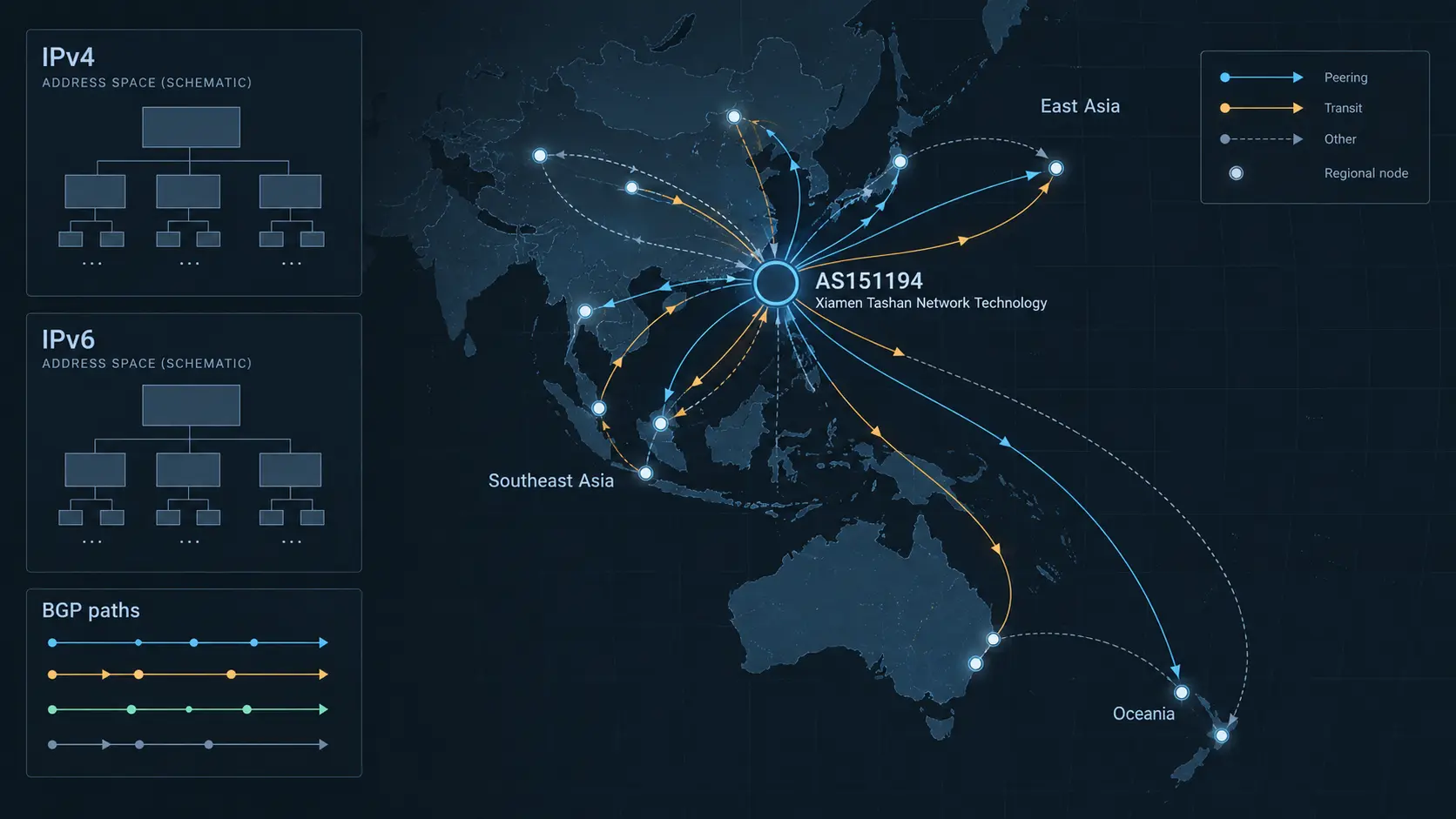
Xiamen Tashan Network Technology and the Evidence Gap Around AS151194
Xiamen Tashan Network Technology and the Evidence Gap Around AS151194 intelligence summary explains the development, the public evidence available to readers, the organisations involved, the regional context, market exposure, and the infrastructure consequences that may follow.…

Story
APNIC's NIR Co-Chair Was Re-elected Without an Online Ballot—By Rule
APNIC 62's linked result sheet contains four polls but no NIR SIG contest. That blank is not a missing tally. It is the visible edge between two procedures: contested positions go to the online system; one confirmed candidate goes to acclamation in the SIG room.

Story
APNIC Closed Its CentOS Workstream. The Evidence Chain Still Has Four Open Joins
APNIC can point to a genuine finish line: in the second quarter of 2026 it completed a multi-year move away from end-of-life CentOS hosts. Its wider security record is less linear. Tests, findings, classifications and exercises appear in separate reports, but the public evidence…

Story
APNIC's Governance Score Is 77%. Its Don't-Know Average Is 20%.
APNIC's new survey does not produce one verdict on governance. It produces a positive score among people able to judge eight claims, and a separate measure of how often members could not judge them. Any decision that carries the first number forward should carry the second one…

Story
APNIC's Honeynet Logged 1.27 Million Events. That Is Not 1.27 Million Attacks
An APNIC 62 presentation turns one deliberately exposed server into a useful security instrument. Its headline, however, moves between attacks, attack events and events—three labels that cannot safely share one number.

Story
APNIC’s Electoral-Committee Recusal Safeguard Lives in a Blog Comment
APNIC has a sensible answer to an awkward governance question: Executive Council members who may seek re-election do not help choose the committee that polices the election. The trouble is not the answer. It is where the answer lives—and how little of the annual record shows the…

Story
A Backup DNS Plan Is Not a Second Resolver
A 9 September APNIC Blog account turns a household outage into a precise infrastructure lesson: resilience begins only when an alternative service is running, reaches the clients that depend on it, survives a controlled failure and can be rolled back.

Story
APNIC and NIXI Cannot Close India’s ROV Plan With One Percentage
On 8 September, APNIC Labs could describe India’s observed ROV filtering as 1.14% or 6.03%. Both figures came from the same dated record. The difference was the window—and it is exactly why a national routing-security promise needs a receipt, not a headline number.

Story
A Scan Found 4,611 Exposed BGP Routers in APNIC. It Cannot Say Why They Were Open
At APNIC 62, researchers put a regional number on a quiet control-plane problem: 4,611 routers across 1,343 APNIC-region autonomous systems answered an unsolicited BGP OPEN exchange in a February IPv4 scan. That is firmer evidence than a port banner, but it is neither a breach…

Story
APNIC’s WHOIS Archive Reports Two Totals for the Same Hour
The latest completed hour says APNIC received 3,192,583 WHOIS queries. Add the seven query types printed beside that total and the answer is 3,183,463. The missing bridge is not a rounding error; it is the meaning of the measurement.

Story
APNIC’s leadership-diversity consultation needs a measurable participation funnel
APNIC has documented who joined the first stage of its leadership-diversity consultation and what barriers they described. The next test is whether it can connect outreach, participation and proposed remedies to a broader leadership pipeline without identifying individual…

Story
APNIC’s NIR SIG Asked Four Charter Questions. Its Deck Shows One Unlabelled Result
An APNIC 62 charter-review deck asks seven National Internet Registries four different questions, then places one 86% support chart beside them without saying which question it answers. The proposed charter may still deserve support. But if the NIR SIG is to consolidate views for…