
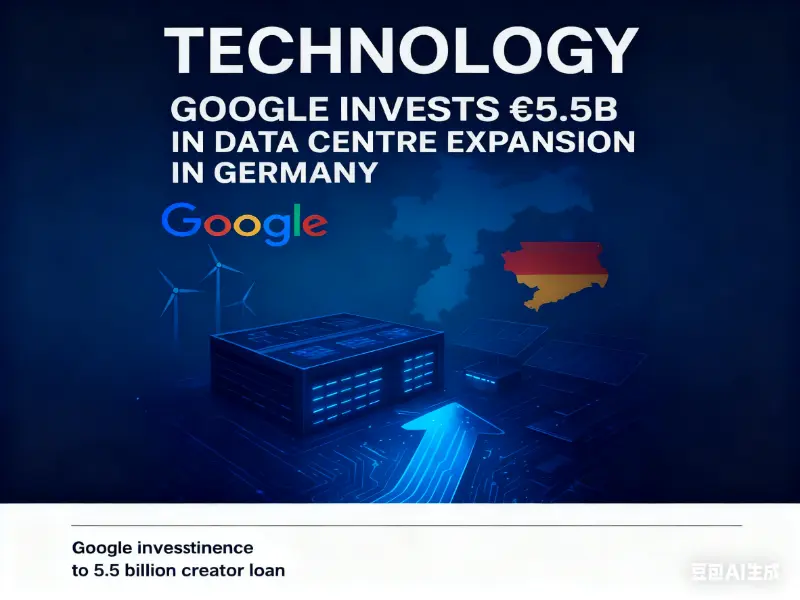
Google expands in Germany with €5.
- The investment focuses on new and expanded data centres in the Frankfurt region and renewable-energy initiatives.
- Germany’s bid to become Europe’s cloud and AI hub receives a major boost from this large-scale foreign investment.
What happened: Google announced a €5.5 billion data centre expansion in Germany
Google has announced plans to invest €5.5 billion (around $6.4 billion) in Germany to strengthen its cloud and data-centre infrastructure. The investment will fund the construction of new data-centre facilities and the expansion of existing ones in the Frankfurt and Rhine-Main region, including sites in Dietzenbach and Hanau.
The company aims to enhance its cloud-computing capacity in Germany, which serves as one of Europe’s largest data-exchange hubs, anchored by DE-CIX in Frankfurt. The expansion could support around 9,000 jobs annually across construction, operations and related industries.
As part of the plan, Google also intends to invest in renewable-energy initiatives and deploy heat-recovery systems to minimise the environmental impact of its data-centre operations. These sustainability efforts align with Germany’s broader goals for carbon neutrality and digital transformation.
Also Read: Google’s ‘Big Sleep’ AI uncovers 5 open-source cyber threats
Also Read: Google claims quantum computing breakthrough
Why it’s important
This commitment marks one of the largest infrastructure investments by a cloud-provider in Germany and underscores the country’s ambition to become a European hub for cloud services, artificial intelligence (AI) and digital infrastructure. The magnitude of the investment reflects both Google’s strategic intent in Europe and Germany’s appeal as a location for tech-scale projects.
From a macro perspective, the deal reinforces a broader trend of major-tech firms channelling substantial resources into Europe amid growing competition from the US and China. The Rhine-Main region, supported by strong digital connectivity and talent, is set to benefit disproportionately from this expansion.
For enterprises and local ecosystems, the increased cloud and data-centre capacity promises improved performance, lower latency and access to advanced AI-driven services. However, the move also raises questions around data sovereignty, vendor dependence and sustainability. While Google highlights the investment as part of its “climate-neutral” strategy, the energy demands of hyperscale infrastructure continue to spark debate over long-term environmental impact.
Member Briefing
Deeper Trend Context
Sign in with the right membership level to unlock the full briefing and source notes.
Only for Strategic Circle
Strategic Circle
Open to all readers. Unlock trend briefings after joining and signing in.
Join Strategic CircleOnly for Leadership Alliance
Leadership Alliance
For operators, investors, and policy teams that need relationship evidence, failure paths, and source notes. Sign in to unlock.
Join Leadership AllianceSnapshot
Category
Europe and Middle East Cloud Services TrendsRegion
ASIA PacificSignal Focus
MarketContent Type
EventPrimary Domain
MarketTopic
MarketImpact
MediumConfidence
Limited confidence (82%)Confidence score guide
Several public sources