
Summary
- Genesis Cloud’s public records belong to different evidence layers. Registration and declared policy can identify an intended network identity, while collector observations and endpoint tests address operational visibility and reachability.
- The available research package does not capture live web responses or HTTP bodies. It therefore cannot establish the current route set, DNS answers, hosting origin, service health or global accessibility of Genesis Cloud applications.
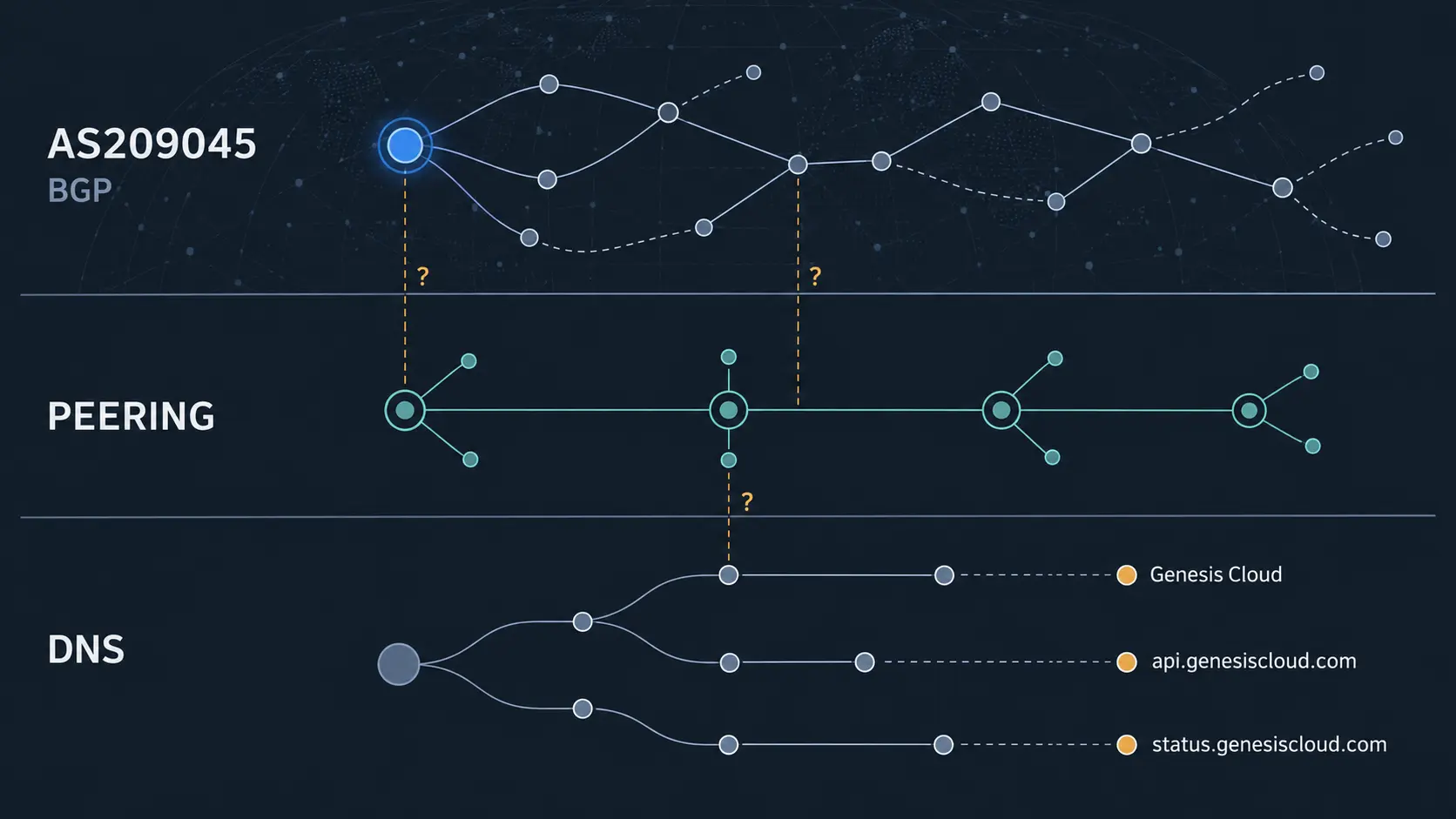
The practical issue for a cloud customer is not whether Genesis Cloud has an ASN, a domain or a peering record. It is whether the customer’s workload has a continuity path when one of those layers changes. A route can disappear while a domain still resolves. A status page can remain available through an external platform while the API is unreachable. A DNS delegation can remain intact while the application behind the name is unavailable. These are different failure modes, controlled by different parties and visible through different instruments.
This distinction matters because public infrastructure records are often read as if they formed one continuous proof. They do not. The RIPE Database can identify an AS209045 registration and operator-maintained routing policy. RIPEstat can report collector-scoped announcement and neighbour observations. PeeringDB can record an operator’s interconnection profile, facilities or exchange presence. DNS and RDAP can expose the public delegation of genesiscloud.com and its subdomains. None of these records, alone or in combination without synchronized observation, proves that a customer can reach a healthy authenticated API from every relevant network.
The immutable evidence package for this investigation explicitly marks current values as unverified because live web responses and HTTP bodies were not captured. The conclusion is consequently bounded: the public record describes a chain that should be tested, but it does not establish that the chain currently operates as one independently observed control plane.
Registration is identity, not an operating signal
An RDAP record for AS209045 can establish registry identity, status, related entities and registration events. The RIPE aut-num object can expose an organization, contacts, maintainers and declared import or export policy. Those are meaningful records: they help identify which network identity an operator claims and how that identity is represented in the registry.
They do not establish that AS209045 is currently announcing a prefix. An active registry object can coexist with no globally visible BGP announcement. A declared export policy can remain unchanged after a transit relationship has been removed. A contact or legal-entity label can differ from a company’s public brand because of renaming, branding or stale third-party data. The registry layer therefore answers “which identity is recorded?” rather than “which customer-facing service is reachable now?”
The relevant registry evidence is the RDAP registration record for AS209045 and the RIPE aut-num object. Their evidentiary role should not be expanded beyond the fields they actually expose.
BGP visibility narrows the question but does not make it global
The next step is to compare declared identity with observed routing. RIPEstat’s AS Overview and Announced Prefixes endpoints can report whether AS209045 is visible in RIPE RIS-derived data and which prefixes RIS attributes to the ASN as origin. Routing History can identify periods in which those prefixes appeared or disappeared. ASN Neighbours can show numbers seen adjacent to AS209045 in collector-observed paths.
That is stronger evidence of operation than a registry entry, but it remains scoped evidence. A collector sees only what its peers and selection process expose. A brief withdrawal can be missed or aggregated. A path can differ between RIPE RIS and another collector because of geography, timing and best-path selection. Absence from one collector is not proof of global absence; presence at one collector is not proof of universal reachability.
For that reason, a credible continuity assessment needs at least three comparisons: the currently originated prefix set, independent collector visibility, and the time sequence of announcements and withdrawals. The RIPEstat AS Overview, Announced Prefixes, Routing History and ASN Neighbours endpoints provide the structure for that test. RIPE route objects add authorization context, but the RIPE IRR search for routes originated by AS209045 still describes operator-maintained intent rather than proof that every listed route is in BGP.
Independent corroboration matters because a route withdrawal is a causal input to customer risk only when the affected prefix actually carries the relevant service. Even a broad AS209045 event would not necessarily remove every Genesis Cloud hostname if some endpoints are served through another network, a CDN or an externally hosted platform.
Peering records describe options, not necessarily sessions
PeeringDB provides a different kind of evidence. Its network record may disclose a traffic profile, facilities, exchange presence and interconnection contacts. Its IX LAN records may identify public peering addresses or exchange fabrics. These details can guide a route-server or looking-glass investigation, but they do not prove an active bilateral BGP session.
A listed facility can remain after a circuit or session becomes inactive. A network can peer privately without a public listing. A declared upstream may not appear in the current best paths, while an undeclared relationship may appear in collector data. Nor does AS-path adjacency identify the commercial mechanism: the relationship could be paid transit, settlement-free peering, a route-server path or a backup connection.
The relevant comparison is therefore between the PeeringDB network record, PeeringDB IX LAN records, observed bgp.tools information for AS209045, and raw RIPE RIS archives and Route Views archives. Agreement would strengthen an operational inference; disagreement would identify a boundary requiring further investigation, not a reason to select the more convenient record.
For customers, the economic mechanism is straightforward. Interconnection diversity can reduce dependence on one upstream or exchange, but only if the paths are active, properly advertised and usable for the prefixes carrying the service. A peering disclosure that cannot be tied to current route visibility may describe bargaining position or intended topology without providing continuity during an incident.
DNS can preserve the name while the service path fails
DNS is another control layer, not a substitute for routing or application evidence. Verisign RDAP can identify the registrar, domain status, registration events, delegated nameservers and DNSSEC-related delegation metadata for genesiscloud.com. Recursive DNS responses can show the nameserver delegation, SOA data, aliases, addresses and TTLs observed by Google Public DNS.
These records can reveal a delegation change, a provider boundary or a CNAME chain. An SOA serial change can support the conclusion that a zone was modified, although it does not identify which record changed. A nameserver hostname can identify delegated infrastructure, but it cannot establish who holds credentials for the DNS account. Resolver answers can also lag or vary because of caching and geographic steering.
The Verisign RDAP domain record, NS lookup, SOA lookup and apex A lookup should therefore be read as delegation and resolution evidence. They do not establish beneficial control or application health.
The key continuity test concerns api.genesiscloud.com. If its terminal addresses are originated by AS209045, a withdrawal affecting those addresses could directly remove IPv4 API reachability. If the addresses are originated elsewhere, the causal mechanism changes: Genesis Cloud may depend on an external edge, CDN, reverse proxy or hosting provider. The API A lookup and API AAAA lookup are needed to identify that distinction. Even then, a valid DNS answer would prove only that a resolver received an answer, not that the API application, authentication path or backend was healthy.
The same separation applies to status.genesiscloud.com. If the status site terminates outside AS209045, it may remain reachable during a withdrawal affecting the compute API. The status A lookup, status summary feed and status incident feed can provide operational chronology, but a green first-party status indicator may be manual, delayed or limited to declared incidents. Status availability and compute-service availability are not interchangeable.
Documentation and automation reveal intended dependency, not resilience
Genesis Cloud’s developer documentation, compute API endpoint and Terraform provider repository can identify the supported API base, resource model, authentication assumptions and infrastructure-as-code surface. That evidence is useful for reconstructing what a customer is expected to control and what remains provider-side.
It still does not prove that the documented endpoint is deployed as described, that an unauthenticated response represents application health, or that configuration can be moved without data, public-address identity, network topology and running state. Automation can preserve configuration intent while leaving the customer dependent on the provider’s routes, DNS account, address space, storage semantics and service backends.
Certificate transparency and passive DNS history can add context. The certificate-transparency query may show hostnames included in certificates, while SecurityTrails’ domain history and API history may reveal historical DNS changes. Historical appearance is not current control, and a certificate does not prove that the corresponding service is reachable or healthy.
The unresolved condition that could narrow the thesis
The most important unresolved condition is endpoint dependency. A synchronized observation showing that the relevant API prefixes are currently originated by AS209045, visible across independent collectors, and directly serve the API addresses would materially strengthen the claim that route control is a customer-continuity dependency. Conversely, evidence that the API and status endpoints are independently hosted, that their addresses remain reachable through separate origins during an AS209045 withdrawal, or that AS209045 does not originate the relevant prefixes would narrow the thesis substantially.
That test must be time-correlated. A BGP event, DNS change, direct TLS or HTTP result and first-party incident should be compared against the same time window. Without that correlation, a researcher can mistake a stale DNS answer for resilience, a CDN edge for application health, or a collector gap for a route withdrawal.
For procurement and risk teams, the resulting checklist is more useful than a single “network control” label:
- Which prefixes carry the API, control plane and customer-facing services?
- Are those prefixes originated by AS209045, and are they visible beyond one collector?
- Which observed paths are active transit, exchange reachability or merely declared relationships?
- Do API, website and status hostnames terminate in the same network or in independent infrastructure?
- Can the customer retain DNS, data, credentials, public identity and a tested recovery path if the provider’s route disappears?
- Does RPKI validation create a selective filtering risk for any currently originated prefix?
The evidence package does not answer those questions with current values. It defines the public tests required to answer them without confusing identity, intent, observation and reachability.
A cloud provider’s control plane is therefore not proved by the existence of an ASN, a peering profile or a working DNS response. It is demonstrated only when the relevant route origin, path diversity, name resolution, endpoint hosting and application behavior align under observation. Until that chain is measured, the defensible conclusion is not that Genesis Cloud lacks operational control, nor that it has global reachability. It is that customers should treat the control chain as an unverified dependency and demand evidence at each layer before pricing continuity risk.
Sources and evidence boundary
The following public sources define the evidence package for this investigation: AS209045 RDAP; RIPE aut-num; RIPEstat AS Overview; RIPEstat Announced Prefixes; RIPEstat Routing History; RIPEstat ASN Neighbours; RIPE IRR search; PeeringDB network; PeeringDB IX LAN; bgp.tools; RIPE RIS; Route Views; Verisign RDAP; DNS NS; DNS SOA; DNS apex A; DNS API A; DNS API AAAA; DNS status A; status summary; status incidents; developer documentation; compute API; Terraform provider; certificate transparency; domain DNS history; API DNS history.
The runtime did not capture live web responses or HTTP bodies. Current registry, BGP, peering, DNS, status and API values remain verification targets rather than established current findings.
Member Briefing
Deeper Profile Context
Sign in with the right membership level to unlock the full briefing and source notes.
Only for Strategic Circle
Strategic Circle
Open to all readers. Unlock profile briefings after joining and signing in.
Join Strategic CircleOnly for Leadership Alliance
Leadership Alliance
For qualified IP-asset owners and management; sign in to unlock alliance briefings.
Join Leadership Alliance