
Summary
- The paid unit is a merchant payment terminal, acquiring and checkout-service account: a retailer pays so a customer can tap, insert, scan, receive authorization, get a receipt, and leave while the merchant later receives settlement net of fees, reversals and risk holds.
- Geidea's public case is stronger on product breadth, licensing context, mada connectivity, support footprint and contractual mechanics than on operating outcomes; the unresolved economics are terminal uptime, settlement-failure frequency, device replacement rates, support cost and merchant churn.
- The realistic substitutes are bank-provided terminals, another Saudi payment service provider, mada and card-network acquiring through a bank, mobile-wallet acceptance through supported rails, payment links, cash, or losing the sale until payment can be taken later.
A dead terminal prices the whole account
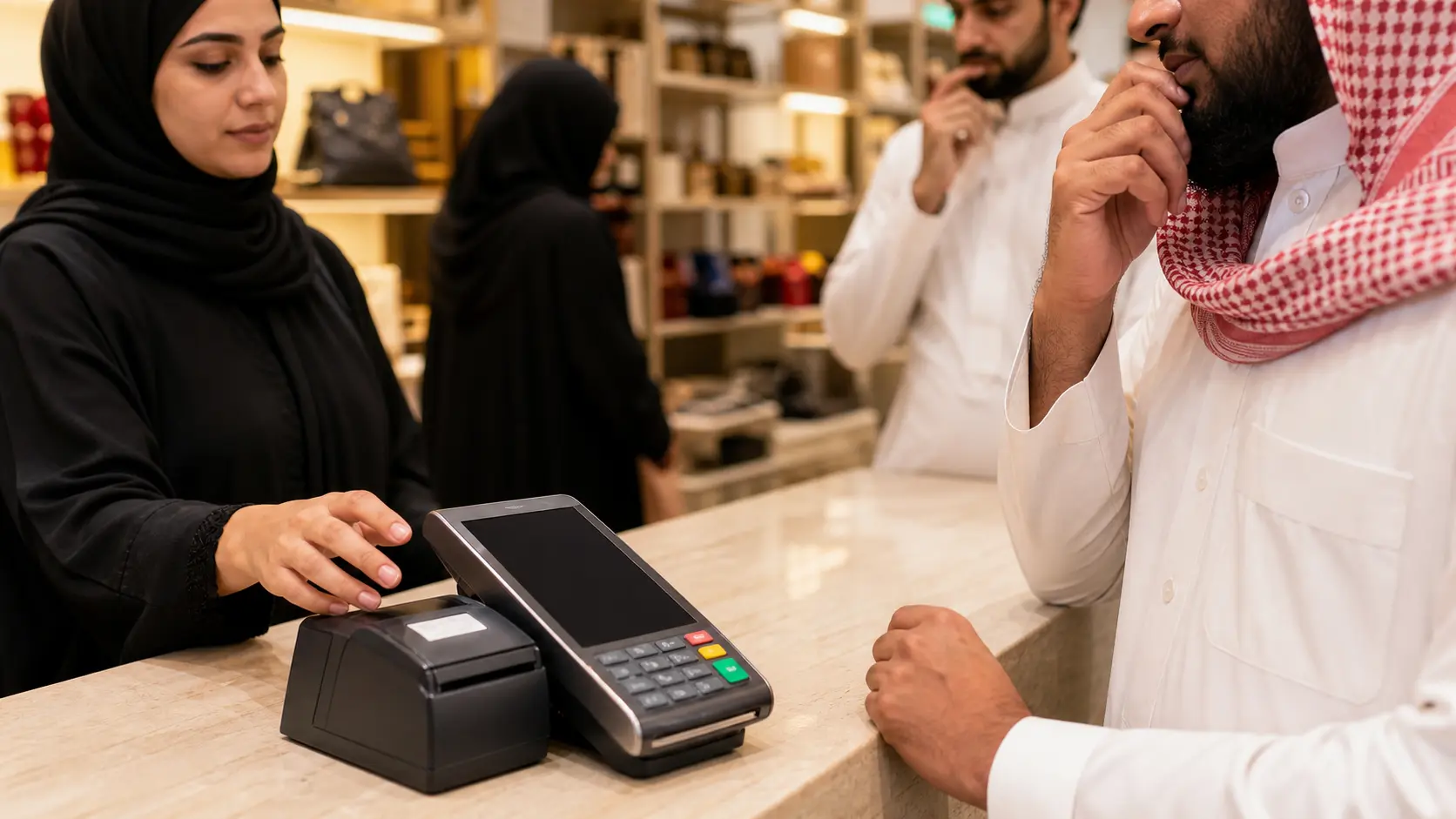
The useful opening scene is not a fintech pitch deck. It is a store counter in Riyadh at 8:45 p.m., when a customer has already chosen the goods, a small queue has formed, and the terminal will not complete authorization. The assistant tries contactless again. The customer inserts the card. A wallet tap also stalls. The device may be faulty, the bank may be slow, the network may be down, the merchant account may have a risk flag, or the staff may be using the wrong settlement or terminal process.
To the person at the counter, the cause matters less than the outcome: a revenue event that was expected to be instant becomes a manual service incident.
That is the paid unit. Geidea Technology Co ltd is not being valued here as a general fintech story or as a directory entry with an ASN attached to it. The economic unit is the merchant payment terminal, acquiring and checkout-service account. A Saudi merchant pays for a device or SoftPOS acceptance surface, access to mada and card-scheme authorization, onboarding, settlement into a bank account, reporting, fraud controls, and the support labour needed when payment, payout or device operation fails. Geidea's Saudi website at https://www.geidea.net/ksa/en presents the firm as a payments and business-management provider under Saudi Central Bank supervision, with contact details, commercial registration number 1010332533 and a visible product set across terminals, gateway, links, mobile POS, point-of-sale software and management tools. That evidence establishes the public offer. It does not establish the operating margin or merchant retention behind the offer.
The difference matters because a payment terminal fee is easy to underprice if it is seen only as hardware rent. A countertop terminal looks like a commodity, and a competing bank, processor or payment app can make the same basic promise: "take cards." The fee becomes more defensible only when it absorbs failure costs that a merchant would otherwise carry alone. If a busy cafe loses twenty transactions in a dinner window, a cheap terminal is no bargain. If settlement arrives late enough to strain supplier payments, the headline discount rate tells only half the story.
If device replacement requires repeated calls, branch visits, courier uncertainty or staff improvisation, the merchant is paying hidden labour on top of the acquiring fee. If the provider handles disputes, suspicious transactions, chargebacks and scheme compliance without forcing the merchant into constant manual work, the fee can be rational. If it does not, the merchant will test substitutes.
Geidea's product pages put the right ingredients on the table. The payment-terminal page at https://www.geidea.net/ksa/en/solutions/hardware/payment-terminal says the device accepts contactless, chip-and-PIN, magstripe, QR payments, local and international schemes including mada, Visa, Mastercard and American Express, and includes installation, integrations, reports, tipping, pre-authorization and dynamic currency conversion. The mobile POS page at https://www.geidea.net/ksa/en/solutions/payments/softpos offers Android-based acceptance without extra hardware and describes quick, regular settlements to a bank account of the merchant's choice. The point-of-sale page at https://www.geidea.net/ksa/en/solutions/customer/point-of-sale adds inventory, staff, reporting, tax and offline-mode claims. Those claims map directly to the fee: authorization capacity, software integration, compliance, support and operational continuity.
The first judgement is therefore narrow. Geidea matters if the terminal is not just a device but a checkout continuity account. It competes poorly if merchants experience it as a plastic box, a portal login and a call-centre queue. Public evidence is enough to show why Saudi merchants have reason to buy the account. It is not enough to settle whether the account consistently repays its cost under the heaviest conditions: peak trading windows, terminal faults, fraud reviews, disputed payouts, multi-outlet reconciliation and contract exit.
Terminal rent is only the visible price
The visible fee is only the start. In merchant acquiring, the paid unit sits on seven cost layers: capacity, specialist labour, capital intensity, compliance burden, upstream dependence, switching cost and substitute pressure. A merchant may see a monthly subscription, a per-transaction fee, a terminal rental charge or a discount rate.
Geidea sees a bundle of risks that has to cover onboarding, Know Your Customer work, device procurement, software updates, fraud monitoring, dispute handling, settlement operations, bank and scheme connectivity, customer support, field or courier replacement and the cost of merchants who transact too little to cover service overhead.
The public terms document linked from Geidea's Saudi site, https://d23r9m22xg868b.cloudfront.net/public/files/KSA-Terms-and-Conditions-CP-CNP-English-Version-%2817-08-2025%29.pdf, is useful precisely because it turns the marketing promise into operational price mechanics. It grants merchants a limited right to use the mada POS device and SoftPOS software for receiving services, keeps title to the device and software with Geidea unless the hardware is sold and fully paid for, and requires Geidea or its authorized agents to maintain, service and replace the device. It also puts responsibility on the merchant to keep the device safe, avoid tampering and report faults. That is not boilerplate in an economic sense. It shows that terminal economics are not simply "pay for a box." They are an allocation of failure and asset risk between provider and merchant.
The same terms make settlement a priced service. The merchant receives funds only after transaction records are transmitted, reconciliation occurs, Geidea receives funds from a partner bank or scheme, and the merchant's settlement bank position is applied. In the card-present settlement section, same-bank settlement can arrive the next business day after Geidea receives funds, while other-bank accounts may be settled on a twice-weekly schedule in the terms. Credit-card collections can take up to seven working days to be transferred under the relevant clause.
The contract also permits holds, deductions and set-off where there are suspicious, non-conforming or disputed transactions, chargebacks, refunds, reversals, fees, wrong payments or other merchant liabilities. That is the real terminal fee: not just the right to take money, but a negotiated place in the risk waterfall after a sale.
Capacity is the first layer. A payment provider has to keep acceptance alive across ordinary retail hours, but the cost appears at the peaks: Ramadan evenings, payday shopping, tourist surges, restaurant dinner rushes, events and mall footfall. Geidea's homepage claims hardware delivery in under twenty-four hours and points to more than 300 technical-support agents across Saudi Arabia. Those claims are not audited staffing counts. They are a statement of the service model: Geidea sells enough field and support coverage to make installation, replacement and issue handling part of the purchase.
If the support system has slack capacity, merchants experience the terminal fee as insurance. If it is overloaded, support becomes a second fee paid through staff time.
Specialist labour is the second layer. A card-present payment failure is not a simple retail IT ticket. The root cause can sit in the terminal, the SIM or broadband connection, the merchant account, the acquirer, the issuing bank, mada, a scheme rule, a fraud filter, a wrong credential, an expired authorization, a refund workflow or a chargeback. Geidea's developer documentation at https://docs.geidea.net/docs/troubleshooting-faqs is revealing because it names the messy middle: refunds involve the gateway, acquirer and issuer; authorization holds can vary by issuing financial institution; failed transactions can involve multiple parties; rejected orders can be blocked by risk rules; and chargebacks require evidence. A provider that can triage those cases quickly creates value. A provider that pushes the burden back to the merchant destroys value.
Capital intensity is the third layer. Terminals, SIMs, batteries, chargers, stands, cables and software updates have to exist before a merchant can transact. SoftPOS shifts part of this cost onto the merchant's phone, but it does not erase the cost of certification, risk controls, support, onboarding and settlement. Geidea's SoftPOS page sells no-extra-hardware acceptance, yet it still promises activation, compliance and settlements. The capital account changes shape; it does not disappear. The same is true for POS software.
When Geidea bundles payment acceptance with reporting, tax, inventory and staff tools, it is carrying software-development and integration costs that only pay off if merchants keep using the stack.
Compliance is the fourth layer. Saudi payments are not an unregulated app market. SAMA's rulebook section on payment systems and payment service providers at https://rulebook.sama.gov.sa/en/entiresection/1367 describes license categories, application procedures and requirements that include risk management, anti-money-laundering controls, business continuity, data protection, cyber security, consumer protection, safeguarding funds, fraud detection and settlement of customer funds. Geidea's own terms require compliance with SAMA, mada, scheme rules, PCI DSS and Saudi personal-data law. Those obligations are part of the fee. They also put a limit on how cheap a serious provider can be without cutting service or taking hidden risk.
Upstream dependence is the fifth layer. Geidea does not mint authorization out of thin air. A transaction depends on mada, card schemes, issuing banks, acquiring/partner banks, telecom or internet connectivity, device software and risk systems. The terms explicitly say settlement depends on funds received from partner banks or schemes; Geidea's FAQ says refund timing reflects multiple parties. That dependence makes the provider valuable as a coordinator, but it also caps the provider's control. The merchant is buying coordination across parties, not a magic guarantee that all parties will behave perfectly.
Switching cost is the sixth layer. A merchant can leave, but not without replacing devices, changing staff habits, moving settlement references, updating integrations, retraining cashiers, reconciling old transactions, handling chargeback windows and possibly losing reporting continuity. The terms include two-year duration, renewal, notice and early-exit mechanics for some services. That stickiness can help Geidea recover acquisition cost. It can also create resentment if the merchant feels trapped by a service problem.
Substitute pressure is the seventh layer. Saudi merchants are not captive to one form of acceptance. The mada service-provider page at https://www.mada.com.sa/en/merchants/service-provider-list lists banks and Geidea among merchant service providers. A merchant can seek a bank terminal, a rival payment service provider, payment links, QR acceptance, a wallet route, cash, or delayed fulfilment. The substitutes are imperfect. Cash loses digital reporting and may not suit customers in a market moving rapidly toward electronic payments. A bank terminal may be familiar but can be slower to integrate with a modern merchant stack. Payment links can save a sale but may slow the checkout line. The substitute set keeps Geidea honest, but it does not remove the need for a managed checkout account.
Saudi regulation makes acceptance a governed service
Saudi Arabia's payment market gives Geidea a stronger backdrop than a generic terminal vendor would have. The public-policy direction is clear: electronic payments are mainstream, mada is central infrastructure, and SAMA supervises payment firms. SAMA announced that electronic payments accounted for 85% of total retail payments in 2025, up from 79% in 2024, with electronic transactions rising to 14.6 billion from 12.6 billion; the announcement is at https://www.sama.gov.sa/en-US/MediaCenter/News/pages/news-1139.aspx. For a merchant, that figure changes the alternative. Refusing or failing digital acceptance is no longer a niche inconvenience. It risks excluding the dominant payment behaviour in the market.
Mada's own public site at https://www.mada.com.sa/en/ describes mada as the national payment scheme of Saudi Arabia, enabling electronic payments through POS terminals, SoftPOS, ATMs and e-commerce through a central payment system that reroutes transactions performed by issuer cards. Its 2023 statistics list more than 1.7 million POS devices, more than 8.9 billion transactions, SAR 613.9 billion in transaction value, more than 8.6 billion NFC transactions and 47.7 million mada cards. Those numbers are not Geidea metrics. They are market infrastructure evidence. They explain why a Saudi terminal account is not an optional add-on for most physical merchants. The buyer is purchasing access to a domestic payment habit that has become ordinary.
The mada POS page at https://www.mada.com.sa/en/services/mada-pos-service adds operational detail. It describes POS terminals as certified electronic devices used for retail financial transactions, says SAMA's certification centre approves devices with merchant service providers to meet security standards, and describes mada contactless payments below SAR 300 without PIN until limits require authentication. It also says SoftPOS allows businesses to accept payments directly from a phone or device without additional hardware, and that accepted methods include Apple Pay, GCCNet, Visa, Mastercard, Amex, Discover Diners Club, JCB and UPI. For Geidea, the key point is not logo collection. It is that the provider is selling into a rail where certification, security and domestic scheme acceptance are part of the commercial product.
The merchant page at https://www.mada.com.sa/en/merchants/overview is even more concrete. It says merchants perform POS reconciliation to receive funds in their bank account and that the process is ideally performed daily under SAMA reconciliation guidelines to avoid amounts pending in the system. It also notes that deposited payments cover transaction totals after reversals, adjustments, refunds and merchant discounts. In other words, the sale at the counter is only the first step. The value of Geidea's account depends on the second and third steps: reconciliation and settlement. A terminal that accepts the card but leaves the merchant uncertain about payout is not a complete product.
SAMA's licensing and rulebook context also affects competitive structure. A provider needs compliance investment before it can credibly onboard merchants at scale. The rulebook requirements around business continuity, cyber security, data protection and settlement of customer funds are not optional features. They shape labour, documentation, systems and reporting. That helps explain why low advertised transaction fees can be misleading. A provider can discount the visible rate, but someone must still pay for risk review, customer due diligence, incident handling, device certification, data controls and complaint handling.
If those costs are underfunded, merchants pay later through delays, support friction or avoided edge cases.
Geidea has public evidence on licensing and supervision, but it must be used carefully. The Geidea Saudi footer says Geidea Technology Company is under SAMA supervision and control, and the public SAMA licensed payments page at https://www.sama.gov.sa/en-US/Supervision/LicenseEntities/Pages/Licensed_Payment_Service_Providers_companies.aspx is the official directory surface for payment service providers, although its dynamic listing does not render fully in simple text capture. Gulf Capital's 2021 announcement at https://www.gulfcapital.com/2021/03/gulf-capital-portfolio-company-geidea-becomes-first-and-only-non-bank-institution-in-saudi-arabia-to-receive-a-merchant-acquiring-license-from-the-saudi-central-bank-sama said Geidea had received a SAMA merchant-acquiring license, enabling direct merchant payment processing. That source is an investor announcement rather than a current regulator database export, but it aligns with Geidea's public positioning and the visible product set.
This regulatory context strengthens Geidea's right to charge for more than hardware. It also raises the evidence bar. A supervised payment provider should be judged on continuity, transparent fee treatment, complaint handling, settlement clarity and data protection, not only on signup speed. The SAMA consumer-protection principles PDF linked from Geidea's site, https://d23r9m22xg868b.cloudfront.net/public/files/%D8%AD%D9%85%D8%A7%D9%8A%D8%A9_%D8%A7%D9%84%D9%85%D8%B3%D8%AA%D9%87%D9%84%D9%83.pdf, emphasises fair treatment, disclosure, fraud protection, privacy, complaints and the customer's ability to compare products. That standard is relevant because merchant acceptance is a financial-service relationship, not a simple software download.
The final regulatory point is price discipline. SAMA's GCC POS pricing policy at https://rulebook.sama.gov.sa/en/gcc-pos-pricing-policy shows that Saudi authorities treat POS fees as a regulated payment-system matter, including cross-border GCC fee caps and a rule that certain service fees should not be passed on to customers. That policy is not a full domestic Geidea rate card. It is evidence that POS economics are part of a public rule environment. Geidea's fee can be high enough to fund the service, but it exists in a market where the regulator, scheme rules and mada operating practices constrain what can be passed to customers and how merchants should be treated.
Settlement timing decides whether the fee feels cheap
The checkout moment gets the attention, but settlement timing often decides renewal. A merchant can forgive an occasional terminal retry if money lands predictably. The same merchant can turn hostile if payout timing changes without a clear reason, if a reversal is hard to trace, if a missing amount requires multiple support contacts, or if a chargeback hold arrives just as payroll, rent or supplier invoices are due. The economic question is therefore not "How much is the terminal?" It is "How much working-capital uncertainty does the terminal account remove or create?"
Geidea's terms put this issue in plain view. For card-present transactions, the payment date depends on reconciliation, funds received from partner banks or schemes, and the physical location and identity of the merchant's settlement bank account. Same-bank settlement can be quicker after Geidea receives funds; other-bank settlement may follow a twice-weekly pattern in the terms. Credit-card payments can take up to seven working days before transfer to the merchant settlement account. The terms also allow the merchant to request no settlement where settlement fees make a payment uneconomic, and they refer to SARIE deductions.
Those clauses tell merchants something valuable: settlement is a process with conditions, not an instant entitlement created by the card tap.
That conditionality is not necessarily bad. It is part of acquiring. The issuer, scheme, acquirer and merchant all have obligations. Fraud review, refunds, reversals and chargebacks exist because card payments are not cash. What matters commercially is whether the provider makes the conditions legible. If a merchant can see transaction status, payout date, fee deductions, dispute flags and expected settlement path in a usable portal, the terminal account reduces anxiety. If the merchant has to infer settlement from bank credits, paper slips and support-ticket references, the same fee feels expensive.
Geidea's public product set tries to address that. Its payment-links page at https://www.geidea.net/ksa/en/solutions/payments/payment-links describes real-time tracking, reports, QR payments, digital invoices, bulk payments and pay-link API flows. Its gateway page at https://www.geidea.net/ksa/en/solutions/payments/payment-gateway describes plugins, checkout pages, mobile SDKs, direct API integration, branded checkout, card-on-file and recurring payment features. Its developer FAQ says merchants can use a portal to check order status, callbacks for real-time transaction data and reports for dashboard updates. If those tools work well, they lower the merchant's back-office cost. They are part of why the terminal fee can be more than commodity acquiring.
The catch is that public pages do not reveal settlement-performance distribution. We do not see the median and tail settlement time by payment method, bank, merchant category, risk review, refund event or holiday period. We do not see how often Geidea withholds partial settlement, how long holds last, what share of merchants experience missing-payout complaints, or how quickly those complaints close. The complaint form at https://www.geidea.net/ksa/en/complains is telling because its dropdown includes categories such as collection-fee delay, delay of registered transactions, missing amount, missing payout, reversed payout, incorrect payout, delay, service delay, terminal replacement and technical issue. That list does not show complaint frequency. It shows the operating surfaces Geidea expects merchants to need help with.
Settlement timing also affects the practical substitutes. Cash settles instantly but carries theft, handling, reconciliation and customer-preference costs. Bank terminals may offer familiar account settlement but can be less attractive if they do not integrate with a merchant's POS, online ordering, delivery apps or business reporting. Payment links may work for remote orders or social-commerce sellers but can slow an in-store queue. A rival payment service provider may advertise faster onboarding or lower fees, but the merchant still has to examine settlement schedule, dispute policy and support capacity.
A delayed sale is the worst substitute: no fee, no risk, but also no revenue.
The operating question for Geidea is therefore retention, not only acquisition. A new merchant may choose Geidea because it promises fast setup, broad payment methods and an integrated product suite. The renewal decision happens after several months of settlement cycles. Did the cash land when expected? Were deductions explainable? Were refunds and chargebacks visible? Did staff spend less time reconciling? Did the provider help when the amount was wrong? If the answer is yes, the fee feels like a working-capital service. If the answer is no, the merchant compares rates aggressively because the provider is no longer reducing uncertainty.
This is where the public evidence is incomplete. Geidea's terms explain its rights and merchant obligations clearly enough to understand the risk allocation. Its product pages show the tools it intends merchants to use. Mada and SAMA sources show why settlement matters at national scale. The missing evidence is hard operating data: settlement failures per thousand transactions, average time to resolve missing-payout tickets, percentage of settlements held for review, chargeback-rate distribution by merchant cohort, and churn after payout disputes. Without those metrics, the terminal fee can be understood but not fully valued.
Hardware failure turns support labour into margin risk
The second place the fee lives or dies is device replacement. A terminal account has a physical tail: terminals break, batteries degrade, chargers disappear, SIMs fail, paper rolls run out, screens crack, cables vanish, staff move devices between outlets, and merchants sometimes use hardware outside the agreed premises. A provider can advertise digital payments, but much of the merchant's experience is determined by mundane hardware logistics.
Geidea's terminal page sells "battle-tested hardware" and installation by technical support agents. The homepage adds a stronger operational claim: hardware delivered to the shop in under twenty-four hours and more than 300 technical support agents across Saudi Arabia. The terms show why that labour matters. Geidea retains ownership of the POS device unless sold and fully paid for, maintains and services it through Geidea or authorized agents, requires access for maintenance or replacement, and can impose misuse fees where merchant-caused damage, loss or tampering creates replacement costs.
On termination, the merchant must return devices within a defined period or may face recovery of replacement value through bank-account debit or sale-proceeds adjustment.
Those clauses allocate asset risk, but they also make support quality central to margin. If Geidea can install, repair and replace quickly, the support fleet turns into a moat. The merchant sees less downtime, less staff improvisation and less risk of lost sales. If replacement is slow, every broken device becomes a churn trigger. A merchant who loses a Friday night because of a dead device will remember the incident longer than the monthly fee. The provider's margin is then caught between two costs: sending support quickly, which is expensive, or saving support expense and losing future revenue.
SoftPOS changes this equation but does not eliminate it. Geidea's mobile POS page says merchants can take payments with an Android device and no additional hardware. That can reduce terminal capex, shipping, charger and battery problems. It can also increase dependence on phone compatibility, operating-system updates, app reliability, NFC capability, merchant staff devices, mobile connectivity and app-store distribution. The mada POS page says SoftPOS currently supports Android, which means the substitute is not universal for every merchant. For a small delivery business or event seller, SoftPOS may be an elegant backup.
For a high-volume fixed counter, dedicated terminals may remain preferable because staff need a known device, predictable battery and a receipt workflow.
Support burden also extends to onboarding. Geidea's terms define onboarding as the process of installing mada POS devices at merchant sales outlets or remotely by dedicated teams. The merchant may need to provide identity evidence, one-time passwords and correct outlet details. That matters because a provider's acquisition cost is front-loaded. Small merchants can be expensive to onboard relative to transaction volume. If the merchant then transacts lightly, goes dormant, changes business type, or cancels early, the provider may not recover onboarding and hardware cost.
The terms allow Geidea to deactivate an inactive account under certain conditions and to charge or recover fees. That is a rational response to unit economics, but it also means the merchant account is not risk-free for either side.
The complaint form categories again point to the real work. Maintenance request, paper request, lost device, service delay, terminal replacement, terminal cancellation and technical issue are not abstract fintech concerns. They are exactly the frictions that decide whether a cashier, branch manager or owner views the provider as operational support or operational overhead. A merchant can tolerate a fee when someone replaces the terminal before the next trading peak. The same merchant will shop around if each service interaction requires repeated follow-up.
Device replacement is also where competition becomes physical. Banks and rival payment providers can compete not only on rates but on delivery, replacement, branch access, field technicians and account-manager responsiveness. Mada's service-provider list shows multiple bank options alongside Geidea, and the App Store "You Might Also Like" area on Geidea's listing at https://apps.apple.com/sa/app/geidea-softpos/id1519264188 displays adjacent business-finance and banking apps such as Hala, Alinma Business, Al Rajhi Bank Business, Tamara Business and SNB eCorp. App-store adjacency is not market-share evidence, but it is a useful clue about how merchants compare tools: acceptance, banking, finance and order management blur into one operating stack.
The hard evidence gap is replacement rate. We do not know how many Geidea terminals are replaced per month, the mean time to replacement, the share of replacements charged as misuse, the courier or field-visit cost per incident, or how often merchants churn after a support event. Those private facts would change the judgement. If device replacement is fast and cheap at scale, Geidea's hardware footprint is a strength. If replacement is slow or costly, the same footprint is a margin drag and a merchant-retention risk.
Mada, wallets and banks make dependence unavoidable
Geidea's promise is valuable partly because the payment chain is crowded. A merchant sees one provider and one device. Behind it sit mada, card schemes, issuing banks, acquiring or partner banks, wallets, telecom networks, device vendors, app stores, cloud or DNS vendors, settlement banks, fraud systems and regulatory obligations. That complexity is not a weakness by itself. It is why a merchant hires a payment provider. But it means Geidea's terminal fee is partly a coordination fee, not a sovereign-control fee.
Mada dependence is central. Geidea's terminal and SoftPOS pages both present mada acceptance as a core payment option. The mada site describes the domestic scheme as a central payment system for POS, SoftPOS, ATM and e-commerce transactions. The merchant cannot replace mada with Geidea; Geidea connects the merchant to mada and related schemes. That distinction matters because some checkout failures will sit outside Geidea's direct control.
If a card issuer declines, if the customer's bank has an issue, if network connectivity drops, or if a wallet token fails, the merchant still calls the provider because the provider is the account interface.
Wallet dependence extends the same problem. Geidea lists digital wallets and payment plans across its pages, and the developer FAQ lists Apple Pay, Google Pay, Samsung Pay, STC Pay, Tamara and Tabby in relevant markets. Wallets help conversion because customers do not all carry the same card or prefer the same flow. They also add certification, tokenization, dispute and routing complexity. The provider earns the fee only if it simplifies that complexity for staff and customers. A wallet tap that fails in front of a queue is still a failed checkout even if the root cause sits with a token, issuer or device.
Bank dependence is equally important. Geidea's terms refer to partner banks, settlement bank accounts, issuing banks and card schemes. The refund FAQ says refund timing is affected by multiple parties and varying manual processes. The settlement clauses depend on funds received from partner banks or schemes. For a merchant, this means the provider's value is partly in exception management: knowing when a delay is normal, when it needs escalation, when evidence is required, and when a bank or scheme rule overrides merchant expectations.
The provider cannot eliminate bank dependence, but it can reduce the merchant's labour in dealing with it.
Telecom and internet dependence sits under the counter. Mada's merchant overview says POS terminals must connect to a network and classifies connectivity into IP-based and mobile options. Geidea's own terms acknowledge that service ability can depend on third-party internet, data traffic and network services, and that interruptions, delays or errors may arise from third-party providers, general internet failures or force majeure. The public evidence should not be overstated. A DNS lookup does not reveal Geidea's private architecture.
But the dependency is basic: a terminal account needs communications working at the moment of sale.
Public technical records add a narrow clue. A RIPE WHOIS lookup for AS43334 shows the aut-num holder as Geidea Technology Co ltd, country Saudi Arabia, registration number 1010332533, with imports from AS35819, AS42333, AS35753 and AS25019 and an abuse contact at network@geidea.net. DNS checks show geidea.net using AWS Route 53 name servers, mail routed to smtp.geidea.net and smtp2.geidea.net, a DMARC reject policy, and api.ksamerchant.geidea.net resolving to 193.25.205.24 at check time. The public RIPEstat entry at https://stat.ripe.net/AS43334 is useful as a technical database pointer. These records show public network and domain surface. They do not show payment processing architecture, data storage location, uptime, private redundancy, security governance or service quality.
The same restraint should apply to partner announcements. Mastercard's 2023 release at https://www.mastercard.com/news/eemea/en/newsroom/press-releases/en/2023/july/mastercard-partners-with-geidea-to-expand-access-to-world-class-payment-solutions-in-saudi-arabia/ said Geidea would leverage Mastercard technology for BIN ranges and fintech enablement, and stated that Geidea served more than 300,000 merchants and 800,000 terminals in the Kingdom at that time. Planet's 2025 announcement at https://www.weareplanet.com/news/planet-and-geidea said Planet would introduce currency conversion services across Geidea POS solutions in Saudi Arabia and described Geidea as serving more than 150,000 merchants and more than 700,000 payment terminals, plus ATM networks. Those figures differ by date, source and framing. They show scale claims from partners; they do not give a clean current audited merchant count.
Dependence also shapes data-sovereignty questions. The public evidence should not invent where transaction data is stored or processed. SAMA's rulebook requires applicants to describe IT infrastructure, data centres, systems, servers and networks, and Geidea's terms refer to Saudi personal-data law, PCI DSS, scheme rules and disclosure to affiliates, subcontractors, regulators, schemes and partner banks. That shows locality and data governance are part of the compliance burden. It does not show the exact location of Geidea's production systems or every subcontractor.
The right conclusion is bounded: the fee includes regulatory and data-handling obligations, while public technical records leave data-residency specifics unverified.
The merchant pays Geidea to stand in the middle of these dependencies. The merchant does not want to troubleshoot mada, an issuing bank, wallet tokenization, settlement rules, SIM connectivity and device software during a rush. The more Geidea absorbs that operational burden, the more valuable the fee. The more the burden reappears as merchant follow-up, the more the merchant sees the fee as a toll rather than a service.
The merchant can replace Geidea, but not the payment problem
The practical substitute set is broad but imperfect. A merchant considering Geidea can choose a bank-provided terminal, another payment service provider, mada and card-network acquiring through a bank relationship, payment links, mobile-wallet acceptance through supported rails, a POS platform with embedded payments, cash or delayed sale. The question is not whether substitutes exist. They do. The question is which failure cost the merchant wants to carry directly.
A bank terminal is the most obvious substitute. Mada's service-provider list puts major banks and Geidea in the same merchant-service ecosystem. Banks already hold the merchant's account, understand settlement flows and can offer familiar treasury relationships. For a conservative merchant, that can lower perceived risk. But a bank terminal may not solve the whole operating stack. If the merchant needs delivery-app integrations, online store sync, product libraries, staff reports, mobile ordering, pay links, QR invoices, or a unified portal, a pure acquiring relationship may leave extra software and reconciliation work.
Geidea's fee is more credible when the merchant values integrated operations, not only card acceptance.
A rival payment service provider can attack Geidea on service speed, pricing, user experience or niche features. Saudi merchants can compare specialist fintechs, POS software firms, wallet providers and bank-owned apps. The choice depends on segment. A restaurant may care about tableside ordering, delivery integration and tip flows. A small service business may care about payment links and low device cost. A tourist-facing retailer may care about international schemes and currency conversion. A delivery seller may prefer SoftPOS or links over fixed terminals.
Geidea's product breadth helps it compete across those segments, but breadth is expensive to maintain and can create support complexity.
Payment links are both a Geidea product and a substitute for a terminal. Geidea's links page says a merchant can sell without a website, terminal or code, send links by SMS, email or social channels, create QR payments, digital invoices, promo links, bulk payments and API-embedded pay links. That matters because some checkout failures can be routed around by sending a link. But this substitute has a cost. It changes the customer journey, may require the customer to open a phone flow, may slow the line, and may not suit every purchase. In-store terminal acceptance remains faster for high-volume retail.
Payment links are a backup and a channel product, not a full replacement for every counter.
Mobile wallets are a customer-side substitute only if the merchant can accept them. A customer using Apple Pay or Samsung Pay still needs a terminal or SoftPOS capable of receiving the transaction. A wallet does not bypass the merchant's acquiring account. It may improve customer convenience and reduce card handling, but it keeps the merchant dependent on terminal, scheme and issuer coordination. That is why Geidea lists wallets as payment options rather than as alternatives to Geidea's own account.
Cash is still a fallback, but a weaker one in Saudi Arabia's electronic-payments environment. SAMA's 85% retail e-payment figure and mada's POS/NFC statistics imply that cash is increasingly a residual option, not the default for many customer journeys. Cash avoids chargebacks and network errors. It creates other costs: counting, safe handling, theft risk, deposit trips, weaker analytics, harder tax and inventory reconciliation, and customer inconvenience. A merchant can switch to cash during a terminal outage, but it may lose customers who arrived expecting digital payment.
Delayed sale is the most expensive substitute because it can look free. "Come back later" avoids a transaction fee and a failed card dispute, but it throws away conversion. The customer may never return. For a small merchant, the lost margin on a few sales can exceed a month's terminal fee. That is why checkout continuity is the core value. The merchant is not buying a cheaper payment method; the merchant is buying fewer lost revenue moments.
The substitute analysis also explains why Geidea's public strength can coexist with churn risk. A merchant may choose Geidea because it offers many products and a recognizable Saudi payments brand. The same merchant may leave after a sequence of small failures: a late settlement, a support delay, a broken terminal, an unexplained risk hold, an app error and a better bank offer. Merchant churn is rarely caused by one abstract complaint. It often comes from accumulated labour. The owner asks: how many times did my staff have to chase payment problems this month?
Public evidence does not disclose Geidea's churn. That is one of the three decisive evidence gaps. Economics: unit margin by merchant cohort, device cost, support cost and take rate. Reliability: checkout uptime, settlement exceptions, terminal replacement and incident history. Retention: churn after support events, renewal rates, complaint closure and share of merchants expanding from terminal to POS/gateway/links. Until those facts are visible, the market case remains plausible rather than conclusive.
Market signals point to support pressure, not a verdict
Market chatter should be used as an early-warning system, not as a finding of fact. App-store reviews, forum snippets, social complaints and buyer behaviour can reveal the kinds of failures that annoy merchants, but they are skewed toward people motivated to complain or praise. They do not represent a statistically balanced merchant survey. They still matter because payment providers sell continuity, and continuity failures are exactly the kind of event that prompts public complaints.
The Apple App Store listing for Geidea SoftPOS at https://apps.apple.com/sa/app/geidea-softpos/id1519264188 showed, at review time, a low average rating from hundreds of ratings, alongside a mix of negative and positive comments. The visible negative comments complained about app and website availability, system errors and poor service experience; visible positive comments praised ease of use and speed. The listing also shows repeated version-history notes about bug fixes and stability enhancements. None of this verifies a current outage rate or support backlog. It does show that app reliability is a public merchant-sentiment surface, and that merchants evaluate Geidea not only on terminal acceptance but on the app and portal around it.
The complaint-category list on Geidea's own site is a stronger signal than anonymous commentary because it names the provider's expected support taxonomy. Missing payout, reversed payout, incorrect payout, delay, terminal replacement, lost device, maintenance and technical issue are all built into the intake form. That does not mean those issues are frequent. It means they are normal enough to require structured routing. For a merchant, the quality of routing matters as much as the category. A complaint form that produces fast resolution is service infrastructure.
A complaint form that becomes a ticket graveyard is churn infrastructure.
Buyer behaviour also points to bundling pressure. Geidea sells terminals, SoftPOS, payment links, gateway, POS software, kiosks, kitchen display, branded apps, loyalty and management tools. The more merchants want a single stack, the more Geidea can convert a terminal account into a broader operating account. That improves revenue per merchant and can lower churn by making the provider part of daily workflow. It also raises expectations. If a merchant buys the integrated story, a failure in reporting, tax, inventory, online ordering or payment links can spill back into the terminal relationship.
The provider is no longer judged only when a card is tapped.
Partner announcements give another market signal. Tamara's Geidea POS plugin page at https://tamara.co/en-sa/plugins/pos/geidea positions Geidea as an in-store route for buy-now-pay-later acceptance. Planet's 2025 announcement positions Geidea's POS suite as a channel for currency conversion, with tourism and hospitality upside. Mastercard's partnership announcement positions Geidea as part of card and fintech enablement. These relationships suggest that Geidea's terminal account is a distribution surface for add-on economics, not just a payment pipe. Add-ons can make the fee easier to justify if they lift conversion or margin. They can also make the provider more dependent on partner reliability and scheme rules.
Merchant review chatter and partner announcements should not be blended into one conclusion. Reviews expose pain points. Partner announcements expose strategic direction. The robust conclusion is narrower: Geidea sits in a market where merchants have high dependence on electronic acceptance, where the provider has public breadth and partner reach, and where small reliability failures can become high-salience complaints. That is enough to frame the terminal fee as a renewal-risk product.
There is also a reputational asymmetry. When a terminal works, customers rarely know the provider. When it fails, the merchant does. The brand can gain merchant goodwill through quiet reliability but lose it through visible moments: a queue, a declined payment that should have succeeded, a missing payout, a support delay, a replacement that arrives after the weekend rush. That asymmetry is why app reviews and complaints deserve attention even when they are anecdotal. They show where the private retention data would need to be strong.
The strongest public market signal, however, is still the SAMA and mada data. When electronic payments reach most retail transactions, merchants have less tolerance for unreliable acceptance. In a cash-heavy market, a bad terminal is a convenience problem. In a digital-first market, it is revenue leakage. Geidea's opportunity and risk both grow with electronic-payment penetration. The company can sell continuity into a large, policy-supported market. It also faces a larger penalty for each visible failure.
Final judgement: checkout continuity earns the fee only with operating evidence
Geidea's terminal fee is economically defensible if the merchant receives checkout continuity rather than a device. The public evidence supports the first half of that sentence.
Geidea has a visible Saudi product suite across terminals, SoftPOS, gateway, links and POS software; it presents itself as SAMA-supervised; mada sources show a large domestic payment infrastructure; SAMA sources show electronic payments dominating retail; Geidea's terms explain settlement, device, compliance, dispute and fee mechanics; partner announcements show scale and adjacent services; technical records show a public Geidea network and merchant-domain surface; app-store and complaint signals identify the service pressures merchants notice.
The second half remains open. Public evidence does not tell us whether Geidea's service consistently meets the merchant moments that matter most. It does not disclose terminal uptime during peak periods, median field-replacement time, settlement-exception frequency, missing-payout closure time, support-ticket backlog, chargeback win rates, fraud losses, unit margin, take rate, merchant churn, cohort renewal or expansion from terminals into software. Those facts would change the valuation. A provider with high uptime, fast replacement, clear settlement and low churn can charge for continuity.
A provider with the same product catalogue but poor exception handling competes back down toward commodity terminal pricing.
For merchants, the buying question should therefore be practical. What happens when authorization fails but the customer says funds were deducted? What settlement schedule applies by payment method and bank account? Which fees are deducted automatically, and when can settlement be held? How quickly are devices replaced, and what counts as merchant misuse? Which support channels operate during the merchant's actual trading hours? How are chargebacks documented, and how much evidence must the merchant produce? Can the portal reconcile daily sales, refunds, reversals and payouts without manual spreadsheets?
What is the path out if the account does not work?
For Geidea, the renewal question is harsher. The company can acquire merchants with setup speed, broad acceptance and integrated software. It keeps them by reducing labour after the sale. Every support interaction either reinforces or weakens the fee. Every payout uncertainty either demonstrates risk management or creates working-capital doubt. Every broken device either shows the value of a support fleet or reminds the merchant that cash, a bank terminal, a rival provider, a payment link or a delayed sale is available.
The terminal fee therefore lives or dies at checkout, but not only at the second of authorization. It lives in the hours before the queue, when the device is charged, connected and updated. It lives after closing, when reconciliation is submitted. It lives on settlement day, when funds arrive net of explainable deductions. It lives during a dispute, when evidence windows are short. It lives when a screen cracks, when a SIM fails, when a wallet tap is rejected, when a customer wants a refund, when a bank takes days to release funds, and when a merchant decides whether to renew.
Geidea has the right market and the right product surface for that account. Saudi Arabia's payment mix creates demand. Mada and SAMA create the governed rail. Merchants need device, software, support and settlement coordination. But the public record leaves three proof gaps: economics, reliability and retention. Until Geidea or credible third parties disclose unit margin, settlement and uptime performance, replacement and support outcomes, and churn or renewal behaviour, the fairest judgement is conditional. Geidea's fee can be worth paying when it keeps retail revenue moving through checkout, settlement and support.
It becomes vulnerable when merchants experience it as hardware rent plus unresolved operational work.