
Summary
- FotoWare Switzerland AG is the Swiss operating entity behind Fotoware Alto, the product line that carries the Picturepark heritage after Fotoware acquired the Swiss DAM provider in 2022 and later renamed the former Picturepark Content Platform. Public legal, security and processor documents support a Cloud Service classification because the paid unit is hosted software for digital-asset management, with SaaS terms, customer-selected data-center regions, Microsoft Azure hosting, daily backups, support, professional-services add-ons and a quote-based modular subscription model.
- The strongest economic evidence is not AS39865. Public routing sources show AS39865 as allocated to FotoWare Switzerland AG and associated with the former VIT/Picturepark identity, but BGP.tools reports zero originated IPv4 or IPv6 prefixes and says the ASN is not currently in the global routing table. That makes network evidence weak and secondary. The thesis rests instead on hosted DAM operations, metadata lock-in, integration depth, regional data placement and the recurring-account economics of enterprise SaaS.
- The business matters because a cloud DAM becomes costly to leave once customers have rebuilt the archive around structured metadata, permissions, rights records, public portals, APIs, content-delivery rules, search and user habits. That lock-in is economically useful for Fotoware, but it also creates obligations: cloud resilience, Azure dependence, data-transfer assurances, migration/export credibility, implementation support and enough product differentiation against Adobe Experience Manager Assets, Bynder, Canto, Cloudinary, Microsoft 365 storage and on-premise archives.
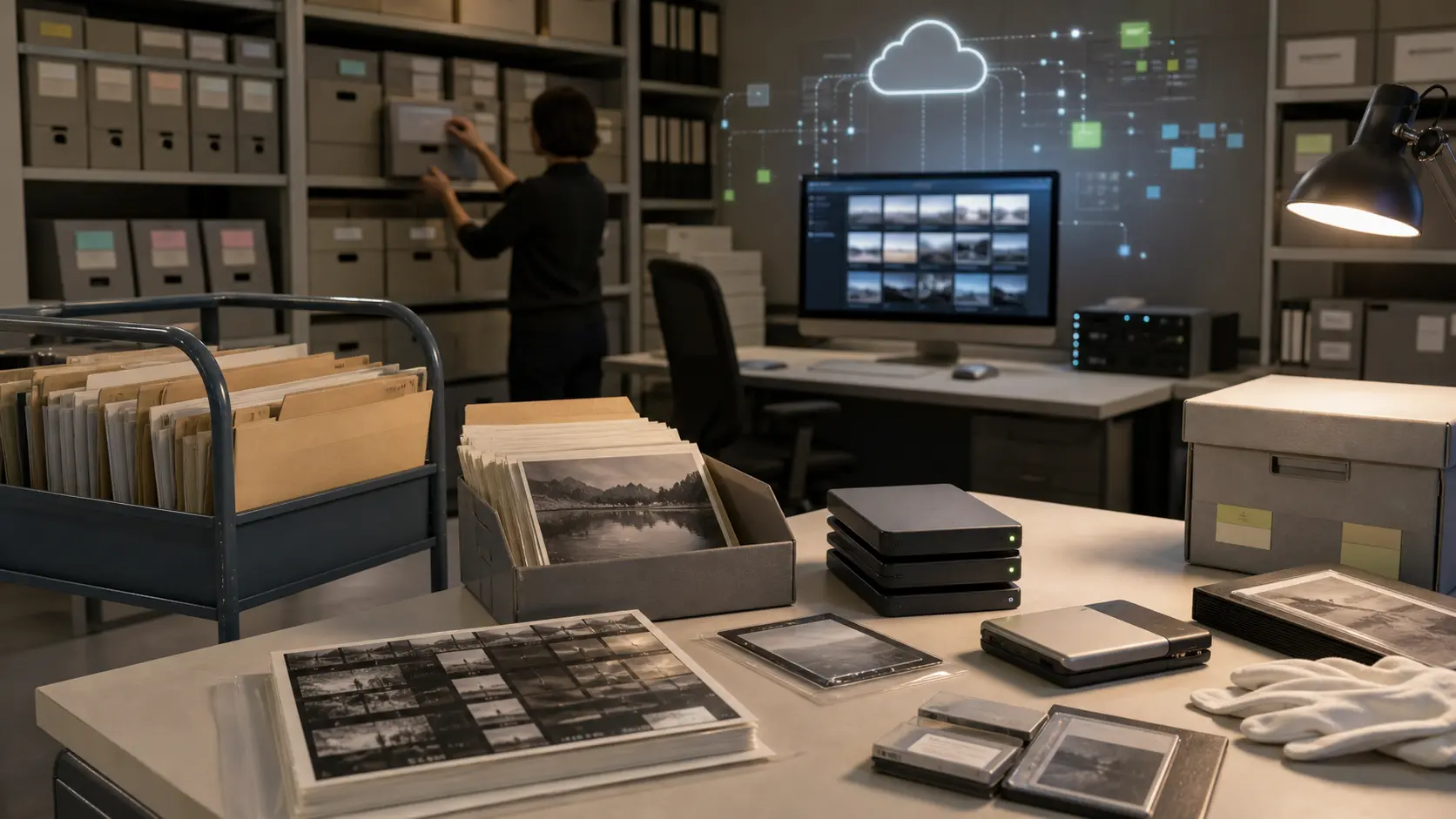
The archive has become a governed cloud account
The simplest way to value FotoWare Switzerland AG is to begin with a team whose archive has already moved. A museum has digitised collections and wants staff, curators, donors and outside publishers to find approved images without reopening rights questions. A magazine has a long tail of photography, captions, permissions and embargoes that must move through editorial and syndication channels. A retailer needs product images, campaign files, packshots, translations and market-specific usage rights to arrive in web shops and partner systems without duplicate work.
A manufacturer wants distributors to download current approved media rather than a stale image found in an employee drive. In each case, the customer is not only storing files. It is turning files into governed assets.
That distinction is why a cloud DAM is priced differently from a generic cloud drive. A folder system can hold photos, documents and video. It does not automatically define a taxonomy, attach usage rights, manage consent, push approved derivatives into a content-management system, let external partners search only what they are allowed to see, or preserve asset context after a campaign ends. The product becomes valuable when the archive is no longer a passive cupboard. It becomes a shared operating layer for marketing, publishing, cultural heritage, law enforcement, manufacturing, retail and communications work.
FotoWare Switzerland sits precisely in that conversion. The public company record and Fotoware legal pages identify FotoWare Switzerland AG at Brown Boveri Str. 7 in Baden, Switzerland, with UID CHE-105.440.683. Moneyhouse records the company as active, entered in the Swiss commercial register in February 2000, formerly associated with Vision Information Transaction AG, and moved to Baden in 2025.
Fotoware's own history pages describe Picturepark as a Swiss digital-asset management pioneer that launched a browser-accessible cloud DAM in 1998, joined the Fotoware group after the 2022 acquisition, and continued as Fotoware Alto after the 2025 renaming.
The economic unit is the cloud digital-asset management subscription around Fotoware Alto. It is not the Swiss company's old network record, not a one-time software licence, and not a simple storage bucket. Fotoware's pricing page says the model is modular and quote-based: the vendor asks for requirements and then sends a tailored quote. The Alto SaaS agreement defines the Swiss entity as the contracting Fotoware company, describes an order form or quote specifying the service and fees, and separates the subscription from add-on support packages, professional services and partner-delivered support.
That structure is typical for enterprise SaaS because the customer is not buying a fixed number of gigabytes in isolation. It is buying a configured service whose cost depends on the archive, user model, data model, integrations, service expectations and migration effort.
The result is a pricing problem with two sides. Fotoware can defend recurring revenue because a customer's content operations become more valuable as metadata, permissions and integrations accumulate. The customer can justify the spend when the system prevents rework, reduces compliance mistakes, accelerates reuse and keeps brand or evidence material under control. But the same accumulation creates buyer caution. Once the archive has moved, leaving is not like cancelling a small application.
It means exporting assets, preserving metadata, preserving relationships among records, checking rights fields, rebuilding portals, reconnecting APIs, training users again and making sure links into websites, commerce systems, publication tools or public collections do not break.
Identity: a Swiss Picturepark legacy inside a Norwegian group
The Swiss entity is best understood through the Picturepark lineage. Public acquisition announcements in 2022 described Picturepark as a Swiss DAM and content-management platform from Vision Information Transaction, with an internationally diverse team and customers in retail and other sectors. Fotoware's current history page says Picturepark's Swiss team in Baden now plays a role in product strategy and enterprise-ready structured content management across Central Europe and beyond.
The group's About page frames Fotoware as an Oslo-headquartered DAM provider founded in Norway, with a product history beginning in the 1990s, a move to Microsoft Azure in 2016, growth by acquisitions and customers across media, retail, cultural heritage, public safety and other sectors.
This matters because FotoWare Switzerland AG is not a local Swiss hosting shop selling commodity infrastructure. It is a Swiss legal and product centre inside a broader group. The group carries the Fotoware Veloz line, the Fotoware Alto line, the FotoStation desktop metadata editor and associated services. The Swiss branch matters for Alto because the old Picturepark product was not just another storage product. It was positioned around structured metadata, an API-first model, adaptive metadata, semantic relationships, microsites and content reuse.
Swiss Made Software's company profile describes Picturepark as a platform for managing and routing content at scale, including file-based and fileless content, Adaptive Metadata, semantic relationships and microsites.
The acquisition changed the market posture. Before the acquisition, Picturepark had a separate Swiss identity. After it joined Fotoware, the customer proposition became a portfolio proposition: Fotoware could sell Alto for structured, API-first content operations, Veloz for a more classic DAM path and FotoStation as a desktop metadata tool. Fotoware's 2025 brand-unification page says the former Picturepark Content Platform lives on as a headless, structured metadata platform for complex digital ecosystems, central content hubs, advanced automation, structured content reuse and omnichannel delivery.
That is the strategy: preserve the Swiss product DNA while putting it under a larger global DAM brand.
The caution is that group scale and product coherence are not the same as public financial transparency. Fotoware's site claims 850-plus organisations worldwide, 30 years of DAM experience, customer satisfaction claims, and customers including The Economist, Marks & Spencer, Breitling and others. The Cision acquisition release named Picturepark customers including Breitling, Faber-Castell, Specialized, Swiss Olympic, Bosch Security and UEFA. These are useful market signals, especially because they show the type of content-intensive customers the product addresses.
They are not audited revenue disclosure, churn disclosure or Swiss subsidiary profitability.
The strongest identity facts are therefore conservative: FotoWare Switzerland AG is active in Switzerland, connected to CHE-105.440.683, now located in Baden, and publicly named in the Alto SaaS terms. Fotoware acquired Picturepark in 2022. The product was later rebranded as Fotoware Alto. The Swiss team is presented as part of the enterprise structured-content strategy. That is enough to analyze the cloud DAM economics without pretending to know private revenue, margins or customer concentration.
Why Cloud Service is supported and ASN evidence is secondary
The Cloud Service category is supported by customer-facing SaaS evidence. Fotoware's Data Processors page says Fotoware as a Service provides a fully self-service DAM system in the cloud and that customers choose a data center for storage. It lists Microsoft as the hosting processor and identifies Microsoft Azure regions including Europe West, US East, Germany German Cloud and Australia East, with EU customers hosted in EU West unless they explicitly choose otherwise.
The Alto Data Processing Addendum says Fotoware processes personal data to provide software-as-a-service for digital-asset management, with the customer as controller and Fotoware as processor. The Alto SaaS agreement says customer content is stored in one of the regions offered by Fotoware and chosen by the customer, logically separated from third-party data and protected from data loss through daily copies by one or more backup solutions.
The security page deepens the same picture. Fotoware says all services operate on Microsoft Azure; data is stored and processed in regions aligned with the customer's selected deployment location; data in transit uses HTTPS/TLS; data at rest is encrypted with Azure-managed encryption; backups use Azure Recovery Services with immutable backups at least every 24 hours; and support access to customer environments requires explicit customer approval. These statements do not prove perfect uptime or every customer's final configuration.
They do prove the service type: hosted, region-selectable, recurring software whose operations depend on cloud infrastructure, identity controls, backups, processors and support processes.
AS39865 should be read differently. IPinfo and BGP.tools associate AS39865 with FotoWare Switzerland AG or the older VIT-CH/Picturepark identity. BGP.tools shows it registered in May 2006, active and allocated under RIPE, but also says it is not currently in the global routing table and originates zero IPv4 and zero IPv6 prefixes. Third-party ASN listings also show no active route footprint. That is enough to confirm a historical or registered network-resource surface, but not enough to make network operations the article's thesis.
A hosted DAM customer's dependency is on the SaaS platform and its cloud-operating chain, not on FotoWare Switzerland behaving like a public transit or access-network operator.
This distinction matters because many companies carry old ASNs, domain records, handles or addresses that survived business-model shifts. The assignment's initial network-evidence grade is weak, and public data supports that caution. The fact that AS39865 exists may be useful in a directory record. It does not prove that FotoWare Switzerland sells connectivity, runs meaningful routed infrastructure today, or controls customer-facing performance in the way an ISP would. For the economics article, the more relevant public records are the SaaS terms, DPA, data-processor page, Azure dependence, support clauses, pricing page and product pages.
The conclusion is therefore narrow but solid. FotoWare Switzerland AG qualifies as a Cloud Service case because the paid unit is hosted recurring DAM software, not because of its old ASN. The article should discuss cloud dependency, data locality, SaaS pricing, metadata switching costs and enterprise buyer alternatives. It should not overstate AS39865 into an operating network thesis.
Metadata is the switching cost
Fotoware Alto's product pages repeatedly frame the product around structured metadata rather than folders. The Alto page describes a data-first DAM that organizes content through structured metadata, connects items, supports schema.org, adds adaptive metadata layers and delivers content through connectors, portals, integrations, a unified API and CDN caching. The enterprise Alto page says the product is browser-based, built for multi-tenant deployment, can partition stakeholders by users, rights and metadata schemas, and integrates through .NET and web-services APIs with CMS, CRM, marketing automation and PIM systems.
The "Why Fotoware" page emphasizes controlled vocabularies, custom metadata fields, hierarchical and relational metadata structures, built-in master data management, support for major metadata types, AI or custom automation, granular access controls and bulk metadata editing.
That is not only a feature list. It explains why customers stay. A DAM that has been configured around a retailer's product hierarchy, a museum's collection taxonomy, a publisher's rights model or a public-safety evidence process becomes part of the customer's work memory. The software fee is recurring, but the sunk cost sits in the metadata model and user adoption.
If each asset has controlled values, rights dates, consent status, geographic tags, product references, photographer information, derivative files, approvals and public-sharing rules, the customer cannot evaluate replacement software by looking only at a monthly price.
Switching requires preserving meaning. A field named "campaign" in one system may not match the new system's taxonomy. A rights flag may be stored as a date in one workflow and a policy object in another. External portals may rely on a filtered set of assets. A public collection may rely on stable image derivatives. A CMS integration may pull renditions by asset ID. A PIM system may synchronize product images by SKU. A user group may have access to one class of records but not another. Exporting files is the easy part. Exporting the operating logic around those files is hard.
This is where Alto's Swiss heritage matters. Picturepark historically marketed itself around structured content and adaptive metadata rather than merely around storage. Fotoware's current pages continue that positioning. The company is not trying to be the cheapest place to park files. It is trying to be the system that turns files into reusable, governed content. If the customer genuinely needs that structure, the service becomes sticky. If the customer mainly needs a shared image folder, the structure may feel too heavy and the substitute set becomes cheaper.
The pricing logic follows from this. A quote-based modular model lets Fotoware price projects by complexity: storage, user roles, metadata model, number of portals, integration work, data migration, regional hosting, support level and professional services. A simple public price list would be less useful because two customers with the same terabytes can create very different implementation costs. A small team with clean metadata and few integrations is not the same as a multinational brand, museum or publisher with deep taxonomy, multiple regions and external partners.
The risk is that complexity can turn against the vendor. Long implementation cycles, unclear ownership of taxonomy, poor customer discipline or overcustomization can make the DAM feel expensive before value arrives. Metadata lock-in is economically useful only when the metadata is good. If the archive enters the cloud with duplicate files, weak rights fields, inconsistent naming and unclear ownership, the customer may blame the DAM for a governance problem it never had the authority to fix.
Fotoware's own educational material about DAM implementation and metadata best practice implicitly points to this issue: the software infrastructure and the digital asset manager's discipline must work together.
The recurring account includes support and professional labour
The Alto SaaS agreement gives the customer standard support through a contact form or support email, with reasonable efforts to respond by the next business day. It also describes support packages as add-ons when customers want support beyond standard support, professional services on a time-and-materials basis, and partner involvement where a reseller carries support obligations toward the customer. This is important because enterprise DAM pricing is not only software margin. It includes people.
Implementation labour is unavoidable. Someone has to map legacy folders into metadata fields, define permissions, decide what should be migrated, reconcile duplicates, build connectors, test portal permissions, train users and establish governance. Fotoware's pricing page says an expert contacts the buyer to understand challenges and requirements before sending a tailored quote. The product-platform page says new customers receive onboarding support from professional-service consultants to help set up and design the solution.
These are sales and onboarding statements, not audited service-delivery statistics, but they identify the labour layer that surrounds the subscription.
Professional services also create a strategic choice. If Fotoware or its partners do the implementation well, customers experience the product as a solved operating problem. If implementation is underfunded, the customer may have a technically capable platform that nobody uses correctly. The switching-cost advantage then weakens because the archive may still be disorderly after migration. In enterprise software, adoption is part of the paid product even when it is not a software feature.
Support expectations are another pricing line. A museum, police unit, newsroom or retailer may not treat archive downtime the same way. A slow response may be tolerable for a brand library that is used occasionally. It may be costly for a publisher, e-commerce team or evidence-management process that depends on asset access every day. Public terms show that the base support commitment is measured in next-business-day response effort, while higher support is packaged separately.
That suggests a standard SaaS segmentation: basic subscription access for normal needs, add-ons for customers whose content operations justify higher service intensity.
The services layer also helps explain why FotoWare Switzerland is not competing only with hyperscale storage. A Microsoft 365 or SharePoint deployment may be cheap on a per-user basis and already present in a company. But SharePoint does not automatically deliver the same domain implementation around metadata, rights, DAM portals, renditions and content workflows. Conversely, if a company already has Microsoft expertise and modest DAM needs, SharePoint plus governance may be a credible lower-cost substitute. Fotoware's account must prove that the specialist implementation and product features are worth the incremental spend.
Data locality is a commercial feature, not just a legal clause
Data sovereignty and locality are evidence-supported topics because the public contracts and processor documents make regional placement central to the service. The DPA says personal data can be stored in the data-center region chosen by the customer and that Fotoware will not transfer personal data from the chosen region except as necessary to provide services or comply with law, using safeguards such as EU standard contractual clauses for transfers from the EEA or Switzerland to third countries. The Data Processors page says EU customers will use EU West by default unless they explicitly choose otherwise.
The security page says customer data is kept within the selected region and handled according to data-minimization principles.
For buyers, locality has economic value because it changes procurement risk. A public institution, museum, publisher, retailer or manufacturer may need to answer questions about GDPR, Swiss FADP, processor chains, cloud-region choice, backups, support access and cross-border transfer. If the DAM stores rights-sensitive media, personal data, evidence images, unpublished product material, brand assets or donor collections, the buyer is not only asking whether the search works. It is asking whether the storage region, processors and deletion terms can survive legal review.
Fotoware's public documents do not make Switzerland itself the default hosting location. They point to Microsoft Azure regions, including EU West and Germany German Cloud. That is an important boundary. A Swiss legal entity and Swiss product heritage do not automatically mean all customer assets are hosted in Switzerland. The commercial proposition is more subtle: a European DAM vendor with Swiss lineage and published region-choice, processor, DPA and security controls can satisfy many locality requirements even when the underlying infrastructure is Azure.
Azure dependence is therefore both strength and risk. It gives Fotoware access to hardened global infrastructure, compliance resources, encryption, backup tooling, regional deployment and enterprise buyer familiarity. It also concentrates operational risk in Microsoft cloud services and pricing. If Azure region costs rise, if egress pricing changes, if cloud-residency rules tighten, if a customer wants a jurisdiction not offered, or if a major Azure incident affects service, Fotoware has to absorb, pass through or operationally manage those effects.
The security page gives recovery objectives for defined failure levels, including automatic recovery for server failure, service recovery within hours for a data-center building loss and restoration within days for full region loss. Those are useful claims, but they are not a substitute for customer-specific SLA review.
Data export is another locality-adjacent issue. Fotoware's security page says customers may export or migrate their data at any time and that customer data is deleted after contract termination through a defined process. That helps procurement, but it does not eliminate switching costs.
Export rights answer the question "can we get our data back?" They do not by themselves answer "can we preserve every metadata relationship, portal rule, derivative, integration and user habit in another system without paying a second migration project?" The stronger the DAM's governance value, the more serious the exit plan must be.
Competition comes from suites, specialist DAMs and good-enough storage
The substitute set is broad. Adobe Experience Manager Assets positions itself as a scalable, cloud-native DAM with Prime and Ultimate offerings and custom pricing. Adobe's product pages emphasize management, activation, delivery, analytics, AI-assisted usage guidance and deep fit with enterprise content supply chains. For customers already invested in Adobe Creative Cloud, Adobe Experience Manager Sites or broader Adobe marketing systems, AEM Assets can be a natural suite choice even if it is expensive or complex.
Bynder positions itself as an AI-powered enterprise DAM and composable, interconnected platform, and its public pages stress integrations and content-experience delivery. Canto targets mid-sized and enterprise teams with custom quotes, brand portals, review and approval, AI search and proofing. Cloudinary approaches the market from an image/video API, transformation and delivery angle, with self-service pricing and enterprise DAM capabilities.
Microsoft SharePoint and OneDrive are not specialist DAM substitutes in the strict sense, but they are powerful default alternatives because many enterprises already pay for Microsoft 365, users know the interface, and procurement may treat incremental storage and collaboration as cheap.
Each substitute attacks a different part of Fotoware's price. Adobe attacks through suite depth and creative ecosystem gravity. Bynder attacks through brand-management scale and enterprise DAM recognition. Canto attacks through a mid-market DAM proposition that may be easier for marketing teams to buy. Cloudinary attacks through developer-friendly media transformation and delivery. SharePoint and OneDrive attack from below by asking whether the customer really needs a specialist DAM at all.
On-premise DAM or self-managed archives attack from the control side, especially where institutions want local infrastructure, though they reintroduce maintenance, upgrade and resilience burdens. Agency-managed archives attack from the outsourcing side, reducing internal implementation effort but often weakening long-term data ownership.
Fotoware's answer is specialization around structured metadata, trust, rights, API-first content operations and vertical use cases. The group markets media and publishing, police and public safety, GLAM institutions, manufacturing and retail. The home page mentions rights, consent and C2PA authenticity. Customer references on official pages include cultural heritage, retail, media and public-safety contexts. Microsoft's partner case study says FotoWare's Azure-based DAM helped a retailer distribute product information to 3,000 franchisees and reduced distribution time by more than 70 percent.
That type of case is not only marketing copy; it shows the operational problem Fotoware wants to monetize: many downstream users need approved assets quickly, and the cost of disorder is measured in labour and delay.
The competitive question is whether Alto is distinctive enough. If a customer needs complex metadata, multi-source content, public or partner portals, master-data-like structures and API-driven distribution, the Swiss Picturepark heritage gives Fotoware a credible angle. If the buyer wants a brand portal with standard marketing assets, Bynder or Canto may feel more familiar. If the buyer is already inside Adobe's content supply chain, Adobe may be easier to justify despite higher cost. If the buyer wants image/video transformation and dynamic delivery, Cloudinary may be the stronger primary platform.
If the buyer only needs shared storage with permissions, Microsoft may be "good enough" at much lower marginal cost.
AI changes the value of old metadata but does not remove it
DAM vendors now market AI because the volume of content is rising and manual cataloguing does not scale cleanly. Fotoware's own 2026 trend and product pages discuss AI-driven tagging, semantic search, metadata enrichment, multilingual captions, object recognition, visual search and governance around AI-generated assets. The home page says AI works across metadata, workflows and integrations while humans remain in control. That positioning is sensible: AI can reduce the marginal cost of describing assets, but it does not remove the need for approved vocabulary, rights records, permissions and human accountability.
For FotoWare Switzerland, AI is an opportunity if it makes old archives more discoverable without forcing customers to rebuild everything. A museum with inconsistent historical captions might improve search. A retailer with thousands of product images might automate first-pass tags. A publisher might use semantic search to find older images whose exact captions are forgotten. A manufacturer might map assets to products or regions faster. The larger the archive, the more valuable semi-automated enrichment becomes.
AI is also a competitive threat because it lowers some barriers to entry. If generic cloud storage, Microsoft 365, Adobe, Google, Cloudinary or other systems can automatically classify, search and caption assets, customers may ask why they need a specialist DAM. Fotoware's answer has to be governance. AI tags are not enough when usage rights expire, consent matters, public evidence must be preserved, product imagery has market rules, or external partners need restricted portals. In regulated or brand-sensitive contexts, AI is only useful if the system keeps humans accountable and metadata consistent.
There is also a cost question. AI features consume compute, require model governance, may involve additional processors or cloud services and can raise data-protection concerns. Public Fotoware documents do not disclose a detailed AI cost structure, model routing, per-feature pricing or training-data policy for every scenario. A buyer should therefore ask whether AI tagging, semantic search, OCR, translation or content-authenticity features are included, metered, optional or region-limited.
The economics of AI in DAM can shift if usage charges rise or if buyers require stricter controls around unpublished, sensitive or personally identifiable media.
The important point is that AI does not eliminate metadata lock-in. It may make metadata creation cheaper, but the customer's approved taxonomy, rights model and integration map remain valuable. A machine can suggest tags. It cannot decide every usage right, brand exception, release form, publication embargo or historical sensitivity without human governance. That is where a structured DAM retains its economic role.
The margin stack is cloud, product and expertise
The visible revenue line is subscription fees. The cost base behind it likely includes Azure hosting, storage, backup, bandwidth, CDN or delivery services, software engineering, security, support, customer success, implementation consultants, partner enablement, sales and administration.
Public records support several of those components: Microsoft is listed as data-hosting processor; SendGrid supports email flows; Zendesk supports customer service; the legal page points to support, consultancy and system status; the pricing page points to tailored quoting; the security page points to Azure-native controls, monitoring, backups and incident response.
Storage is only one input. Video, high-resolution imagery, derivatives, thumbnails, previews, transcoding, search indexing, API calls, portals, CDN delivery and backups all change cost. An archive that holds millions of small images behaves differently from one that holds heavy video. A public portal that serves many outside users creates different delivery economics from a private collection accessed by a few archivists. A customer with complex integrations may consume more engineering and support than one with a simple upload-search-download loop.
This creates a rational basis for modular quote pricing. A fixed public plan could underprice complex customers or overprice simple ones. Quote pricing lets Fotoware include implementation and support assumptions. It also lets the vendor defend value in terms of outcomes: fewer duplicate assets, lower search time, safer rights use, faster distribution, controlled public sharing and less rework. The downside is procurement friction. Some buyers prefer transparent tiers.
A quote process can be slow, and the lack of public pricing makes it harder for budget owners to compare against Microsoft 365, Cloudinary self-service tiers or lighter DAM tools.
Professional-services intensity can either improve or pressure margins. If the vendor has reusable implementation patterns, partners and disciplined onboarding, services pull customers into a durable subscription. If each customer requires bespoke integration and long support cycles, services can become margin drag. The Picturepark/Alto proposition leans toward sophisticated data models, which can justify higher prices but also raises the risk of overcustomization. The best economic outcome is a configurable product with enough structure to avoid one-off engineering for every client.
Supplier dependence is another margin issue. Azure gives scale and trust, but Fotoware does not control Azure pricing or every regional infrastructure risk. Email and support processors are small compared with hosting, but they still matter for compliance. AI features may add new cost dependencies. If customers demand stricter regionality, private cloud, dedicated instances or unusual backup arrangements, the delivery cost can rise. The customer may be willing to pay for that, but only if the requirement is linked to real compliance or operational value.
What would change the judgment
Several facts would materially change the evaluation. First, current Alto revenue, gross retention, net retention, churn, average contract value and implementation backlog would show whether the cloud DAM account is expanding or merely preserving legacy Picturepark customers. Public pages prove the service type and positioning; they do not disclose commercial momentum by product line or Swiss entity.
Second, customer evidence after the 2025 rebrand would matter. Picturepark's heritage is valuable, but rebrands can confuse procurement if customers are uncertain which product is Alto, which is Veloz, and how old Picturepark features map to current Fotoware support. New named customer wins, renewals or case studies specifically for Alto would strengthen the thesis. Customer losses to Adobe, Bynder, Canto, Cloudinary or Microsoft would weaken it.
Third, export and migration evidence would sharpen the switching-cost analysis. Public security text says customers may export or migrate data at any time. A detailed export format, API capability, metadata portability, relationship preservation and migration tooling would help buyers trust the platform. If export is broad and well-documented, customers may accept deeper lock-in because exit remains feasible. If export is technically possible but practically expensive, the vendor's retention may look more like friction than value.
Fourth, data-region and processor details could become more important. If Swiss public institutions or European customers begin requiring narrower residency, sovereign cloud arrangements or stronger limits on cross-border support access, Fotoware's Azure-region model may need to adapt. Germany German Cloud and EU West may satisfy many buyers, but Switzerland-specific hosting evidence would be needed before claiming a Swiss-residency premium.
Fifth, support metrics would matter. The public terms describe next-business-day support efforts and add-on packages, while security pages describe monitoring and resilience. They do not disclose first-response performance, incident history, customer satisfaction by support tier, implementation duration or partner quality. Those are decisive in DAM because poor support can turn an archive migration into an expensive frustration.
Finally, the competitive pricing map is opaque. Adobe, Bynder, Canto and many enterprise DAM vendors use custom pricing, while Cloudinary and Microsoft expose more self-service or plan-based pricing. Fotoware's quote model is normal for enterprise DAM, but buyers will still compare it against both specialist DAM and good-enough storage. A public benchmark showing total cost by archive size, user group and integration depth would make the price easier to defend. Without that, the sales case depends on whether the customer already understands the labour cost of disorganized assets.
The investment reading: a small cloud-service surface with high switching leverage
FotoWare Switzerland AG matters because a cloud DAM account becomes more durable after the hard work has happened. The first migration is painful: assets are selected, cleaned, tagged, mapped, integrated and governed. Once that work is complete, the recurring subscription sits behind daily behaviour. Users search the DAM. Marketers pull approved assets. Publishers reuse images. Museums open controlled access. Retailers push product content. Partners download from portals. Rights fields prevent mistakes. APIs feed other systems. The archive becomes an operating layer.
That is attractive economics for Fotoware if the product remains trusted. It gives the vendor a chance to earn recurring revenue and sell additional support, services, integrations and capabilities. It also creates a responsibility. A cloud DAM is hard to leave because it is important, not because it should be trapped. Customers will tolerate complexity when it reduces their own complexity. They will question it when it becomes another administrative system.
The public evidence supports a serious but bounded view. The company has a credible Swiss identity, an active legal presence in Baden, a well-documented SaaS contract surface, Azure-based cloud operations, data-region language, processor disclosures, structured metadata positioning, a Picturepark legacy and group-level customer signals. The weak point is not whether it is a Cloud Service; that is well supported. The weak point is public visibility into current commercial performance, Alto-specific momentum, support outcomes and post-rebrand customer adoption.
The correct conclusion is therefore not that FotoWare Switzerland is a network operator with a cloud side business. It is the reverse. The relevant business is enterprise SaaS for governed digital assets, with the old ASN as a secondary identity artifact. Its price power comes from the moment an archive has moved from folders into a governed cloud account. From that point on, the customer is not asking only what storage costs. It is asking what it would cost to rebuild trust in every asset.