
Summary
- Flint began distributing locally treated Flint River water on 25 April 2014 while the city was under a state-appointed emergency manager. The plant did not maintain the corrosion control used in Detroit-supplied Lake Huron water. Lead was not primarily introduced at the river intake; the changed chemistry damaged protective scale and mobilised lead from service lines, galvanized pipe, solder, brass and accumulated deposits closer to consumers.
- Practical control was divided but identifiable. Emergency managers controlled key source and contracting decisions. Flint staff operated the plant and sampling programme. The Michigan Department of Environmental Quality, or MDEQ, held primary state enforcement authority and approved the switch. EPA retained federal oversight and emergency powers. Health agencies controlled surveillance and warning. Residents controlled none of those systems but produced decisive household evidence when official sampling and communication failed.
- The state-appointed Flint Water Advisory Task Force placed primary responsibility on MDEQ and state government. EPA's inspector general separately found state, city and federal lapses, including failure to maintain a reliable lead-service-line inventory and continuous corrosion control, weak federal risk assessment and oversight, and a delayed emergency response. Those findings assign responsibility by control rather than treating the crisis as diffuse misfortune.
- Health evidence supports serious population harm while retaining important limits. Independent and CDC analyses found increased elevated blood lead among tested young children during the Flint River period. Genesee County also experienced two Legionnaires' disease outbreaks totalling 90 cases and 12 deaths. Water-system conditions plausibly contributed to Legionella growth, but the public record does not establish one municipal source for every case or permit a precise lifetime injury count for lead exposure.
- Repair evidence is substantial. Flint reconnected to Detroit-supplied water in October 2015, restored and enhanced orthophosphate treatment, distributed filters, conducted extensive monitoring, built backup and chemical-feed infrastructure, and replaced more than 10,000 lead or galvanized service lines. By January 2025, Michigan reported 18 consecutive monitoring periods below action levels and a 90th-percentile result of 3 parts per billion. EPA lifted its 2016 emergency order in May 2025 after finding its requirements satisfied.
- Repair proof remains bounded. A 90th-percentile result is a regulatory system statistic, not a health threshold or guarantee for every tap. Courts repeatedly enforced the pipe-replacement settlement and found Flint in civil contempt in 2024 over missed work and reporting obligations. Records, access permissions, vacant properties, premise plumbing, particulate spikes, untested people, long-latency outcomes and residents' trust remain outside any single compliance number.
- The durable accountability test is whether a public-water system can document source-change authority, independently validate corrosion treatment before distribution, sample the highest-risk homes without bias, preserve complete service-line and treatment records, escalate resident evidence, issue protective warnings under uncertainty, replace lead-bearing infrastructure, fund health follow-up, and publish enough independent evidence to prove that repair survives operational and political change.
Corrosion control is the centre of the case
The Flint River was not a pipe delivering a fixed dose of lead into the water plant. Lead entered much of the delivered water after treatment, when the water contacted lead-bearing infrastructure. That distinction does not reduce the seriousness of the source decision. It identifies the control that converted a change in source chemistry into a citywide exposure risk.
Before April 2014, Flint purchased finished Lake Huron water from the Detroit Water and Sewerage Department. That water included orthophosphate corrosion control. Orthophosphate can support a less soluble protective layer on metal surfaces, reducing the rate at which lead and iron enter water. When Flint began treating river water locally, it did not continue equivalent treatment. The EPA Office of Inspector General's 2018 audit concluded that the system failed to maintain corrosion control after the source switch and that MDEQ's direction to delay installation prolonged exposure.
The failure was therefore not simply that Flint chose a river. Public systems change sources, coagulants, disinfectants and operating conditions. Each change can alter pH, alkalinity, chloride, sulfate, oxidants, dissolved inorganic carbon and the stability of existing pipe scale. The operator and regulator must evaluate those interactions before distributing the changed water. In Flint, the source change was made into a public-health event by sending differently treated water through an old, incompletely mapped distribution system without a verified barrier against corrosion.
Lead was also only one expression of destabilised distribution chemistry. Residents reported brown or orange water, odour and taste problems. Iron released from corroding mains can consume disinfectant and create deposits. Additional chlorine used to manage microbial problems can interact with corrosion. Total trihalomethane violations and boil advisories were separate compliance signals. They did not themselves prove lead contamination, but they showed that the system was not operating as a stable continuation of the prior supply.
The lead action level then in force, 15 parts per billion at the 90th percentile of a prescribed high-risk sample, was a treatment trigger. It was not a declaration that 14 parts per billion was harmless, and it was not a maximum contaminant level applied to every household. EPA's audit stated directly that there is no safe level of lead in drinking water. A system can report a percentile below the action level while individual homes have much higher values. This is why sampling design, the service-line inventory and the treatment record belong inside the causal account rather than in a technical appendix.
An original Virginia Tech investigation of one Flint residence, published as Flint Water Crisis Caused by Interrupted Corrosion Control, documented rising water lead and damaged scale after the treatment interruption. That is a detailed case study, not proof that every property followed the same trajectory. Its importance is mechanistic: stopping corrosion control can leave unstable material that continues to release lead even after the source is reversed. Recovery is a chemical and hydraulic process, not a switch that becomes safe the instant a valve is turned.
Who had practical control
Flint residents encountered one water bill and one tap, but the control structure behind that service was layered. The state-appointed emergency manager had exceptional authority over city decisions during financial receivership. The Flint City Council voted in 2013 to support purchasing future water from the Karegnondi Water Authority, but the council vote was not the final state-controlled approval, and it did not itself determine every feature of the interim river supply.
The Flint Water Advisory Task Force final report found that emergency manager Ed Kurtz authorised the engineering work to prepare the plant for full-time Flint River treatment and that emergency manager Darnell Earley presided over the April 2014 switch.
That distinction matters because the long-term KWA choice and the interim Flint River choice are often collapsed into one decision. They were connected but not identical. A future pipeline to Lake Huron did not require distribution of untreated-for-corrosion river water while the pipeline was built. The practical control test asks who authorised the interim configuration, who certified plant readiness and who could require a safer transition or backup arrangement.
Flint's water department and treatment-plant staff controlled daily treatment, sampling, records, customer contact and escalation within the city system. Their authority had limits. They could not independently reverse state-approved financial and source commitments, and the city lacked the institutional capacity expected of an established full-time surface-water treatment operation. Still, operational staff had duties to document treatment needs, report noncompliance, collect valid samples and resist instructions that compromised public-health detection.
MDEQ was Michigan's Safe Drinking Water Act primacy agency. It reviewed permits, interpreted and enforced the Lead and Copper Rule, approved treatment decisions, supervised monitoring and could issue violations or require corrective action. The state task force placed primary responsibility for the water contamination on MDEQ, citing its incorrect interpretation of the rule, inaccurate statements that Flint had optimized corrosion control, delayed requirement for treatment, weak sampling guidance and resistance after evidence accumulated. This is stronger than saying the regulator merely failed to notice a city mistake.
The regulator exercised the relevant legal and technical control incorrectly.
EPA Region 5 did not run the plant and ordinarily relied on Michigan's primacy programme. It nevertheless retained information-gathering, oversight, enforcement and emergency powers. The OIG found that Region 5 lacked clear roles, effective risk-assessment procedures, strong communication and proactive oversight tools for a state failure of this kind. EPA's 2016 management alert concluded that the agency had authority and sufficient information to issue an emergency order by June 2015, about seven months before it did so.
Public-health control was divided among the Michigan Department of Health and Human Services, the Genesee County Health Department, health-care providers and federal health agencies. They held surveillance data, laboratory expertise, warning channels and follow-up programmes. Water regulators could see chemistry and compliance; health agencies could see illness and blood tests. The failure to combine those views made each warning easier to treat as isolated.
Residents held consequence without institutional control. They could complain, request tests, use filters if supplied and seek outside help. They could not select the source, mandate orthophosphate, inspect MDEQ's legal interpretation, issue a Section 1431 order or compel a valid high-risk sample pool. Their persistence, household samples and collaboration with independent scientists became a substitute monitoring network. That contribution should be recognised as evidence production under institutional failure, not as a transfer of the utility's duty to the public.
The timeline began before contaminated samples became public
Flint entered state receivership in 2011 after years of population loss, shrinking revenue, ageing infrastructure and financial distress. Those conditions explain why price and system restructuring dominated decisions. They do not excuse removing a health barrier. Financial control is still operational control when cost decisions determine whether a safety process exists.
In March 2013, Flint's council voted 7-1 to join KWA for a future Lake Huron supply. State treasury approval and emergency-management authority governed the final commitment. Detroit subsequently ended the existing supply arrangement. In June 2013, emergency manager Kurtz authorised a sole-source engineering contract to prepare Flint's plant to treat Flint River water as the temporary primary source. MDEQ later allowed full-time plant operation through permit modifications.
The plant had not operated as Flint's full-time drinking-water source for decades, making staffing, training, treatment design and commissioning evidence essential.
On 25 April 2014, the city switched from Detroit-supplied finished water to water drawn from the Flint River and treated at the Flint plant. The omission of corrosion control was present at startup, not introduced months later. That means the first accountability checkpoint should have been before distribution: a signed source-change review, corrosion study, validated chemical-feed plan, high-risk service-line map, emergency fallback and regulator approval grounded in the correct rule.
Problems emerged quickly. The system issued boil-water advisories after total coliform detections in August and September 2014. It increased chlorine, and later reported total trihalomethane violations. General Motors changed the water used at an engine facility because of corrosion concerns. None of those facts alone established household lead exposure. Together they contradicted the assumption that the transition was routine and should have triggered a whole-system review.
Residents were already describing discoloured, foul-smelling water and health concerns. In January and February 2015, testing at resident LeeAnne Walters's home produced very high lead values. EPA corrosion specialist Miguel Del Toral learned that the house's interior plumbing did not explain the result and questioned the absence of treatment. By late April 2015, MDEQ confirmed to EPA that the plant was not using corrosion control. The state task force chronology records Del Toral warning that this was very concerning given likely lead service lines.
Yet public assurance continued. MDEQ had treated Flint as if it could wait through two six-month monitoring periods before determining corrosion treatment. EPA later concluded the system should have maintained continuous treatment after changing source. This legal interpretation was not a minor dispute over paperwork. It decided whether a preventive barrier would exist while tens of thousands of people used the water.
In June 2015, Del Toral completed an interim report warning of high lead, missing corrosion control and sampling concerns. EPA did not immediately issue a public emergency order. MDEQ disputed the analysis and continued to represent the system as compliant. An April 2015 emergency-loan agreement also restricted the city's ability to return to Detroit water without state approval, demonstrating that restored local political control did not equal practical freedom to reverse the source.
Independent evidence broke the deadlock. Flint residents organised sampling with Virginia Tech researchers in summer 2015. Their citywide first-draw survey produced a 90th-percentile value of 26.8 parts per billion. A later peer-reviewed analysis, Evaluating Water Lead Levels During the Flint Water Crisis, explains why that survey and official compliance data differed: the independent pool was broad and still not perfectly targeted to all high-risk lead-service-line homes, while official site selection, flushing advice and exclusions reduced the sensitivity of the regulatory sample.
On 24 September 2015, Hurley Medical Center researchers presented evidence of increased elevated blood lead among young children after the source change. State officials initially challenged the analysis, then accepted the problem. On 2 October, Michigan announced filters and testing; on 8 October, state funding was approved to reconnect Flint; and on 16 October, the city returned to Detroit-supplied water. The source reversal ended new distribution of Flint River water, but it did not immediately rebuild pipe scale or remove lead-bearing infrastructure.
Emergency declarations followed rather than preceded the decisive source reversal. Flint declared a local emergency in December 2015. Michigan declared a state emergency in January 2016, the federal government declared an emergency, and EPA issued its Safe Drinking Water Act emergency administrative order on 21 January. The official EPA enforcement docket shows the order was directed to the City of Flint, MDEQ and the State of Michigan, reflecting shared remedial obligations after divided preventive control failed.
Sampling was a governance control, not a neutral measurement
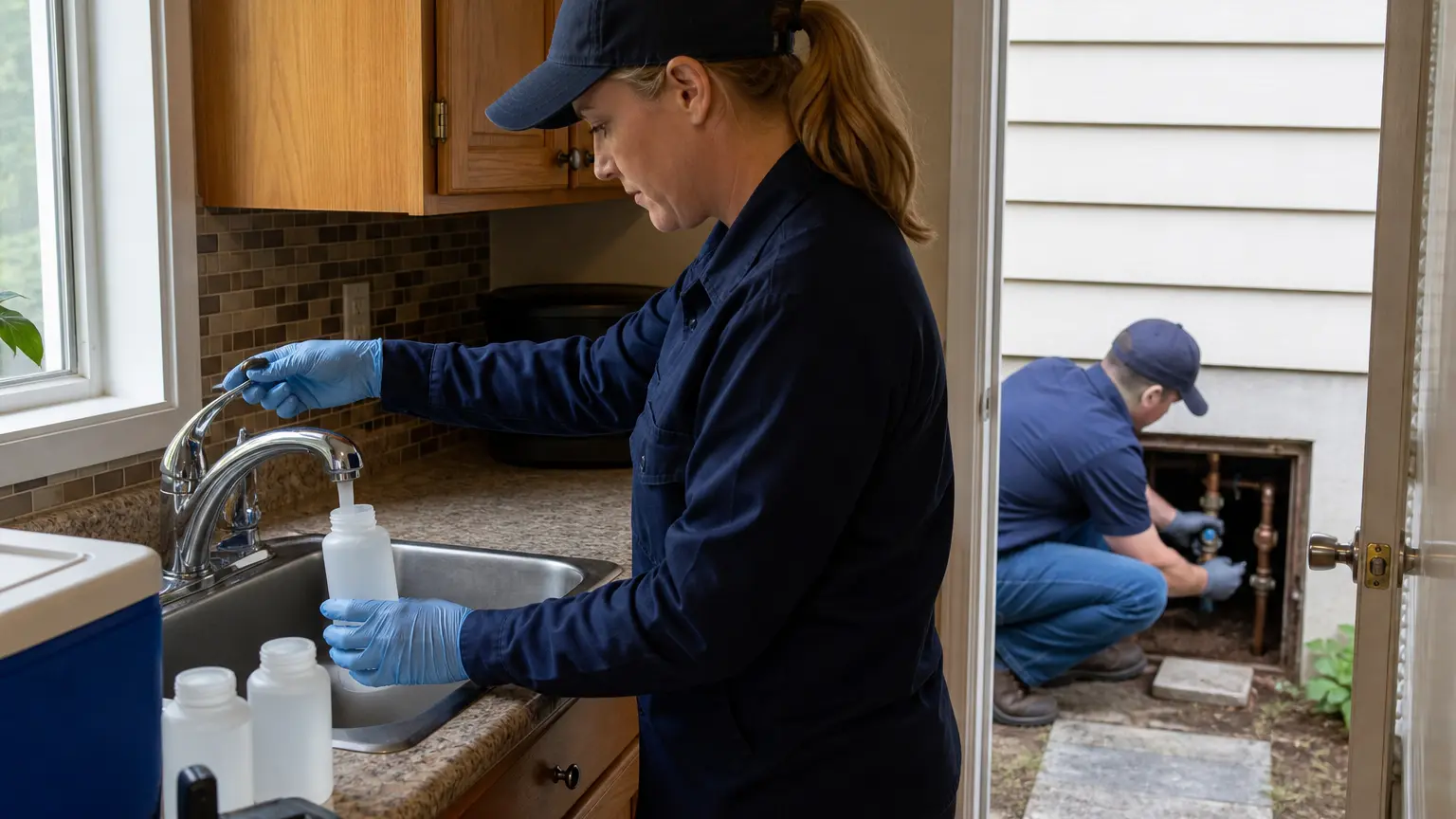
Lead in drinking water is difficult to represent with a city average. It can vary by service-line material, premise plumbing, water age, stagnation, flow, disturbance, particle release, temperature and sampling sequence. A first-draw sample may capture water sitting in indoor plumbing; later litres may better intersect a service line. A disturbed particle can create a brief extreme value that is real for the user even if the next sample is low. The Lead and Copper Rule therefore depends on a defined high-risk sample pool and protocol, not random convenience samples.
Flint did not maintain an accurate inventory of lead service lines adequate for selecting the required highest-risk homes. The OIG found that both this inventory duty and continuous corrosion control were not met. Without a reliable inventory, a nominally compliant sample can answer the wrong question. It may describe accessible volunteer homes rather than the portion of the network most likely to release lead.
Sampling instructions also affected detectability. The state task force found that MDEQ guidance included pre-flushing and small-mouthed bottles and that Flint staff used procedures not designed to maximise detection of public-health risk. Pre-flushing can remove water that stood in contact with lead-bearing materials. Slow filling and bottle geometry can influence whether particles enter the sample. The task force also found that high results were excluded without adequate investigation and that staff were pressed to obtain cleaner remaining samples.
This does not mean every official sample was fabricated or every low result was false. It means the data set was not independent of the governance incentives around it. Officials used the resulting percentile to reassure residents, while the rules used to select and collect the data made it less likely that the most hazardous conditions would be represented. Data quality in a public-water emergency includes custody of the sample pool, metadata about plumbing, discarded-result logs, protocol deviations and publication of individual values.
The contrast with resident-led sampling is instructive. Citizen sampling also had limitations: volunteers were not a probability sample, plumbing records were incomplete, and household technique could vary. Researchers disclosed those limitations and used repeat rounds and sequential samples to test recovery. Official monitoring had legal authority but weak targeting; citizen monitoring had less formal control but stronger motivation to investigate the reported hazard. Neither data set should be accepted solely because of who produced it. Their protocols and selection effects should be compared openly.
Data sovereignty in this case means more than a public spreadsheet. Residents needed access to their household result, the basis for excluding any result, the material recorded for their service line, the system's treatment settings and the uncertainty around a percentile. Regulators needed raw and quality-assured data without losing urgent signals while waiting for a perfect dataset. A durable system would preserve both: rapid provisional warnings and a versioned record suitable for enforcement and later science.
Root cause was a chain of controlled decisions
The initiating technical condition was absence of corrosion control after the source change. The deeper root cause was a governance chain that allowed a known safety function to disappear without a clear owner proving that the new configuration was safe.
First, financial receivership narrowed decision criteria. Emergency managers were appointed to restore solvency and had power that displaced ordinary local accountability. The state task force found that emergency managers often lacked relevant expertise and did not receive sufficient support for complex public-health decisions. A financial mandate did not remove their duty to seek competent treatment assurance, but it shaped the incentives and limited the channels through which elected local objections could change the decision.
Second, plant readiness was treated as a construction and permit milestone rather than an integrated safety case. Equipment could produce water meeting several plant-exit parameters while the distribution system remained chemically vulnerable. The relevant system boundary extended from source and treatment through mains, service lines and household taps. The absence of a validated corrosion plan shows that no one had to sign a complete claim that the water would remain safe at the point of use.
Third, MDEQ misinterpreted and minimally applied the Lead and Copper Rule. It advised waiting for monitoring rather than maintaining treatment and treated a percentile as proof against accumulating contrary evidence. Its regulatory culture, as described by the state task force, prioritised technical compliance and resisted external challenge. A regulator that defines the minimum as the objective can turn legal ambiguity into extended exposure.
Fourth, federal oversight assumed state primacy would work until the evidence was overwhelming. EPA technical staff identified the hazard, but the institution did not convert that knowledge into a timely order or public warning. The OIG did not find that EPA lacked all authority; it found unclear roles, weak risk processes, ineffective communication and insufficient use of oversight tools.
Fifth, health and water information remained separated. Complaints, skin symptoms, discoloured water, Legionnaires' disease, high household lead and paediatric blood results appeared in different institutions. Each signal could be disputed within its own data limitations. No cross-agency incident structure was empowered early enough to ask whether one source change could explain several deteriorating indicators.
Sixth, warnings were evaluated through institutional status rather than evidence. Residents were repeatedly reassured. Del Toral's draft was disputed. Independent researchers and clinicians had to establish credibility against agencies that controlled the official narrative. The Michigan Civil Rights Commission's investigation concluded that the crisis reflected environmental injustice and systemic racism, linking the failure to Flint's segregation, loss of political power and the diminished weight given to residents' voices.
These causes are cumulative, not competing. Old pipes created vulnerability but did not require exposure. River chemistry raised treatment demands but did not prohibit safe operation. A city employee's error did not remove state primacy. State failure did not remove federal authority. Poverty and race did not alter chemistry, but they affected who controlled the decision and whether warnings produced action. Accountability improves when each layer is assigned the decision it could actually make.
Health impact must be stated with both seriousness and limits
Lead exposure is the most firmly established population hazard. CDC describes approximately 99,000 residents as exposed during the Flint River period. That is an estimate of the population served and potentially exposed, not a count of people with a measured toxic dose or diagnosed injury. Individual dose depended on where a person lived, plumbing, water use, filters, diet, age, other lead sources and timing.
The original Hurley-led study, Elevated Blood Lead Levels in Children Associated With the Flint Drinking Water Crisis, compared tested children younger than five before and after the switch. It reported an increase in the proportion at or above 5 micrograms per decilitre from 2.4 percent to 4.9 percent citywide, with larger increases in neighbourhoods having higher water lead. The study linked geography and time in a way that supported urgent public-health action, but it did not test every child or isolate drinking water from every possible source of lead.
CDC conducted a separate analysis of children younger than six. Its MMWR investigation found that the likelihood of a tested child having a blood lead level at or above 5 micrograms per decilitre was nearly 50 percent higher after the switch, then returned toward pre-switch levels after reconnection. CDC explicitly noted limitations, including lack of household water-consumption data and inability to account for all other sources such as lead paint. The two studies use different cohorts and methods, so their statistics should not be merged into one exposure rate.
No blood lead reference value separates injured from uninjured children. The 5-microgram value used in the 2015-2016 analyses identified children with comparatively high exposure at that time; it was not a safe boundary. CDC later lowered its blood lead reference value to 3.5 micrograms per decilitre as national exposure distributions changed. A child below a reference value may still have absorbed lead, and a child above it needs source investigation and follow-up rather than a conclusion that water caused a specific future outcome.
Lead's developmental effects may emerge over years and overlap with many social and medical influences. Public evidence cannot produce a reliable count of future learning, behavioural, cardiovascular or reproductive outcomes attributable only to Flint water. That unknown is not evidence of no harm. It is a reason to fund long-term developmental, educational and medical support without forcing each family to prove a precise counterfactual life history.
The crisis also imposed behavioural-health and material burdens. CDC's 2016 Community Assessment for Public Health Emergency Response found widespread self-reported anxiety, depression and stress-related concerns, as well as barriers to care and distrust. Such a rapid household survey cannot diagnose every respondent or prove that each symptom resulted from water contamination. It does demonstrate that emergency response, bottled-water use, uncertainty and institutional betrayal became part of the health impact.
Genesee County experienced two Legionnaires' disease outbreaks during 2014 and 2015. A CDC-hosted genomic and epidemiological study, Comparison of Whole-Genome Sequences of Legionella pneumophila in Tap Water and in Clinical Strains, records 90 cases and 12 deaths and found evidence linking some environmental and clinical strains. Corroded iron, lower disinfectant residual and warmer water can support Legionella growth. The supported inference is that changed system conditions contributed to outbreak risk.
The unknown is whether Flint's distribution system caused every case or death, because health-care exposure, limited clinical isolates and incomplete environmental sampling prevent a universal attribution.
Emergency response reduced exposure but could not erase it
Reconnection on 16 October 2015 stopped use of the Flint River source, but the distribution network had undergone roughly 18 months without the former corrosion-control regime. Restoring Lake Huron water and orthophosphate began a repair process. It did not instantly remove loose leaded deposits, rebuild uniform scale or replace every lead-bearing component.
EPA's January 2016 order required a coordinated response, corrosion-control planning, system-wide sampling, public communication, certified personnel and a reliable future source and backup. Filters and bottled water provided point-of-use protection during uncertainty. EPA teams sampled homes and supervised treatment optimisation. The emergency order is important not because federal control was inherently better, but because it created explicit duties and reporting after informal intergovernmental coordination had failed.
Field evidence supported filters as a useful barrier. An EPA-authored study of more than 345 Flint locations found that more than 97 percent of filtered samples contained lead below 0.5 micrograms per litre and that the maximum filtered result was below the bottled-water standard used in the study. That finding applies to properly installed and maintained certified faucet filters within tested conditions. It does not show that every resident received, used or replaced a cartridge correctly, or that filters solved bathing, trust and infrastructure concerns.
Flushing was another interim measure. Running water can remove stagnant water and transport orthophosphate to remote plumbing, but it can also mobilise particles, and effectiveness varies with plumbing and flow. The independent multi-round study found citywide improvement alongside occasional high particulate spikes. Guidance therefore had to specify when to flush, when to use a filter, how construction changed risk and when a household should obtain individual testing.
Public response also included blood lead testing, Medicaid expansion, nutrition support, developmental services and the Flint Registry. Those programmes recognise that a water repair cannot by itself repair exposure. Their existence is evidence of institutional response, not proof that every eligible person was reached or that long-term outcomes are known. Participation, retention, service quality and the needs of residents who moved away remain relevant evidence gaps.
Congress and EPA funded infrastructure. In March 2017, EPA awarded Michigan $100 million under the Water Infrastructure Improvements for the Nation Act for Flint drinking-water upgrades. That award should not be added mechanically to every figure in the service-line settlement, because funding streams overlapped in purpose and not all grant money represented a separate pipe replacement. Financial accountability requires project-level expenditure and outcome records, not a cumulative headline assembled from announcements.
Water recovery evidence is strong, but a percentile is not a household guarantee
Independent studies tracked declining lead after reconnection, enhanced orthophosphate, flushing and service-line replacement. A peer-reviewed citywide recovery analysis used wastewater biosolids as a separate indicator of lead mass entering potable water. It found a sustained reduction associated with enhanced corrosion control and large-scale removal of lead and galvanized lines. Biosolids are not a direct measure of a person's dose, but their agreement with tap trends provides a useful independent system-level check.
Recovery was uneven. The 2018 citizen-science analysis reported a first-draw 90th percentile of 22.4 parts per billion in March 2016, 13.6 in July 2016 and 8.4 in November 2016, with occasional extreme particles even as central values improved. A separate longitudinal study of two anomalous homes found that lead deposits persisted until complete service-line removal. These cases do not establish that all homes remained unsafe for the same period. They show why system statistics must be paired with hotspot investigation.
Michigan's January 2025 monitoring release reported a 90th-percentile result of 3 parts per billion and 18 consecutive monitoring periods below lead and copper action levels since July 2016. It also stated that more than 98 percent of residential lead service lines had been replaced. These are substantial, regulator-reported indicators of improved control.
The limits need equal prominence. A 90th percentile means nine-tenths of the valid compliance results were at or below the calculated value, subject to the governing sampling protocol. It does not mean 90 percent of all addresses were tested. It does not mean the remaining ten percent were all below 15 parts per billion. It does not cover every school fixture, private interior pipe, vacant property or episodic particle. It is not a medical determination that no exposure occurred.
EPA terminated the Section 1431 emergency order on 19 May 2025. Its termination letter states that the city and state satisfactorily completed the order's terms, conditioned on the accuracy of their representations. EPA's public announcement cited optimised corrosion treatment, repeated lead compliance, a backup pipeline, staffing, procedures and 13 state-certified operators.
Ending the order is meaningful independent regulatory evidence. It is not a declaration that the historic harm is reversed, that no lead-bearing component remains or that ordinary oversight can relax. EPA expressly retained its Safe Drinking Water Act authority, and Michigan resumed primary day-to-day regulatory control. The relevant post-emergency test is whether the system can maintain chemistry, staffing, records, finance and backup capacity without extraordinary supervision.
That concern is visible in the city's continuing infrastructure plan. A 2024 City of Flint and EGLE account described a new chemical-feed building, monitoring stations, backup connection and meter upgrades, while identifying remaining reservoir, pump-station, transmission-main, staffing, procedure and technical-managerial-financial capacity work extending through 2028. These are not necessarily evidence of current contamination. They are evidence that durable public-water service depends on assets and organisational capacity beyond lead sampling.
Pipe replacement became a second accountability test
Corrosion control manages release from lead-bearing materials; full replacement removes a major source. In March 2017, the city, state and resident plaintiffs entered a court-enforceable Safe Drinking Water Act settlement. The official settlement agreement required at least 18,000 excavations, replacement of discovered lead or galvanized steel lines with copper at no cost to eligible households, outreach, filters, monitoring and health programme support. It also prohibited partial replacement in the covered work because disturbance and leaving part of a lead line can increase short-term risk.
The programme had to operate with incomplete and inaccurate historical records. Crews used excavations, predictive models and updated inventories to identify material. Property access required resident consent. Vacant or abandoned homes presented different eligibility and contact problems. Contractors had to coordinate street-side and private-side work, avoid other utilities, reconnect service, advise residents about flushing and filters, and restore yards, driveways and sidewalks.
Those constraints explain difficulty but do not erase deadlines. The court modified the agreement as the replacement-eligible list expanded and work lagged. In February 2023, the federal court's fifth enforcement order stated that Flint continued to miss deadlines and ordered work at the agreed list of 31,578 eligible homes as quickly as practicable, with a new deadline, prescribed contact attempts and auditable call logs.
In March 2024, the court issued an opinion finding civil contempt. It found that Flint had not fulfilled modified obligations involving outreach, excavation, replacement, restoration and consistent reporting. Civil contempt here was an enforcement mechanism to obtain compliance, not a criminal conviction for causing the original crisis. The opinion is nonetheless important repair evidence: an infrastructure programme can report a high completion percentage while still failing identifiable households and record duties.
By early 2025, Michigan said approximately 1,800 property restorations had been completed and more than 98 percent of residential lead lines replaced. The difference between "98 percent" and "all" is not merely rhetorical. Some owners may refuse access; some homes may be vacant; some records may remain uncertain; and premise plumbing beyond the service line can contain leaded solder or fixtures. Public reporting should separate confirmed non-lead, replaced, access refused, no response, vacant, demolished, ineligible and unknown statuses.
The programme also illustrates why an inventory is an accountability asset. Before the crisis, Flint lacked a reliable map for high-risk sampling. During remediation, the same gap increased excavation cost, delayed work and complicated proof of completion. A durable inventory needs address-level material on both sides of the curb, evidence source, inspection date, confidence level, replacement record and disclosure to the resident. Predictive models can prioritise work, but prediction should never silently become a factual material designation.
Civil redress and criminal process answered different questions
Civil litigation produced money, infrastructure duties and constitutional rulings. In November 2021, a federal court approved a $626.25 million partial settlement funded principally by Michigan, with contributions from Flint's insurer and other settling defendants. The Michigan Attorney General's approval announcement described allocations prioritising children, with smaller portions for adults, property, businesses and special education.
The settlement is not a court calculation of the total harm and does not establish that every claimant received compensation equal to loss. Eligibility, supporting records, age, exposure category, injury evidence, claim validation, fees and the number of approved claims affect distribution. Settlement also resolves claims against participating defendants under agreed releases; it is not the same as a trial finding against every actor.
Federal appellate decisions addressed constitutional accountability at the pleading and immunity stages. In Guertin v. State of Michigan, the Sixth Circuit held that allegations that officials knowingly caused residents to consume contaminated water and assured them it was safe could state a bodily-integrity claim, while analysing each official's alleged conduct separately. Such a ruling permits claims to proceed; it does not by itself prove every allegation or award damages.
Michigan's criminal prosecutions ended without a merits trial of the principal 2021 charges. The Attorney General used a one-person grand-jury process in which a judge investigated and issued indictments. In 2022, the Michigan Supreme Court's People v. Peeler decision held that the statutes authorised a judge to investigate, subpoena and issue arrest warrants, but not to issue indictments, and that accused people were entitled to the ordinary preliminary-examination process.
Lower courts dismissed the affected charges, and the state Supreme Court declined attempts to revive them. In October 2023, the prosecution team declared the Flint water prosecutions closed. The accurate conclusion is procedural and limited: the cases ended without convictions and without a trial testing the underlying evidence. It would be wrong to describe the invalid indictments as adjudicated proof of guilt. It would also be wrong to describe dismissal on charging-process grounds as a judicial finding that every official decision was sound.
Accountability is not interchangeable across these forums. An inspector general can find management weakness without criminal intent. A civil settlement can fund recovery without admissions. A constitutional case can recognise a right while leaving factual disputes for later proceedings. A criminal court requires valid charging procedure and proof beyond a reasonable doubt. Public disappointment with one forum cannot justify erasing its safeguards, but process failure can itself become an accountability failure when years of investigation produce no merits hearing.
Environmental injustice concerned control and credibility
Flint was a majority-Black, economically distressed city operating under emergency management. Those facts did not chemically corrode pipe scale. They shaped the distribution of decision power, infrastructure neglect, financial pressure and credibility. The Civil Rights Commission asked whether similar warnings would have been tolerated in a more affluent, politically influential Michigan community and concluded that systemic racism helped create the conditions in which Flint's residents were denied equal environmental protection and meaningful participation.
The state task force likewise called the crisis a clear case of environmental injustice. Its reasoning was not limited to disparate exposure. Emergency management reduced local democratic control; residents paid high water rates while losing influence over the service; complaints were discounted; and public institutions defended compliance claims after independent evidence showed danger. The people bearing the consequence did not control the choice, treatment, sampling or warning.
Trust should not be treated as a public-relations variable. Residents were told water was safe while it was visibly discoloured and while regulators had information about missing corrosion control. Later low results could not automatically reverse the rational lesson that official reassurance had been unreliable. Asking residents to trust a new percentile without exposing the sample addresses, protocol, service-line status and independent review repeats the structure of the original failure.
Repair therefore includes procedural rights. Residents need timely individual results, plain explanations of uncertainty, access to independent testing, representation in source and treatment decisions, enforceable response deadlines and a route to challenge the regulator. Community advisory bodies need information and influence before a decision is final, not a briefing after construction begins. Compensation and infrastructure cannot fully restore lost autonomy, but future control can be redesigned.
The crisis also reveals a locality problem in public data. State and federal databases recorded violations at the system level, while exposure occurred at particular taps. Household plumbing and service-line records were fragmented across cards, maps, city files and resident knowledge. A national dashboard could show compliance while a local family experienced a particle spike. Public-water assurance must connect system-level regulation to local material facts without exposing private health or identity information.
Counterfactuals show where prevention was practical
The weakest counterfactual is that old lead pipes alone made the crisis inevitable. Detroit-supplied water had served the same network with corrosion control. Old infrastructure created serious latent risk, but treatment had been managing part of that risk. The supported conclusion is that maintaining effective corrosion control would have materially reduced lead release. The public evidence cannot prove that every tap would have remained below every health-relevant value.
A stronger counterfactual begins before startup. If Flint and MDEQ had performed a representative pipe-loop and distribution study, maintained orthophosphate during transition, set water-quality parameters, validated disinfection and documented an emergency fallback, the system could have tested the source change without exposing the full population. If results did not support safe operation, the city could have extended or renegotiated finished-water supply. This would have cost money and time, but those are normal costs of changing a safety-critical utility.
Another counterfactual begins with the first microbial and corrosion signals in 2014. A cross-agency incident review could have treated repeated complaints, main corrosion, coliform events, trihalomethanes and industrial rejection as indicators that the distribution system was unstable. Those facts did not yet prove lead exposure. They justified targeted high-risk lead sampling and a corrosion assessment before another year passed.
The most evidence-grounded mid-crisis counterfactual is April to June 2015. By then EPA specialists knew there was no corrosion treatment and had extreme household lead results. MDEQ could have ordered treatment and public education. EPA could have issued a Section 1431 order or an independent treatment determination sooner. A protective warning could have recommended certified filters and blood testing while agencies resolved legal disagreement. The OIG's finding that EPA had sufficient information by June supports this counterfactual directly.
Sampling offers another practical alternative. A verified inventory, no pre-flushing, transparent inclusion rules, sequential sampling at known lead-service-line homes and automatic publication of exclusions would have made under-detection less likely. Independent duplicate samples could have separated laboratory error from household variability. The exact official 90th percentile under that design is unknown, but citizen sampling suggests it would have produced a more protective picture.
An earlier return to Detroit water was also possible in principle, but the exact timing, contract price and political feasibility are counterfactual. The April 2015 loan agreement required state approval, so city officials could not act as if reversal were solely local. Supported inference says earlier state approval would have shortened exposure. The record cannot quantify the lead dose or health outcome avoided for each day.
For remediation, replacing all lead and galvanized lines before declaring recovery would have provided stronger household assurance, but construction at tens of thousands of properties required money, contractors and consent. The responsible standard is not instant completion. It is a verified inventory, risk-based sequencing, transparent exception categories, disturbance protection and enforceable deadlines. Court intervention shows that schedule and record controls were not consistently sufficient.
Confirmed facts, supported inference and public unknowns
The confirmed facts are extensive. Flint switched to locally treated Flint River water on 25 April 2014. The plant did not maintain corrosion control. Emergency managers controlled key interim-source and plant-preparation decisions. MDEQ was the primacy regulator, approved the system and incorrectly delayed treatment. Residents complained, high household lead results emerged, EPA technical staff warned about missing treatment, and official sampling and communication were inadequate. Independent water and paediatric blood studies changed the public response. Flint returned to Detroit-supplied water in October 2015.
EPA issued an emergency order in January 2016.
It is also confirmed that tested young children had higher elevated-blood-lead prevalence during the river period, that two Legionnaires' disease outbreaks occurred, and that the response imposed substantial household, health and trust burdens. It is confirmed that orthophosphate, filters, monitoring, pipe replacement, funding and health programmes were implemented. Courts approved civil settlements and enforced service-line duties. The principal criminal prosecutions ended without convictions or a merits trial.
Later repair facts are also strong. Repeated compliance samples fell below action levels. More than 10,000 lead or galvanized lines were replaced. The city added treatment and backup infrastructure and certified staff. Michigan reported a 3-part-per-billion 90th percentile and 18 consecutive compliant monitoring periods in early 2025. EPA found its emergency-order requirements complete and terminated the order in May 2025.
Supported inference goes further but must remain labelled. Absence of orthophosphate and changed water chemistry destabilised scale and caused the system-wide increase in lead release. Earlier treatment, warnings or source reversal would probably have reduced exposure. Corrosion, iron release and reduced disinfectant residual plausibly increased conditions favourable to Legionella. Emergency management, racialised political power and institutional dismissal contributed to delayed action. Court supervision accelerated or disciplined some replacement work.
These conclusions are supported by converging evidence but do not calculate each person's dose, motive or legal liability.
Important unknowns remain. There is no complete tap-by-tap record of lead throughout 2014-2015. The full service-line inventory before the crisis did not exist. Water consumption, filter use and other lead sources are unknown for many residents. Not every child was tested, and testing was not random. Public data cannot assign a lifetime developmental outcome to a particular water dose. Nor can they identify one source for every Legionnaires' disease case or quantify all mental-health, property and business loss.
Internal decision evidence is incomplete in public. The record does not reveal every conversation, rejected alternative, legal analysis or individual motive. Institutional findings of failure do not prove that each employee knew the same facts or acted with criminal intent. The invalid grand-jury indictments cannot fill that gap because their evidence was not tried publicly.
Post-repair unknowns also matter. Public summaries do not provide continuous household-level lead results for every address, complete independent audit results for every service-line status, all pipe-loop data, every orthophosphate excursion, every operator-competency test or a fully funded lifecycle plan through asset renewal. The absence of another crisis is not equivalent to proof that governance will respond correctly to a future source or treatment change.
A durable accountability test for public water
The first test is decision authority. Every source or treatment change should name the official with final authority, technical signatories, independent reviewer and regulator. Financial approval must not be mistaken for safety approval. Minutes should record alternatives, dissent, assumptions and the evidence required before distribution.
The second test is a distribution-system safety case. The operator should model source chemistry, disinfectant demand, corrosion, scale stability, metals and microbial risks across representative pipe materials. Pipe-loop and staged field testing should precede full exposure. A regulator should approve explicit water-quality parameters and reject startup when evidence is incomplete.
The third test is continuous barrier control. Chemical-feed status, dose, pH, alkalinity, phosphate, disinfectant residual and other critical parameters should be monitored and retained on a common clock. Alarm limits, override authority and response deadlines should be tested. Stopping corrosion control should require documented senior and regulatory approval, not a passive interpretation that monitoring can come first.
The fourth test is inventory integrity. The utility should maintain address-level service-line material for public and private portions, with evidence, confidence and replacement history. Unknown must remain a visible status. Residents should be able to review and correct their record. Inventory completeness should be independently audited and tied directly to sampling and replacement priorities.
The fifth test is sampling independence. Compliance samples should target the highest-risk valid sites and preserve protocol metadata. Pre-flushing, aerator removal, bottle type, stagnation, sequence, plumbing disturbance and exclusions should be disclosed. Extreme values should trigger investigation, not automatic removal. A regulator should reproduce the percentile from public, privacy-protected data.
The sixth test is warning under uncertainty. Agencies should define when one credible high result, a pattern of complaints or a treatment-barrier failure requires provisional public advice. Protective communication can state that causation is still under investigation while recommending filters, alternative water and health testing. Waiting for a final citywide percentile can be more harmful than correcting a cautious warning later.
The seventh test is cross-domain escalation. Water-quality, infectious-disease, paediatric, emergency-management and complaint data should meet in one incident process. Named leaders should have authority to order independent sampling and escalate outside the primacy agency. A disagreement between state and federal staff should produce a documented decision deadline, not indefinite deference.
The eighth test is household protection. Certified filters, cartridges, installation checks, accessible bottled water where necessary, construction notices and post-replacement flushing should reach people with disabilities, renters, non-English speakers, disconnected accounts and absent owners. Programme counts should measure successful protection at the tap, not boxes distributed.
The ninth test is source removal. Lead and galvanized service lines should be replaced in full, on both ownership sides, with disturbance controls and property restoration. Public reporting should distinguish completed, verified non-lead, refused, inaccessible, vacant and unknown addresses. Deadlines, contractors, costs and exceptions should remain auditable after grant money ends.
The tenth test is health continuity. Blood testing, developmental screening, educational support, nutrition, behavioural-health care and registry follow-up should be funded for the time horizon of possible effects. Programme evaluation should report who was not reached and why. Compensation should not be the only route to services.
The eleventh test is independent repair assurance. Low 90th-percentile results, biosolids trends, sentinel-site data, treatment logs, external laboratory checks, service-line audits and sanitary surveys should be reconciled. Each measure answers a different question. Regulators should publish adverse findings and corrective actions as readily as milestones.
The twelfth test is institutional legitimacy. Residents need enforceable participation, access to local data and a route to challenge source, rate and treatment decisions. Emergency financial powers should include public-health expertise and independent safety review. Trust should be treated as the result of verifiable conduct, not as a message to be managed.
Flint demonstrates that safe water is not produced by a single compliant sample or a single competent operator. It is produced by a chain of technical, legal, financial and democratic controls that continue from source selection to the household tap. In 2014, that chain allowed corrosion control to disappear and warnings to be discounted. From 2015 onward, residents, scientists, courts and emergency regulators forced the system to build evidence in the opposite direction.
The repair record is real: a safer source, enhanced treatment, lower lead results, thousands of replaced lines, improved infrastructure, civil redress and termination of the federal order. The missing evidence is also real: complete historic exposure, individual lifetime effects, universal household verification, the merits of failed criminal cases and proof that ordinary institutions will challenge themselves next time. Public-water accountability requires both statements to remain true at once.
A city is not made whole by declaring the emergency over; it is made safer when no official can again remove a critical barrier, shape the sample and dismiss the people at the tap without leaving an immediate, reviewable record.