
Summary
- FirstLight says an unnamed major hyperscaler selected a 240-route-mile, high-fibre-count connection between Albany and the Boston metropolitan area.
- The announcement identifies one corridor and calls it diverse and reliable, but publishes no second physical route, shared-risk boundaries or service configuration.
- The agreement is therefore evidence of buyer demand and regional infrastructure relevance, not yet evidence of independently survivable capacity.
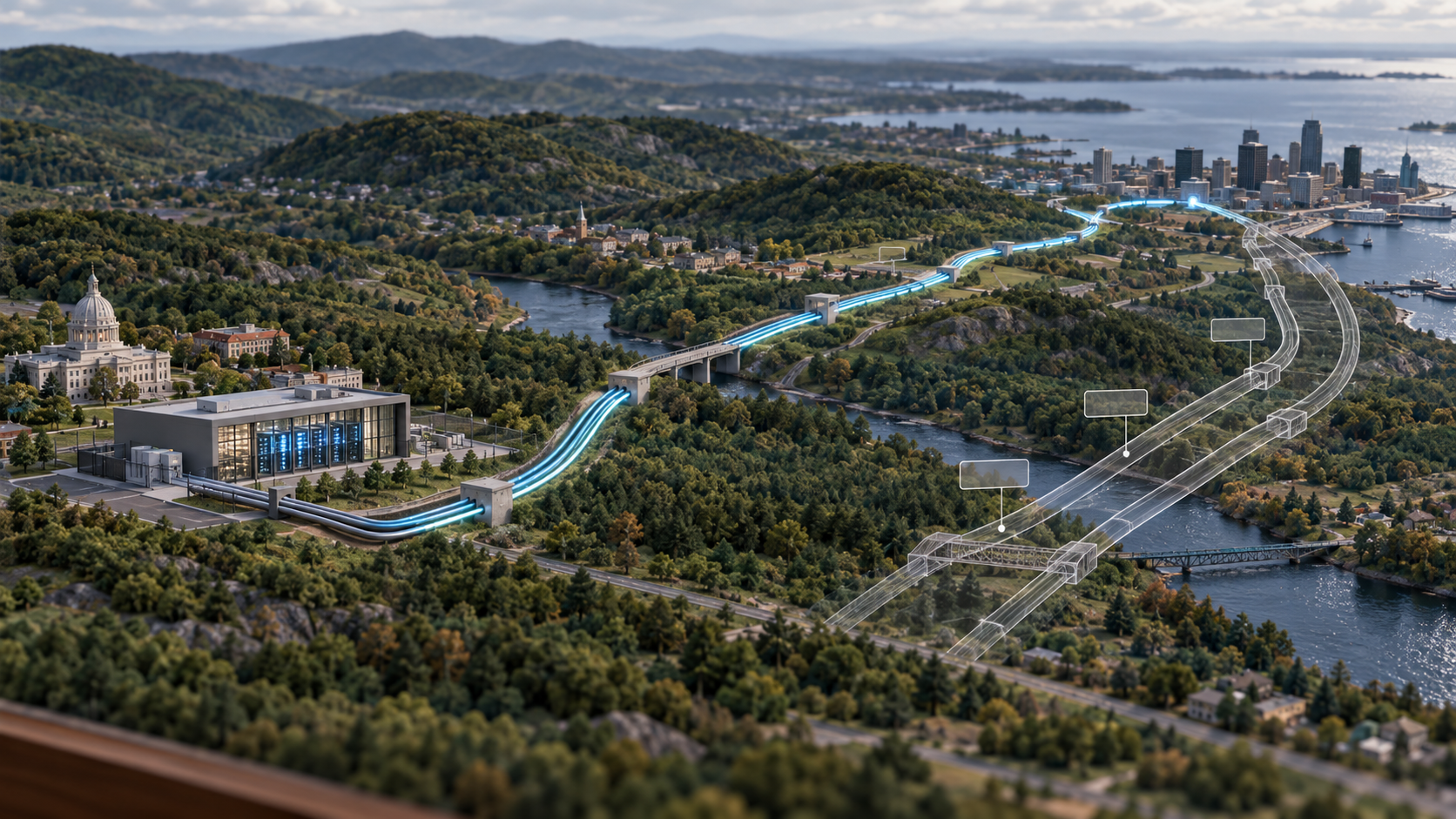
On 17 September, FirstLight announced an agreement to provide an unnamed major hyperscaler with a high-fibre-count connection spanning 240 route miles between Albany and metropolitan Boston. The operator says the corridor will deliver low-latency, reliable and diverse connectivity, with Albany serving as a primary regeneration and colocation point. Those details matter: they tie a large digital-infrastructure customer to a defined regional axis rather than to a general expansion claim.
The distinction between a route and a resilient service is the central issue. FirstLight’s published Boston–Albany route sheet depicts a path through Nashua, Brattleboro and Bennington and describes it as geographically diverse from traditional alternatives. That can make the corridor commercially useful, particularly for buyers seeking a path outside the most common New York–Boston alignment. Yet a route that differs from competitors’ customary paths is not automatically one half of a protected, failure-independent pair.
The public announcement names only one 240-mile route. It does not show a second path, identify where two paths separate and rejoin, or disclose whether they share bridges, ducts, rights of way, fibre bundles, regeneration sites, power systems or building entrances. These are not semantic details. The Metro Ethernet Forum defines a shared-risk link group as links that depend on a common resource whose failure can affect them all. The IETF’s optical-network analysis similarly notes that apparently separate links may share a cable, conduit, right of way, ring, office or power supply.
Diversity is a property of the failure model and the physical implementation, not of the adjective attached to a sales announcement.
Capacity is also unspecified. “High fibre count” can describe the cable or allocation without revealing how many strands the customer receives, whether they are lit or dark, which wavelengths or line rates are committed, or how much capacity is initially usable. FirstLight’s general wavelength material advertises services up to 800 Gbps and offers single, unprotected or diversely routed configurations. Its Boston–Albany sheet lists 100–400 Gbps lit waves and dark fibre, subject to availability. Neither document states what this customer bought. Generic product capabilities cannot be imported into a specific contract.
Nor does the release say whether the 240 miles are newly built, newly equipped, reserved on existing plant, or assembled from a mixture. The phrase “builds on FirstLight’s established route” points to an existing corridor, but does not reveal where construction is required, who pays for it, or which permits and facilities govern readiness. The operator’s earlier Pennsylvania hyperscaler announcement said that a separate 280-mile network had been completed and provisioned in two months. That precedent shows FirstLight can disclose delivery status when it chooses; it does not establish the status of the Albany–Boston agreement.
Commercial and operational evidence remains equally thin. No contract value, term, revenue-recognition schedule, minimum commitment, acceptance milestone, ready-for-service date or service-level agreement is public. Albany’s role as a primary regeneration and colocation point makes that facility part of the disclosed operating surface, but the release does not identify the other regeneration dependencies or the customer’s hand-off sites. A signed agreement may support future revenue. It is not the same as accepted service, billable capacity or cash received.
The defensible conclusion is narrower than the promotional language and more useful than scepticism for its own sake. A major hyperscaler has selected FirstLight for a long regional corridor, validating demand along an inland Albany–Boston axis and the value of regional fibre outside the largest national backbones. What remains unproved is whether the purchased service delivers physical path diversity, how much capacity it contains, when it becomes operational and how strongly it changes FirstLight’s economics.
Sources
- FirstLight agreement announcement, 17 September 2026
- FirstLight Boston–Albany route sheet
- FirstLight wavelength services sheet
- FirstLight Albany data-centre sheet
- FirstLight’s separate 280-mile Pennsylvania hyperscaler announcement
- MEF 2, Requirements and Framework for Ethernet Service Protection
- IETF RFC 4054, Impairments and Other Constraints on Optical Layer Routing
Member Briefing
Deeper Profile Context
Sign in with the right membership level to unlock the full briefing and source notes.
Only for Strategic Circle
Strategic Circle
Open to all readers. Unlock profile briefings after joining and signing in.
Join Strategic CircleOnly for Leadership Alliance
Leadership Alliance
For qualified IP-asset owners and management; sign in to unlock alliance briefings.
Join Leadership Alliance