
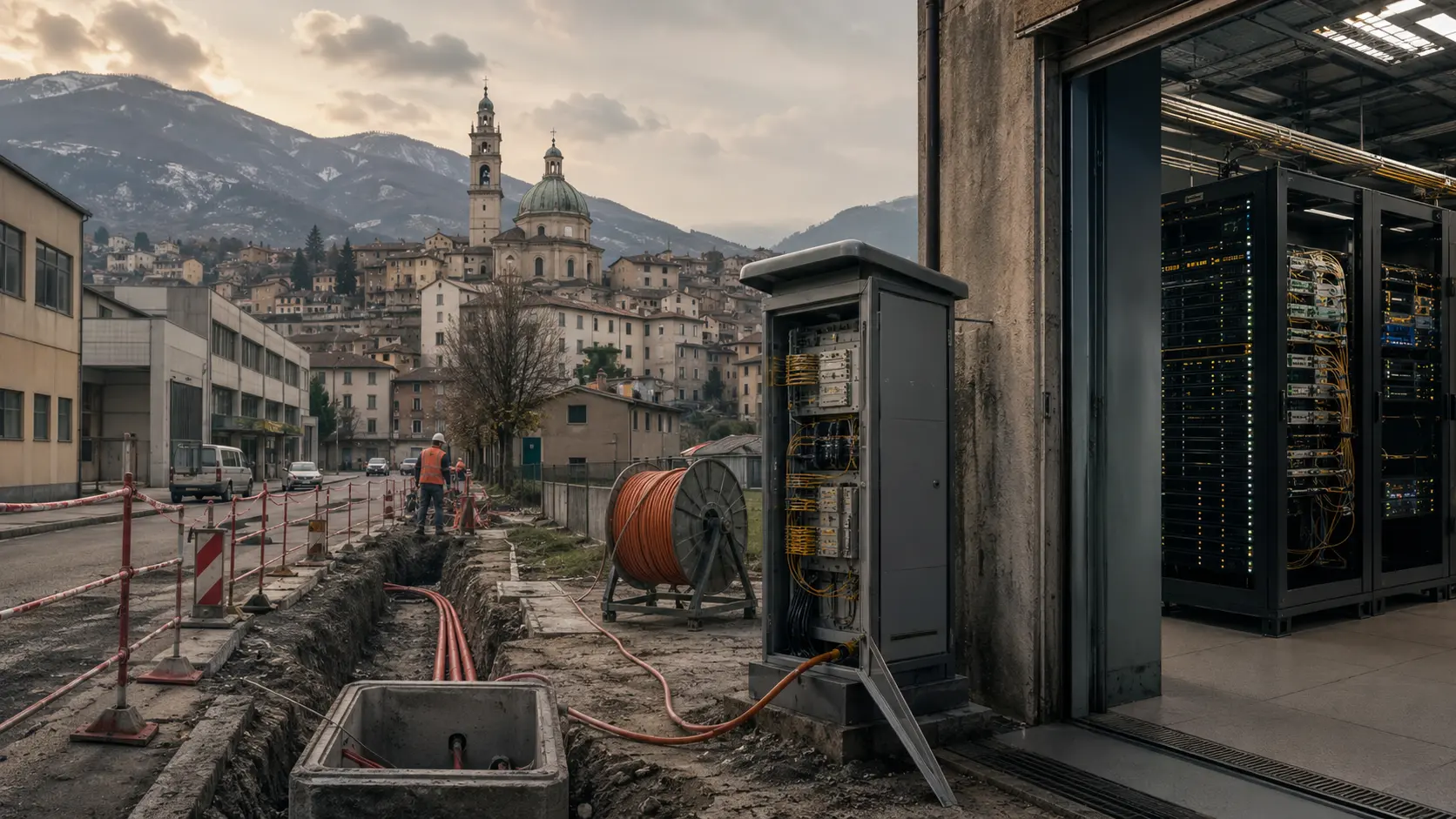
Summary
- What it says: FibreConnect S.p.A. is not just another fibre builder in Italy. The company is attempting to address the shortage of high-capacity business connectivity in industrial and artisanal districts, leveraging capex density and a regional partner distribution model.
- Main topic: Regional ISP economics; Wholesale access economics
- Context: Infrastructure / Company research / Italy
The market divide thesis FibreConnect S.p.A. looks, at first glance, like just another fibre builder in a country already crowded with telecom brands, public broadband plans, legacy operators and two giant wholesale platforms. That reading is too superficial.
The economically more useful interpretation is narrower and harder: FibreConnect is a specialised attempt to solve a very specific Italian market failure – the under-provision of high-capacity business connectivity in industrial and artisanal districts that fall outside the logic of national deployment plans, but sit in the real economy where small manufacturers, logistics firms, workshops, wholesalers and municipalities still need low-latency, reliable, scalable access to cloud, security, machine telemetry and external markets. Its business is not ‘fibre in Italy’ in the abstract.
Its business is monetising bundled professional demand in places that national coverage maps often describe poorly and where national operators often serve incompletely.
That is why the company is strategically more interesting than its size suggests. Italy's public broadband strategy has long recognised that certain ‘sub-areas’ such as industrial zones need demand aggregation and tailored interventions rather than simple household-coverage logic. Infratel's strategy documents explicitly described industrial zones as a case where demand could be aggregated in circumscribed areas to reach critical mass.
At the same time, the current policy architecture remains heavily shaped by white-area, grey-area and building-passed metrics, including the ‘Piano Italia 1 Giga’'s focus on locations with no network able to deliver 300 Mbps or more reliably. That framework is necessary, but it does not guarantee that a mid-sized factory in an industrial estate outside a secondary city gets the right kind of broadband, on the right commercial terms, through the right sales channel, with service levels suited to business operations.
This is where FibreConnect's model starts making economic sense. It is essentially a capex-density arbitrage and a channel arbitrage. The capex-density bet is that industrial estates can be denser, more cohesive and more economically valuable than the surrounding municipal territory, so civil works and backhaul can be justified even where a generic consumer rollout would look marginal. The channel arbitrage is that the company does not try to become the national household brand.
Instead, it leans on local and regional internet service providers, plus selected national and B2B partners, to sell into their own territories and customer relationships. In short, it tries to buy infrastructure economies centrally and sell trust locally. Its own ‘How we operate’ language emphasises the role of ‘FibreConnect-powered’ ISPs, and by early 2024 it said it had already onboarded more than fifty providers, with a target of around eighty; by the end of 2025 it indicated it had signed 87 ISP agreements.
The strategic value, therefore, is not that FibreConnect becomes the third Italian fixed-network titan. The strategic value is that it could become a profitable filler of the gaps left vacant by the large-scale planning logic of Open Fiber, FiberCop and state-aid programmes. That has real economic value if, and only if, three conditions hold: first, its industrial zones truly are commercially underserved rather than merely unmapped; second, it can sustain low customer-acquisition costs through its partner model; and third, its funding remains patient enough to tolerate slow, district-by-district infrastructure ramp-up.
Public information suggests the first two conditions are plausible and the third is the real hinge. But the same public information also shows why caution is warranted: FibreConnect's visible public routing footprint is smaller than its self-description implies, its public data leaves major gaps on unit economics, and its presentation as a ‘wholesale only’ operator is not as clean as the slogan suggests.
Who FibreConnect really is The identity question matters because this company is easy to misread. FibreConnect S.p.A. is an Italian telecom infrastructure operator headquartered in Rome, with VAT number 16449641006. Its official public pages describe it as a business created to digitise Italy's industrial and artisanal areas, and say that telecom veterans partnered with Azimut Libera Impresa in 2022 to establish it.
Yet the competition authority's file is slightly different and more precise: in the Italian Competition Authority's April 2025 decision on Marguerite's investment, FibreConnect is described as having been founded in 2021, with a business focused on developing, building and managing fibre-optic networks mainly serving Italian industrial and artisanal areas. The discrepancy is not fatal, but it serves as a reminder that even the company's basic timeline is not entirely clear in public information.
Ownership is easier to pin down. In February 2025, Marguerite agreed to invest alongside Azimut's infrastructure fund, resulting in a 45% stake for Marguerite and 55% for Azimut's IPC fund. The antitrust filing shows the deal structure more clearly: Azimut Libera Impresa wholly owns FibreConnect Italian Holding, which in turn held 97.3% of FibreConnect at the time of the review, while founders and related vehicles retained small stakes and governance rights. The same filing also states that FibreConnect generated Italian turnover in the €5–10 million range in 2023.
That is modest revenue for a national infrastructure story, but not absurd for a company early in deployment. It also tells you what FibreConnect still is: a mid-stage infrastructure-backed project, not a mature national network utility.
The management story reinforces that reading. In May 2026, FibreConnect announced a senior-management reshuffle, naming Fulvio Siotto as CEO, Luca Scano as Chairman and Giovanni Mercante as CFO, while explicitly stating the company was entering a new plan to widen its customer base and deliver more tailored commercial solutions. That is what companies say when the first pure-build phase gives way to the harder monetisation phase. It suggests a business trying to move from ‘the network exists’ to ‘the network earns’.
The company's category itself is also more ambiguous than its marketing implies. Official press releases consistently call FibreConnect a ‘wholesale only’ operator, and that is how Open Fiber describes it in the July 2024 partnership announcement. The competition authority also defines its main market as wholesale fixed-network access and says it offers wholesale connectivity services on its own high-performance fibre-optic network as well as additional connectivity services on third-party networks, also on a wholesale basis. But official public information also contains signs of a broader reality.
FibreConnect's transparency page publicly lists ‘Business Connect Internet’ FTTC and FTTH profiles; its certification page states the company provides high-speed telecommunications services ‘on both a wholesale and direct basis’; and the Italian Ministry of Enterprises and Made in Italy lists FibreConnect in June 2025 as holding both an ISP authorisation and a fixed-telephony resale authorisation, with application dates in January 2025. This does not mean the wholesale story is false. It means the clearest formulation is that FibreConnect is wholesale-focused, not purely a pure wholesale operator.
That distinction has economic implications. A pure wholesale operator can stay lean on sales, support and product complexity. A wholesale-focused operator that also accumulates direct-service authorisations, consumer-type business products and third-party network resale capabilities carries more flexibility, but also faces margin dilution, channel conflict and operational drift. Public evidence suggests FibreConnect is trying to keep its wholesale positioning while reserving some flexibility. Strategically, that is sensible. Analytically, it means investors and competitors should not take the ‘wholesale only’ phrase too literally.
Another clue comes from Internet numbering registries. FibreConnect appears in the RIPE database as an Italian LIR, ORG-FS383-RIPE, with an address at Via Antonio Salandra 18 in Rome, and its autonomous system AS213462 was assigned on 6 February 2025. That is strikingly late relative to the company's operational narrative, because FibreConnect had already announced live services, partnership agreements and a national backbone before that date.
The plausible inference is that the company's transition to a more directly visible public-network operator lagged behind its commercial launch, which is normal for a company that may initially lean more on upstream providers, partner infrastructure or managed-backbone arrangements than on a mature, externally visible peering posture.
The gap it tries to price within Italy's fibre economy The Italian fixed-network market is large, but the part that interests FibreConnect is not the national average. AGCOM's Communications Observatory 2026, using data updated to December 2025, shows a fixed market where FTTH continues to grow strongly, reaching 7.01 million lines, but FTTC remains even larger at 8.32 million lines; total business broadband and ultra-broadband lines stood at around 3.005 million. This is not a market where fibre has failed.
It is a market in transition, where the median media narrative of national progress co-exists with a substantial stock of mixed, copper-terminated or otherwise second-choice business connectivity.
The enterprise demand side is similar. ISTAT's 2024 ‘Imprese e ICT’ publication reported that 88.8% of enterprises with at least 10 employees used a fixed broadband connection of at least 30 Mbps in 2024, but only 18.1% had fixed connectivity of at least 1 Gbps; in the South and Islands, the share of enterprises that considered their fixed connection speed sufficient for their needs was below the national average. This provides a useful corrective to simplistic coverage talk. Availability above 30 Mbps is one thing. The distribution of genuinely high-capacity, enterprise-suitable bandwidth is another.
For industrial zones seeking to implement cloud ERP, machine data links, camera backhaul, cybersecurity services or AI-based production optimisation, the step from ‘good-enough basic broadband’ to ‘truly scalable fibre’ is economically material.
The macro-digital backdrop also helps explain why this niche exists. Eurostat's 2026 digitalisation publication indicated that 71% of EU SMEs had at least a basic level of digital intensity in 2025, still well below the 2030 target. Italy's country reports and ISTAT releases consistently show a mixed picture: some progress, but slow diffusion of advanced digital tools across an SME-dominated economy. In other words, Italy does not merely need consumer broadband success stories.
It needs a way to connect mid-tier industrial demand with higher-level digital capability, especially outside the handful of metropolitan cores where fibre operators naturally start.
This is precisely where the industrial-zone problem becomes more interesting than the white-area problem. Documents on Italy's broadband strategy have long recognised that industrial zones and similar clusters are special cases. Infratel's strategy summary explicitly envisaged a fourth intervention model based on demand aggregation for 100 Mbps connectivity in circumscribed sub-areas such as industrial zones, where critical mass can be reached. That is almost a textbook description of what FibreConnect later presented as a private-sector-based infrastructure logic. The problem is not that Rome failed to understand the issue.
It is that the issue sits awkwardly between public plans and private incentives. Industrial districts can be too commercially fragmented for national consumer rollouts, yet too economically valuable to ignore.
FibreConnect's founder rhetoric leans heavily on this. In early 2024, Renzo Ravaglia told CorCom that Italy had around one million businesses in over 10,000 industrial and artisanal areas and that many still could not access speeds above 15 Mbps. By June 2024, the same publication quoted the company as saying there were more than 14,000 industrial, artisanal and commercial agglomerations in Italy, characterised by lower density than inhabited centres. These company numbers must be treated as advocacy, not neutral statistics.
But the economic intuition is sound: business precincts are often dense enough to matter, yet too patchy and too permit-dependent to be solved cleanly by national averaging.
The other half of the gap is qualitative rather than geographical. Open Fiber and FiberCop are huge by comparison, but both optimise for broad national architectures. Open Fiber was created to build a very-high-speed network across Italy and describes itself as Europe's largest wholesale-only FTTH operator. FiberCop claims to run Italy's most extensive digital network infrastructure, with nearly 28 million kilometres of fibre laid, coverage reaching more than 96% of active lines and 14.3 million units covered by end-2025, while participating in the PNRR-linked ‘Italia 1 Giga’ programme. These are nation-scale systems.
FibreConnect's niche only persists if those systems leave behind not literal white areas, but commercially hard areas: industrial zones where coverage exists in theory but not in professional quality, or where a local ISP can monetise the demand faster than a giant platform can.
That is why the July 2024 partnership between Open Fiber and FibreConnect is so revealing. Open Fiber's own announcement said the two wholesale operators were interconnecting their respective networks to broaden coverage, optimise investments and accelerate network development, explicitly noting that FibreConnect's customers could reach Open Fiber coverage outside industrial zones and Open Fiber's customers could access FibreConnect coverage inside them. This is not the language of two identical models. It is the language of complementarities driven by segmentation. FibreConnect is not trying to beat Open Fiber everywhere.
It is trying to be important where Open Fiber's generic map alone does not close the business case.
Network evidence and what it actually proves Based on raw public-network evidence, FibreConnect is real enough. It is not vapour. But the public evidence proves a narrower version of the story than the marketing would like.
Deployment evidence is strongest where it comes from operational milestones, permits and partner announcements. In early 2024, FibreConnect told CorCom that during 2023 it had made fibre available to 35,056 businesses in 67 industrial and artisanal zones and had activated a long-distance network of around 4,000 kilometres connecting 20 PoPs and the main national Internet exchanges. By June 2024 it said it had covered over 40,000 businesses in 85 zones.
By March 2025, in the China Mobile deal announcement, it stated it had reached over 56,000 businesses in 126 zones and had activated a backbone of around 4,000 km connecting 20 PoPs and the main national IXPs. By May 2026, in the management-change announcement, it said connectivity was available to over 60,000 businesses and that it had around 10,000 active customers across fibre and FWA services. These are company numbers, so they should be treated sceptically. But they are at least internally consistent: the number of districts, the number of businesses covered and the number of distribution channels all move in the same direction.
The backbone story receives credible third-party support. EXA Infrastructure announced in March 2023 that FibreConnect had selected EXA to build its backbone across Italy to connect major industrial sites and data centres, and FibreConnect's own version of that release said the company had identified a lack of fibre connectivity in the business market and had chosen EXA to build a strategic backbone between Rome and Milan.
Later partner announcements add texture: Acantho said in 2025 it was implementing four backhauling links with FibreConnect across Emilia-Romagna and Veneto for a total extension of 1,737 km; Retelit's 2025 announcement described the contribution of its regional fibre infrastructure for district-level cabling; and Open Fiber's 2024 statement described direct interconnection between the two networks. The economic meaning is clear: FibreConnect does not need to own every kilometre to own the economics. It can lease, interconnect and federate. But that same flexibility also weakens the purity of ownership as a competitive moat.
Civil-engineering records make deployment tangible. Italian public bulletins show FibreConnect obtaining real permits: the August 2023 Marche regional bulletin records a dig authorisation along and across the Corridonia Maceratese road for new fibre-optic infrastructure, requested by FibreConnect; the December 2023 Veneto bulletin records a watercourse concession for two crossings of the Retrone river with fibre cables in the municipalities of Creazzo and Vicenza, explicitly naming FibreConnect. These entries are mundane, but economically they are gold. They prove that the company's activity is not just marketing or bandwidth resale.
It includes the slow, unglamorous, permit-intensive work of physically inserting itself into local rights-of-way. That is one of the scarce assets of this model.
The authorisations trail points the same way, while complicating the ‘wholesale only’ mantra. Italy's public list of licensed communication companies, updated June 2025, shows FibreConnect with ISP status applied for on 27 January 2025 and fixed-telephony resale status applied for on 29 January 2025. These look like administrative formalities for a company that is broadening, or at least formalising, its service authorisations.
Paired with the company's public technical transparency documents for FTTC and FTTH business offers, this suggests a business more comfortable with multiple layers of access and go-to-market than the slogan might imply.
Internet resource evidence is just as telling, but here the more interesting point is the inconsistency. PeeringDB lists FibreConnect as AS213462, operational, with a presence in Rome, Milan and Carini facilities, including Cornelia, EXA Edge DC Milan, MIX DC Caldera, the Namex data centre and Open Hub Med. It also announces 100–200 Gbps of traffic, 100 IPv4 prefixes and 50 IPv6 prefixes. Public routing observatories are much more limited.
BGP.tools currently shows one issued IPv4 block, 62.50.140.0/22, no visible IPv6 issuance, two upstream providers and 42 peers; Hurricane Electric's BGP view shows two issued prefixes, no IPv6, 56 observed peers and one visible exchange, MIX-IT. Both show a valid, active, routed AS, but not an AS whose public table footprint matches PeeringDB's more expansive self-description.
There are several possible explanations for this mismatch. PeeringDB may simply be stale or aspirational; some address space may not yet be widely visible; internal transport and customer services may sit behind partner ASNs; or FibreConnect may have built more of a service and interconnection fabric than a highly externalised public BGP footprint. The economically important point is that the public routing evidence supports the existence of an active network operator with real peering, but not yet a public Internet footprint proportional to a large national brand or full backbone.
That is consistent with a wholesale operator specialised in building, and inconsistent with visions of imminent nationwide telco scale.
Technical architecture documents add another layer to the capex story. FibreConnect's public architecture slides state that it uses GPON as its preferred solution in industrial and artisanal areas because it optimises infrastructure utilisation, reduces digging and lowers environmental impact; the access network is fully passive, based on FTTH/B, with both point-to-multipoint and point-to-point elements, and uses single-level 1:16 splitting. This is important because it tells you the company is not chasing the most heroic technical architecture in every case. It is chasing the architecture that makes district economics viable.
GPON, passive distribution and a multi-tree topology are choices made to balance performance against civil-engineering cost and fault isolation. That is the kind of design you would expect from a company trying to make medium-density industrial zones financeable.
There is also weak but useful market chatter. On the FibraClick forum, a user at the end of 2024 described activating a GetBy FTTH product on FibreConnect's network in a zone where the offer was said to be aimed mainly at business or VAT-numbered customers; the same thread indicates that installers were using Open Fiber IRUs, which is not public evidence but is plausible. In another thread, a FibreConnect representative confirmed that an address in a disputed area was covered by FibreConnect and marketable through ISP partners, while specifying that FibreConnect's offerings were designed for business needs.
None of this is hard evidence of standard architecture. It is anecdotal. But it is commercially revealing because it suggests three things: first, the network can spill over the strict ‘business-only’ boundaries at the edges; second, address census and marketability can be messy in areas where multiple infrastructures overlap; and third, FibreConnect's practical operating model may include leased or interfaced use of third-party fibre more often than the simple story implies.
Finally, there are organisational signals that the company is becoming more operationally mature. FibreConnect's career pages have advertised NOC operator, HSE specialist and accounting roles; the Barco customer story in June 2026 says FibreConnect had recently set up a new Network Operations Centre in Rome to monitor the health and performance of its newly built networks, especially a new Rome–Milan backbone. These are not the artefacts of a slideware company. They are the artefacts of a builder trying to operate what it has built.
The economics of the model The cleanest way to think about FibreConnect is as a business that sells concentrated optionality. It spends capital where enterprise density is high enough to support premium broadband, but low enough that national players do not prioritise the zone. It then monetises the asset through a partner-driven distribution model that makes every metre of fibre earn through multiple retail brands. Economically, that can be attractive. But the model only works if capex density and penetration rate align better than they do in generic suburban FTTH.
Start with rough capital intensity. The EIB's project page for FibreConnect's Italian FTTH deployment shows a total project cost of around €104 million, with €50 million financed by the EIB, for a project initially described as running from 2023 to 2025. If we use FibreConnect's own availability numbers as very rough outputs for that phase, the implied capital intensity is not absurd. Using 40,000 businesses covered in June 2024 gives a gross €2,600 per business covered; using 56,000 in March 2025 gives about €1,850; using 60,000 available in late 2025 gives about €1,730. These are not audited ‘cost per location covered’ figures.
They are inferences, and imperfect ones, because the EIB figure covers a project period rather than a net output unit, and because later availability may include evolution beyond the initial assessment snapshot. Nonetheless, the order of magnitude is useful: FibreConnect does not need mass-market urban economics, but it needs industrial-cluster economics that are markedly better than rural state-aid economics and markedly more valuable than baseline consumer broadband.
The same inference can be framed per zone. Dividing €104 million by 85 industrial zones yields about €1.2 million per covered zone; dividing by 126 zones drops that to about €0.8 million. Again, this is just a heuristic. Yet for industrial districts with tens or hundreds of businesses, that kind of capital envelope looks economically plausible if the company is able to exploit shared civil works, passive optical architecture, pre-existing duct where possible, and backhaul partnerships rather than full ownership of every segment.
The architecture document's emphasis on GPON, passive splitters and topologies that reduce digging fits this reading.
The channel model is the second economic lever. FibreConnect's partner ecosystem is not decorative. It is the sales engine that makes the infrastructure earn. Public announcements cite Tiscali/Tessellis, Retelit, Acantho, Neomedia, TecnoGeneral, Zal, Estracom, GetBy, AlenaNet and, later, China Mobile International Italy. In concrete terms, this means FibreConnect does not carry the full burden of local prospecting, installation trust, support culture and SME relationship management.
Regional players already know which business parks are worth marketing, which municipalities are easy to deal with and which firms are most likely to switch from low-end copper or radio links to premium fibre. Economically, that lowers customer-acquisition cost and raises the chance that a newly lit district begins monetising before capital turns stale.
That is why ‘anchor tenants’ in the classic sense are almost absent from public information. There is no widely documented list of large single factories underwriting each industrial zone. Instead, the visible anchors are distribution anchors: ISPs and B2B service partners who agree to sell on the network, or contribute backhaul and service overlays around it.
The Tiscali deal in 2023 was pitched as a progressive extension across several regions; the Retelit deal in 2025 used Retelit's regional fibre presence; the Acantho deal in 2025 focused on 57 industrial zones and bundled HERABIT services; the Open Fiber deal in 2024 extended reciprocal reach; the China Mobile deal in 2025 opened a cross-border value proposition to Asia-facing businesses. In other words, FibreConnect anchors demand upstream in channels and service ecosystems rather than downstream in named end-users. That keeps concentration at the partner level rather than the tenant level.
The margin model flows from that structure. FibreConnect can capture three kinds of benefit. First, physical network economies: shared civil works, clustered business locations and passive architecture. Second, wholesale multiplexing: multiple partners can sell over the same district fibre. Third, service contiguity: by enabling higher-value B2B services around connectivity, partners can justify better pricing than basic broadband. Retelit's language around Industry 5.0, IoT, AI, cybersecurity and personalised customer service is exactly what you expect when fibre is used to support more than just a low-ARPU bare access line.
The Acantho deal also bundled HERABIT services. Later, the Comeser acquisition and China Mobile deal indicate a wider stack of managed and international connectivity services.
There are, however, several clear ways the economics can go wrong. The first is take-up. FibreConnect's late-2025 statement of around 10,000 active customers against availability of over 60,000 businesses implies a very rough active-to-available ratio of about 17%, if the wording is taken literally. That is not bad for a ramping district fibre deployment, especially since the active-customer figure includes both fibre and FWA services and is therefore not a pure FTTH penetration figure.
But it is also not enough to know whether mature districts are economically solid while immature ones lag, or whether sales conversion is merely average everywhere. The company does not publish cohort-by-zone penetration, payback periods, churn rate or ARPU. Without those, it is impossible to know whether the first 10,000 active customers are the easiest ones or the evidence of scalable demand.
The second risk is ownership quality. The AGCM indicates that FibreConnect not only designs and builds its own high-capacity networks but also provides connectivity services over third-party networks on a wholesale basis. The Open Fiber partnership explicitly expands its addressable reach through interconnection; forum discussion suggests practical use of Open Fiber IRUs; Acantho and Retelit clearly contribute infrastructure in some regional cases. This is rational and probably necessary. But economically, it means you need to separate two moats: the moat of owned district fibre and the moat of a smart orchestrator of others' infrastructure.
The first is harder to replicate and more capital-intensive. The second scales faster but may be more exposed to margin compression and competitive imitation. Public information does not tell us the split.
The third risk is strategic drift. FibreConnect's architecture document explicitly says the access network can connect both businesses and residential units within industrial and artisanal areas; the technical pages list FTTC products alongside FTTH; the company's 2026 statement counts FWA services among active customers. Commercially, this is understandable. In tough districts, a company may need to use whatever access layer it can to close a sale. But every step outside a clean wholesale-fibre thesis makes the economics messier.
It raises product complexity, service-assurance burden and the risk of becoming a mid-scale operator doing several things mediocrely rather than one thing very well.
The counterweight to these risks is the funding. Here FibreConnect has been unusually fortunate for a company of its size. The EIB project page states that its financing helps diversify the borrower's capital structure, reduces interest expenses and allows a greater share of revenue to be directed to deployment. CorCom's June 2024 coverage reported the company's comments that debt is used specifically to support capex investment and that the company focuses on zones where market demand exists rather than on state-aid-style yield structures. In 2025, Marguerite joined Azimut as a second institutional shareholder.
This is what ‘debt patience’ means in practice: not cheap capital for its own sake, but a capital structure that does not demand the company behave like a retail ISP chasing instantaneous monthly volume. The company can tolerate district-by-district accumulation, provided investors remain convinced those districts will mature into stable cash flows.
Dependencies, competitors and the state context that can erode the moat FibreConnect's real dependencies are not mysterious. They are in plain sight.
The first dependency is local permit. The economics of industrial fibre rest on the mundane but decisive ability to get rights-of-way, watercourse crossings, street-opening permits and municipal cooperation fast enough that capital does not get trapped in planning. The Veneto and Marche bulletins show this reality directly. So do local stories such as Monte Urano, where a town-targeted article pitched the FibreConnect partnership as wiring the whole industrial area at no cost to the municipality. The local state, in this model, is not just a regulator. It is part of the cost structure.
Fast permitting effectively lowers capex; delay destroys IRR even where nominal demand exists.
The second dependency is partner demand. FibreConnect's channel strategy is powerful precisely because it does not want to become the single national retail interface. But that means the company depends on regional and sectoral sellers continuing to see value in its footprint. If the best local ISPs get bought by larger groups, if they decide to use Open Fiber/FiberCop access instead, or if national brands improve their SME offer in those zones, FibreConnect's most valuable non-physical asset erodes quickly. The partner list is therefore a strength, but also a concentration risk of a kind.
The third dependency is access to third-party infrastructure. The March 2023 EXA release makes clear that FibreConnect selected EXA to build its backbone across Italy; Open Fiber later formalised network complementarity; Acantho and Retelit each contributed regional fibre facilities under partnership structures. This is capital-light, but it means that parts of FibreConnect's service promise sit on contracts rather than fully owned physical bottlenecks. Contractual bottlenecks remain bottlenecks. They are just less absolute.
The competition can erode the moat from several directions.
At the top are the national platforms. Open Fiber remains the archetypal wholesale fibre operator in Italy, majority-owned by CDP Equity with Macquarie holding the remainder, and says it was built to cover the entire national territory with very-high-speed FTTH. FiberCop is even more extensive in practical network reach, claiming to cover over 96% of active lines and having invested €2.7 billion in 2025 alone. In May 2026, the EIB announced a €1 billion deal with FiberCop to extend FTTH coverage to an additional 5.8 million households in underserved areas, with the network operating on an open-access wholesale basis.
These are not niche players. They are giant infrastructure machines, increasingly entangled with the state.
The state context makes the competitive map even less static. Reuters reported in 2025 that Italy was considering handing part of Open Fiber's delayed PNRR obligations to FiberCop in order to meet EU-backed deployment targets, and that Rome was also interested in a broader network rationalisation. By June 2026, Reuters further reported that TIM had filed a complaint over FiberCop's tariff changes after AGCOM reclassified FiberCop as a wholesale-only operator with greater freedom under an ‘equitable and reasonable’ standard. These are not minor matters.
They imply that the national wholesale architecture is still being reshaped politically and regulatorily. For FibreConnect, this creates both danger and opportunity. The danger is obvious: the more coherent and aggressive the large wholesale systems become, the smaller the remaining niche becomes. The opportunity is subtler: turbulence in the large systems can create openings where small, fast-moving specialists win zones that the large players still treat as rounding errors.
There is also a category of competitors below the giants: local and regional operators who already know their territories and may decide to build or upgrade themselves. In some cases FibreConnect has chosen to ally with them, which is astute. In others, the partner could become a rival, especially if district fibre becomes more provably monetisable after the early testing years.
Indeed, the later purchase of Comeser shows FibreConnect moving down a layer in the stack by integrating a regional operator into the group and, through Comeser's own marketing, pushing further into managed professional services such as VoIP, cybersecurity, fleet tracking and professional-grade customisation. This strengthens local control, but also reveals where the industry may be heading: consolidation around regional B2B specialists rather than a clean permanent split between infrastructure host and service vendor.
The most underestimated competitive threat, however, is simple map erosion. FibreConnect's own plan has shifted over time: from reaching 250,000 SMEs and 700–1,000 zones by 2027 in early 2024, to 200,000 business customers in five years in some 2024 regional newspapers, to a more commercial focus by 2026. Meanwhile, public programmes and the large operators continue to advance. Even where national operators do not fully solve the business problem, they can improve it enough to compress FibreConnect's pricing power. A district does not need to be perfectly served to be less attractive to a specialist entrant.
It only needs to be served well enough that the residual performance gap no longer justifies the extra civil works.
That is why the Open Fiber partnership is so economically important. It is not just a growth deal. It is also a tacit admission that duplicate fibre can be irrational in many of these zones. FibreConnect's June 2026 press-review article even quotes its leadership as saying the answer is ‘more synergy, not parallel networks’. That is strategically honest. It also means the best long-term version of FibreConnect may be not a standalone overbuilder, but a specialised industrial-park layer within a more interoperable wholesale ecosystem.
In that future, its scarce assets are the selection discipline, the local channels and the operational district-by-district know-how – and not monopolistic ownership of every last fibre route.
Evidence register Source name URL Source type What it supports What it does not prove Why it matters economically FibreConnect official ‘Who we are’ pagehttps://www.fibreconnect.it/en/who-we-are/Company website Company mission, Rome identity, 2022 launch, partnership with Azimut, industrial and artisanal zone focus Audited finances, penetration, ownership chain mechanics Establishes the stated strategy and how management wants the market to perceive the company AGCOM Provvedimento n. 31522https://www.agcm.it/dotcmsCustom/getDominoAttach?urlStr=192.168.14.10%3A8080%2F41256297003874BD%2F0%2F9E265841A9ADEDD3C1258C7A003B45D8%2F%24File%2Fp31522.pdfCompetition authority filing Ownership structure, Marguerite/Azimut governance, 2023 revenue range, foundation year reference, wholesale market framing, use of third-party networks Profitability, debt terms, customer concentration Best quasi-official public view of the firm as an economic entity rather than as a press release EIB FONOI project pagehttps://www.eib.org/en/projects/all/20230507Public lender project record €50 million EIB financing, total project cost of €104 million, open-access wholesale objective, project scope, additionality justification Whether total cost remained unchanged after appraisal, actual realised returns Key anchor for capex-density inference and for the ‘debt patience’ argument AGCOM Osservatorio sulle comunicazioni n. 1/2026https://www.agcom.it/pubblicazioni/osservatori/osservatorio-sulle-comunicazioni-n-1-2026Telecoms regulator report National fixed-access mix, FTTH/FTTC evolution, business-line totals, market transition context FibreConnect-specific performance Provides the market denominator against which FibreConnect's niche must be measured Infratel / Italian ultra-broadband strategy documentshttps://www.infratelitalia.it/sites/infratel.mise.gov.it/files/Strategia%20BUL%20sintesi%20operativa%20Piano%20strategico.pdfGovernment strategy document Explicit recognition that industrial zones may need demand aggregation in circumscribed areas Whether FibreConnect is the chosen or the only solution Shows the company is tackling a problem the Italian state itself has long recognised Open Fiber–FibreConnect partnership press releasehttps://openfiber.it/media/comunicati-stampa/fibreconnect-e-open-fiber-insieme-per-la-transizione-digitale-delle-imprese-italiane/Operator press release Complementary coverage, interconnection logic, non-duplication rationale, industrial-zone specialisation Contract economics, revenue sharing, depth of dependence Demonstrates how FibreConnect fits alongside, not simply against, a large wholesale platform MIMIT public list of authorised communication companieshttps://www.mimit.gov.it/images/stories/documenti/allegati/Albo_259_10_06_2025_da_pubblicare_.pdfMinistry register ISP and fixed-telephony resale authorisations held by FibreConnect in 2025 Actual retail revenue size or strategic weight Important evidence that the company's authorisations go beyond a narrow passive wholesale label RIPE database / RIPE member registrationhttps://apps.db.ripe.net/db-web-ui/query?searchtext=ORG-FS383-RIPEInternet registry FibreConnect as an Italian LIR, organisation details, ASN/public resource identity Traffic volume, customer numbers, ownership of physical routes Confirms the company's emergence as a directly visible network operator in the public Internet resource system PeeringDB AS213462https://www.peeringdb.com/net/39077Network self-description / industry database Facilities in Rome, Milan and Carini, traffic band claim, self-stated scope Whether all stated data are current or externally visible Useful for locating commercial peering posture and strategic facilities, notably Open Hub Med BGP.tools / Hurricane Electric BGP viewshttps://bgp.tools/as/213462andhttps://bgp.he.net/AS213462Routing observability tools Publicly visible prefixes, peers, upstream providers, MIX presence, RPKI validity Internal/private traffic, all customer routes, commercial-contract value Critical reality check on how much of FibreConnect's network is visible from the public routing edge EXA Infrastructure March 2023 press releasehttps://exainfra.net/media-centre/press-releases/exa-infrastructure-powers-high-speed-connectvity-across-italy-in-partnership-with-fibreconnect/Backbone partner press release Rome–Milan backbone construction, data centre connectivity, dependence on third-party backbone Exact contract duration, pricing, exclusivity Shows that the company's national expansion began with leased/partnered backbone muscle, not just local access builds Veneto and Marche public bulletinshttps://bur.regione.veneto.it/BurvServices/pubblica/stampapdfburv.aspx?date=29%2F12%2F2023&num=171Sandhttps://bur.regione.marche.it/bur/PDF/2023/N77%20del%2028%20agosto%202023.pdfRegional public records Real civil works, watercourse crossings, dig permits, geographical spread of deployment Commercial success after the permit, time to profitability Proves that FibreConnect's footprint involves actual infrastructure deployment, subject to permits Retelit / Acantho partner announcementshttps://www.retelit.it/it/stampa/comunicati-stampa/2025/fibra-ottica-intesa-tra-retelit-e-fibreconnect-per-favorire-la-digitalizzazione-delle-aziende-nelle-aree-industriali-dell-emilia-romagnaandhttps://www.gruppohera.it/-/acantho-e-fibreconnect-per-la-digitalizzazione-delle-impresePartner pages Regional backhaul contribution, service overlay, named industrial zones, B2B use cases FibreConnect's overall economics or exclusivity Demonstrates that the company's channel and infrastructure model is federated rather than fully vertically integrated FibraClick forum threadshttps://forum.fibra.click/d/61590-esperienza-ftth-2500500-con-getby-su-rete-fibreconnectandhttps://forum.fibra.click/d/60443-la-mia-via-e-coperta-dalla-fibra-ftth-openfiber-ma-non-e-attivabileInformal market chatter Marketability troubles, business-facing positioning, anecdotal use of Open Fiber IRUs, residential spillover at the margin Standard operating architecture, representative customer experience Useful precisely because it reveals the friction, ambiguity and overlap that polished corporate material omits
What would change the picture The business case for FibreConnect improves markedly if three hidden variables turn out stronger than public information suggests: mature-zone penetration rate, share of owned infrastructure, and durability of channels.
The most important missing number is cohort-by-industrial-zone penetration rate. If mature zones convert well above the roughly 10,000-out-of-60,000 ratio implied by the company's 2025 statements, then the model can work as a disciplined infrastructure annuity with attractive incremental returns. If, instead, coverage runs far ahead of monetisation and the best districts are already largely harvested, the company is more a coverage accumulator than a cash-generating asset. Public information does not settle that.
The second missing number is the split between owned access, leased backbone, third-party wholesale reach and resale traffic. A specialist industrial-zone operator can be very valuable with a limited public BGP footprint if it really owns the last-mile bottlenecks in the right districts. It is far less defensible if much of its economics come from orchestrating others' infrastructure on terms that large operators could replicate or undercut. The evidence available today points both ways: real permits and civil works on one side, visible partnership and third-party network language on the other.
The third missing fact is whether the partner layer is durable or transitional. If the 87 ISP agreements announced for end-2025 generate stable local ecosystems that national giants still cannot serve efficiently, then FibreConnect's channel moat is real. If those deals are mostly opportunistic and can migrate to Open Fiber, FiberCop or another wholesale substrate as addressability improves, then FibreConnect's specificity is narrower than its expansion rhetoric suggests.
In plain terms, the facts that would most change the view are not new coverage claims or another partnership release. They are harder numbers: connection rates in mature districts, net churn, average revenue per active business line, capex per connected business rather than per covered business, debt tenor and headroom against covenants after the EIB line, and a map that separates owned from interfaced infrastructure. If those numbers are strong, FibreConnect is a clever industrial connectivity utility in embryo. If they are weak, it is a well-marketed middleman living in the temporary seams of Italy's much larger fibre rebuild.