
Topic
Software Lifecycle and Lock-in
Within the Topic facet, Software Lifecycle and Lock-in topic intelligence connects articles that share a specific subject, signal focus, or monitoring theme. The page gives readers a richer path through related reporting, source evidence, market actors, and infrastructure implications, with enough context to understand why the topic matters across company movements, governance decisions, regional exposure, and operational risk. Readers can compare recurring signals, affected organisations, public evidence, market context, service continuity, procurement, competition, compliance, and strategic planning questions behind the subject instead of stopping at a thin list of matching articles. It explains what the topic covers, which infrastructure actors or policies are involved, what evidence supports the coverage, and why the subject may matter for operators, customers, investors, and policy readers.

History
The mailbox had been deleted. One client could still read it: RFC 2180
In 1997, IMAP documented an awkward but useful truth: two clients could be attached to the same mailbox and temporarily inhabit different operational realities. Interoperability did not require every server to erase that difference in the same way. It required clients to survive…

History
A Fast Bus Was Not an Ethernet: RFC 2143’s Missing Peer
The attraction was obvious in 1997: put nearby workstations on a fast SCSI cable and carry IP between them. The hard part was not fitting an IPv4 datagram into a command. It was making a peripheral bus accept an unsolicited message from another host—and finding a neighbor when…

Academics
Nancy Leveson and the Accident With No Broken Part
A system can do exactly what its components were built to do and still put people in danger. Nancy Leveson's work asks who was meant to keep that system within safe bounds, what they knew when they acted, and which feedback failed to correct a mistaken picture of the world.

IETF
Composite ML-KEM for CMS Cleared the IESG — Its Operational Dependency Chain Did Not
The IETF’s 18 September 2026 approval of `draft-ietf-lamps-cms-composite-kem-03` is an important standards milestone, but it is not the end of the delivery chain. The CMS companion is now in the RFC Editor queue while its normative Composite ML-KEM/X.509 dependency remains under…

History
The Connection Closed. Its Measurements Stayed: RFC 2140 and TCP's Host-Pair Memory
A short TCP exchange can finish before it has learned much about the route it used. In 1997, Joe Touch asked why the next exchange between the same hosts should have to forget everything the first had observed. The answer was not to preserve the entire connection. It was to…

IETF
Two “Not Ready” Reviews Put ACTN’s Packet–Optical Control Boundary on Trial
The IETF’s packet–optical ACTN draft has reached Last Call with an extensive map of controller interactions. Security and operations reviewers now ask what the map cannot settle: who trusts a topology update, and what survives when only one layer completes a change.

History
The Command Stayed ASCII. The Reader Needed More Than Bytes: RFC 2130
A mail server's command and the explanation a person reads after it fails can travel in the same conversation. The 1996 IAB character-set workshop insisted they were not the same design problem. Its report, RFC 2130, treated international text as a chain of explicit choices, not…

History
Mary Shaw and the Protocol Between the Boxes
In 1994, Mary Shaw argued that software design had become fluent about the boxes and strangely inarticulate about the lines. Calling one procedure from another was useful machinery, but it was too small a language for the flows, events, shared representations, synchronization and…

IETF
JPEG XS Approval Does Not Prove a Working Upgrade
The IESG has approved the third-edition JPEG XS RTP revision, but a standards decision is only the first checkpoint. RFC publication, IANA registration, endpoint capability, SDP agreement, decoded samples and production enablement still require separate evidence.

History
One Call Became Many Interfaces. Several Channels Became One Call: RFC 2127
RFC 2127 made an ISDN connection legible by separating its physical access, signaling, bearer channels and upper protocol into distinct managed interfaces. That clarity came with a warning still useful today: a topology row, a call counter, a channel allocation and a service…

IETF
RFC 10040 Deprecates LCAF Type 5. Experimental Is Not a Migration Plan
RFC 10040 gives LISP a new Geo-Location encoding and marks the older Geo-Coordinates type deprecated. The publication is real, but it does not collapse document maturity, registry state, implementation support, interoperability, migration and responsible location-data use into…

History
RFC 2169: An HTTP Route Is Not a Resource Authority
In 1997, RFC 2169 made an intentionally modest proposal: use ordinary HTTP requests to ask a resolver about a URN. Its value was not that HTTP could settle identity. It was that a familiar transport could carry a narrowly defined question while leaving authority, access and…

CASE FILE
RFC 9647 and the Missing Evidence Chain Between Babel State and Network Behaviour
A Babel route row can report that a path is selected while the operational proof behind that selection remains incomplete: the YANG datastore may show intent, the interface may appear enabled, the neighbour may exist, and the route may be marked feasible, yet the chain from…

IETF
WebAuthn’s 2026 Rejoin Handoff: The Governance Receipt Behind a New Participation Cycle
The Web Authentication Working Group’s 11 September 2026 recharter begins a new institutional phase for WebAuthn. The central challenge is not simply continuing technical discussion; it is preserving a reliable record of how an approved charter becomes active participation and…
History
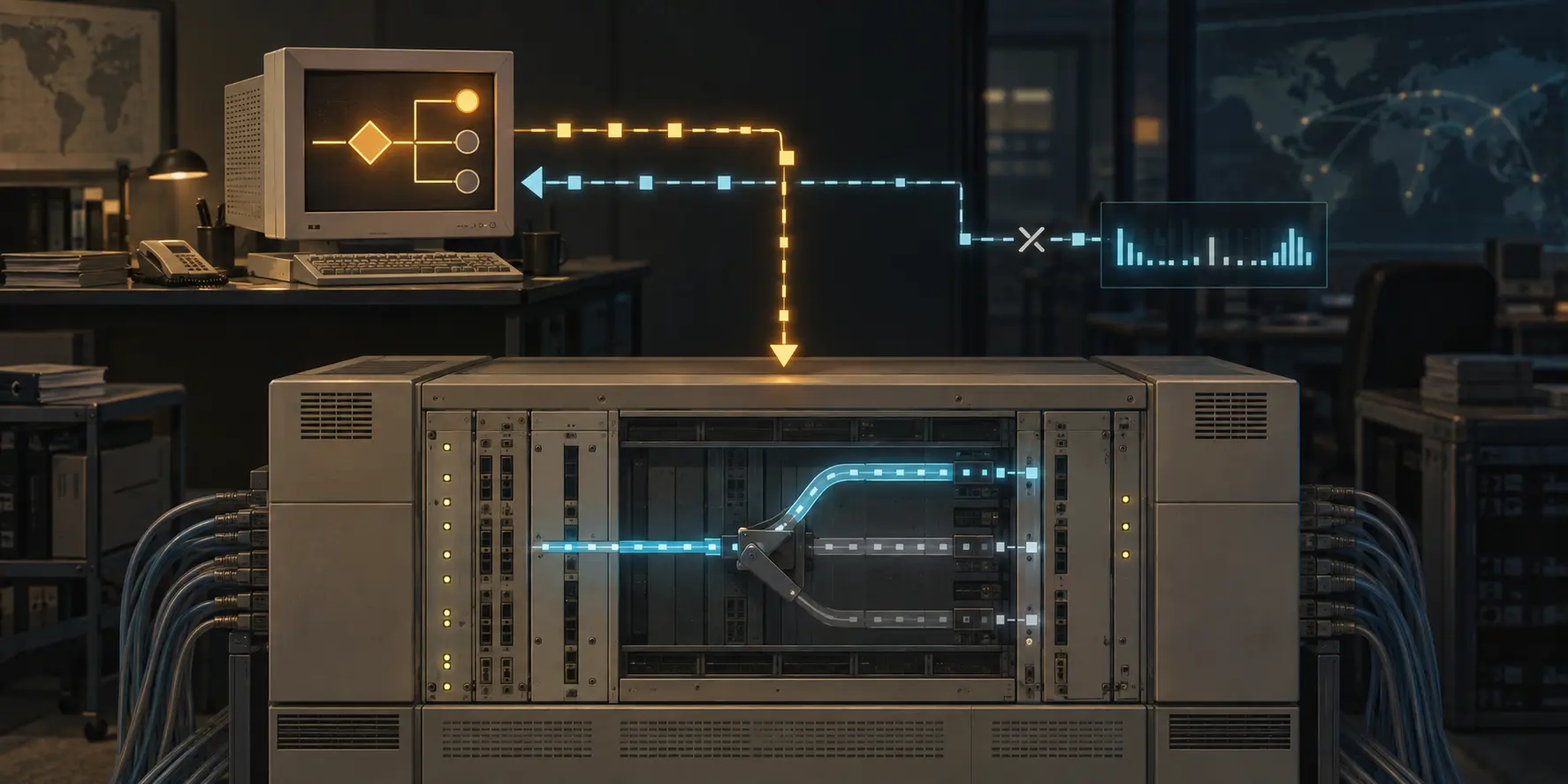
The Verdict Left the FAS. The Switch Still Had to Make It Real
RFC 2124 put connection policy in an external service, but it never made the service’s answer identical to the connection that followed. Its message chain preserved a more useful truth: a decision, an execution and an accounting record are different events.

History
RFC 2123: A Flow Record Was a Rule-Set Projection, Not the Wire
NeTraMet did not preserve traffic as such. Before a packet could become a flow row, a downloaded rule set decided which protocol mattered, which attributes survived, which direction counted as source, and how much detail the meter could afford. RFC 2123 made that editorial…

History
The Link Opened a Session, Not an Object: RFC 2122’s VEMMI Boundary
A `vemmi` hyperlink looked like an address, but its destination was not a file waiting to be fetched. RFC 2122 used the Web as a dispatch surface for a different system: a local client would open a continuing multimedia session, negotiate service and identity, and later decide…

History
Sophie Wilson and the Receipt That Arrived with ARM1 Silicon
When ARM1 returned from fabrication on 26 April 1985, the board was already waiting and much of its software had already run—on models and simulators. The chip's immediate boot was not a miracle of a naturally flawless RISC design. It was the visible receipt for months of…

History
The Root Was a Coordination Shortcut, Not a World Directory: RFC 2120
X.500 drew a clean Directory Information Tree, but its root carried an awkward human obligation. Every administrator of a first-level Directory System Agent was expected to coordinate with every other one through bilateral agreements or private arrangements outside the standard.…

History
The Reset Was in the Next Packet: RFC 2118’s MPPC Recovery
RFC 2118 gave Microsoft Point-to-Point Compression a continuous memory and a deliberately spare recovery signal. When packet loss broke that shared history, the receiver asked for a reset—but it was the sender’s next `FLUSHED` data packet, not a separate Reset-Ack, that…