
Topic
Software Lifecycle and Lock-in
Within the Topic facet, Software Lifecycle and Lock-in topic intelligence connects articles that share a specific subject, signal focus, or monitoring theme. The page gives readers a richer path through related reporting, source evidence, market actors, and infrastructure implications, with enough context to understand why the topic matters across company movements, governance decisions, regional exposure, and operational risk. Readers can compare recurring signals, affected organisations, public evidence, market context, service continuity, procurement, competition, compliance, and strategic planning questions behind the subject instead of stopping at a thin list of matching articles. It explains what the topic covers, which infrastructure actors or policies are involved, what evidence supports the coverage, and why the subject may matter for operators, customers, investors, and policy readers.

History
They Shared a System. They Did Not Merge Authority: RFC 3113
In June 2001, the Internet and the emerging third-generation mobile system needed one another. RFC 3113 made cooperation possible by drawing a line that mattered: information could cross the boundary, but approval authority stayed where it began.

IETF
The Prefix Was Registered. The Interpreter Was Still Local.
One readable literal enters two production gates. The first interpreter recognizes its prefix and constructs a value. The second recognizes the same name but refuses to run the extension because the operator never allowed it. Nothing in the source file changed. The disagreement…

History
The Registry and the RFC Disagreed. Running Code Chose the Registry: RFC 3115
In 2001, a standards-track RFC and the IANA registry assigned different numbers to the same Mobile IP extensions. The replacement RFC settled the conflict with an unusually direct fact: implementations were already using the registry values.

IETF
The String Was Exact. The Authority Was Still Local
A service can now hand a customer a precise DNS change instead of a paragraph of instructions. That removes one class of ambiguity. It does not tell the DNS operator who authored the request, whether the customer may alter the named zone, whether local policy should accept the…

IETF
The AS2 Names Matched. The Signer Was Still a Local Decision
A certificate rollover can leave every visible signal green—TLS connected, names reflected, signature valid, MIC matched—while one decisive fact remains outside the protocol transcript: who authorized this key to speak for this partner, in this direction, now?

IETF
One Packet per Second Is Not Idle
PowerBench revision 03 turns a tiny traffic trace into a large warning for buyers of network equipment: a watt figure cannot be compared until the useful work, device state, configuration, meter and time window have been made part of the same result.

CASE FILE
The Draft Had Eight Numbers. The Registry Still Had None
On 1 October 2026, an OpenPGP implementer could place two official-looking documents side by side and receive two different answers. Revision 05 of a working-group draft called eight composite algorithms 37 through 44. The live IANA registry still called the entire range from 37…

IETF
The Debug Header Named Every Step. It Could Not Prove Any of Them Happened
A new DKIM2 draft gives interoperability testers a common forensic trail inside the message. Its precision is useful precisely because its authority is deliberately zero.

History
The Policy Server Pushed the Rules. A Reconnect Had to Reconcile What the Device Kept: RFC 3084
RFC 3084 tried to make policy provisioning a disciplined conversation between a server and a network device. Its most revealing work began after delivery: a transaction needed a receipt, a failure needed rollback, and a broken connection left two machines that could remember…

History
The Cable Link Encrypted Traffic. Its Management Plane Could Still Disable Privacy: RFC 3083
RFC 3083 turned DOCSIS Baseline Privacy into something operators could inspect, tune and reset through SNMP. That visibility helped diagnosis and incident response, but it created a second security boundary: the interface that observed encryption state could also change…

CASE FILE
The SID Selected the Lane. It Did Not Prove the Capacity Was There
A new Segment Routing identifier can tell every router which resource partition a packet is meant to use. The difficult part begins after that lookup succeeds: proving that the promised bandwidth, buffers and queues were actually committed at every hop, remained bound to the same…

History
One Connection Was Not One Conversation: RFC 3080
A BEEP connection could be healthy while no application conversation had yet been agreed. RFC 3080 began with channel zero, a deliberately thin management plane that advertised profiles and negotiated new channels. Only an accepted profile gave an application channel meaning.…

History
The Master Key Never Encrypted a Packet: RFC 3079
RFC 3079 called one value a master key, then forbade it from touching traffic. Its job was to feed two role-aware branches, which in turn produced transient send and receive keys for separate cipher contexts. That hierarchy made a quiet point about interoperability: deriving…

CASE FILE
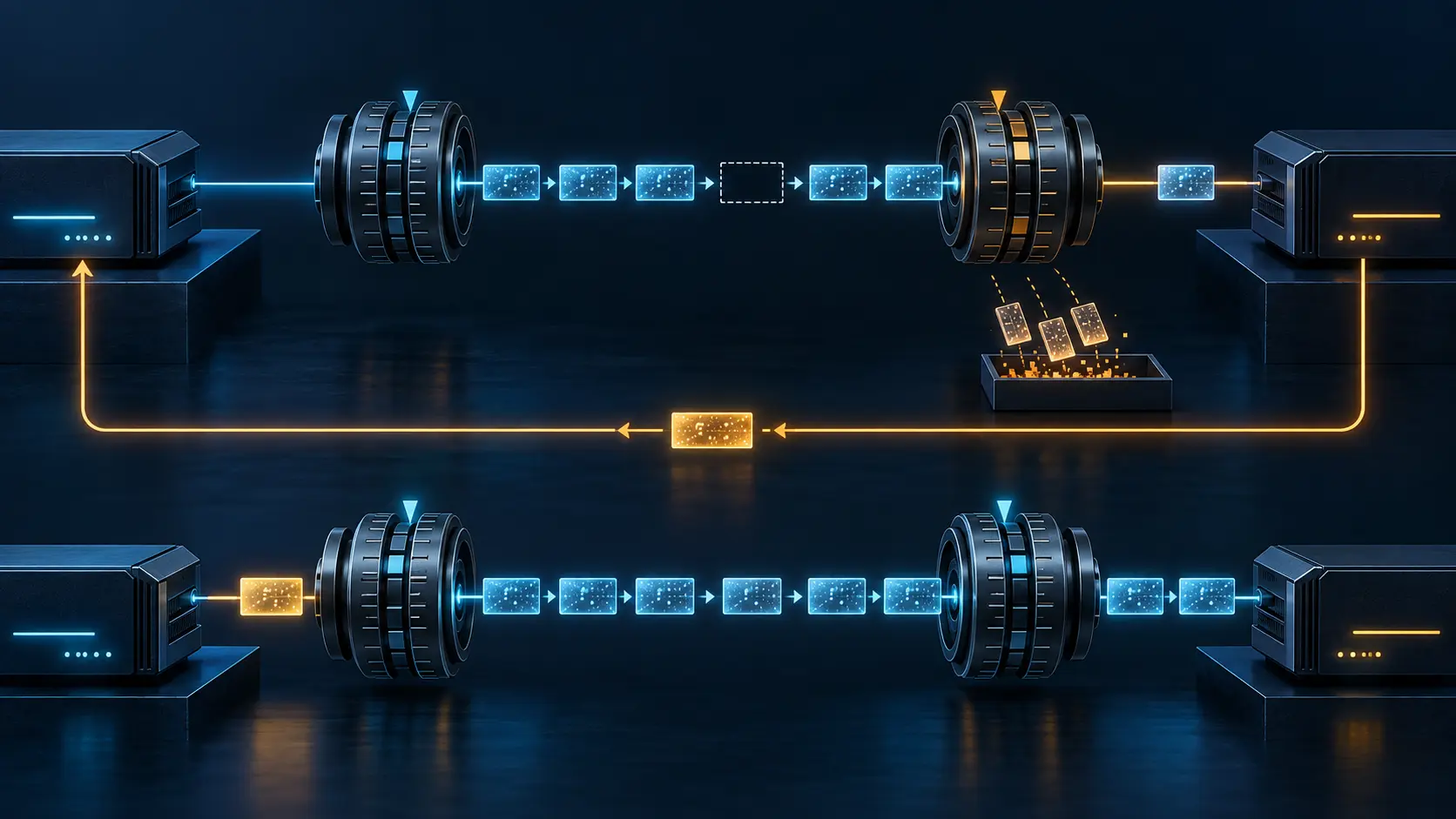
The Report Was Signed Before the Code Ran
An authenticated status report can be perfectly honest and still stop one step before the fact a governor wants. SUIT revision 22 names that boundary `invoke-pending`: the processor is about to hand control to code, but no one yet knows what the code will do.
History
The Counter Detected the Lost Packet. It Could Not Decrypt the Next One: RFC 3078
RFC 3078 placed a twelve-bit counter beside encrypted PPP traffic so a receiver could notice when the stream had jumped. In stateful mode, that knowledge arrived with an uncomfortable consequence: the packet that exposed the gap still had to be thrown away. Recovery needed a…

IETF
The Configuration Succeeded. Its Trace Began Again
A device can accept a management change after rejecting the identifier meant to follow that change across the control stack. Two current IETF drafts make that split explicit—and force operators to decide how they will prove an action whose observability chain starts halfway…

History
The Bytes Became Canonical Only After the Parser Had Already Changed the Document: RFC 3076
Canonical XML promised a stable byte stream, not a time machine. Before RFC 3076 could sort a single attribute, an XML processor had already normalized line endings, expanded entities, replaced CDATA and built an XPath node-set. The resulting octets could be repeated exactly.…

History
The Hash Chose Which DHCP Server Could Answer. It Could Not Promise Service
RFC 3074 turned a configured share into 256 buckets and a repeatable answer to one narrow question: which server was eligible to respond? The map did not measure work or prove a lease arrived.

History
The MIME Name Was Public. The Font Specification Still Lived at the Vendor: RFC 3073
RFC 3073 gave Portable Font Resource files a public MIME name. It did not make that name a substitute for the complete specification, a compatible decoder or evidence that a recipient rendered the intended glyphs.

History
The Parser Could Skip the Chunk. It Could Not Know What It Meant: RFC 3072
RFC 3072 made an unfamiliar SDXF chunk traversable by giving it a boundary a reader could locate. But reaching the next chunk is not the same as understanding what was skipped—or knowing whether an application can safely ignore it.