
Topic
Registry Governance
Within the Topic facet, Registry Governance topic intelligence connects articles that share a specific subject, signal focus, or monitoring theme. The page gives readers a richer path through related reporting, source evidence, market actors, and infrastructure implications, with enough context to understand why the topic matters across company movements, governance decisions, regional exposure, and operational risk. Readers can compare recurring signals, affected organisations, public evidence, market context, service continuity, procurement, competition, compliance, and strategic planning questions behind the subject instead of stopping at a thin list of matching articles. It explains what the topic covers, which infrastructure actors or policies are involved, what evidence supports the coverage, and why the subject may matter for operators, customers, investors, and policy readers.

Story
APNIC Reported 60 Atlas Probes Distributed and 23 Deployed. The Missing Unit Is the Cohort
A probe in a box is an opportunity to measure the Internet. A probe that has connected, remained available and filled a blind spot is measurement capacity. APNIC’s 2025 reporting places 60 distributed devices beside 23 deployed ones, but does not publish the join that would tell…

Story
APNIC's NIR Co-Chair Was Re-elected Without an Online Ballot—By Rule
APNIC 62's linked result sheet contains four polls but no NIR SIG contest. That blank is not a missing tally. It is the visible edge between two procedures: contested positions go to the online system; one confirmed candidate goes to acclamation in the SIG room.

Global Institutional
DFINFRA and AS210860: The Missing Continuity Loop
A registry association can identify where to investigate, but continuity is demonstrated only when routing, reachability, recovery authority and customer consequence align in time.

ICANN
How ICANN Turned a .COM Renewal Into an Operative Contract
ICANN’s 2024 renewal of the .COM registry agreement shows where authority in internet governance actually changes form: community input becomes a proposal, the Board authorizes an institutional act, delegated officers complete the transaction, and a contract becomes the operating…

IETF
Leslie Daigle and the URN Namespace That Needed a Steward, Not a Resolver
A persistent name is easy to mistake for a durable hyperlink. Leslie Daigle’s work on the rules for Uniform Resource Name namespaces made the harder bargain visible: the name survives only if an institution keeps assigning it consistently, never recycles it and preserves the…

Story
AFRINIC’s Green Status Page Leaves a Website Incident in “Recovering”
AFRINIC’s public status API says every system is go. The same API says a July website incident is still present, still recovering and has never ended. Both statements cannot serve as the final operational record without a rule that explains how they reconcile.

Story
AFRINIC's Arabic Policy Index Returns 404 While English Tracks Seven Live Proposals
A policy register can be authoritative in one language and still become unreliable evidence in another. On 11 September, AFRINIC's English current-proposals index answered normally; the official Arabic route did not answer with an older table, a move notice or an English…

ICANN
ICANN’s Authority Chain: From Institutional Mandate to Contractual Remedy
ICANN’s power over the domain-name system is easiest to misunderstand when it is treated as a single grant of authority. The public record describes something more layered: institutional powers and accountability rules in the Bylaws, operational obligations in registry and…

Global Institutional
DFINFRA and AS210860: The Missing Link Between Registration and Operational Control
DFINFRA and AS210860: The Missing Link Between Registration and Operational Control intelligence summary explains the development, the public evidence available to readers, the organisations involved, the regional context, market exposure, and the infrastructure consequences that…

Story
RIPE NCC's Archived May GM Page Is Showing October's Live Registration Table
The October 2026 General Meeting page carried a live country-by-country registration count. At the same instant, the archived page for May displayed precisely the same 37 rows and 231 votes, although May's final report records 3,421 registrations and 3,049 ballots cast. The…

ICANN
ICANN’s Authority Is a Chain, Not a Crown
ICANN can influence the global domain-name system without being a government. Its practical authority is assembled across several instruments: a California nonprofit charter, corporate bylaws, multistakeholder policy procedures, contracts with registries and registrars, technical…

ICANN
ICANN’s Authority Is Contractual Before It Is Public
ICANN can influence the global identifier system without being a government and without possessing unilateral control over every technical action that follows its decisions. Its authority is assembled from several instruments: corporate bylaws, operational agreements, registry…
Global Institutional
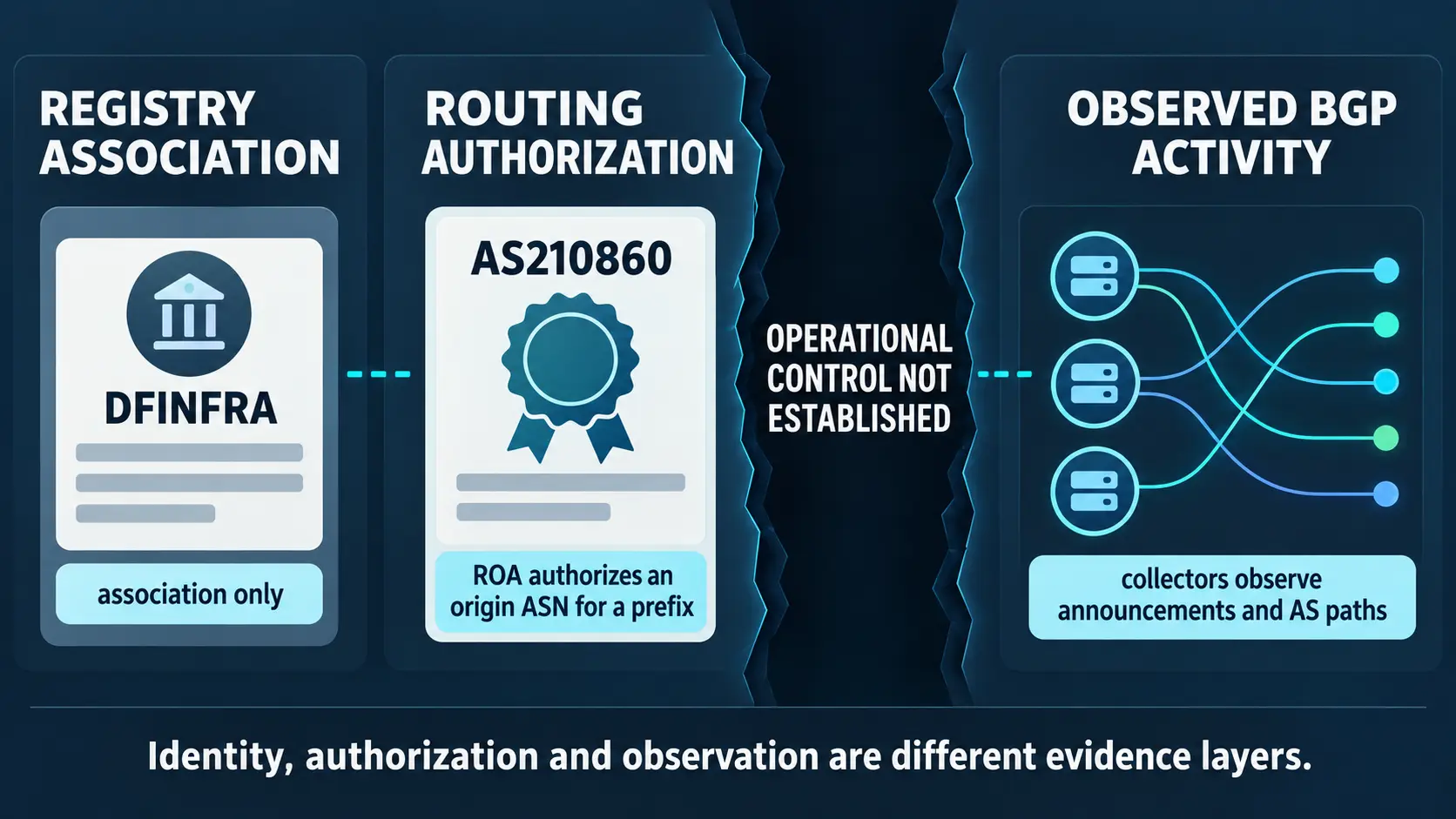
DFINFRA and AS210860: The Control Chain Is Still Unproven
DFINFRA and AS210860: The Control Chain Is Still Unproven intelligence summary explains the development, the public evidence available to readers, the organisations involved, the regional context, market exposure, and the infrastructure consequences that may follow. The Global…

Story
ARIN’s 2026 Candidate Forum Page Still Carries the 2025 Voting Window
ARIN opened registration for an October forum on its 2026 Board candidates. The event page gets the year, forum date and subject right, then tells readers that voting runs from 30 October through 7 November—the window ARIN published for 2025, not the 22–30 October window on its…

Story
RIPE NCC's Admin WebUI Fills Automation Gaps. Retirement Needs an Exception Ledger
The revealing phrase in RIPE NCC’s current registry plan is not “technical debt” but “admin-like capabilities”: the old interface carries operational exceptions that a cleaner replacement could otherwise erase from view.

IETF
IETF–W3C: A Relationship Record, Not a Single Institution
The label “IETF–W3C” compresses two standards institutions into one directory entry. The public record supports a narrower description: the organizations have documented channels of cooperation, but the evidence reviewed does not establish one legal entity, one administrative…

Story
LACNIC Listed 32 Resources for December Revocation. That Is Not 32 Cases.
A new LACNIC cohort places 32 number-resource records on one 90-day clock. The table is useful precisely because it is public. Its limit is just as important: a row identifies a resource, not the recovery case behind it.

Story
AFRINIC Crossed an ASN Block Boundary With 52 Earlier Numbers Absent From the Ledger
AFRINIC Crossed an ASN Block Boundary With 52 Earlier Numbers Absent From the Ledger intelligence summary explains the development, the public evidence available to readers, the organisations involved, the regional context, market exposure, and the infrastructure consequences…

Story
APNIC's Governance Score Is 77%. Its Don't-Know Average Is 20%.
APNIC's new survey does not produce one verdict on governance. It produces a positive score among people able to judge eight claims, and a separate measure of how often members could not judge them. Any decision that carries the first number forward should carry the second one…

Story
RIPE NCC’s New IPv6 Exam Lasts 60 Minutes. Its Badge Will Last Three Years
A short private assessment is being asked to support a long public claim. Before RIPE NCC launches its IPv6 Advanced certificate, it should make the badge’s changing technical scope visible without exposing a single exam question.