
Topic
DNS Delegation Power
Within the Topic facet, DNS Delegation Power topic intelligence connects articles that share a specific subject, signal focus, or monitoring theme. The page gives readers a richer path through related reporting, source evidence, market actors, and infrastructure implications, with enough context to understand why the topic matters across company movements, governance decisions, regional exposure, and operational risk. Readers can compare recurring signals, affected organisations, public evidence, market context, service continuity, procurement, competition, compliance, and strategic planning questions behind the subject instead of stopping at a thin list of matching articles. It explains what the topic covers, which infrastructure actors or policies are involved, what evidence supports the coverage, and why the subject may matter for operators, customers, investors, and policy readers.
Global Cloud Services
AlmazCloud’s AS210328: The Operating Chain Still Has to Be Demonstrated
AlmazCloud’s AS210328: The Operating Chain Still Has to Be Demonstrated intelligence summary explains the development, the public evidence available to readers, the organisations involved, the regional context, market exposure, and the infrastructure consequences that may follow.…

ICANN
Where ICANN's Authority Becomes Operational Control
ICANN is often described as a coordinator of Internet identifiers. That description is accurate but incomplete. Its practical authority is assembled across several instruments: corporate purpose, Bylaws, registry agreements, registrar accreditation contracts, compliance…

Global Cloud Services
AlmazCloud’s AS210328: The Operating Chain Still Has to Be Demonstrated
AlmazCloud’s AS210328: The Operating Chain Still Has to Be Demonstrated intelligence summary explains the development, the public evidence available to readers, the organisations involved, the regional context, market exposure, and the infrastructure consequences that may follow.…
Global Cloud Services
AlmazCloud’s AS210328: The Operating Footprint Still Has to Be Shown
AlmazCloud’s AS210328: The Operating Footprint Still Has to Be Shown intelligence summary explains the development, the public evidence available to readers, the organisations involved, the regional context, market exposure, and the infrastructure consequences that may follow.…

Story
RIPE NCC’s AuthDNS Ledger Counts 43 Nodes but Not the Eyeball Coverage They Deliver
RIPE NCC has made the objective unusually clear: put AuthDNS where poorly served networks can actually reach it. Its public inventory can show that 43 hosted instances are operational. What it cannot yet show is whether each new map pin changed the anycast catchment that matters.
Europe and Middle East Cloud Services
Genesis Cloud’s Public Control Chain Cannot Be Read From One Network Record
Public records can describe a cloud provider’s identity, domain, autonomous-system registration and reported interconnection. They cannot, by themselves, prove that one operator controls every layer or that a service is reachable worldwide.

ICANN
ICANN’s Authority Has Five Separate Links
ICANN’s practical power is easiest to misunderstand when mission, policy, contract, implementation and review are treated as one thing. Its public materials describe a mission centred on Internet unique-identifier coordination, while its agreements and procedures show how…

ICANN
How ICANN Turned a .COM Renewal Into an Operative Contract
ICANN’s 2024 renewal of the .COM registry agreement shows where authority in internet governance actually changes form: community input becomes a proposal, the Board authorizes an institutional act, delegated officers complete the transaction, and a contract becomes the operating…

ICANN
ICANN’s Authority Chain: From Institutional Mandate to Contractual Remedy
ICANN’s power over the domain-name system is easiest to misunderstand when it is treated as a single grant of authority. The public record describes something more layered: institutional powers and accountability rules in the Bylaws, operational obligations in registry and…
ICANN
ICANN’s Authority Is a Chain, Not a Crown
ICANN can influence the global domain-name system without being a government. Its practical authority is assembled across several instruments: a California nonprofit charter, corporate bylaws, multistakeholder policy procedures, contracts with registries and registrars, technical…

IETF
Shumon Huque and the Extension Pin That Promised Evidence, Not DANE Forever
A service can promise to keep answering a security question without promising that tomorrow’s answer will match today’s. That is the subtle bargain inside RFC 9102. The TLS DNSSEC Chain extension can pin a server’s obligation to deliver verifiable DNSSEC evidence, yet still…

ICANN
ICANN’s Authority Is Contractual Before It Is Public
ICANN can influence the global identifier system without being a government and without possessing unilateral control over every technical action that follows its decisions. Its authority is assembled from several instruments: corporate bylaws, operational agreements, registry…
IETF
The Hidden Service Answered. The Onion Key Had Not Yet Spoken: RFC 9799
The hidden service answered over Tor, the ACME account was valid, and the final CSR was ready. None of those facts yet proved that the applicant controlled the `.onion` identity. RFC 9799 makes that missing proof explicit—and shows why issuance authority, descriptor visibility…
Global Cloud Services
AlmazCloud’s AS210328: What the Public Record Can—and Cannot—Verify
A fresh review of the available registry, routing, DNS, web, certificate and PeeringDB sources finds a useful monitoring baseline, but not a verified operating or customer-service footprint. The central distinction is between a recorded network identity, an independently observed…

IETF
Paul Mockapetris and the Authoritative Bit That Did Not Cover the Whole Reply
One DNS response can carry an authoritative alias, a cached destination and helpful address records under a single AA flag. The bit has done its job; the database that stamped the whole packet “authoritative” has not.

IETF
DNS Types 69 and 70 Delegate Meaning but Do Not Name the Registry Version
A signed DNS record can preserve every octet and still leave one historical question outside the signature: which edition of an external registry gave those octets meaning? Two newly assigned resource-record types make that boundary concrete. UNECE is now type 69 and ISO is type…
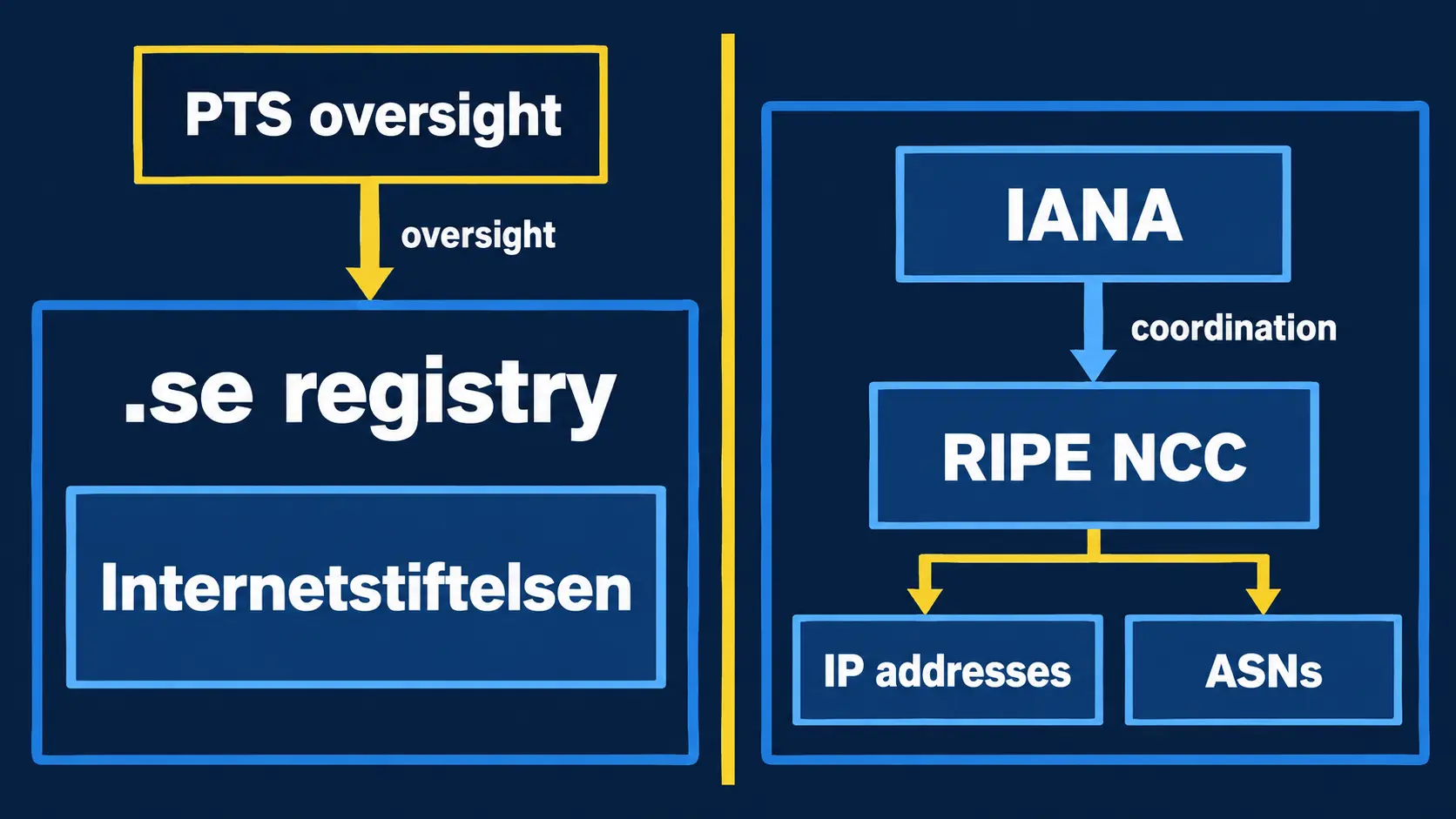
Europe and Middle East Institutional
What Internetstiftelsen Controls—and What It Does Not
A sparse directory label points toward Sweden’s .se registry, but the evidence separates domain-name stewardship from the Internet’s IP-address and autonomous-system infrastructure.

Story
AFRINIC Calls Its NS2 Dashboard ‘Real-time.’ All Twelve Linked Measurements Are Stopped One-Offs
A page can refresh on demand without measuring the present. AFRINIC’s public NS2 dashboard illustrates the distinction: it advertises “Real-time Anycast Node Monitoring”, yet every RIPE Atlas measurement wired into the interface is a stopped one-off. The result is useful evidence…

Story
A Backup DNS Plan Is Not a Second Resolver
A 9 September APNIC Blog account turns a household outage into a precise infrastructure lesson: resilience begins only when an alternative service is running, reaches the clients that depend on it, survives a controlled failure and can be rolled back.

Story
RIPE NCC’s K-root Refresh Needs Three Acceptance Records, Not One Batch Status
Amsterdam can be refreshed while the three-site programme remains in progress. That is not a contradiction; it is a warning about the unit of evidence. RIPE NCC has named three K-root core sites whose seven-year-old routers and servers were due for replacement. The useful public…