
Topic
Cross-border Connectivity
Within the Topic facet, Cross-border Connectivity topic intelligence connects articles that share a specific subject, signal focus, or monitoring theme. The page gives readers a richer path through related reporting, source evidence, market actors, and infrastructure implications, with enough context to understand why the topic matters across company movements, governance decisions, regional exposure, and operational risk. Readers can compare recurring signals, affected organisations, public evidence, market context, service continuity, procurement, competition, compliance, and strategic planning questions behind the subject instead of stopping at a thin list of matching articles. It explains what the topic covers, which infrastructure actors or policies are involved, what evidence supports the coverage, and why the subject may matter for operators, customers, investors, and policy readers.

History
ThaiSarn’s May 1992 Surge Was Recorded, Not Measured
A line in NECTEC’s history says political unrest in May 1992 brought a surge in email use and Usenet circulation between Thailand and the wider world. The record gives no traffic count. What it preserves is a small but revealing sign of what people asked an academic network to…

History
The Access Point Was Ready; Colombia Still Needed the Circuit, 1993–94
By 1993, entities recalled that a U.S. Internet access point for Latin America was available, but Colombia still lacked the costly communications circuit needed to use it as a service. The later connection did not arrive as one clean flag day: an attempt failed, public histories…

Asia-Pacific National Telecom Trends
India–US 5G SA roaming turns the border into an interworking contract
The T-Mobile–Jio milestone is a live cross-border service built across two independent mobile cores, with Syniverse named as the interconnection and mediation layer. Its strategic value will depend on the terms and operating boundaries behind that link: what each home and visited…

History
The Gateway Was a Consortium: PHNET’s 64 Kbps Link, 1994
PHNET did not begin as one campus plugged into a line. Its record describes two stages: UUCP mail relayed through an Australian university, then a 64 Kbps route to the United States shared by a Philippine institutional consortium.

History
Botswana Had an ISP; SADC Still Used UUCP Mail
In late 1996, a commercial provider in Gaborone reported a full 64K Internet link, while the SADC Secretariat still used a 9,600-baud UUCP mail route to Pretoria and was planning Internet access. The records show two operating choices in one place, not one shared network.
History
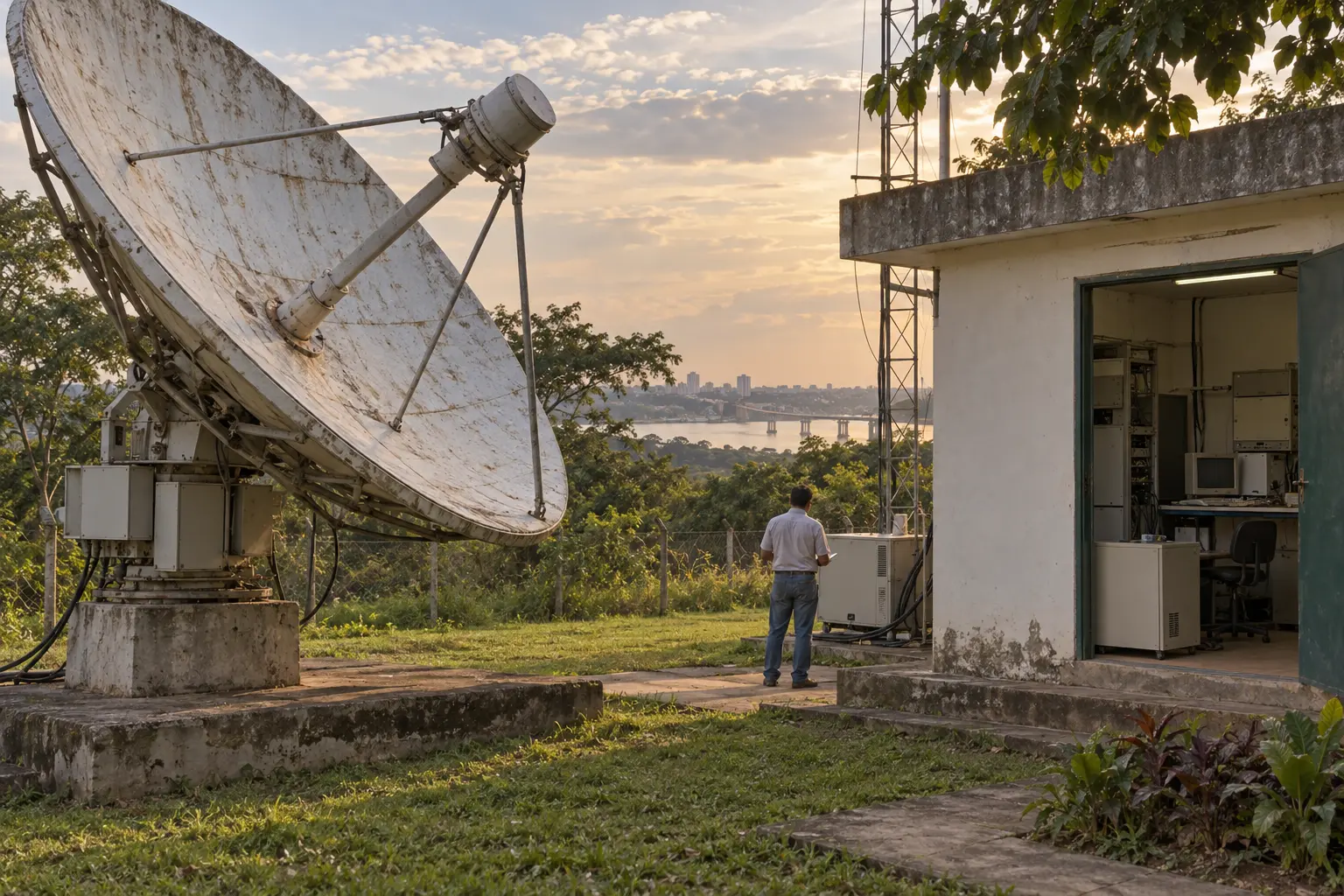
Three Payers Built Paraguay’s First Interactive Internet Gateway
A satellite earth station, a recurring international circuit and an upstream Internet port came from different budgets. That division explains how a university project in Paraguay crossed the gap between scheduled email and an interactive Internet connection.

History
Nicaragua Reached the Internet through Costa Rica’s Old Microwave Link
Before Nicaragua had its own direct international Internet exit, its academic network could reach the wider Internet by crossing a neighboring country. A decades-old analog microwave path carried the regional link; Costa Rica’s satellite gateway supplied the route outward.

History
Dakar’s Web Server Was Online Before Senegal’s Permanent Link
A November 1995 network message already listed Senegal Contact at refer.sn. A later history describes a Dakar server carrying IP over X.25, months before SONATEL’s permanent national link. The records mark different kinds of “online” and cannot tell us who successfully reached…

History
Cuba’s Four Networks Went International Before the 64 kb/s Link
A July 1996 field update described four Cuban networks exchanging information abroad while CENIAI was still seeking a direct IP connection. The 64 kb/s Sprint line that followed changed the kind of reach available; it did not create Cuban networking from nothing.

History
Nepal Opened International Gateways to ISPs in 1999. NTC Still Held the Local Line
Nepal’s 1999 decision changed who could buy international capacity. It did not hand ISPs the wires connecting local customers to them.

History
The Internet Arrived in Stages: Papua New Guinea’s 1997 Launches
Papua New Guinea’s Internet did not enter the record as one switch thrown on one day. A carrier announcement, an international gateway, retail providers, academic use and a public website each marked a different kind of arrival—and the sources assigned them different dates.

Europe and Middle East National Telecom
Space Norway’s shared optical standard is a resilience claim to test
Ciena will modernize Space Norway’s existing Svalbard cables and equip the new Arctic Way system with the same optical technology. That may simplify operations, but a shared equipment standard does not establish independent routes or tested continuity.

History
The International Link Came First; TCP/IP Came Later: Lithuania’s LITNET, 1991–94
Lithuania’s first route abroad was already useful before its research network had become an ordinary IP network. The early story runs through a satellite channel, X.25 packet switching and X.400 mail, then through a domestic link and a gradual TCP/IP transition.

History
Karachi Went Online; Four Cities Still Waited for the Upgrade: Digicom in 1995
In August 1995, a Karachi company could offer a live route to the Internet while the service reported in four other cities still belonged to the slower world of stored mail. Pakistan’s first commercial online service was a real connection, but its launch did not make the same…

History
Eight Institutions Built India’s Research Network Before Public Internet, 1986–95
India’s public Internet service arrived in 1995, but its research community had been building international connectivity for years. ERNET’s history is a story of institutions learning to operate a network together—and of the boundary between that shared research system and a…

History
The Network Was Free. The Internet Had to Pay Its Way: Zambia’s ZAMNET, 1991–95
A university email network reached hundreds through scheduled calls before Zambia had a direct Internet circuit. Turning that shared system into a public service demanded a company, outside financing and a way to pay recurring costs.

Europe and Middle East National Telecom Trends
Europe’s backbone map is being drawn before the next funding rules
The Commission wants a map of Europe’s terrestrial and submarine networks, then a view of where money may be missing. The study can clarify those choices; it cannot make a network, a grant or a market failure appear by itself.

Europe and Middle East National Telecom Trends
Pisces has a joint venture. Its access rules remain the real test
The 14 October announcement gives the Ireland–continental Europe cable a named delivery company and chief executive. It does not yet show who will receive capacity, on what terms, or when the route will carry traffic.

History
Malawi’s Fidonet Network Turned Call Logs into a Cost per Kilobyte, 1993–94
A university email network in Malawi kept more than messages: its node recorded calls, traffic and telephone bills. Those records let its operator ask what each international kilobyte cost—and what the local phone link could actually deliver.

History
The Route Disappeared. Some Egyptian Packets Still Got Out.
In January 2011, Egypt’s Internet became globally difficult to reach in a sequence visible to routing monitors. A network telescope still saw packets sourced from Egyptian addresses. That residue records a surviving path for some traffic; it does not show that the public retained…