
Time Horizon
Medium
Within the Time Horizon facet, Medium time-horizon intelligence organises articles by the period over which a signal is expected to matter. The page helps readers distinguish immediate operational changes from longer-cycle governance, investment, standards, and infrastructure shifts that may unfold across quarters or years. It connects timing assumptions with public evidence, related actors, market context, customer exposure, policy pressure, and infrastructure planning so readers can judge whether a development is urgent, strategic, or still waiting on confirming evidence. The page also explains how time horizon changes the meaning of a signal, which organisations may be exposed, and which infrastructure decisions require short-term action or long-cycle monitoring.

Story
One LACNIC Office Has Three Public Calendar States
LACNIC’s contact record describes one Montevideo office, one set of weekday opening hours and one institutional doorway. Change the language, however, and its public holiday calendar changes year. Spanish presents thirteen dates in 2026; English leaves three in 2025; Portuguese…

IETF
David Meyer and the Address That Had to Ask Where It Lived
LISP lets an endpoint keep one identifier while its network attachment is described separately. That does not make location disappear. It moves forwarding into a chain of registered, resolved, cached, selected and reachable EID-to-RLOC state—and turns each link in that chain into…

Story
ARIN Published a 15-Seat Fellowship Ceiling. Its Roster Has 19
ARIN’s Fellowship timeline and its selected-Fellows announcement describe the same ARIN 58 cohort with different capacities. The planning page stops at 10 in-person and five virtual places. The announcement keeps the 10 in-person places and raises the virtual count to nine. A…

Story
APNIC’s NRO Ballot Has Two Electorates. Its Result Needs the Mix
At 14:00 in Brisbane on 27 August, APNIC opened one electronic ballot for one regional seat on the NRO Number Council. It did not open that ballot to one electorate. Member organizations and qualified conference regulars enter through different doors, vote on different clocks and…

IETF
Alan DeKok and the RADIUS Variant That Moved Trust into TLS
RFC 9765 is unusual not because it promises a clean break, but because it records a protocol author revisiting a choice he helped make: Alan DeKok's RADIUS/1.1 removes old packet-security machinery only where two peers explicitly negotiate a protected transport profile. The…

Story
AFRINIC’s Trust Anchor Still Runs to 2030. The NRO Roadmap Said “Short-Lived” by the End of 2025
A roadmap can name a destination and a date. It cannot prove that a live trust anchor has crossed the line. AFRINIC’s retrievable certificate shows why RPKI commitments need an implementation receipt rather than a silently ageing table.

Story
AFRINIC Has Named Its Next CEO. It Has Not Yet Named the Owner of Every Decision Before January
Mike Silber is due to become AFRINIC's chief executive on 1 January 2027. The 130 days between announcement and assumption of office need a public responsibility map, not an assumption that a future title already carries today's authority.

Story
RIPE's NRTMv3 Stream Can Skip an Invalid Object. A Moving Serial Is Not a Completeness Receipt
RIPE Database release 1.124 made a small change with a large evidentiary consequence: the NRTMv3 server should skip invalid objects. Keeping a replication stream alive may be the right operational choice, but continuity alone can no longer answer the mirror operator's most…

Story
LACNIC’s 70% Pass Mark Is Not a Candidacy Receipt
LACNIC’s Board-election rules contain a consequential distinction: a person can pass the mandatory competency assessment and still not become a validated candidate. The Electoral Commission receives the score and remote-proctoring incident evidence, but the public process does…

Story
ARIN Put the Reg-RWS Key in a Header. That Does Not Make It Uncapturable
ARIN now accepts a Reg-RWS API key in the `Authorization` header while continuing to accept the same credential in a URL query string. The new channel removes a dangerous source of routine propagation, but the public record still needs to distinguish a safer request shape, client…

Story
AFRINIC Extended Its Bylaws Consultation. Its Only Named Form Went Down Four Days Before the Deadline
A deadline is a promise about access, not merely a date printed on a page. AFRINIC gave contributors until 17 May to use a designated constitutional-comment form; on 13 May it announced that the form host was unavailable, leaving the public record without the timestamps and…

Story
The 27 August Redline: Reading APNIC’s prop-165 Through Its Assessment Delta
APNIC’s canonical `prop-165` record now points to `prop-165-v004`, published on 27 August 2026, while the Secretariat analysis displayed on that record is expressly introduced as applying to version 3. With the APNIC 62 Open Policy Meeting scheduled for 10 September 2026, the…

Story
RIPE-861 Recommends Off-List Nominations. The Candidate List Needs a Receipt
RIPE's new guide gives a quiet volunteer a private way to approach a continuing working-group chair. That can widen participation. It also moves the first step outside the public archive, making the later conversion from interest to a complete candidate list the part that needs…

Story
LACNIC's FORT Can Validate ASPA. Its Router Feed Defaults to Version 0
LACNIC announced a validator that can carry ASPA data towards routers. The release also keeps that route behind a configuration value whose default is zero. That is not a contradiction or a defect. It is the difference between shipping a capability and establishing that the…

Story
A Date Is Not a Review Window: AFRINIC’s Missing Assessment-to-Agenda Record
AFRINIC’s staff impact assessment for `AFPUB-2026-GEN-002-DRAFT01` is dated 23 June 2026. AFRINIC-37 met on 24 June, with the Policy Compliance Dashboard scheduled for 15:15–16:05 local meeting time. The minutes preserve the PDWG Chair’s concern that providing an assessment only…
Story
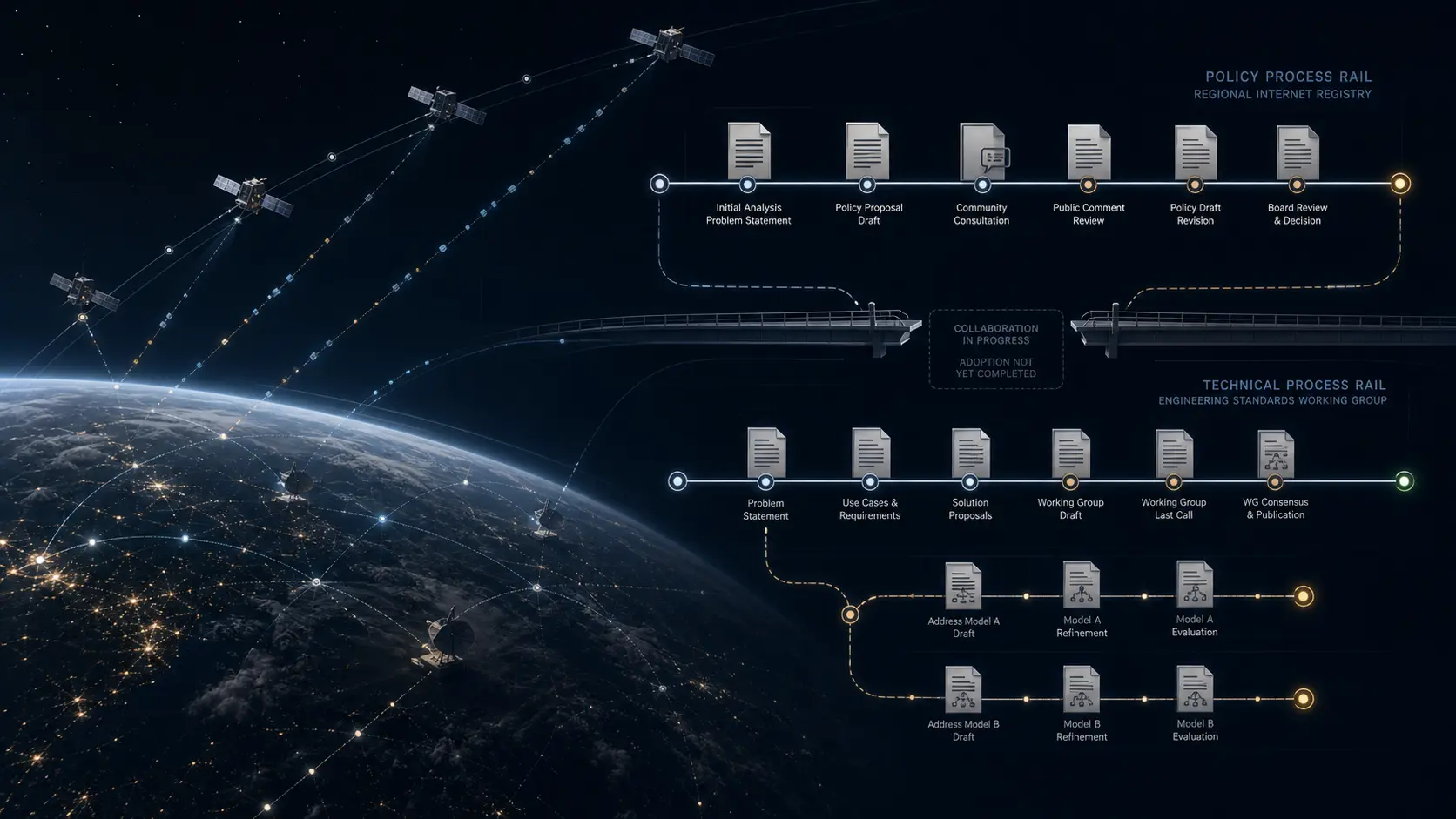
ARIN Calls Its Space Policy Joint. IETF Has Not Adopted the Address Model
ARIN-2026-1 says the proposal is joint with an IETF working group. The linked IETF record says the address model has no formal standing, and the working-group chairs found no clear consensus to adopt it as-is. Both statements can be faithfully recorded only if institutional…

Story
APNIC’s Service-Term Delegation Has No Public Classification Receipt
APNIC’s Executive Council gave the Secretariat room to change service terms without turning routine administration into policy making. The delegation is sensible and expressly bounded. What the public record lacks is the small entity that would let a later reader test the…

Story
AFRINIC’s $20,790 MyAFRINIC Line Cannot Count Its Staff Work
AFRINIC’s half-year accounts put USD 20,790 of capital expenditure against MyAFRINIC v2. Six days before the reporting cut-off, its policy-meeting record said human resources had been channelled to the same project. The statements can both be accurate because they count different…

Story
RIPE’s CoC Draft Joins Final Appeal and Team Removal
A second RIPE Code of Conduct draft would let the RIPE Chair appoint, continue and remove community reviewers at discretion. The current appeal process already names that office as the final assessor. Neither power proves interference. Their combination does create a hard…

Story
LACNIC’s 11 IXP Collectors Need a Vantage-Point Receipt
LACNIC has opened a useful window onto local routing: eleven BGP collector views, public MRT files and charts of prefixes, origin networks and paths. The problem begins only when a window is mistaken for the landscape. The portal does not bind each result to the peer cohort…