
Region
Latin America
Latin America regional intelligence explains how companies, people, policy moves, network operations, investment signals, data centre demand, telecom execution, and market constraints shape infrastructure delivery in the same geographic market or governance area. The page connects published coverage with evidence, regional actors, operating dependencies, market context, and customer or regulatory exposure that may otherwise sit across separate topic or company pages. Readers can compare who is active, which signals are backed by public evidence, how local execution risk connects to broader internet infrastructure strategy, and what changes may affect customers, partners, regulators, or capital planning. Readers can understand the geography, the relevant infrastructure sectors, the public evidence base, and the practical questions that make the regional page more useful than a short listing of articles.

Leaders
Edmundo Cázarez-López Put 131,072 IPv4 Addresses Behind Glass
The network can run out of addresses while a new critical facility still needs them. Cázarez-López wrote a special reserve for that awkward day, complete with a size limit, a return rule and a sharp penalty for changing its purpose.

Leaders
Nicolás Antoniello Asked Who Could Order a Router Around
An IPv6 dispute proposal told IPv4-only networks to upgrade to dual stack. Antoniello, an engineer and former LACNIC policy-forum moderator, challenged the verb. The next draft turned an order into advice.

Leaders
Carlos Plasencia Got the Only Nomination. He Wanted More Voices.
LACNIC proclaimed him a policy-forum co-moderator after an uncontested nomination. A year later, he described a discussion still carried by the regulars—and the awkward work of opening the door wider.

Leaders
Ricardo Patara Gave IPv6 Infinity a Four-Year Calendar
His 2012 rule asked networks seeking more than a /32 to show a plan, a POP-by-POP reality check and a prefix that landed on a hexadecimal digit. Five years later, the calendar came off the wall.

Latin America and Caribbean National Telecom Trends
Brazil’s New Drone Band Has One Awkward Guest Question: Can It Talk to Air Traffic Control?
Anatel proposes ten 200 kHz channels between 468 and 470 MHz for remotely piloted aircraft. Brazil’s existing rulebook gives that category a surprisingly specific guest list.

Latin America and Caribbean National Telecom Trends
Brazil’s Mobile Market Meets Anatel’s National Target. The Municipal Data Add a Second Test
Anatel says Brazil’s national mobile-market concentration indicator met its 2027 target in the third quarter. In the same report, its municipality-level analysis shows a much less even picture: concentration rises as population falls. The two findings measure different scales…

Latin America and Caribbean Datacenter
Ascenty: The Megawatt That Travels Without Its Basis
Brazil's data-centre buildout is routinely described in megawatts, but the documents gathered for this report on 18 October 2026 contain no megawatt figure for Ascenty Data Centers e Telecomunicações S/A at all — and that gap is the story, because the unit itself is doing work…

Leaders
The RedCLARA handover: what Florencio Utreras's office actually held
RedCLARA's own announcements record fifteen years in the executive direction and a named successor. The European Commission's project record puts the association, not its director, at the centre of the ALICE2 grant. Read together, they turn a career note into a continuity test…

Latin America and Caribbean Regional ISP
Giga+ Fibra's better margins still have an interest bill to pay
The Brazilian fiber group is making more of a smaller customer base. Its quarterly cash figures show both the progress and the distance between an operating improvement and money left over.

Latin America and Caribbean National Telecom Trends
Sercomtel's exit from the old phone contract has a price—and a delivery address
The Brazilian operator's settlement turns a dispute over a fixed-line concession into commitments to mobile coverage and school connectivity. Reading the price correctly is the first step towards judging what the public gets.

History
Honduras Opened Internet Service to ISPs, but Kept Leased-Line Sales
Hondutel said five internet service providers and four organisations were directly connected in March 1996. A year later, one provider said private firms could sell dial-up but not dedicated service—an opening shaped by who controlled the circuit.

History
Guyana’s University Email Stayed Online Through Storms and Voltage Failures
Before Guyana had a field of commercial providers, a university mail gateway linked users to Puerto Rico. Its reach depended on a local phone bill, scarce hardware and one lecturer who volunteered to keep the system working.

History
NIHERST Sent Research Email via Puerto Rico—and Allocated Costs by Volume
A research institute’s route to Puerto Rico ran through a head-office modem. In 1996, NIHERST said its Institute of Marine Affairs shared that path, with local phone costs allocated by the volume of mail sent and received.

CASE FILE
Mexico’s child-safety decree starts a 30-day platform reporting test
Mexico has made a broad set of child-safety duties binding on online platforms. The first test of the decree will be whether the required reports show what changed, how risks are measured and who checks the claims.

Latin America and Caribbean National Telecom Trends
Uruguay’s Fibre Trunk Cuts Exposed a Cross-Layer Dependency
Four terrestrial fibre-trunk cuts on 13 October did more than interrupt domestic transport routes in Uruguay. Their simultaneous effect also constrained access to international submarine-cable capacity reaching Maldonado, showing how a terrestrial failure can become an…

History
Hurricane Andrew Hit Costa Rica’s Internet Route Before It Opened
Costa Rica’s first Internet connection depended on a receiving site in Homestead, Florida. Hurricane Andrew damaged that end of the route; the University of Costa Rica connected on 26 January 1993.

Latin America and Caribbean Institutional Trends
Five Caribbean islands joined the exchange; local routing is the test
The Eastern Caribbean Internet Exchange now reaches five named islands through a cable operator, a local network and an exchange platform. That is a meaningful extension of regional infrastructure. It does not yet tell readers how much traffic stays local, which island networks…

Latin America and Caribbean National Telecom Trends
AT&T Mexico’s sale hinges on more than closing
AT&T calls the proposed sale a US$2 billion exit. The buyer documents describe a 50–50 consortium, a financing plan, regulatory conditions and transition agreements still to be completed. The transfer is a sequence, not a single signature.

History
Uruguay’s .uy Identified Email Before the Internet Link Arrived, 1988–94
In Uruguay, messages could cross borders before the country had a permanent Internet connection. The email route, the national domain and the later academic link marked three different capabilities.
History
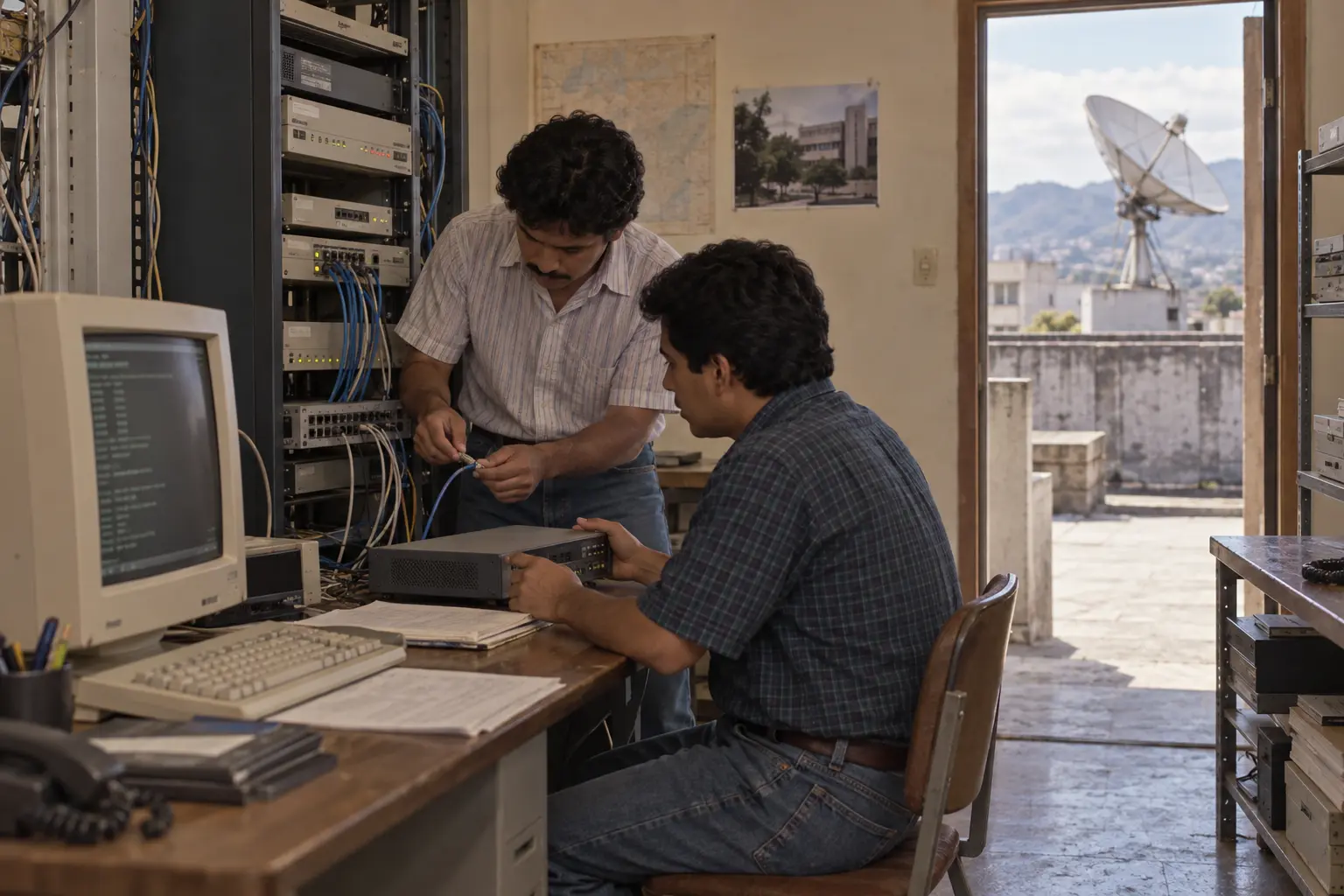
Honduras Reached the Internet by Satellite. A .hn Dispute Split HONDUNet
A June 1995 announcement said a satellite link had connected Honduras to the Internet. A later history dates the link five days later. Between the project plan and that route sat a dispute over who should administer `.hn`—one that paused HONDUNet and sent its organizers to a…