
Profile
Research
Research profile intelligence connects person, company, institution, and other entity coverage for readers comparing the subjects behind BTW.MEDIA reporting. The page helps compare public profiles, related events, evidence packs, role changes, operating footprints, governance exposure, organisational links, and market relevance while keeping organisation and people records distinct from ordinary news chronology. Readers can understand the subject behind the headline, the evidence supporting that profile, and the infrastructure or market relationships that make the profile relevant. They can see who or what the profile represents, which public sources support it, how it connects to companies, markets, governance bodies, or events, and what changes may deserve continued attention as the subject evolves.

IETF
MIKEY Was Green. The Proxy Could Still Read the Master Key.
The session dashboard showed a reassuring result: MIKEY active, SRTP encrypted, policy passed. The exchange had used MIKEY-NULL over TLS, and the TLS connection ended at a signaling proxy. On the wire outside that hop, the media key looked protected. Inside the trust boundary…

North America Institutional
Two Companies Named Hughes, One AI Legacy That Got Lost
Before Hughes Network Systems ran self-healing networks on Microsoft's cloud, an earlier Hughes ran one of the defining autonomous-vehicle programs in American AI research. The directory entry that links them is mostly an accident of naming — and the collision tells you something…
History
Zero Was Already One: RFC 3544 and PPP Compression Negotiation
An operator could ask PPP to keep compressing TCP headers while leaving other traffic untouched. The obvious instruction—set the non-TCP context space to zero—did not mean “none.” RFC 3544 added a small, explicit override for the value the older field could not express.

IETF
The Patch Localized the Card. It Did Not Create Another Authority: RFC 9553
A contact card can present a name, title and address in another language without becoming a second contact record. RFC 9553 makes that distinction concrete: a language-tagged PatchObject is applied to a copy of one base Card. The view may be fluent and valid while its identity…

Global Institutional Trends
The ILC’s Regional Seat Map Is Not a Candidate Scorecard
The International Law Commission’s 2027 election has opened a year before the vote. Its regional allocation is precise, and its eligibility rules are formal; what those rules do not supply is a common public record for comparing the people nominated to fill the seats.

IETF
Presence Said Video Was Supported. SDP Said No.
The watcher chose video because the presence document advertised it. Seconds later the session offer failed. Nothing in that sequence was contradictory: the first signal was a filtered, time-bound hint about a service or device; the second was a live negotiation with the endpoint…

IETF
The Probe Shared the Path. It Still Did Not Prove the SLO: RFC 9551
The operations screen showed the DetNet test packet crossing the right links with the right priority. That was valuable evidence—and still not the same thing as proving that every protected packet arrived within its delay, loss and ordering objective. RFC 9551 is most useful when…

History
The Bridge Reached 100%. It Had Not Proved Settlement or Delivery: RFC 3538
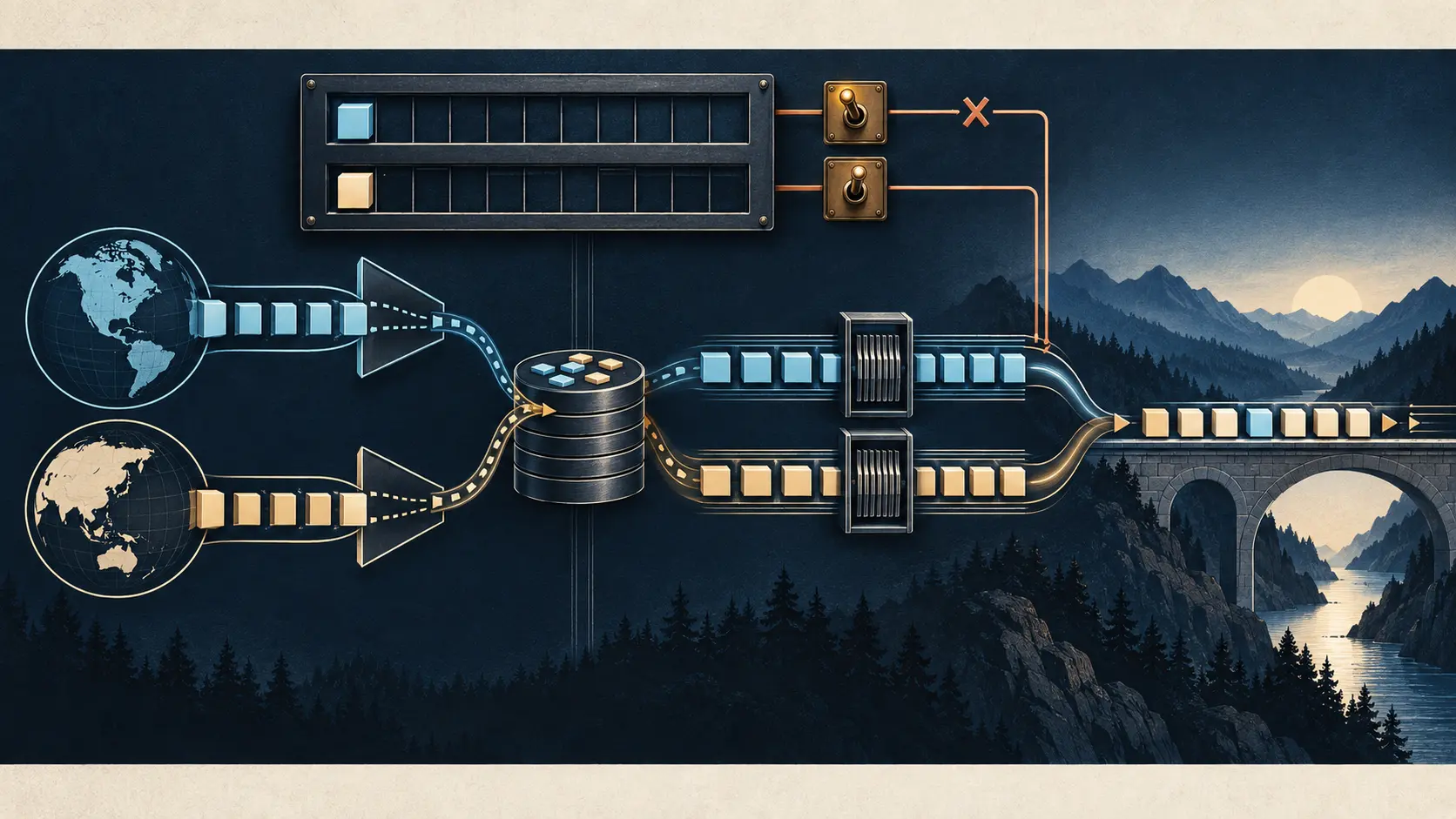
A payment interface can finish every message it was designed to carry and still leave the most important commercial questions open. RFC 3538 made that limit visible in a five-step progress meter whose final mark belonged to a protocol bridge, not to the whole transaction.

IETF
The Port Was Discovered. No One Could Prove Who Authorized It.
The new customer port appeared in every expected Port Information Table before the change window ended. Its BGP path was stable, the Route Target matched, and the immediate neighbor had authenticated correctly. The audit still had no answer to the decisive question: which actor…

History
The Envelope Knew the Key’s Length. It Did Not Know the Key’s Job: RFC 3537
A CMS package can carry an HMAC key in a form another system can recover byte for byte. That is a useful transport receipt. It is not yet a record of which digest, service, principal or decision those bytes are authorized to serve.

Story
RIPE NCC Reversed a Package Update After Its RPKI rsync Service Went Offline
RIPE NCC restored the named RPKI repository service by reverting an rsync package on 2 October. Its incident record explains the recovery, but does not measure how many relying parties were affected.

IETF
The Call Connected. The Text Waited for Return.
The SIP dialog was established, the text media had been negotiated, and the dashboard showed the call as healthy. Yet the first words did not leave the caller's device. They remained in an editing buffer until Return turned them into a complete line. Every character eventually…

History
The Glyph Looked Right. The Protocol Still Had Not Named a Language: RFC 3536
A browser can draw a flawless shape from the wrong assumption. RFC 3536’s historical contribution was to make every assumption between the received octet and the reader’s understanding visible—and to deny the final glyph authority over the steps that came before it.

IETF
The Ping Replied. It Did Not Prove the Origin Was There: RFC 9508
A green diagnostic arrived for `/video/segment/42`, yet the origin server could have been offline. In an information-centric network, the answer may have come from a forwarder’s administrative name, a local application face or an on-path Content Store. RFC 9508 makes that…

Europe and Middle East Datacenter
bit datacenters GmbH: A German Data-Centre Name That Outruns Its Registry Footprint
German commercial-register and routing records describe a young, small Gießen company whose branding implies capacity that no public source has yet evidenced.

IETF
The Client Moved to Open Radio. Its Security Profile Did Not.
The laptop left a physically protected Ethernet port and attached through an open radio. The PANA session was restarted, but the deployment profile was not. It still said the PaC-to-EP channel was secure before PANA, so the client used the EAP method selected for that environment…

IETF
The First PAA Timed Out. The Second Was Never Tried.
The dashboard displayed two PANA Authentication Agents and marked discovery complete. Its connector then chose the alphabetically first address, which happened to be the server’s second preference. That address timed out. The workflow stopped. A valid ordered list had been…

IETF
EAP Said Success. The Network Still Said No.
The identity check had passed. The key existed. The event stream showed EAP Success. Then the PANA Authentication Agent returned `PANA_AUTHORIZATION_REJECTED` and ended the session. Nothing was contradictory except the dashboard that had treated authentication as permission.

IETF
The Notification Arrived. The Reply Was Still in Another Table.
The event collector marked the change complete when the trap arrived. RFC 5190 gave that event only two decisive fields: operational status and lifetime. The address, port and error evidence that explained what had actually happened still had to be read from the managed row.

Europe and Middle East Cloud Services
Novacloud's service layer under the microscope: DNS split, twin status pages and a 19-day outage the registry never sees
The storefront sells three European datacenters and direct control over routing. The operator's own incident records and third-party DNS data describe something more layered — and more dependent — than the marketing suggests.