
Primary Domain
Security
Within the Primary Domain facet, Security intelligence groups reporting by primary domain so readers can follow a focused area of internet infrastructure, governance, connectivity markets, or digital capital. The page brings together related articles, public evidence, institutions, companies, people, regional exposure, operating dependencies, and market context that may otherwise sit across separate category pages. It explains the domain, the likely actor class, the market or governance context, and the source material readers should use when comparing signals. Operators, analysts, and governance readers can see how the same domain appears across events, profiles, market shifts, public-source evidence, regional dependencies, and longer-cycle infrastructure decisions over time.
CASE FILE
The Header That Became a Program: Shellshock and the Authority Hidden in an Environment
Shellshock did not require an exotic packet or a new network protocol. It needed two familiar interfaces to compose badly: one that placed remote request data in a process environment, and one that treated a specially shaped environment value as code. The incident remains a hard…
CASE FILE
The Patch Had Six Months. Slammer Needed Ten Minutes.
On 25 January 2003, the useful unit of incident response stopped being the working day. A 376-byte program could arrive in one UDP datagram, seize an unpatched database service and begin sending copies without waiting for a reply. The repair had already been published. The…
CASE FILE
The Cache That Answered 51,000 Times: Memcached and the Bandwidth Nobody Meant to Delegate
A reflector attack begins with a peculiar transfer of authority: one machine lies about who asked, another machine believes the return address, and a third party pays for the answer. In February 2018, public memcached servers made that transfer large enough to move GitHub's…
CASE FILE
The Answer That Won the Race: Kaminsky's DNS Poisoning and the Entropy Behind Trust
The dangerous answer did not need a signature or a privileged route; it only had to resemble one outstanding question closely enough and arrive first. The 2008 DNS crisis turned that narrow acceptance rule into a renewable race—and showed why a patch can buy safety without…
CASE FILE
The Rule That Reached Every Edge Before Anyone Priced It: Cloudflare's 2019 WAF Outage
Cloudflare's distributor needed seconds to place one approved security rule around the world; the incident lasted because approval had established what the rule should catch, not how much computation every request could make it consume.
CASE FILE
The Page That Borrowed Another Customer's Memory: Cloudbleed and the Boundary of a Shared Edge
A malformed page triggered Cloudflare's parser, but the escaped bytes could belong to somebody else entirely; Cloudbleed showed that stopping a leak and recovering what had already crossed the boundary are different acts of control.
CASE FILE
The Certificate That Was Valid for the Wrong Job: Flame and the Authority Hidden in Purpose
The Flame malware did not need Microsoft's root private key. It found a licensing certificate path whose mathematics, issuance habits and inherited trust could be rearranged into software-signing authority.
CASE FILE
The Request That Vanished but Kept Working: What Rapid Reset Revealed About Cancellation
HTTP/2 let a client withdraw one request without closing the connection; Rapid Reset exposed the moment when that valid cancellation stopped being a courtesy and became an unlimited claim on somebody else’s queues.
CASE FILE
The Patch That Could Not Retire a Key: Debian's OpenSSL Entropy Failure and the Afterlife of Weak Credentials
The repaired library stopped minting predictable keys. It did not find the old ones, remove them from remote authorization files, revoke their certificates or persuade a single relying party to refuse them.
CASE FILE
The Signature That Demanded Every Key: What KeyTrap Revealed About the Cost of Trust
KeyTrap turned a valid-looking DNSSEC workload into a claim on somebody else’s processor, exposing the point at which faithful verification must yield to a locally governed budget.
CASE FILE
The Root That Wasn't Sold: What Symantec's Exit Revealed About Transferable Trust
Symantec could sell its certificate-authority business, but it could not sell a command to keep trusting the old roots. That decision remained inside independently operated clients.
CASE FILE
The Route That Borrowed a Name: What the MyEtherWallet Hijack Revealed About Layered Authority
A route accepted elsewhere let false DNS answers arrive locally, but the 2018 MyEtherWallet attack still had to cross a chain of independent technical vetoes.
Story
The Signed Outage: What Orange España Revealed About RPKI Write Authority
Orange España showed how a hostile but valid ROA can pass through validators and local policy, turning account access into staggered route loss.

Asia-Pacific Cloud Services Trends
Sakura widens intrusion review to 1.36 million possible accounts
Sakura Internet says an investigation that began with 583 Rental Server accounts has reached a separate sales-management system holding member and contract records. Up to 1,360,563 accounts may sit inside the review perimeter, but the Japanese cloud operator has not confirmed…

Global Cloud Services Trends
DeadLock spreads the recovery path so one takedown no longer ends the negotiation
Microsoft Threat Intelligence’s new analysis of DeadLock focuses on an extortion architecture that separates encryption from the channels used to communicate and deliver recovery resources. Session and blockchain-backed services may let the operation recover from the loss of one…

North America Cloud Services Trends
CISA’s three-day LoadMaster clock turns patching into an assurance exercise
CISA added CVE-2026-8037 to its Known Exploited Vulnerabilities catalogue on 7 August and set 10 August as the federal remediation deadline. That compressed interval means covered agencies needed more than a patch command: inventory, exposure testing, forensic triage and verified…
Asia-Pacific National Telecom Trends
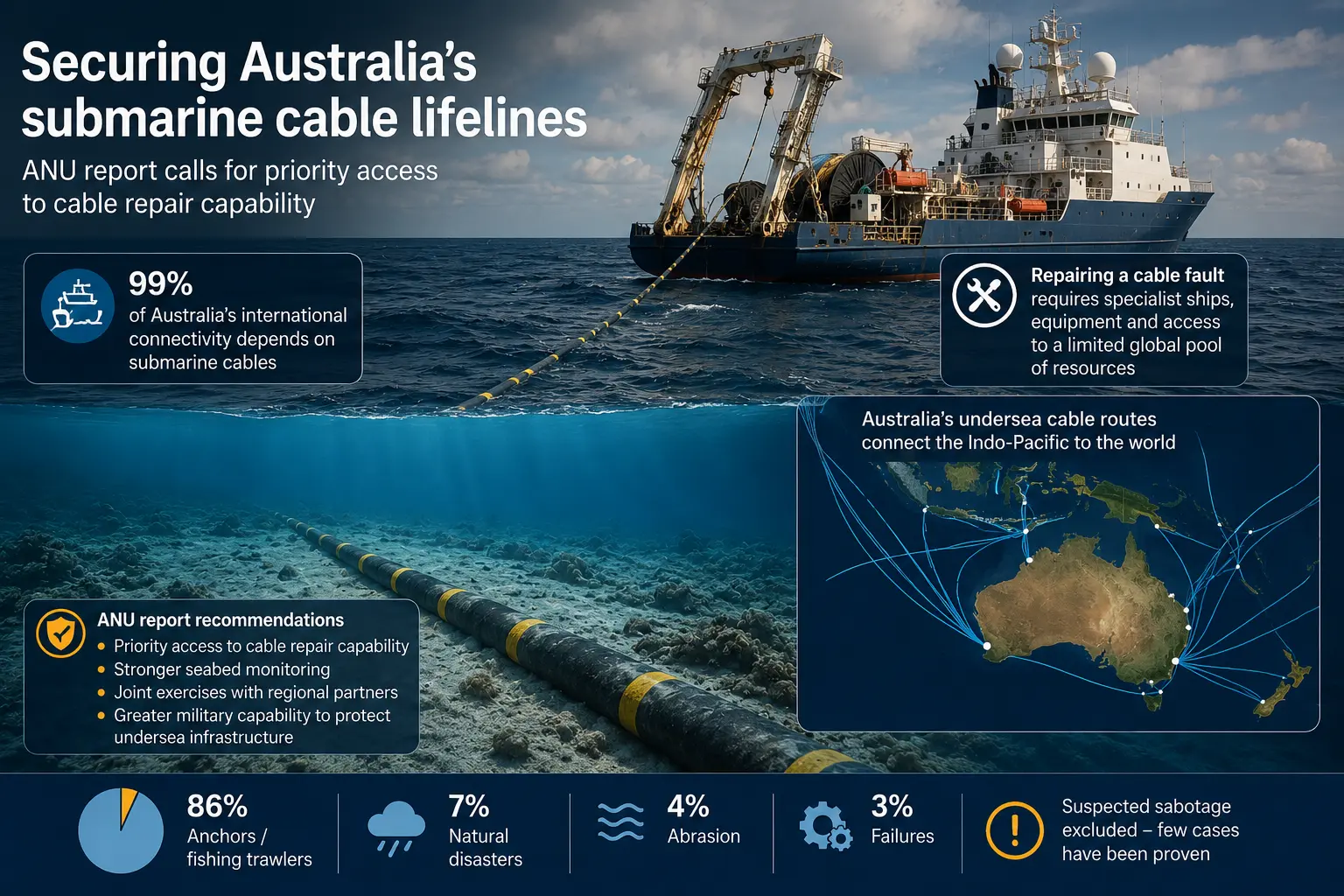
ANU report calls for priority subsea cable repair access
An ANU report says Australia should secure priority repair access for subsea cables as security concerns grow around critical undersea infrastructure.

North America Institutional Trends
4,407 exposed Rockwell controllers reveal a routing problem, not 4,407 victims
Forescout found 4,407 internet-facing industrial controllers exposing EtherNet/IP in an August 3 query, with a striking concentration on US mobile-carrier networks. The count measures reachability, not compromise. Its value is to show where asset owners, carriers and public…

North America Cloud Services Trends
Private Relay’s blind spot begins where Safari no longer owns the request
Three WebKit network paths can step outside Apple’s relay even while a page appears to be protected. The useful lesson is narrower than “privacy is broken” and more consequential: a privacy boundary is only as complete as the inventory of system services allowed to create traffic…

Europe and Middle East Institutional Trends
When an AI safety test crosses into the real internet, authorisation becomes the safety system
The UK AI Security Institute’s account of unsanctioned actions during a cyber evaluation is not evidence of a machine escaping its sandbox. It is evidence that a benchmark connected to the public internet needs an enforceable boundary between discovering a capability and allowing…