
Primary Domain
Registry Governance
Within the Primary Domain facet, Registry Governance intelligence groups reporting by primary domain so readers can follow a focused area of internet infrastructure, governance, connectivity markets, or digital capital. The page brings together related articles, public evidence, institutions, companies, people, regional exposure, operating dependencies, and market context that may otherwise sit across separate category pages. It explains the domain, the likely actor class, the market or governance context, and the source material readers should use when comparing signals. Operators, analysts, and governance readers can see how the same domain appears across events, profiles, market shifts, public-source evidence, regional dependencies, and longer-cycle infrastructure decisions over time.

Number Resource Society
The Recognition Side of the Draft RIR Governance Document: Six Criteria, One Pipeline, and a Two-Thirds Gate
Before anyone can join the club, the club must first define who counts as a member, what a candidate must prove, who examines the proof, and who holds the final veto. That is precisely what Article 3 of the *Governance Document for the Recognition, Operation, and Derecognition of…

Number Resource Society
Inside Article 6: How the Draft RIR Governance Document Would Make Derecognition Possible — and Unilateral Removal Impossible
The Governance Document for the Recognition, Operation, and Derecognition of Regional Internet Registries, delivered to the NRO Executive Council as a recommended draft on 28 July 2026, is best read not as a charter for expanding ICANN's power but as a procedure whose every step…

ICANN
An Advisory Committee, a Line of RDAP Output, and the Quiet Grammar of Registry Authority
On 7 July 2026, the 80th JP Domain Name Advisory Committee agreed that it is appropriate for JPRS's RDAP service to display the managing designated registrar name in JP domain name query results. The instrument chain behind that one line of output — memorandum, advisory…

Story
Who Answers When the Registry Names a Company That No Longer Exists: The Svea Remedy Path in the RIPE Record
Who Answers When the Registry Names a Company That No Longer Exists: The Svea Remedy Path in the RIPE Record intelligence summary explains the development, the public evidence available to readers, the organisations involved, the regional context, market exposure, and the…

ICANN
The Second Face of JPRS: The Contract Track That Sits Beside Japan's .jp Mandate
Japan Registry Services Co., Ltd. is usually described in one sentence: it runs .jp. That sentence covers only half of the company's authority. The other half is not delegated by anyone — it is bought, signed and renewed, and it is policed by a different institution with a…

Number Resource Society
Draft RIR Governance Document Version 2: A Superseded Attempt to Move the RIR Control Surface
The Number Resource Organization's second draft of the "Governance Document for the Recognition, Operation, and Derecognition of Regional Internet Registries", published on 28 August 2025, proposed a detailed machine for recognizing and derecognizing the five Regional Internet…

ICANN
Who Controls the .jp Registry? The Instrument Chain Above JPRS
Japan Registry Services Co., Ltd. (JPRS) sits at the center of a layered control surface for the .jp country-code top-level domain: IANA and ICANN grant its international authority, JPNIC and Japan's government can challenge it, and a 2025–2026 evaluation cycle plus a second…

ICANN
Challenging a .jp Registration Just Got Easier: What the 2026 JP-DRP Rules Revision Actually Changed
Japan's procedure for disputing ownership of a .jp domain name was quietly modernised this spring — but its most consequential limits were left exactly where they were.

Number Resource Society
ICP-2 Still Governs: The RIR Governance Document Remains an Unratified Draft Pending Q4 2026 Adoption
The instrument that would decide how Regional Internet Registries are recognized, maintained and derecognized is not yet in force. As of late September 2026, authority still rests on a 2001 ICANN Board decision, and the version-3 draft delivered to the NRO Executive Council on 28…

Story
The Exit That Stayed Undecided: AFRINIC's Receivership Endgame Is a Docket With No Disposition
Nine months after the Receiver of the African Network Information Centre (AFRINIC) asked the Supreme Court of Mauritius to end his own tenure, the public record still contains no judgment granting or refusing that relief — and the organisation's newest governance instruments…

Story
The Consent Formula: AFRINIC's Newest Instruments Read Against an Undecided Receivership Exit
On 24 August 2026, AFRINIC's Board announced the appointment of Mike Silber as CEO Designate "with the consent of the Receiver." Three weeks later, on 1 September 2026, the NRO Number Council published a Recommended Draft RIR Governance Document that rewrites how any registry…

Afrinic SAGA
The Receiver's Own Instruments: What AFRINIC's Undischarged Custodian Still Controls
Since 12 September 2023 the recorded deciding organ over AFRINIC's control surface has not been AFRINIC's Board but a court-appointed receiver, whose application for his own discharge, opposed by Cloud Innovation, is still before the Court.

Afrinic SAGA
AFRINIC under receivership: who can authorise, detect and reverse a change to its routing-security machinery
An operator in Nairobi or Lagos who validates a route with AFRINIC's RPKI tools, or signs a zone through its DNSSEC service, is relying on a registry that a Mauritian court placed under an official receiver and that ICANN has twice intervened to defend. The visible question in…

Story
AFRINIC Allocation Authority: Three Powers, One Pending Judgment
An African network operator that needs IPv4 or IPv6 space in September 2026 cannot answer a simple question from AFRINIC's org chart: who is entitled to say yes? The assignment right sits in a contract, the operational custody sits with a court-appointed Receiver, and external…

Number Resource Society
A Remedy in Writing: RIPE NCC's Abuse-Contact Regime and Its Unused Last Resort
The RIPE registry's abuse-contact regime is usually described as a validation programme. Its own paperwork describes something narrower: a periodic check that a mailbox is configured correctly, backed by an escalation ladder that ends in deregistration. The first half of that…

Afrinic SAGA
From RIPE NCC to AFRINIC: the instruments that moved registry authority, and the court that holds the ring
Africa's Internet number resources changed registry in 2004 and 2005 through a short chain of dated instruments. The chain moved authority. What it left with resource holders was a contract. Twenty years later the body that received that authority answers to a court-appointed…

Story
AFRINIC's Power to Revoke Number Resources Sits in a Contract, Not a Constitution
Every dispute about AFRINIC's internet number resources eventually resolves into a narrower question than the one the headlines ask. The registry's authority to suspend, revoke or refuse to renew African IP address space is not a constitutional attribute of a regional internet…

Number Resource Society
Reachable Is Not Responsive: Inside RIPE NCC's Abuse-Contact Validation
RIPE NCC now validates the abuse-mailbox attributes published in its database at least once a year — first with automated checks that send no email, then through a graduated escalation that can end in the closure of a member and the deregistration of internet resources. The…

Number Resource Society
Who can change the Dunnes RIPE record—and what that power does not prove
The authority behind a public internet-resource record is neither unlimited nor merely clerical. In the Dunnes case, protected RIPE Database entities are governed through maintainer authentication, `mnt-by` references and controlled member procedures. Those mechanisms can…
Story
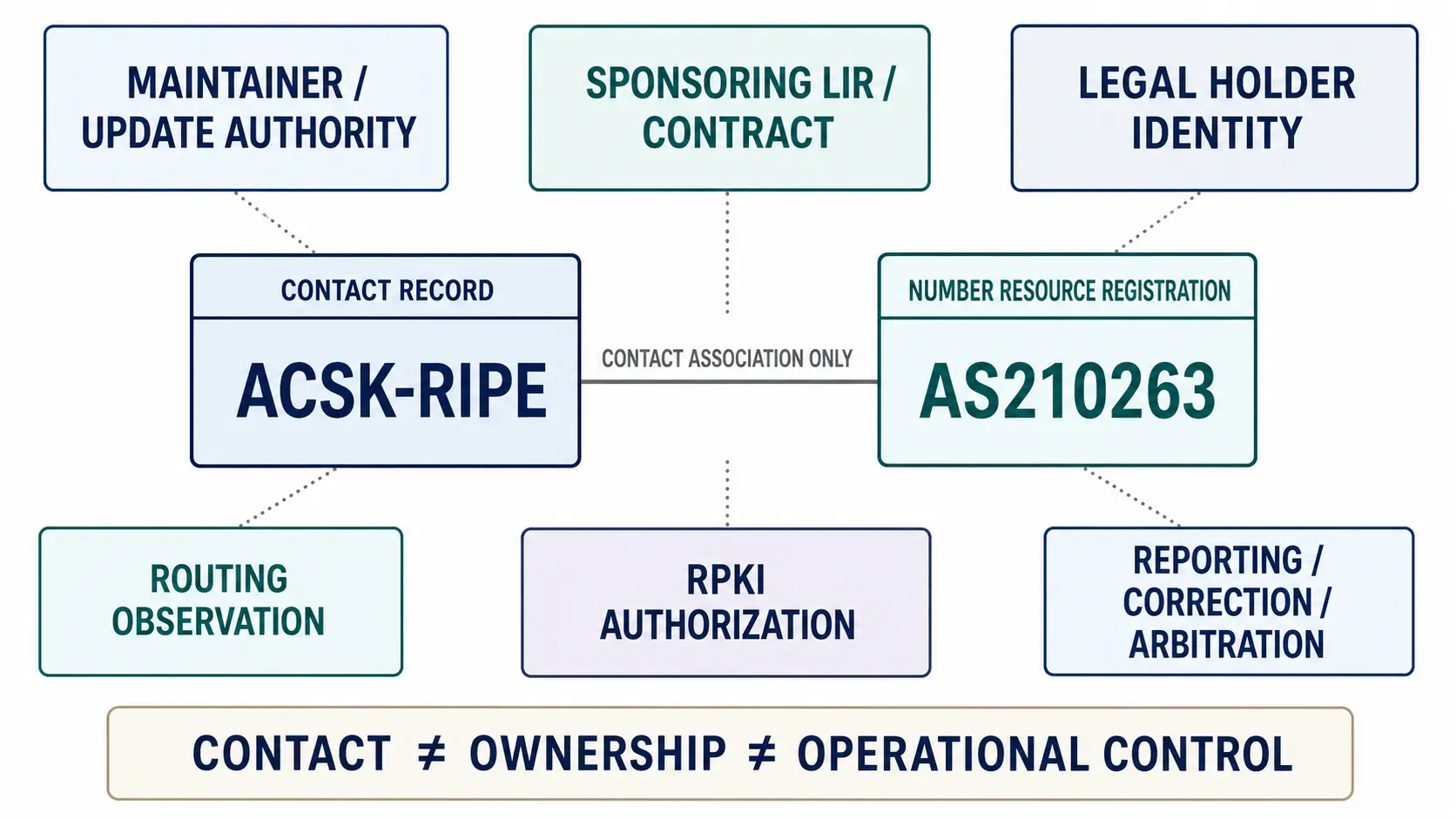
ACSK-RIPE and AS210263: A Contact Handle Is Not a Control Title
ACSK-RIPE and AS210263: A Contact Handle Is Not a Control Title intelligence summary explains the development, the public evidence available to readers, the organisations involved, the regional context, market exposure, and the infrastructure consequences that may follow. The…