
Content Type
Research
Within the Content Type facet, Research intelligence gathers BTW.MEDIA articles that share the same editorial format, helping readers compare briefings, profiles, risk notes, market analysis, and event coverage without mixing different kinds of evidence. The page explains how this content type frames internet infrastructure events, company movements, governance decisions, operational signals, and public evidence across the site. Readers can compare which actors or infrastructure systems appear most often, how source quality changes interpretation, and whether the material is a durable profile, a time-sensitive event, a strategic market signal, or a governance development. The result is a useful search page for operators, investors, customers, analysts, and policy stakeholders who need to understand the consequence, timing, and evidence behind similar article formats.

CASE FILE
PIM Flex-Algo Can Choose a Better Path. One Router's Local Policy Can Still Break the Tree
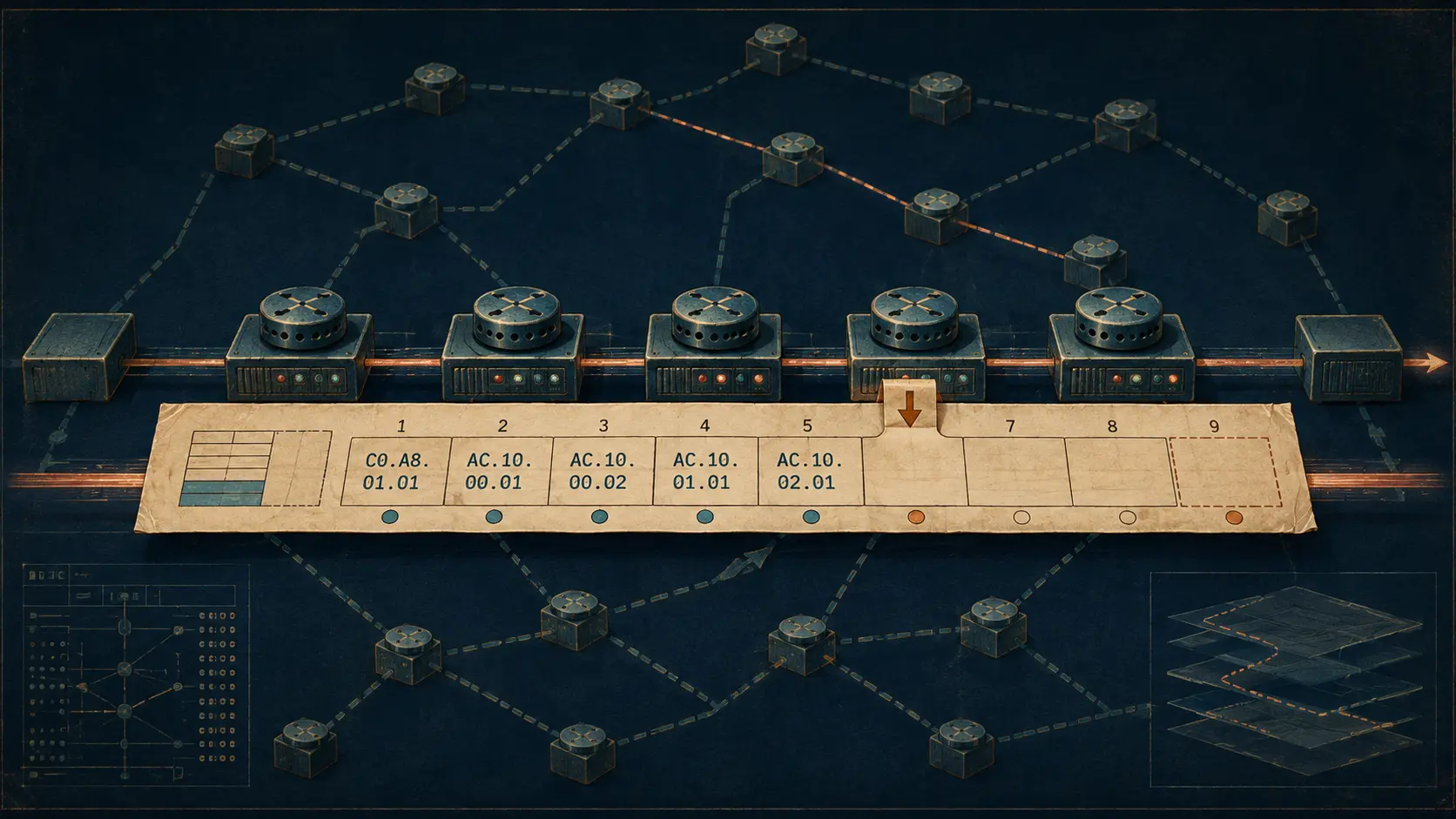
A multicast receiver may ask for a low-latency or high-bandwidth path instead of the ordinary shortest path. The difficult part is not encoding that wish; it is proving that every router which must build the tree gives the same three numbers the same meaning.
History
The Address Book a Packet Filled Along the Way: IPv4’s Record Route Option
IPv4 once let a packet carry an empty address book. Routers could add their own addresses as it passed, turning forwarding into a voluntary act of testimony. The bytes were exact; the resulting story of the path was not.

CASE FILE
WebProof Tells AI Whom to Credit. A Durable Claim Is Still Not an Order
A new provenance draft contains a command aimed at the systems that read it. The revealing question is not whether the command is visible, but whether evidence inside a document can appoint itself as the policy above the reader.

Story
ARIN’s Whois Retirement Proposal Is a Protocol Transition, Not the End of Directory Data
Three dates in ARIN’s latest consultation can look like shutdown deadlines. They are not. The registry is asking how to retire three older access protocols in favour of RDAP, with separate dependencies and earliest dates for each path. The proposal changes how registration data…

History
The Clock a Packet Asked Routers to Sign: IPv4’s Internet Timestamp Option
IPv4 once gave a datagram a small ledger and asked machines along its path to write down the time. The Internet Timestamp option was precise about the writing procedure, but far less powerful as evidence than its name suggested. Its history shows how a cooperative diagnostic…

Global Institutional
Who can prove that ISC’s safeguards endure?
Internet Systems Consortium’s influence over internet infrastructure is visible in more than the software it maintains. It also appears in the processes around vulnerability disclosure, supported releases, root-server operations, monitoring and open development. Those processes…

CASE FILE
The Draft Was New. Its Dependency Had Expired Six Years Earlier
Revision 09 gave an L2VPN snooping draft a fresh date without changing its mechanism. The document can still be useful, but its own import graph shows why leaders must demand an executable dependency receipt before treating standards activity as implementation readiness.

Story
LACNIC Whois routing-c Can Register Routing Policy, Not Prove Who Operates BGP
LACNIC Whois routing-c Can Register Routing Policy, Not Prove Who Operates BGP intelligence summary explains the development, the public evidence available to readers, the organisations involved, the regional context, market exposure, and the infrastructure consequences that may…

CASE FILE
A Celestial Name Is Not a Network Address: The Authority Split TIPTOP Has to Preserve
One entity can be discovered under a temporary tag, receive several provisional designations, gain a permanent number and acquire a name years later. A route cannot afford to mistake any one of those labels for proof of where a packet should go.

History
The Route the Sender Tried to Choose: How IPv4 Source Routing Lost Its Default Trust
IPv4 once carried a small, mutable itinerary inside the packet itself. The history of source routing is the history of how that sender-supplied path changed from a protocol feature into an explicitly configured exception.

History
The Address That Meant Everyone: How IPv4 Broadcasts Chose Ones Over Zeroes
IPv4 did not gain broadcasting through a new flag. It gained it by teaching hosts and gateways that some destination values did not name one machine at all. A field of ones came to mean everyone within a scope, while receivers carried an awkward obligation to understand the…

Leaders
Hisham Ibrahim and the Measurement Problem Inside Community Building
When RIPE NCC reorganised its community work in 2021, Hisham Ibrahim inherited more than a collection of events and services. He inherited a harder management question: how can an institution tell whether community activity creates lasting value rather than merely producing a…

Story
AFRINIC Whois mnt-domains Authorizes Reverse-Domain Records, Not DNS Service Operation
A database key can authorize the creation of a reverse-domain record while every DNS query to the supposed service still times out. In the AFRINIC Database, `mnt-domains` identifies a maintainer with authority over child domain-entity creation. It is evidence about registry…

CASE FILE
The IAB Gave Post-Quantum Authentication Evidence Another Week. It Still Needs a Chain of Custody
The extended deadline invites one more week of operational evidence. The harder task begins after a paper arrives: keeping measurements, disclosure choices, workshop synthesis and eventual standards work from collapsing into one unsupported claim.

History
The Bit That Made Routers Report Their Limits: IPv4 DF and Path MTU Discovery
One IPv4 flag began as a prohibition: do not split this datagram. Path MTU Discovery turned that refusal into a measurement loop. An oversized packet would be discarded, a router would report the narrow link, and the source would learn what the path could carry—provided the error…

Story
RIPE assignment-size Describes Aggregated IPv6 Assignments, Not Active Subscribers
A `/46` contains 1,024 possible `/56` prefixes. When a RIPE Database entity pairs that aggregate with `assignment-size: 56`, the arithmetic is exact—but the tempting subscriber count is not. The field records the size used for End User assignments inside an aggregate…

CASE FILE
The Message Was Encrypted. Its Headers Still Needed Their Own Receipts: RFC 9788
An encrypted-mail badge compresses a complicated evidence chain into one reassuring symbol. RFC 9788 shows why the symbol cannot answer which header was hidden, which sender identity was authenticated, what an intermediary changed, or where a reply may safely go.

CASE FILE
A CA Audit Is Not a Certificate-Issuance Verdict
An annual assurance report can show that a certificate authority’s controls were examined over a bounded period. It cannot, on its own, answer the smaller and more consequential question a relying party often needs to ask: why was this exact certificate for this exact name and…

CASE FILE
Four Bits Looked Like IP. They Were Not: RFC 9790 and the End of Payload Guessing
An MPLS router can see `0x4` after the label stack and reach for an IPv4 hash. RFC 9790 explains why those four bits cannot carry that conclusion on their own.

CASE FILE
One Circuit Failed. The Port Did Not: RFC 9784 and the Cost of the Wrong Failure Domain
A provider edge port can carry thousands of virtual services. RFC 9784 asks operators to prove which entity failed before allowing recovery to inherit the size of the container.