
Content Type
Analysis
Within the Content Type facet, Analysis intelligence gathers BTW.MEDIA articles that share the same editorial format, helping readers compare briefings, profiles, risk notes, market analysis, and event coverage without mixing different kinds of evidence. The page explains how this content type frames internet infrastructure events, company movements, governance decisions, operational signals, and public evidence across the site. Readers can compare which actors or infrastructure systems appear most often, how source quality changes interpretation, and whether the material is a durable profile, a time-sensitive event, a strategic market signal, or a governance development. The result is a useful search page for operators, investors, customers, analysts, and policy stakeholders who need to understand the consequence, timing, and evidence behind similar article formats.

Story
LACNIC's ASN-Only Label Is Not a Test of Network Use
LACNIC's ASN-Only Label Is Not a Test of Network Use intelligence summary explains the development, the public evidence available to readers, the organisations involved, the regional context, market exposure, and the infrastructure consequences that may follow. The Story…

Story
ARIN’s IPv6 CSV Has a Spelling Problem, Not a New Address
An uppercase letter in an IPv6 export does not allocate a second network. It can still give a spreadsheet, log search or text-based join a second name for the same one. An ARIN customer asked for lowercase in the Manage Networks CSV; ARIN agreed that the change would be more…

History
The mailbox had been deleted. One client could still read it: RFC 2180
In 1997, IMAP documented an awkward but useful truth: two clients could be attached to the same mailbox and temporarily inhabit different operational realities. Interoperability did not require every server to erase that difference in the same way. It required clients to survive…

History
Version 3 Stayed. The Service Changed: RFC 2126’s Compatibility Trap
An old peer could return a perfectly parseable Class 0 confirmation to a Class 2 request that offered no alternative. The TCP connection was open, the TPKT version was familiar, and the reply was still unacceptable. RFC 2126 made that difference explicit.

History
Permission Came Before the Call: RFC 2125’s Two-Stage Bandwidth Decision
Two peers could agree that another line should be tried and still have no new bandwidth. RFC 2125 made that gap explicit: BAP first obtained a response to the proposed action, then a separate Call-Status message reported what happened when somebody actually placed the call.

History
The Locator Moved. Then the Network Moved: RFC 2103
Nimrod’s mobility paper began with an elegant separation: keep the endpoint’s identity stable and update the locator that says where it can be reached. Then it found the case that broke the elegance—a network could move while the endpoint’s locator stayed the same, leaving the…

History
The Tree Was Not Standardized. The Forwarding State Was: RFC 2102
Nimrod declined to choose one multicast tree algorithm. Its narrower bargain was more durable: different methods could coexist if routers agreed on the shape and meaning of the state that actually replicated packets.

Story
RIPE NCC Kept the Lameness Checks and Stopped the Emails
In 2009, RIPE NCC separated two activities that are often mistaken for one: it continued periodic checks of broken DNS delegations and ended the bulk email alerts generated from them. The decision is a useful historical operating case in what an infrastructure measurement can…

Story
LACNIC’s WHOIS Shows the Origin ASNs but Not Their Authorization Boundary
LACNIC’s WHOIS Shows the Origin ASNs but Not Their Authorization Boundary intelligence summary explains the development, the public evidence available to readers, the organisations involved, the regional context, market exposure, and the infrastructure consequences that may…

Story
ARIN’s Legal RPSL Still Produced a Partial Mirror Answer
A recursive query returned seven ASNs. The reference described in ARIN’s public suggestion contained far more. Nothing in that contrast required the routing policy to be invalid: the failure could sit in the journey from a logical set, through one very long physical line, into a…

Story
APNIC Wants Login to Read the Current IRT Email State
An account should not inherit yesterday’s lock answer when today’s IRT contact state says something else. APNIC’s 2026 roadmap proposes replacing reliance on a static account lock flag with a login-time check of continuously tracked IRT email validity. That is a small sentence…

Story
AFRINIC's Resource Certificate Can Be Valid Without Naming the Member
A resource certificate with a generated, apparently meaningless Common Name can be doing its job perfectly. AFRINIC’s own practice statement shows why: the public certificate proves a bounded resource authorization, while a different chain connects the request key to a…

Global Institutional
LibreNMS and the operating cost of seeing the network clearly
LibreNMS gives operators a transparent, self-hosted way to discover devices, poll counters, build inventory and turn network state into alerts. Its credibility does not come from a promise that open source is automatically safer or cheaper. It comes from an operating bargain: the…
Global Institutional
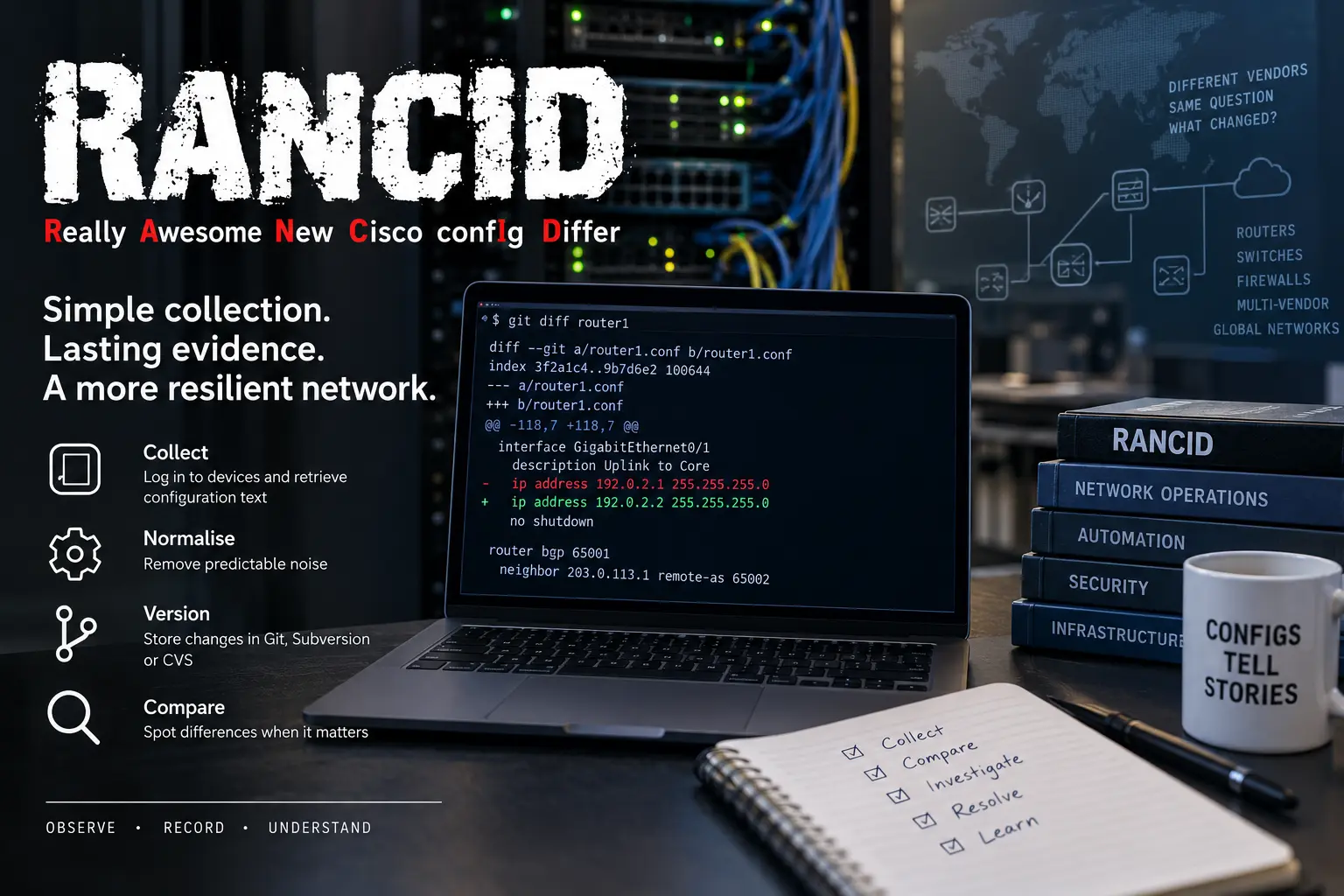
RANCID and the enduring value of a one-line network diff
RANCID has survived successive eras of network management by doing one narrow job: logging into devices, collecting selected configuration text, removing predictable noise and committing the result to version control. It does not model intent, approve changes or reconstruct every…

Story
LACNIC Approved the Security Framework Before Measuring the Baseline. The Next Control Is a Versioned Maturity Receipt
The May board record exposes a useful sequence: authorize the framework, have outside experts measure the current state, and only then choose the destination. That order is not evidence of a security failure. It is a reason to keep approval, implementation, target-setting…

Story
Rapport Counts Outcomes Only After a Requested Test Path Exists
LACNIC’s revised Rapport runner can expand several category and test selectors into a matrix. Yet a requested cell with no matching directory leaves no row in the result: it returns before a test identity is printed or any outcome counter moves.

Story
APNIC’s Two-Nameserver Run Had Fewer Repeats. The Difference Still Needs a Reproduction Receipt
APNIC measured fewer authoritative DNS queries in a later run using two nameservers than in an earlier run using one. The observation is real in the published aggregates; the cause is not settled. A reproducible decision needs the two treatments to share a clock, cohort and…

Story
AFRINIC’s Holiday Notice Appeared One Day Before Closure. That Is Not a 72-Hour Verdict
AFRINIC’s public record shows a 14 September notice for a 15 September office closure. Its service commitment speaks of seventy-two hours, but on a different channel: announcement mail. The right audit separates the website, the mail record, human response time and always-on…

History
The Server Stopped Speaking It. The Client Still Had to Understand: RFC 2062
In December 1996, IMAP drew a line that software migrations still struggle to express. A new server could retire an old command without demanding that every client forget how to read it. RFC 2062 made compatibility directional: stop producing obsolete syntax, keep only the…

Story
LACNIC’s Election Upload Test Reads Bytes, Not Excel or PDF
A new compatibility test in LACNIC’s open election system carries two reassuring filenames across a disk boundary. The bytes arrive intact. That is valuable evidence—but it is evidence about transport, not about whether a workbook or a result letter is a valid document, whether…