
Summary
- Expresnet looks economically credible where it can turn local scarcity into dense recurring revenue: own-fiber, wireless and Air Metro Ethernet products give it several ways to reach Antalya customers, but each new account has to repay installation, backhaul, customer equipment, field labour and support before churn or faults consume the tariff.
- The routing footprint is real but small. AS213658 is active, has a valid route-origin authorization for 185.130.102.0/24 and is visible as a one-prefix IPv4 network, but that number-resource evidence should not be confused with proof of broad national retail scale.
- The best upside is an Antalya access-density story: Expresnet can win buildings, underserved neighborhoods and small businesses that value fast local installation or wireless reach. The risk is that national operators, inflation-linked costs, limited public interconnection diversity and customer-service friction leave too little margin after every truck roll.
- A stronger positive judgment would require verified take-up, churn, fault, backhaul-cost and gross-margin data. A weaker judgment would follow if public complaints cluster in the same dense service zones, if upstream dependence stays narrow, or if new customer growth requires installations that cannot be recovered inside the first contract period.
The payer is buying availability before elegance
The most important economic fact about Expresnet is the identity of the payer. The payer is a household in Aksu or Muratpasa that wants the internet to work tonight. The payer is a small office that cannot wait for a national carrier's standard process. The payer is a hotel, school, retailer, construction-site office or local services company that needs enough bandwidth, a reachable support desk and a line that can be installed without turning procurement into a project. That payer does not care whether the path begins with fiber, VDSL, a radio hop or a wholesale handoff.
The payer cares whether the line arrives, whether the monthly bill is understandable and whether a fault is fixed before lost work exceeds the saving from choosing a local provider.
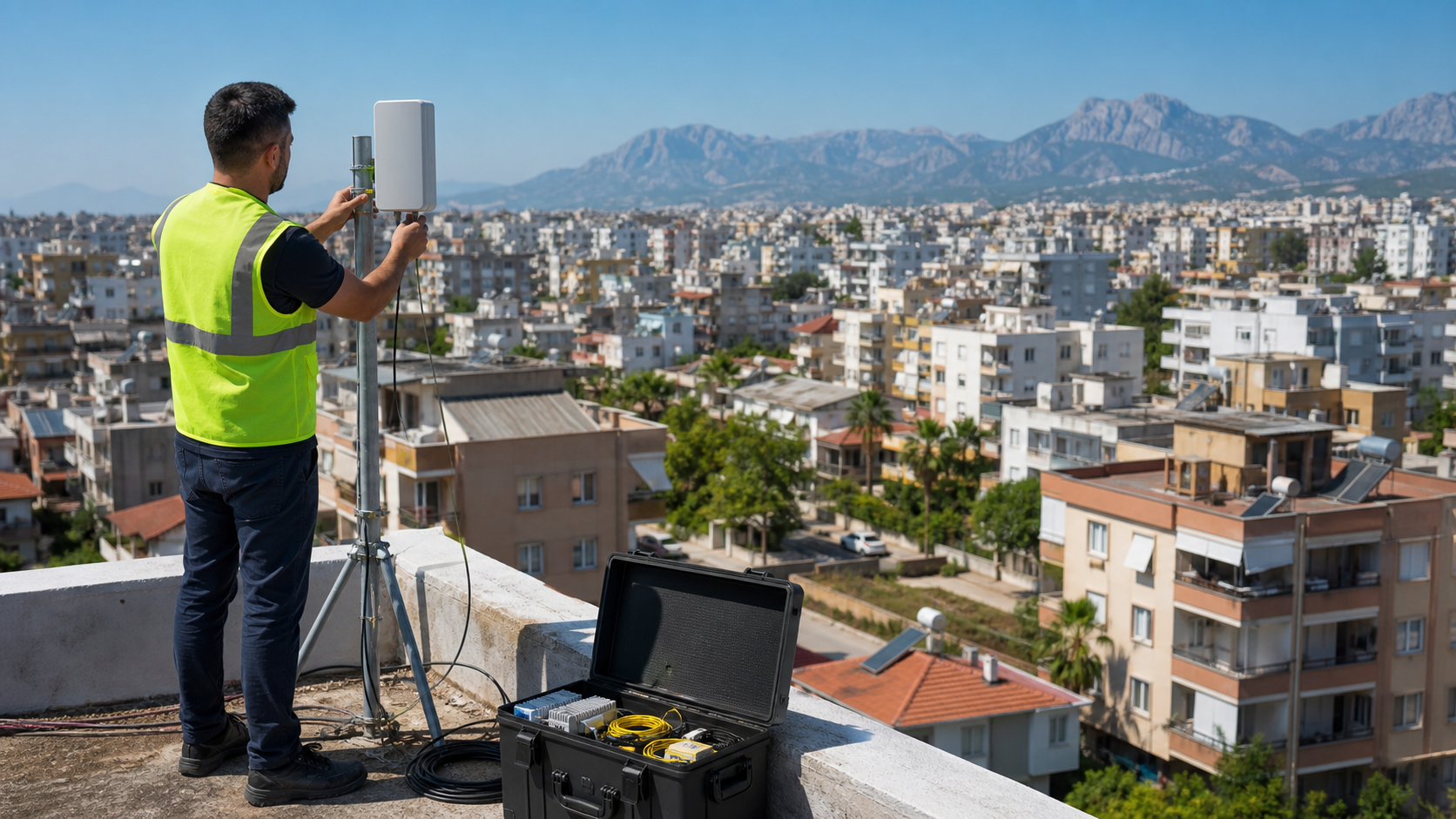
That is why the analysis has to start with incentives. Expresnet is not monetizing abstract internet growth in Turkey. It is monetizing pockets where national networks, building access, local construction timing or customer-service preferences leave a gap. Its own pages repeatedly sell immediacy, unlimited use, no complicated commitments, local contact and multiple access modes. The company advertises fiber, VDSL, wireless internet, corporate internet and Air Metro Ethernet. It claims an Antalya-centered operating base and presents recently added service areas in Antalya neighborhoods. Those are not decorative details.
They define the revenue opportunity and the cost burden.
The customer-acquisition logic is plausible. In a fast-growing district such as Aksu, a new apartment, shop row or business cluster may value any provider that can reach the address before a larger carrier's installation queue clears. A local wireless or fiber provider can sometimes win that customer by being physically close, by knowing the neighborhood, or by offering a plan that avoids the psychological cost of a long commitment. The incentive is strongest where the customer feels underserved.
Public complaint posts are not representative market research, but several mention local dependence in Antalya areas where customers believed better-known alternatives were not available. That is exactly the kind of gap a regional ISP can monetize.
But the same incentive contains the trap. A customer acquired because no one else is available is not necessarily loyal once a national operator or fiber challenger arrives. A customer who pays because installation is urgent can become a churn risk if evenings are congested, Wi-Fi support is poor, a radio path degrades, or customer service is hard to reach. Expresnet therefore needs more than sign-ups. It needs accounts dense enough to make each intervention cheap, tariffs high enough to absorb hardware and labour, and service good enough that the first available alternative does not take the customer away.
The payer's monthly bill must cover several layers. There is the initial sale, site check, customer-premises equipment, modem or radio receiver, cable pull, activation, address record, billing setup and possible transfer from another operator. Then there is backhaul, upstream transit or wholesale access, power, tower or roof rights where radio is used, support staff, fault calls, replacements, administrative compliance and collection. The customer sees a monthly price. The operator sees a payback clock.
Expresnet's opportunity is that some customers will pay for a local operator that solves a real access problem. Its risk is that the same local access problem is expensive to solve one address at a time. The article's core judgment is therefore not whether Expresnet is "an ISP" in a legal or registry sense. It is whether enough of its customers can be clustered, supported and retained so the economics of every new connection stay positive.
The operating boundary is Antalya access, not national backbone scale
Expresnet's own public identity is broad in wording but local in evidence. The company describes itself as Antalya-based and says it offers Radyolink or Airfiber, VDSL, Fiber and Metro internet to individual and corporate customers. It also says it has operated since 2015. The contact footprint is Aksu, Antalya. The service-area page lists recently added locations in Antalya districts such as Aksu, Muratpasa and Kepez, and it presents an address-check flow rather than a fully national coverage map.
That evidence makes the operating boundary clear enough: Expresnet should be judged as a regional access provider with a local construction and support burden.
There is a national note in the company's self-description. Its LinkedIn page says Expresnet serves customers across Turkey and operates traffic collection points, using equipment in incumbent exchanges to carry wireless, ADSL, VDSL and fiber traffic to its backbone. That claim is useful, but it is still self-reported. It also does not change the economic question. A local ISP can have traffic aggregation arrangements or services outside one city while still earning or losing money through neighborhood-level density.
For this article, the safest boundary is the one that public product and contact evidence can support: Antalya-centered access service, with broader claims treated as possibilities rather than audited scale.
The number-resource evidence supports a real operator, but not a large one. RIPE records identify Expresnet Elektronik Haberlesme Bilisim Ve Ticaret Limited Sirketi as a Turkish Local Internet Registry. AS213658 is assigned, active and associated with the expresnet name. The announced prefix is 185.130.102.0/24. Current routing-status evidence shows one announced IPv4 prefix, 256 IPv4 addresses, no visible IPv6 announcement and one observed neighbour. The route has valid RPKI origin validation. That is a clean enough technical footprint to show that the company is not merely a reseller with no public routing presence.
Yet this evidence must be kept in its lane. A /24 and an ASN are not proof of thousands of paying customers, enterprise concentration, backhaul resilience or high utilization. They show control of a small public IPv4 block and participation in BGP. The RIPE aut-num also contains import/export policy statements involving several ASNs, while current public routing views show only one observed neighbour or upstream in the most visible summaries. The difference matters. Registry policy can describe intended or authorized routing relationships; live observation tells us what is visible to collectors at a point in time.
Neither source by itself proves the monetized service base.
That separation is important because local ISP economics often depend more on access engineering than on public address space. A provider can serve many residential customers behind carrier-grade NAT with little public IPv4. It can also have public address space and still serve a narrow base. The scarce facts are not the ASN and route. The scarce facts are active subscribers, average revenue, contention ratios, customer-acquisition cost, fault repeat rate, backhaul cost per megabit and churn. Those are not publicly disclosed.
The operating boundary should therefore be described with restraint. Expresnet appears to be a real Antalya-centered access operator, with product evidence across fiber, wireless, VDSL, corporate internet and Air Metro Ethernet, and with a small active public routing footprint. It should not be described as a national backbone, a large wholesale platform or a broad fiber infrastructure owner without more evidence. That distinction protects the economic analysis from the common mistake of turning registry data into scale.
The tariff ladder exposes a payback clock
Expresnet's public prices are useful because they show what the company asks the customer to pay for different access problems. The most striking consumer offer is the Expres Fiber ladder: 35 Mbps symmetric at 500 TL per month, 50 Mbps symmetric at 550 TL per month and 100 Mbps symmetric at 600 TL per month, each with a 12-month commitment. On paper, the 100 Mbps own-fiber plan produces 7,200 TL of gross recurring revenue over a year before taxes, access costs, backhaul, equipment, labour, collection and support. That is not a large envelope if the installation requires meaningful civil work or repeated technician visits.
The separate fiber page shows a different ladder: 35 Mbps at 840 TL without commitment, 890 TL with 12 months, 100 Mbps at 940 TL without commitment and 990 TL with 12 months. The upload speeds there are 12 Mbps for 35 Mbps download and 20 Mbps for 100 Mbps download, so it looks different from the symmetric own-fiber offer. The inconsistency does not make the data useless. It tells us that Expresnet sells several access products under similar language and that contract terms, infrastructure type and equipment conditions matter.
A customer in one building may be an own-fiber symmetric customer; another may be on a different fiber or access arrangement with a different margin.
Wireless pricing is lower and riskier. The wireless page lists unlimited no-commitment plans from 8 Mbps at 330 TL per month to 50 Mbps at 650 TL per month, with an explicit need for a special receiving device. The appeal is obvious: wireless can reach places where fiber or copper is absent, slow or delayed. The cost problem is equally obvious. A radio receiver, alignment, rooftop access, line of sight, interference checks and later support can eat into a low monthly tariff quickly.
No-commitment pricing makes recovery even harder if the customer leaves after a few months or complains because evening capacity feels worse than the headline speed.
Corporate packages improve the revenue side but require better execution. The corporate internet page lists 10-100 Mbps packages and speaks of static IP, 7/24 technical support and priority handling. The Air Metro Ethernet page is the clearest business-margin signal: 15 Mbps symmetric is priced at 2,850 TL per month, 50 Mbps at 6,000 TL and 200 Mbps at 13,500 TL. These packages include static IP and support, and the FAQ says installation is generally 15 business days while the legal period can be 90 business days. It also says installation and activation up to 100 Mbps cost 10,000 TL, with above-100 Mbps installation borne by the company.
That 10,000 TL installation figure is the whole economics in miniature. It is bigger than one year of gross revenue from a 100 Mbps Expres Fiber consumer account at 600 TL per month. It is smaller relative to a 50 Mbps or 100 Mbps Air Metro Ethernet business account. The conclusion is not that one product is good and another is bad. The conclusion is that Expresnet needs the right product for the right payer. Consumer own-fiber can work with density and low fault rates. Wireless can work if equipment is reused, support is light and churn is contained.
Air Metro can work if business customers are creditworthy and contract duration is long enough. A mismatch between access cost and tariff can destroy the payback.
The tariff ladder also suggests an upsell path. A household may begin with wireless because fiber is unavailable. A business may begin with ordinary corporate internet and later need static IP, symmetric service or a dedicated link. A building cluster may move from expensive per-customer installs to a denser fiber distribution point. Expresnet's value is greatest when it can convert an isolated installation into a cluster of accounts. Its value is weakest when every account remains a bespoke job.
Density is the hidden balance sheet
For a regional ISP, subscriber density is a balance-sheet item even when it does not appear in a public filing. A dense street turns field labour into a repeatable route. A dense apartment block spreads feeder fiber, cabinet work, access permissions, spares and support knowledge across many paying accounts. A dense business district can justify better backhaul and faster fault response. Sparse customers do the opposite. They turn every install and repair into a custom cost centre.
Expresnet's service-area page is therefore more revealing than a generic coverage claim. It lists ten active regions and recently added Antalya neighborhoods. It invites the user to check an address by province, district and neighborhood. It advertises symmetric speed up to 200 Mbps in that service-area context. This is exactly how a local-access business should be evaluated: not by the number of provinces in a brochure, but by how many customers can be won per distribution point, per radio sector, per technician route and per backhaul path.
The company's business page claims more than 100 business customers, more than 20 fiber distribution centers and more than 70 radiolink points. Those numbers are not independently audited in the public sources, so they should not be turned into a hard valuation. But they are economically meaningful as claims. If true, they suggest a hybrid network where fiber distribution and radio reach work together. The company would then have a chance to win both fixed locations and difficult-to-wire addresses. If the counts are promotional or include low-utilization points, the economics are weaker.
Density also determines support cost. A customer problem in a dense cluster may be solved by fixing a common upstream path, adjusting a sector, replacing a shared device or improving power at one distribution point. A customer problem at the edge may require a separate visit, a roof climb, a new alignment, a modem swap or customer education. The customer's tariff may be similar in both cases; the operator's cost is not. This is why the public complaints matter even though they are not representative.
The complaint themes are not only "some customers are unhappy." They point to the cost categories that can ruin density economics: evening slowdown, repeated outages, unreachable support, ping spikes and frustration after installation.
The company sells 7/24 support on several pages, while one public contact page lists actual office hours. That may simply distinguish technical support from front-office contact, but it also shows how support promises can become expensive. A local ISP can promise availability as part of its differentiation. If customers believe support is not reachable at the moment service fails, the same promise becomes a churn driver. The economic test is whether Expresnet can deliver enough support to protect retention without staffing every complaint at a cost that overwhelms the tariff.
The strongest local-operator case is a cluster model. Expresnet identifies a neighborhood where fiber rollout is incomplete, installs or uses a distribution point, supplements with radio where needed, wins multiple households or businesses, keeps truck rolls close, collects through digital payment and online self-service, and uses visible local support to retain customers. The weakest case is a scattered model: one difficult wireless customer here, one low-tariff VDSL customer there, a few price-sensitive households switching as soon as Turk Telekom, TurkNet, Superonline or Vodafone improves availability.
Public evidence does not prove which model dominates, but it tells us exactly what to watch.
Wireless access solves reach and creates liabilities
Wireless internet is not a second-rate product by definition. In the right terrain and density, fixed wireless can be a rational way to serve customers ahead of fiber or beyond the economic edge of copper. Expresnet's wireless page advertises unlimited no-commitment plans and describes wireless internet as radio-wave access. Its business page describes radiolink as a way to serve locations where cable access is not possible. For a regional operator in Antalya, that flexibility can be valuable. New housing, tourism sites, semi-rural edges and business premises may need service before wired access is economical.
The liability is that wireless makes the customer experience more variable. Line of sight, interference, sector load, weather exposure, rooftop rights, customer equipment quality and installation workmanship all matter. A fiber tariff can fail too, but wireless faults are often more visible to customers because speeds and latency can change by hour. Public complaint posts about evening problems and ping spikes cannot be treated as a statistical sample. Still, they are consistent with the generic risk of a wireless or capacity-constrained local access network: the customer remembers the worst evening, not the average month.
The no-commitment structure compounds this. A no-commitment wireless customer is easier to acquire, but also easier to lose. If Expresnet provides a receiver, visit and setup effort, it has to recover that cost from either activation fees, monthly margin or equipment reuse. If the customer pays a low monthly price and leaves after a better wired option appears, the operator may recover too little. If the company increases activation fees to protect payback, it weakens the "quick local solution" sales pitch.
The corporate radiolink product has a clearer economic role. Point-to-point or Air Metro Ethernet service can be valuable where a business needs symmetric bandwidth, static IP and faster deployment than a full fiber construction project. The tariff can justify survey work, equipment and support if the customer signs for 12 or 24 months and actually values continuity. The installation FAQ, with a normal 15-business-day expectation and a much longer legal period, hints at the operational reality: this is not a commodity click-to-connect product. It requires feasibility, planning and sometimes patience.
Expresnet's best wireless economics probably sit between emergency availability and premium business continuity. It can use wireless to win customers where wired carriers are slow, then keep the customer by delivering better local service or later migrating dense pockets to fiber. It can also use radiolink for business customers whose value justifies support. It should be careful about treating low-price wireless as a volume engine if capacity and service staffing do not scale. The revenue looks recurring; the cost arrives through faults, replacements and churn.
Enterprise and Air Metro are the margin counterweight
Consumer broadband builds density, but enterprise accounts can make the network worth owning. Expresnet's corporate pages try to sell exactly that higher-value layer. They emphasize business-specific configuration, security focus, 7/24 support, assigned sales visits, infrastructure assessment, fiber or Air Fiber selection and installation. The Air Metro Ethernet page adds static IP, symmetric speeds and support. These claims matter because a local ISP cannot rely only on household price competition against national operators. It needs accounts where local presence, fast troubleshooting and tailored access create a price premium.
The 15-200 Mbps Air Metro tariff ladder suggests where that premium might live. A 15 Mbps symmetric business link at 2,850 TL per month is not cheap compared with mass-market home internet, but it may be reasonable for a shop, school, clinic, hotel back office or local company that values upload, static IP, stability and a reachable technician. At 100 Mbps and above, the monthly tariff is high enough to absorb a more complex installation if the customer stays. The problem is customer concentration.
A small operator with a few high-paying business customers can look profitable until one hotel group, campus or local enterprise switches provider or renegotiates.
No public source provides Expresnet's business-customer concentration, renewal rates or bad debt. The company's business page claims more than 100 service-taking businesses. If accurate and diversified, that is a healthier base than a handful of large accounts. But "100+" does not reveal revenue weight. Ten high-paying Air Metro customers can matter more than ninety small offices. The article therefore treats the business segment as necessary but unproven.
Enterprise service also raises the capability bar. Static IP, VPN/firewall language, symmetric bandwidth and 7/24 support are not only marketing features. They imply more serious fault accountability. A household may tolerate occasional support delays if the price is low. A business paying several thousand lira per month will expect escalation, outage communication and maybe contract clarity. That requires staff, process and spares. The public documents page, with repair, complaint, cancellation and inter-operator forms, shows some operational maturity. It does not tell us how quickly faults are resolved.
The business upsell works only if it is attached to a controlled access boundary. Expresnet's sales flow says the team visits, determines whether fiber optic or Air Fiber is appropriate and completes installation after planning. That consultative model is expensive if every lead is low value. It is valuable if site visits convert into multi-year accounts, referrals in the same commercial building, or business clusters around the same distribution point. Again, density is the hidden asset.
The firm conclusion on enterprise is conditional. Expresnet needs corporate and Air Metro revenue to lift average margin and justify deeper infrastructure, but those products add service obligations. They are not a free profit pool. The business can earn attractive returns if contracts are long enough, accounts are diversified and installation is repeatable. It can disappoint if each enterprise job is bespoke, supplier-dependent and support-heavy.
Upstream dependence is manageable only if it stays priced and resilient
Expresnet's public routing evidence makes upstream dependence central to the analysis. RIPE routing-status data shows one observed neighbour at the current query point. BGP.tools and Hurricane Electric both display a very small network with one IPv4 prefix and Vodafone Turkey or Vodafone Net visible in the path context. The RIPE aut-num object lists import/export policy with several ASNs, including Vodafone and other networks. The safe reading is that Expresnet has registry policy for multiple routing relationships, while public collectors currently see a narrow live footprint.
That is not automatically a defect. A local ISP can operate profitably with a small public AS if it buys good upstream service, manages internal access well and prices customers properly. Transit and backhaul are costs, not vanity metrics. A small operator does not need a glamorous peering map to serve households in Antalya. It does need enough upstream capacity, redundancy and bargaining power to avoid becoming hostage to one path, one supplier or one price reset.
The cost side is sensitive. If Expresnet's traffic grows because it wins more households, evening usage and streaming can pressure upstream capacity faster than revenue grows. If it wins business accounts, it may need stronger service-level expectations. If it uses wireless access, it has to manage both last-mile capacity and upstream capacity. A cheap acquisition campaign can therefore create a network cost problem if the company sells too much usage at too little margin.
Supplier dependence goes beyond transit. Fiber equipment, routers, switches, optical modules, wireless radios, towers, rooftop rights, modems, power protection and software systems all have replacement cycles. Some are imported or priced against currencies stronger than the lira. Some require trained technicians. Some are tied to warranties or vendor availability. The public sources do not identify Expresnet's suppliers, leases or debt. But the macro context is enough to make the risk real: Turkish revenue is in lira, while parts of network equipment and software support often have dollar or euro exposure.
High inflation sharpens the issue. The central bank's consumer-price table shows annual CPI above 30% in June 2026. A regional ISP can raise nominal tariffs, but customers compare against national promotions and their own household budgets. If labour, rent, fuel, equipment and backhaul rise faster than effective ARPU, the operator's payback clock stretches. A company can look busy and still destroy value if every new subscriber requires hardware bought at expensive currency rates and monthly pricing that cannot catch up.
The upstream and supplier question therefore reduces to resilience and bargaining power. Expresnet does not need to become a large peering network. It does need enough supplier diversity, backhaul options and capacity planning to keep quality stable when customers use what they bought. A one-prefix network can be economically healthy if the access clusters are dense and upstream contracts are rational. It can be fragile if the visible simplicity reflects single-path dependence and weak negotiating leverage.
Competition sets the price ceiling
Expresnet's prices should not be read in isolation. Turkish households and small businesses can compare against Turk Telekom, Turkcell Superonline, TurkNet, Vodafone and local alternatives. Even when a national carrier is not available at a specific address today, its published prices shape customer expectations. A local ISP can charge a premium for availability, symmetric upload, fast installation or support. It cannot ignore the national reference price forever.
The current competitor pages show that national and challenger operators keep the market disciplined. Turk Telekom markets first-six-month promotional rates on 50, 100, 200, 500 and 1000 Mbps packages and also presents 12-month fixed-price alternatives. Superonline advertises 100 Mbps fiber packages around 800 TL per month after free or discounted opening periods, includes modem and installation in some offers, and offers no-commitment fiber options at higher monthly prices. TurkNet sells a simple, no-commitment proposition and advertises a 12-month prepaid fixed-price offer around 699.90 TL per month.
Vodafone's residential page lists a 200 Mbps fiber package at 1,039 TL per month with modem, fixed-price guarantee and churn-fee support.
Against that background, Expresnet's own-fiber 100 Mbps at 600 TL is attractive if the customer can actually get symmetric service at the address. The general 100 Mbps fiber product at 940-990 TL is closer to national no-commitment or fixed-price references and must compete on availability, local support or speed to install. Wireless at 330-650 TL can be attractive in underserved pockets, but it has to overcome lower speed and potential variability. Air Metro is a different market; its comparison is not mass-market home fiber but business-grade access with static IP, symmetry and deployment where normal fiber is hard.
Competition also affects churn. National operators can pay churn-fee support, bundle mobile or TV, include Wi-Fi hardware, run online discounts and absorb installation costs over a larger base. TurkNet can sell simplicity and digital support. Superonline and Vodafone can use brand, modem inclusion and promotional periods. Turk Telekom has infrastructure scale and broad fixed-line presence. Expresnet's counter is local reach and flexibility. That is valuable, but it is not unlimited.
The most dangerous competitor is not always the cheapest plan. It is the arrival of a credible wired alternative in a building where Expresnet previously had a local access advantage. If a national operator installs fiber in an underserved block, customers who tolerated wireless variability or higher setup fees may reassess. If Expresnet has already recovered installation cost and retains customers through service quality, the arrival of competition is manageable. If it has not, the payback is cut short.
The pricing conclusion is firm: Expresnet can win on local availability and tailored access, not on a permanent ability to price above national references. Its tariffs have to carry enough margin for field work while staying close enough to the customer's comparison set. That is a narrow corridor. The company earns its return by knowing exactly which addresses and businesses sit inside that corridor.
Regulation is a cost surface, not just a badge
The company's business page says Expresnet is a BTK-licensed corporate internet service provider. Its presence in RIPE as a Turkish Local Internet Registry and in public telecommunications payment lists supports a regulated operating posture, though the captured sources do not include a dated official BTK row for the exact company query. The distinction matters. Regulatory status is important, but for economics it is not enough to say "licensed." The licence and compliance surface create obligations.
Internet service providers in Turkey operate in a framework shaped by electronic communications rules, consumer protection, data protection and internet-content/access regulation. Expresnet's own KVKK disclosure refers to personal data categories that are natural for an access provider: identity data, contact data, customer transactions, invoice and payment data, IP address and access logs. These are not incidental. They require systems, retention discipline, security and customer-process controls. A small ISP cannot escape those obligations by being local.
Regulation also affects customer switching and complaints. The documents page includes cancellation, transfer, address change, complaint and inter-operator transition forms. That is operationally useful, but it also reminds us that a dissatisfied customer has formal paths. A local ISP with weak service can lose time and money in support and cancellation handling. A local ISP with strong processes can turn those same obligations into trust.
The ESB context is relevant too. Turkey's access-provider association describes membership as compulsory for internet service providers and other operators that provide internet access under the electronic communications law. That does not by itself prove Expresnet's exact status, but it shows the institutional environment in which an ISP operates. Blocking obligations, lawful requests, abuse handling and customer data are part of the job.
Regulation is also geopolitical in a broader sense. Turkey's communications market sits at the intersection of domestic regulation, 5G policy, data-locality concerns, imported network equipment and currency volatility. Expresnet is mostly a fixed/local access story, but it still buys equipment and upstream services in a market affected by these pressures. If supplier rules, security rules or import costs change, a small operator has less balance-sheet room than a national carrier.
The positive reading is that regulated status can help a local ISP win business customers. A school, hotel, clinic or local company wants a provider that can invoice properly, handle static IPs, manage data obligations and respond to formal complaints. The negative reading is that compliance consumes overhead even when subscriber scale is modest. Expresnet must carry the costs of being an operator while earning revenue one local account at a time.
Unofficial signals point to both demand and fragility
Unofficial sources need careful handling. Complaint sites are self-selected. Map ratings are thin. Social profiles are partly promotional. They should not be used as verdicts. But they can reveal pressure points that official product pages avoid. For Expresnet, the unofficial signal is not one-sided. It shows both demand for a local alternative and fragility around support and performance.
The demand signal appears when customers describe local dependence. Some public complaints refer to Antalya, Aksu or Altintas contexts where the customer felt other providers were unavailable or where infrastructure was new. That is a real market opening. If a neighborhood is growing faster than national fixed networks can serve, a local ISP can acquire customers at relatively low marketing cost. If it solves the problem well, it can become the trusted default before a national operator focuses on the area.
The fragility signal appears in the themes: evening connectivity problems, repeated outages, ping spikes, difficulty reaching customer service and dissatisfaction after installation. Again, these are complaints, not a denominator. They do not say how many satisfied customers exist. But they point to exactly the operating risks that determine margins. Evening congestion suggests capacity planning. Ping and lag suggest quality under load or radio-path issues. Unreachable support suggests staffing or process limits. Installation disputes suggest payback and expectation problems.
Yandex's local listing shows a modest review base and a mid-level rating. That is too thin to prove brand strength or weakness. It does, however, reinforce the fact that Expresnet is a visible local provider in Aksu with nearby alternatives. Visibility is useful for acquisition. Nearby alternatives limit complacency.
The article therefore uses unofficial signals as watchpoints, not as evidence of failure. A local ISP may have a higher public complaint rate because customers know the brand personally and expect quick fixes. It may also have hidden loyalty from customers who prefer local contact to a national call center. Without churn and satisfaction data, neither side can be proven. What can be said is that Expresnet's public economic case is service-sensitive. The difference between a profitable local operator and a churn-prone stopgap lies in whether those complaints are exceptions, growing pains or symptoms of structural undercapacity.
The useful question is not "are there complaints?" Every ISP has complaints. The useful question is whether complaints cluster in the same areas where Expresnet most needs density. If the most profitable neighborhoods are also the most congested, the business loses margin twice: first through repair and support, then through churn. If complaints sit at the edge while dense fiber areas work well, the business is stronger. The public evidence does not answer that question, but it identifies the map future diligence should draw.
The missing financials are not a footnote
No public audited financials were found for Expresnet in the available sources. That absence is common for a private limited company, but it matters. Without revenue, subscriber count, EBITDA, debt, capex, churn, gross margin or customer mix, the economic judgment has to be inferential. The inference is built from tariffs, product mix, routing footprint, market prices, service areas and unofficial signals. It should not pretend to be a valuation.
The missing revenue number is especially important. A company can have a polished website and a real network yet remain small. It can also have understated public routing while serving many NATed retail customers. The public ASN does not tell us either way. The self-reported 100+ business customers could represent meaningful recurring revenue if many are on Air Metro or corporate links. It could also be a broad count of low-revenue accounts. The answer changes the business.
The missing cost data is just as important. Installation cost determines payback. A 600 TL monthly own-fiber account can be excellent if the drop is easy and the building is dense. It can be poor if the installation requires repeated visits, long cable runs, customer education and later fault repair. A 10,000 TL activation fee on Air Metro up to 100 Mbps protects the company if collected and if the customer stays. It does not protect the company if waived, discounted, disputed or followed by heavy support.
The missing churn data determines whether no-commitment offers are smart. No-commitment can be a competitive weapon because customers dislike being locked in. It can also shorten payback. If customers stay because service solves a real local problem, no-commitment offers build trust. If customers leave quickly when national carriers arrive, they transfer installation risk to Expresnet.
The missing supplier data determines resilience. A local ISP can be strong with one visible upstream if the contract is well priced, capacity is ample and internal access is controlled. It can be weak with several registry-stated relationships if none are commercially useful or redundant in practice. Public routing tells us the footprint is small; it does not reveal the contract terms.
This uncertainty is not a reason to avoid judgment. It is a reason to make the judgment conditional and explicit. The public evidence supports a real, bounded operator with a plausible local niche and a demanding payback equation. It does not support claims of broad scale, strong diversification or proven profitability. That is the right uncertainty for a company research essay: enough facts to identify the mechanism, not enough to close the case.
What would change the judgment
The facts that would improve the judgment are concrete. First, address-level take-up in the listed Antalya service areas. If Expresnet can show high penetration in Altintas, Aksu, Muratpasa or Kepez pockets, the density thesis becomes much stronger. Second, installation economics by product. A breakdown of average cost and time for own fiber, general fiber, VDSL, wireless and Air Metro would show which products actually earn back their setup. Third, churn and tenure. Twelve-month contract completion, renewal rates and no-commitment tenure would reveal whether customers view Expresnet as a bridge or a durable provider.
Fourth, quality metrics would matter. Peak-hour utilization, fault repeat rate, mean time to repair, customer-support response time, installation completion time and complaint resolution would test the unofficial signals. If evening congestion is rare and localized, the current concern is manageable. If it is systemic in dense areas, it threatens the model. Fifth, upstream and backhaul data would show resilience. Actual active upstreams, capacity, redundancy, outage history and pricing would clarify whether the small public routing footprint is efficient simplicity or fragility.
Sixth, enterprise concentration would change the read. A diversified base of more than 100 paying businesses, spread across sectors and products, would make corporate and Air Metro revenue a stabilizing counterweight to consumer churn. A small number of high-paying accounts would make the company more vulnerable. Seventh, evidence of equipment reuse and inventory discipline would strengthen the wireless case. A local wireless ISP can perform well if radios, mounts, modems and spares are standardized and redeployed quickly after churn. It performs poorly if every install creates stranded hardware.
The facts that would weaken the judgment are equally specific. Public evidence of repeated outages in the same dense service areas, a rise in unresolved complaints, heavier customer discounts, waived activation fees without longer contracts, single-upstream outages, unpaid corporate accounts, or tariff increases that lag inflation and equipment costs would all make the model less attractive. So would signs that national fiber availability is expanding exactly where Expresnet earns its highest consumer margins.
The largest reversal fact would be a verified customer-count and revenue mix. If Expresnet is mostly low-tariff wireless and scattered consumer lines, the business is much more exposed to field cost and churn. If it has dense own-fiber clusters plus diversified business accounts, the same public footprint can support a healthier economics. The sources do not give that answer. They define what answer is needed.
Conclusion: a real niche with a narrow corridor
Expresnet's public evidence supports a firm but bounded conclusion. The company appears to be a real Antalya-centered access provider with its own product menu, customer-service surfaces, documented operational forms, a public ASN, a valid route-origin authorization and a small visible IPv4 routing footprint. It sells the right products for a regional ISP: own-fiber where it controls infrastructure, wireless where wired access is missing, VDSL/fiber where available, and Air Metro Ethernet for businesses that need symmetric or dedicated service.
The economic question is not whether that menu is real. It is whether the menu is profitable. The answer depends on density. A 100 Mbps own-fiber customer at 600 TL per month can be attractive in a dense building and unattractive as an isolated job. A wireless customer can be profitable if support is light and equipment is reused, or loss-making if line-of-sight, congestion and churn require repeated work. An Air Metro customer can fund deeper capability if contract length and support cost are controlled, or become a bespoke liability if installation and service expectations exceed the monthly margin.
The network-resource evidence should make readers cautious. AS213658 is active and properly visible, but it is small: one IPv4 /24, no visible IPv6 announcement and one observed neighbour in current RIPEstat data. That does not undermine the local ISP thesis; many access providers use small public address footprints. It does undermine any lazy claim of national network scale. Expresnet's investment case is local, not grand.
The competitive corridor is narrow. National operators and challengers keep customer price expectations low through promotions, modem inclusion, churn-fee support, prepaid fixed-price plans and brand trust. Inflation and currency exposure push Expresnet's costs upward. Customer complaints, while anecdotal, point to the very service issues that can destroy a local operator's margin. The company can still win if it is faster, closer and more useful in the specific addresses where national alternatives are late or poorly matched.
The final judgment is therefore conditionally constructive. Expresnet has a plausible economic role where Antalya access gaps create real willingness to pay and where clusters of customers can be served from common infrastructure. Its upside is not abstract traffic growth; it is disciplined neighborhood economics. The company must make each new account part of a denser route, a stronger business cluster or a higher-value service tier. If it does that, a small public routing footprint can still support a durable regional ISP. If it does not, every installation becomes a bet that one more monthly bill will arrive before the next truck roll.
Sources
- https://api.asrank.caida.org/v2/restful/asns/213658
- https://apps.db.ripe.net/db-web-ui/lookup?key=AS213658&source=ripe&type=aut-num
- https://bgp.tools/as/213658
- https://bireysel.turktelekom.com.tr/evde-internet/yeni-musteri-kampanyalari
- https://ipv4.bgp.he.net/AS213658
- https://oim.expresnet.com.tr/
- https://rest.db.ripe.net/ripe/inetnum/185.130.102.0%20-%20185.130.102.255.json
- https://rest.db.ripe.net/ripe/organisation/ORG-EEHB1-RIPE.json
- https://rest.db.ripe.net/ripe/route/185.130.102.0%2F24AS213658.json
- https://stat.ripe.net/data/announced-prefixes/data.json?resource=AS213658
- https://stat.ripe.net/data/as-overview/data.json?resource=AS213658
- https://stat.ripe.net/data/routing-status/data.json?resource=AS213658
- https://stat.ripe.net/data/rpki-validation/data.json?resource=AS213658&prefix=185.130.102.0/24
- https://tr.linkedin.com/company/expresnetoffical
- https://www.btk.gov.tr/en/electronic-communication-market-data
- https://www.enpara.com/sirketim/odemeler/kurum-odemeleri
- https://www.expresnet.com.tr/
- https://www.expresnet.com.tr/dokumanlar
- https://www.expresnet.com.tr/expres-fiber
- https://www.expresnet.com.tr/fiber-internet
- https://www.expresnet.com.tr/hakkimizda-detay.php?slug=sirket-bilgileri
- https://www.expresnet.com.tr/hizmet-bolgelerimiz
- https://www.expresnet.com.tr/iletisim
- https://www.expresnet.com.tr/is-yerine-ozel-internet?tip=kurumsal
- https://www.expresnet.com.tr/kablosuz-internet
- https://www.expresnet.com.tr/kurumsal-internet
- https://www.expresnet.com.tr/kvkk
- https://www.expresnet.com.tr/metro-ethernet
- https://www.mellatbank.com/en/foreign_exchange.php
- https://www.peeringdb.com/api/net?asn=213658
- https://www.ripe.net/membership/member-support/list-of-members/tr/
- https://www.sikayetvar.com/expresnet
- https://www.superonline.net/ev-interneti/fiber-internet
- https://www.tcmb.gov.tr/wps/wcm/connect/EN/TCMB%2BEN/Main%2BMenu/Statistics/Inflation%2BData/Consumer%2BPrices
- https://www.trade.gov/country-commercial-guides/turkey-information-and-communication-technology
- https://www.ttyatirimciiliskileri.com.tr/en-us/turk-telekom-group/investing-in-turk-telekom/pages/turkish-telecom-sector
- https://www.turk.net/evde-internet
- https://www.vodafone.com.tr/net/ev-internet-paketi-fiyatlari
- https://yandex.com.tr/maps/org/expresnet/123395641224/