
Summary
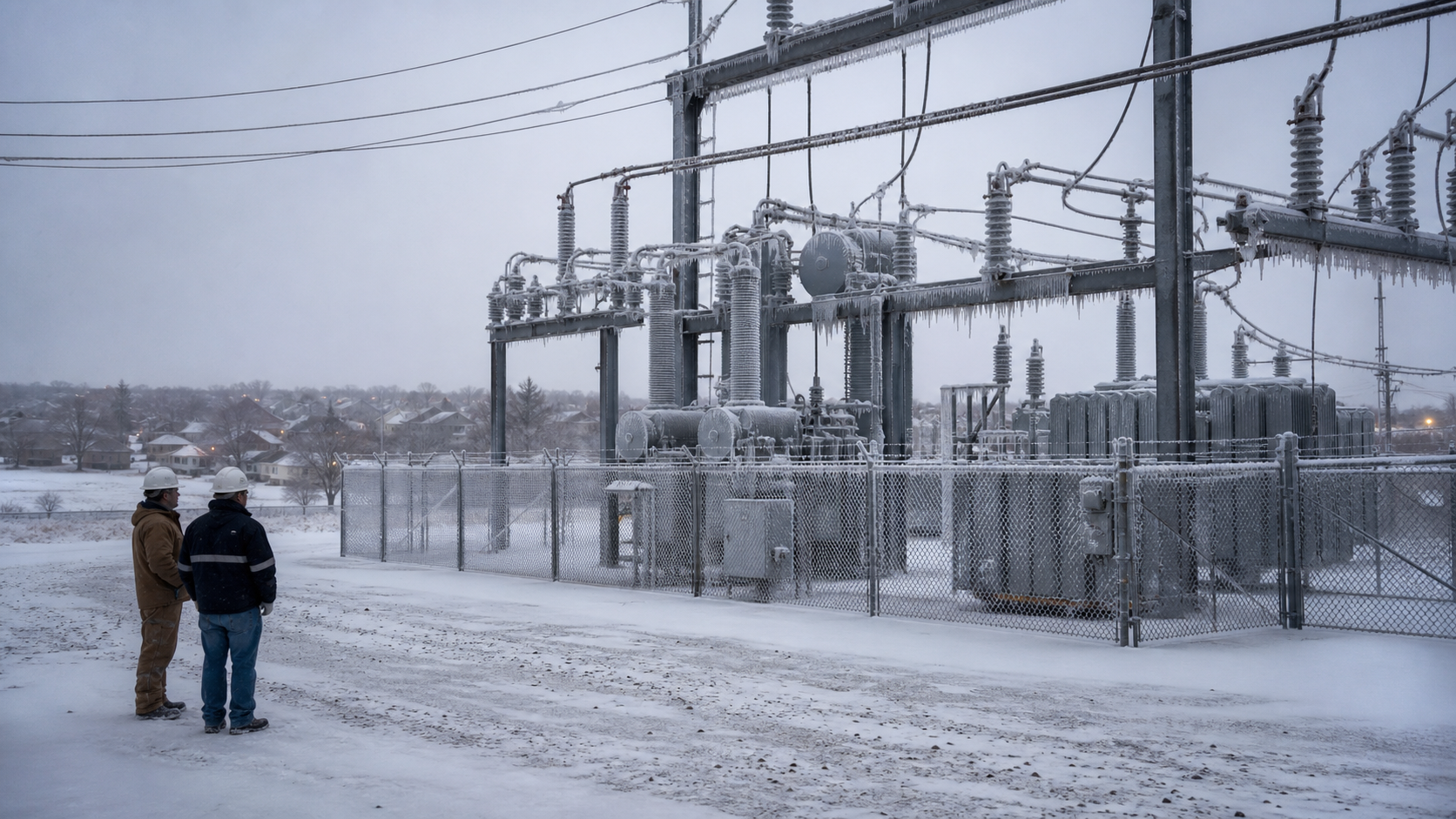
- Trigger and emergency action: Prolonged extreme cold raised electricity and gas demand while disabling generation and gas infrastructure. In the early hours of 15 February 2021, rapidly falling supply and frequency forced ERCOT to order firm-load shedding. Federal investigators concluded that the shedding decision was necessary to arrest the frequency decline and prevent a wider uncontrolled collapse. The protective action saved the interconnected system while transferring an extraordinary continuity burden to homes, hospitals, water systems and local responders.
- Technical cause: The joint FERC, NERC and regional-entity inquiry attributed 44.2 percent of unplanned generating-unit outages, derates and failures to start across the affected area to freezing issues and 31.4 percent to fuel issues. Natural gas dominated the fuel failures; coal, wind, nuclear and solar also suffered distinct losses. These are event findings, not a fuel-politics scorecard. Unit counts, unavailable megawatts and energy not produced are different measures and should not be conflated.
- Institutional root: Texas had received detailed cold-weather lessons after the 1989 and 2011 freezes, yet important preparation remained voluntary, assurance was fragmented between electric and gas regulators, and the energy-only market did not reliably assign the cost of system-wide winter resilience to the parties controlling vulnerable equipment. ERCOT could dispatch and shed load, but it did not own power plants, gas wells, pipelines, local distribution feeders or most public-health systems.
- Contributing controls: Planning did not sufficiently bound correlated winter outages, gas-electric interdependence, prolonged high demand, fuel curtailment, limited imports or the practical inability of utilities to rotate very large outages around circuits carrying critical services. Incomplete critical-facility identification allowed power loss to worsen some gas-supply failures, creating a feedback loop between the two systems.
- Human and financial impact: Texas later confirmed 246 storm-related deaths through a defined surveillance process. More than 4.5 million people lost power, some for as long as four days, and water, communications, medical support and food access were disrupted. Wholesale scarcity prices, fuel prices and defaults created costs far beyond directly indexed retail bills; later financing spread substantial balances over time rather than making them disappear.
- Legal boundary: Investigative reports establish technical and administrative findings within their mandates, not criminal guilt or a complete civil allocation of loss. The Texas Supreme Court upheld the PUC's emergency scarcity-pricing orders in 2024 and separately held that ERCOT has sovereign immunity in its system-operator role and that the PUC has exclusive jurisdiction over claims within its regulatory competence. Those decisions do not establish that every settlement interval, communication or pre-storm control was optimal.
- Repair evidence: Texas imposed mandatory electric weatherization, gas-facility rules, inspections, revised critical-infrastructure mapping, new ERCOT governance, firm-fuel service, market changes and a formal reliability standard. Federal cold-weather standards added component identification, plans, training and corrective action. Later winters, including January 2026, produced materially better performance, but they were not exact repetitions of Uri and sometimes relied on large-load reductions, special commitments or emergency authority.
- Open durability test: As of 16 July 2026, ERCOT's first triennial assessment against Texas's reliability standard was still in process, with final determination scheduled for late 2026. Inspection counts and successful operation during lesser or differently shaped storms are meaningful evidence of implementation. They are not yet a completed stress test proving that weatherized generation, gas supply, imports, demand response, feeder rotation and public services can withstand another Uri-scale event while a rapidly growing load base, including data centres and other large flexible or inflexible loads, changes the risk envelope.
Evidence discipline: fact, allegation, finding and inference are not interchangeable
The principal technical authority for this analysis is the joint FERC, NERC and regional-entity staff report. It drew on operating data, unit questionnaires, weather records, gas-system information and interviews across ERCOT, the Southwest Power Pool and the Midcontinent Independent System Operator. Its causal percentages describe reported unplanned generating-unit outages, derates and failures to start within the study population. They are not a judicial verdict, they do not assign every Texas death to one entity, and they do not measure each technology by the same denominator.
The report's findings are corroborated and bounded by ERCOT's contemporaneous event document collection, the PUC's Independent Market Monitor's 2021 State of the Market report, legislative enactments, agency rules and court opinions. ERCOT records prove what the system operator observed, directed or reported; they do not independently validate every generator's explanation. Market-monitor analysis can identify pricing and design effects but cannot by itself decide legal authority. A bill proves what the Legislature enacted, not that implementation succeeded.
A later agency performance report proves the agency's stated results, subject to its methods and incentives.
Four labels are used throughout. A confirmed fact is supported by records or adopted findings. An allegation is a party's claim that has not been adopted after the relevant process. A supported inference connects established facts while making the reasoning visible. An unresolved question identifies evidence that the public record does not close. A counterfactual asks whether a specified control, applied at a specified time, probably would have interrupted the chain; it is not a claim that the alternative outcome can be observed.
Legal timing also matters. The mandatory Texas weatherization rules and federal cold-weather standards adopted after Uri are repair evidence. They are not silently applied backward as duties that already had identical text in February 2021. Pre-event accountability instead rests on requirements then in force, ownership of physical and operational controls, knowledge available from earlier freezes, filed plans, market rules and ordinary engineering responsibility. Later standards can show that regulators considered a control necessary after the event without proving that every pre-event omission was unlawful.
The system was one service but many control owners
ERCOT is a nonprofit independent system operator certified under Texas law. It balances supply and demand, maintains system frequency, runs wholesale markets, schedules transmission, procures ancillary services and directs transmission operators during emergencies. It does not own the generation fleet, most transmission or distribution facilities, gas production, fuel transport, customer premises or local emergency infrastructure.
Treating ERCOT as if it physically operated every failed asset obscures the actual control map; treating it as a passive messenger obscures its authority over forecasting, commitment, market protocols, emergency declarations, load-shed instructions and system communication.
Generation owners controlled winter protection for their units: insulation, enclosures, heat tracing, instrument-air dryers, sensing lines, fuel switching, staffing, inventories, maintenance and minimum-temperature claims. Gas producers and midstream operators controlled wellhead, gathering, processing, compression and pipeline preparation within their assets and contracts. Local transmission and distribution utilities controlled feeder topology, outage execution, restoration and much of the critical-load list. Retail providers controlled product design, customer disclosures, hedging and credit exposure.
Municipalities and public-health agencies controlled warming centres, water continuity, emergency medical coordination and local warning.
The Public Utility Commission of Texas, or PUC, controlled electric-sector rules, ERCOT oversight and enforcement. The Railroad Commission of Texas, or RRC, controlled much of the intrastate oil and gas chain despite its name. Federal authority was divided: NERC reliability standards, approved by FERC, governed much of the bulk electric system, while no equivalent federal entity held comprehensive authority to impose cold-weather reliability standards across upstream intrastate gas production and gathering. Interstate gas pipelines were federally regulated in other respects, but that did not create one end-to-end winter reliability owner.
This fragmentation did not make the event ownerless. It made interfaces into controls. ERCOT and the PUC owned the quality of system assumptions, required information and emergency operating design. Generators owned their physical readiness and fuel arrangements. The RRC and gas operators owned gas-facility scope and performance. Utilities owned executable load-shed plans. Legislators and regulators owned the policy choice between voluntary guidance and mandatory assurance. Every handoff needed a named decision, data requirement, escalation trigger and verification record.
Timeline I: the warning history began decades before Uri
Texas experienced major cold-weather generation losses in December 1989. The state investigated and recommended winterization improvements. The later federal reconstruction found that those recommendations were not mandatory and that implementation weakened over time. That history matters because it rejects the idea that freezing power-plant instruments in Texas was unimaginable. It does not establish that the exact geography, duration and gas-electric feedback of Uri were predicted in 1989.
In February 2011 another Southwest cold event caused generators to trip, derate or fail to start and reduced natural-gas production. ERCOT shed load. The FERC and NERC 2011 report documented frozen sensing lines, frozen equipment, fuel constraints and gas-electric interdependence. It found that generators and producers had accurate forecasts and reported winter procedures, but poor performance indicated that measures were inadequate or inadequately followed. It recommended stronger planning, winterization and coordination. Many recommendations were guidance rather than enforceable plant-by-plant obligations.
The 2011 report also identified a repeating governance pattern: a successful recovery can make a severe event look closed even when the physical controls remain optional. Annual planning then returns to the more common Texas summer peak. Owners face immediate costs for enclosures, heat trace, dual fuel or firm supply, while the avoided system-wide loss is shared. In an energy-only market, scarcity revenue can reward available generation, but it does not guarantee that every reliability-critical dependency has been hardened before the event.
A frozen transmitter cannot respond to a price signal, and a gas compressor without power cannot produce fuel merely because the electricity price is high.
Additional cold events in 2014 and 2018 affected the South Central bulk system and generated further reviews. They reinforced the known mechanisms: freeze-sensitive components, incomplete minimum-temperature data, correlated outages and gas supply risk. The supported inference is not that regulators knew the precise date of Uri. It is that by 2021 a long-duration winter loss scenario belonged inside governance, engineering and system-planning controls rather than outside them as an unforeseeable anomaly.
Before Uri, ERCOT conducted seasonal assessments and coordinated voluntary winter readiness activities. Generators submitted information, and ERCOT could visit selected facilities, but the regime did not amount to the later mandatory declaration, inspection and enforcement framework. Gas and electric critical-load information was also incomplete. Some gas facilities had not been designated for priority electric service, and utilities could not protect facilities they did not know were essential or that shared feeders with large blocks of ordinary load.
Timeline II: forecast, preparation and the narrowing margin
By early February 2021, forecasts showed an Arctic outbreak capable of producing prolonged freezing temperatures across a wide region. ERCOT and market participants issued notices, adjusted operations and prepared for record winter demand. The existence of forecast activity means the event was not undetected. The accountability issue is whether the forecast was translated into sufficiently conservative demand, correlated-outage and fuel-supply assumptions, and whether asset owners executed measures capable of surviving the actual temperature and duration.
The storm's geographic breadth mattered. Heating demand rose across the electric and gas systems at the same time. Residential electric heating, commercial loads and industrial needs increased electricity demand. Residential and commercial gas heating competed with gas-fired generation for supply. Cold affected wells, gathering lines, processing plants, compressors, power-plant instruments, cooling systems, valves and wind-turbine equipment. Roads and workforce access were impaired. A plant's nominal installed capacity therefore said little about whether the full chain from fuel source to busbar would remain available.
Scheduled generation outages and maintenance also reduced the starting pool, although planned outages were not the main cause of the emergency. ERCOT sought additional availability and committed resources, but system planning remained exposed to a common-mode loss much larger and longer than the normal forced-outage assumptions. Limited direct-current ties allowed only modest imports compared with the size of the deficit. By contrast, the federal report found that SPP and MISO could draw large quantities from the Eastern Interconnection, though they also shed load.
Interconnection was a risk-reduction difference, not proof that importing would have cured all Texas failures.
Generation losses began before the most acute emergency. As temperatures fell, units tripped, derated or failed to start. Natural-gas output and delivery weakened while gas demand surged. ERCOT could see generation disappear through telemetry and outage reports, but it did not have complete real-time visibility into every frozen component, wellhead, processing constraint, pipeline pressure or fuel contract. Operators were observing the electrical consequence after some upstream controls had already failed.
This is the detection distinction: weather was detected; loss mechanisms were known in general; the pace and combined magnitude of actual failures were not controlled. An early-warning system is not effective merely because it issues a notice. It must trigger pre-agreed actions, identify the owner, verify completion and escalate deviations while time remains to commit alternatives or reduce demand safely.
Timeline III: 15 February and the decision that prevented a larger collapse
In the early hours of Monday, 15 February, generation fell rapidly as demand remained extreme. ERCOT progressed through Energy Emergency Alert levels and entered EEA3. System frequency, which must remain close to 60 hertz, declined as supply failed to match demand. The Texas Supreme Court's later account in the PUC v. Luminant opinion records that the system came within fewer than five minutes of total collapse under the applicable under-frequency protection sequence.
ERCOT directed transmission and distribution utilities to shed firm load. At the worst point, roughly 20,000 megawatts was shed, the largest controlled firm-load-shedding event in U.S. history. The federal findings release expressly concluded that operators made the correct decision to arrest frequency decline and prevent further outages. Accountability analysis must preserve that finding. The blackout was a catastrophic consequence, but refusing to shed enough load at that moment could have caused uncontrolled separation, equipment trips and a much longer restoration.
The action was often described as rolling blackout, yet much of the burden could not be rolled in the ordinary sense. Utilities had to shed an unusually large share of load. Many feeders included hospitals, emergency services, water facilities or other critical customers and therefore were protected where possible. Some available circuits carried so much critical or technically inseparable load that the remaining circuits stayed off for long periods. Distribution equipment damage and local outages further limited rotation.
The system-level instruction specified megawatts; the customer-level outcome depended on feeder topology and local critical-load records.
Load shedding also interacted with gas supply. Some production, processing and compression facilities lost electricity because they were not identified or operationally protected as critical. Weather also caused direct gas failures, so it would be wrong to attribute the gas decline entirely to electric curtailment. The federal report separated major causes: freezing drove a large share of gas-production decline, while power loss at wellhead, gathering and midstream facilities accounted for another material share that could stem from controlled outages or weather-damaged distribution.
The circular dependency was real even though its branches had different origins.
ERCOT remained in emergency operations for days. Firm load shed persisted for nearly three consecutive days, with restoration occurring as generation and fuel returned and demand conditions improved. ERCOT recalled the firm-load-shed instructions on 17 February, while the EEA3 condition and administrative scarcity pricing continued into 19 February. That difference in timing later became central to the pricing dispute. Grid recovery and market-price recovery were related controls, not the same event marker.
Trigger, root cause and contributing conditions
The physical trigger was a prolonged, widespread cold event that produced exceptional heating demand while causing simultaneous equipment, fuel and infrastructure failures. The trigger explains when the system moved into crisis. It does not answer why a known class of weather hazard produced outages of such scale.
The technical root was inadequate cold-weather capability across a material portion of generation and the natural-gas supply chain. The joint inquiry attributed 44.2 percent of affected unplanned generating-unit outages, derates and failures to start to freezing and 31.4 percent to fuel issues. It reported that 81 percent of freeze-related unit outages occurred at temperatures above the units' stated ambient design temperature. That finding points not only to extreme weather but to the quality of design claims, maintenance, implementation and validation.
The investigators estimated that protecting four recurring classes of freeze-sensitive plant components could have reduced the number of outage megawatts substantially, including by 67 percent in ERCOT. The estimate is a modeled prevention opportunity, not proof that one retrofit would have kept every affected megawatt online. It nevertheless demonstrates concentration: a large event can arise from many units sharing ordinary vulnerabilities such as sensing and instrumentation systems rather than from exotic failures unique to each plant.
Fuel issues were predominantly natural-gas issues. Gas-fired units made up the largest share of units experiencing unplanned outages, derates or failures to start, while wind, coal, solar, nuclear and other units also appeared in the affected population. Those percentages count units and do not equal the share of unavailable megawatts or causal responsibility. Wind forecasts already assume variable output; a thermal unit expected to be dispatchable but unavailable because of frozen instrumentation or missing fuel creates a different planning deviation. Both still belong in an integrated adequacy assessment.
The institutional root was a control system that did not align responsibility, incentives and verification across the shared risk. Recommendations after prior freezes did not become comprehensive enforceable requirements. Electric reliability planning did not fully capture correlated fuel and weather failures. Gas and electric oversight was divided. Critical-load mapping was incomplete. Market incentives rewarded energy delivered during scarcity but did not ensure that the upstream dependencies needed to deliver it had been hardened.
Local utilities were asked to execute a system-protection strategy whose customer-level distribution consequences had not been engineered for a 20,000-megawatt event.
The contributing conditions included limited import capability, prolonged regional demand, planned outages, imperfect load forecasting, incomplete minimum-temperature and fuel data, gas-delivery contract constraints, loss of electric service to gas infrastructure, difficulty rotating outages, retail products that passed real-time wholesale prices to households, and public systems with limited backup duration. No one condition is an alternative root. They increased the probability, scale, duration or consequence of the core cold-weather capability failure.
Detection failed at the point where information had to become a stop or spend decision
The weather forecast reached the system. Many operators took preparatory actions. The failure was in converting signals into verified capability. A credible generator declaration would state the unit's tested minimum temperature, duration, wind exposure, vulnerable components, heat-trace electrical dependencies, fuel path, staffing plan and prior cold-weather problems. It would also identify what evidence supports each claim. Before the later rules, ERCOT and the PUC did not possess this complete, enforceable assurance chain for the fleet.
Outage reporting during the event was necessary but reactive. A code such as weather, fuel limitation or equipment failure can hide a more specific control failure. A gas unit may stop because a sensing line freezes, because gas pressure falls, because a compressor loses power or because a contract permits interruption. Each cause has a different owner and remedy. The federal investigation's questionnaire and reconciliation work occurred after the emergency; operators needed more of that dependency map before the storm.
Demand detection also had structural limits. During firm load shed, observed demand no longer represents the electricity customers would consume if served. Forecast models must estimate suppressed load, weather sensitivity and restoration pickup. Underestimating that hidden demand can make reserves appear more comfortable than the service obligation would be. Overestimating it can lead to costly commitments. The control is therefore transparent model governance, scenario ranges and pre-authorized actions, not a demand forecast treated as a single precise fact.
Public warning was uneven because ERCOT communicated system conditions while utilities communicated local outages and governments communicated safety measures. Customers often heard that outages would rotate, then experienced long interruptions without address-level restoration information. ERCOT could not promise a particular household's restoration, and a local utility could not make generation reappear. A mature communication plan has to state those limits while providing actionable warming, carbon-monoxide, water and medical guidance through channels that still work without household power.
Emergency response: necessary grid action, unequal continuity outcome
At the control-room level, shedding load was the principal barrier between a severe shortage and uncontrolled collapse. Operators deployed reserves, instructed utilities, attempted to balance generation and demand, coordinated restoration and maintained frequency. The finding that this action was correct does not erase upstream accountability. Emergency response should be judged separately from prevention: a well-executed last line of defence can coexist with failed earlier barriers.
At the distribution level, utilities had to convert ERCOT megawatt instructions into feeder interruptions within minutes. Circuits were not designed primarily as fair rotating blocks; they reflected decades of network development and critical-service connections. When the required curtailment became immense, protecting one hospital feeder could also protect adjacent ordinary load, while another residential feeder remained continuously de-energized. This was not necessarily a discretionary choice among individual homes. It was a topology and critical-load-data problem whose inequitable effect should have been anticipated and engineered.
At the public-health level, prolonged cold without electricity produced risks beyond inconvenience: hypothermia, carbon-monoxide exposure from unsafe heating, fire, failure of powered medical equipment, inaccessible care, falls and vehicle crashes. The final Texas DSHS mortality report confirmed 246 storm-related deaths across 77 counties using death certificates, disaster surveillance and medical-certifier verification. Of those, 161 were associated with extreme cold exposure, including 158 hypothermia deaths. The count is a surveillance finding under stated definitions, not a civil finding that ERCOT legally caused 246 deaths.
Water utilities lost power, pressure, treatment capability or distribution integrity; frozen pipes and building damage extended recovery after electricity returned. The Texas Comptroller's economic-impact review reported survey evidence that 69 percent of Texans lost power and 49 percent experienced water disruption, while cited estimates placed economic losses between $80 billion and $130 billion. Survey estimates, confirmed customer interruptions, insured loss and total economic loss measure different things. The ranges should not be combined into a false precise total.
Scarcity pricing became a second accountability event
Texas's energy-only wholesale market relied on high prices during scarcity to encourage generation, conservation and investment. In February 2021 the system-wide offer cap was $9,000 per megawatt-hour. When ERCOT was shedding firm load, its scarcity-pricing mechanism at times produced prices well below the cap because the software treated reserves retained for reliability as available supply. The PUC concluded that this did not reflect actual scarcity and, through emergency orders on 15 and 16 February, directed ERCOT to account for shed firm load in scarcity pricing. ERCOT implemented the direction by producing cap-level prices.
The price remained at the cap after firm-load-shed instructions ended and until the morning of 19 February. The Independent Market Monitor later recommended correcting a period it considered improperly priced. The PUC declined broad retroactive repricing. Market participants disputed authority, procedure, reliance and the distributional consequences. It is accurate to describe the monitor's figure as a recommendation and litigants' overcharge figures as allegations, not as an adjudicated billing error.
In 2023 the Third Court of Appeals held that the PUC orders exceeded statutory authority. In June 2024, however, the Texas Supreme Court reversed and affirmed the orders, holding that the PUC acted within its authority and substantially complied with emergency rulemaking procedure. That final appellate disposition controls the legal validity of the orders. It does not establish that cap pricing procured a specific amount of additional supply, that every settlement consequence was economically efficient or that ERCOT's timing and communications could not have been improved.
Scarcity prices also had different effects at different layers. Hedged retail customers did not receive a direct $9,000-per-megawatt-hour household bill, although utilities and providers could bear costs later recovered through rates or financing. Customers of Griddy, whose retail product passed through wholesale prices, received direct extreme bills. The Texas Attorney General sued, alleging deceptive practices; Griddy entered bankruptcy; and a settlement released participating former customers from outstanding balances and imposed a permanent injunction.
The settlement document expressly states that it was made without an admission or finding of wrongdoing or liability. Debt relief and an injunction are real remedies, but the settlement must not be rewritten as an admission.
Market defaults then caused ERCOT to short-pay amounts owed to other participants. A May 2022 ERCOT market notice estimated cumulative aggregate short pay at approximately $2.303 billion. The Legislature's House Bill 4492 authorized default and uplift financing, including up to $800 million of Economic Stabilization Fund investment and mechanisms to spread eligible balances over time. Securitization stabilized cash flow and allocated repayment. It did not reverse the underlying transfers or make storm cost vanish; it changed timing, funding and who paid through future charges.
Accountability by practical control
Generation owners controlled unit-specific cold protection, truthful capability data, maintenance, training, fuel arrangements and prompt outage reporting. Their accountability is asset-specific. A unit that failed from frozen instrumentation presents different evidence from one curtailed by external gas pressure. The public record supports fleet-level findings but not an identical fault finding against every owner.
Gas producers, processors and pipeline operators controlled winter preparation and continuity for facilities they owned, subject to contracts and physical constraints. Direct freezing and power loss both mattered. An operator cannot be assigned responsibility for an upstream failure it did not control, but each operator should be able to document dependencies, backup power, freeze protection, operating limits and escalation to electric counterparts.
ERCOT controlled system forecasts, commitment tools, emergency declarations, load-shed quantities, market implementation, outage information and communication at the bulk-system level. It did not control the physical weatherization of market participants before the event. Its accountability therefore lies in whether it requested sufficient data, modeled severe common-mode risk, used authority available to it, clearly escalated remaining exposure and designed emergency procedures around physical realities.
Transmission and distribution utilities controlled how bulk load-shed instructions reached customers, critical-circuit records, feeder switching, local restoration and outage communication. They could not reduce the system-wide megawatt deficit. They could improve segmentation, validate critical loads, protect gas-electric dependencies and document why rotation was or was not possible.
The PUC controlled ERCOT oversight, electric weatherization rules, market design and enforcement. The pre-Uri reliance on voluntary preparation and post-Uri emergency price direction belong to different control phases. The PUC's later mandatory rule is evidence that the regulatory model changed; it is not proof that implementation at every site is complete.
The RRC controlled the relevant intrastate gas regulatory framework, including which facilities later became critical and subject to weatherization. Pre-Uri fragmentation and incomplete mapping sat at this boundary. Post-Uri rules still depend on facility scope, operator measures, attestations, inspection quality and enforcement.
The Legislature controlled statutory authority, governance, funding and the division of agency responsibilities. It enacted major reforms after the storm. Legislative action can close authority gaps, but it can also distribute long-lived storm costs and define exemptions. Accountability requires tracking each enacted control to operational evidence rather than counting bills passed.
Retail providers, local governments and public-service operators controlled consumer exposure, local warning and continuity resources. Their roles did not cause the bulk generation deficit, but they shaped the consequence. Indexed pricing without an effective household loss limit, warming centres without transport, and water plants without adequate backup all converted an electricity shortage into broader harm.
Legal and regulatory boundaries
Texas law assigns ERCOT essential reliability and market-accounting functions under PUC oversight. In CPS Energy v. ERCOT, the Texas Supreme Court held that the PUC has exclusive jurisdiction over claims within its regulatory competence and that ERCOT has sovereign immunity as an arm of the state when performing its system-operator role. The holding limits damages litigation and directs disputes through the regulatory process. It does not make ERCOT factually incapable of error, immunize conduct outside the protected role or bar constitutional claims in every posture.
The Luminant decision addressed the PUC's legal authority and emergency procedure for the February price orders. It did not decide wrongful-death claims, generator weatherization negligence, every invoice dispute or the wisdom of the energy-only design. Conversely, the earlier appellate decision that invalidated the orders no longer states the final Texas law after reversal. A forensic account must give the procedural history without presenting the superseded result as current.
The FERC-NERC report is a staff investigation, not a criminal prosecution or civil damages judgment. Its 28 recommendations identify corrective work; they do not create retroactive violations. NERC standards approved by FERC can be mandatory for covered bulk-power entities, but the federal framework does not provide comprehensive reliability regulation for every intrastate gas well, gathering system or processor. Later federal reports continued to call for clearer authority over gas reliability, demonstrating that the interface remained institutionally incomplete.
DSHS mortality classification establishes that 246 deaths met its storm-related surveillance criteria. Individual causation, standard of care and damages would require case-specific evidence. Economic estimates likewise do not equal a court award. The Griddy settlement resolved disputed claims without admission. Market financing legislation allocated balances without adjudicating who morally deserved each gain or loss. These boundaries preserve accountability by preventing a strong technical record from being overstated into legal conclusions it did not reach.
Response and statutory repair after the storm
Leadership and governance changed quickly. ERCOT's board resigned, its chief executive left, PUC commissioners departed, and the Legislature restructured oversight. Senate Bill 2 replaced the prior stakeholder-heavy ERCOT board model with state-selected directors meeting specified qualifications, required Texas residency and strengthened PUC approval and oversight of ERCOT rules, finances and operations. Governance reform addresses independence and accountability channels; it does not physically winterize a unit.
Senate Bill 3 created the central resilience package. It required weatherization of specified generation, transmission and gas facilities, inspections, emergency plans, supply-chain mapping, the Texas Energy Reliability Council, customer protections and a reliability standard. It authorized substantial penalties for violations. The law distributed implementation across the PUC, ERCOT, RRC and other agencies rather than creating one super-regulator.
The PUC adopted 16 Texas Administrative Code Section 25.55, requiring covered ERCOT generation entities and transmission service providers to identify weather-critical components, implement measures, train personnel, maintain plans, submit declarations and undergo inspection. The rule evolved after its initial 2021 adoption, including requirements connected to major or repeated weather-related interruptions. ERCOT now performs site and document inspections, tracks cure periods and refers unresolved deficiencies to the PUC.
The RRC adopted Rule 3.66 for mapped and designated critical gas facilities. Its official implementation notice makes the scope explicit: the rule applies to specified gas supply-chain and pipeline facilities on the electricity supply-chain map and, for gas supply facilities, designated critical under Rule 3.65. Facilities outside the map are outside Rule 3.66. Later critical-designation amendments excluded lower-producing wells and leases and allowed justified exceptions. Scope is therefore a material control, not a footnote.
The PUC also approved a wholesale market redesign blueprint. Phase-one measures changed the operating reserve demand curve, ancillary services and operational tools. ERCOT implemented Firm Fuel Supply Service to contract with resources capable of maintaining on-site fuel under defined conditions. These products reduce selected risks, but a few hundred megawatts of firm-fuel service cannot substitute for fleet weatherization, gas-chain continuity, demand-side controls or adequate transmission.
At the federal level, FERC approved NERC standards EOP-011-3 and EOP-012-1 in 2023. The approval and directive required covered owners to identify freeze-sensitive components, maintain plans, implement measures, train staff and correct recurrence. FERC simultaneously found weaknesses in applicability, generator-declared constraints, minimum operating durations and open-ended corrective-action timing, and directed revisions. Approval was therefore not a declaration that the first standard was sufficient.
Winter Storm Elliott in December 2022 produced another major cold-weather event before all Uri reforms had matured. The later FERC-NERC inquiry again found extensive freezing and fuel problems and called for completed electric standards and enforceable gas reliability rules. That repetition outside Texas shows that Uri's mechanisms were not unique to one market. It also tests claims that written preparedness plans alone eliminate common-mode winter risk.
Recovery evidence: what has been demonstrated
Electric restoration by 19 February 2021 closed the immediate frequency emergency. Financial recovery took far longer. Retail-provider failure, municipal and cooperative costs, gas-utility expenses, market defaults, litigation and securitization moved through different processes. Human recovery, home repair, water-system repair and bereavement cannot be reduced to the date ERCOT left EEA3.
Post-reform inspections are concrete evidence that the control environment changed. ERCOT's winter-readiness repository publishes checklists, declarations, guidance, workshop material and inspection reports. An April 2025 update reported 3,362 generation and transmission inspections since the programme began, including 460 during winter 2024-2025. Inspection is stronger than voluntary self-description because it can compare documents, components and personnel practice. It remains a sampled compliance process, not a simultaneous full-load test of every facility.
The RRC reports large gas-facility inspection volumes. Its April 2026 operational update stated that the winter inspection cycle had conducted 5,419 inspections by 19 March 2026 and that gas storage stood at 524.9 billion cubic feet on 19 January. These are relevant preparedness indicators. They are agency-reported counts, and the public summary does not show a facility-by-facility failure-rate distribution, all exclusions, the severity of each deficiency or performance under a Uri-equivalent combined stress.
The wider North American system performed materially better during January 2025 Arctic weather. A FERC-NERC review found improved preparation, additional unit commitments, stronger communication, minor gas-production declines and no major gas-electric incident. The report still called for continued implementation. A successful event is a positive test at its actual temperatures, duration, outages and demand; it does not establish performance outside that envelope.
Texas faced another significant cold event, Winter Storm Fern, in January 2026. ERCOT's January 2026 monthly report states that the grid operated reliably, transmission outages were low relative to precipitation, weatherization performed better and real-time co-optimization supported operations. ERCOT had obtained federal emergency authority to use specified generation and customer backup resources notwithstanding certain environmental limits, but the board record says that authority was not operationally used.
Fern also illustrates why the evidence must be bounded. ERCOT forecast potential peak demand near 84,500 megawatts absent reductions. Its post-event analysis estimated approximately 4,200 megawatts of oil-and-gas load reduction, 4,100 megawatts from cryptocurrency mining, 420 from steel, 170 from data centres and 75 from hydrogen and electrofuel facilities. Adding those estimates back produced an adjusted Monday morning peak near 84,558 megawatts. Demand flexibility was a major resource, while the counterfactual demand estimate and sector attribution remain model outputs rather than metered proof of every avoided megawatt.
Fern also included a South Texas transmission emergency after a unit trip, managed with Braunig Unit 3 under a Reliability Must-Run contract and mobile generation. That episode shows useful operational depth. It also means the event was passed with special commitments, large-load behavior and network-specific interventions, not solely because every ordinary market resource independently met a weatherization declaration.
The reliability standard is a stronger test, but its first verdict is still pending
Texas eventually converted a general promise of reliability into numerical criteria. The PUC's Rule 25.508 defines an ERCOT reliability standard using frequency, duration and magnitude measures for loss-of-load events. The adopted structure targets no more than 0.1 expected loss-of-load events per year, a maximum event duration of 12 hours and a maximum hourly loss of load of 19,000 megawatts, subject to the rule's modeling definitions and review process.
This is a planning standard, not a promise that no customer will lose power. Probabilistic compliance depends on assumptions for demand, generation additions, retirements, weather years, forced outages, fuel, transmission, demand response and economic value. A model can satisfy a standard while a different real sequence fails; it can also estimate risk conservatively enough to prompt unnecessary cost. Accountability rests in transparent assumptions, independent review, sensitivity testing and action when the standard is not met.
As of 16 July 2026, the first assessment had not reached a final determination. ERCOT's April 2026 assessment timeline described model runs through summer, an August filing, independent-market-monitor and stakeholder review, and a PUC decision late in 2026. The schedule was affected by rapidly changing large-load forecasts. Accordingly, no article published on this date can honestly cite a completed 2026 reliability-standard pass.
The load-growth issue is central to accountability. Data centres, cryptocurrency mining, industrial electrification and other large loads can be flexible, inflexible or conditionally interruptible. Their interconnection changes local transmission, forecast uncertainty, reserve needs and restoration priorities. During Fern, estimated large-load reductions materially supported balance. That does not mean every future data centre can be counted as emergency response. ERCOT needs enforceable telemetry, performance baselines, dispatch rights and penalties before forecast flexibility becomes a dependable control.
ERCOT's resource-adequacy page now publishes monthly probabilistic outlooks and scenarios. This improves visibility compared with a seasonal point estimate. The reports themselves warn that market-participant data may contain errors or become obsolete. Their value is as an early indicator and governance record, not as a warranty that installed capacity, queued batteries or forecast demand will perform during a correlated freeze.
Counterfactual controls and confidence
Mandatory, verified plant winterization after 2011: high confidence of material reduction. The same classes of frozen components recurred, and federal investigators estimated a large preventable share from protecting a small number of component types. A rule requiring tested minimum-temperature capability, corrective action and inspection before 2021 would probably have kept substantial generation online. It cannot be claimed that it would have prevented all outages because fuel, transmission, wind conditions and unmodeled failures remained.
End-to-end gas-electric dependency mapping and protected power: high confidence of partial reduction. Identifying wells, processors, compressors and pipelines essential to generators, then validating their feeder protection and backup power, would have interrupted part of the feedback loop. Direct freeze-related gas losses would still have occurred. Priority power without physical gas weatherization is incomplete; gas weatherization without assured power is equally incomplete.
A Uri-class correlated-outage and demand scenario in reserve planning: high confidence of earlier escalation, moderate confidence on avoided load shed. More conservative assumptions could have led ERCOT and the PUC to recall outages, procure additional reserves or fuel, request conservation sooner and expose the residual deficit before the storm. Limited imports and the scale of physical failures constrain how much additional supply could have been found within days.
More transfer capability: moderate confidence of reduced severity, low confidence as a complete cure. SPP and MISO imported large quantities from the Eastern Interconnection during the regional event. Additional Texas ties could have supplied mutual assistance if neighboring capacity and transmission paths remained available. Because the cold affected a broad region, imports cannot be assumed unlimited, and new interconnection has cost, jurisdictional and stability implications.
Feeder segmentation and validated critical-load rotation: high confidence of fairer continuity, low confidence of eliminating total interruption. More switching capability, smaller curtailable blocks and accurate critical lists could have rotated a given shortage across more customers while protecting hospitals, water and gas assets. At a 20,000-megawatt deficit, some prolonged outages would probably still have occurred. The benefit is consequence reduction and transparency, not creation of energy.
Predefined household protection against unbounded real-time prices: high confidence of avoiding direct bill shock. Fixed-price or capped retail structures, automatic suspension of indexed exposure during declared emergencies, and stronger disclosure could have prevented households from receiving wholesale-cap bills. The wholesale cost would still exist and require allocation. Consumer protection moves risk to entities better able to hedge; it does not manufacture supply.
Earlier or different scarcity-price termination: unresolved net effect. Ending cap pricing with firm load shed might have reduced transfers for the later intervals, as the market monitor argued. It might also have changed incentives or unsettled reliance during an ongoing EEA3. The Texas Supreme Court upheld the orders' legality, but the public record does not supply a controlled experiment showing the counterfactual generation, demand and defaults. This should remain a market-design question, not a declared forensic fact.
Longer backup duration for water, health and communications: high confidence of reduced consequence. Facilities with tested generation, fuel, freeze protection, staffing and islanding could have maintained essential service longer. Backup systems can also fail, lack fuel or sit on the same gas dependency. Continuity evidence must include full-duration exercises and fuel delivery under blocked-road conditions, not only installed generator nameplates.
What durable remediation evidence should contain
First, every covered generator should maintain a component-level weatherization register linked to tested temperature and duration, maintenance history, power and fuel dependencies, inspection findings and closed corrective actions. A declaration without the underlying evidence is an assertion. An inspection count without deficiency severity and repeat-performance data is an activity measure.
Second, Texas needs a shared gas-electric dependency model that both regulators can use without exposing unnecessary security or commercial detail. Each critical node should have a named electric feeder, backup arrangement, gas role, minimum service requirement and owner. Exceptions and low-volume exclusions should be tested for aggregate and network effects; many individually small facilities can become collectively material.
Third, ERCOT's adequacy model should publish enough assumptions and sensitivities to show the effect of weather-correlated thermal outages, gas interruption, renewable output, battery duration, imports, demand response and large-load growth. A pass under a central case is weaker than a pass that survives plausible adverse combinations. Model changes should be versioned so later success cannot rewrite the assumptions that supported an earlier decision.
Fourth, utilities should demonstrate executable load rotation at multiple shed levels. Evidence should include feeder granularity, critical-load recertification, gas and water dependencies, communications, restoration pickup and treatment of medically vulnerable customers. Exercises should state where rotation is physically impossible and fund changes rather than promising rotation that topology cannot deliver.
Fifth, market products should be evaluated against delivered reliability, not procurement volume. Firm-fuel service needs evidence that stored fuel, equipment, emissions permissions, staffing and transmission all remain available during the event. Demand response from data centres or other large loads needs metered baselines and dispatch performance. Scarcity pricing needs settlement controls that distinguish ongoing physical shortage from administrative continuation and provide a documented exit decision.
Sixth, public consequence metrics should sit beside grid metrics. Hours without power, unrotated outage duration, water loss, warming-centre accessibility, carbon-monoxide incidents, medical continuity, communication reach and household financial exposure show whether reliability policy protects people. Frequency recovery is essential, but it is not the whole service outcome.
Finally, repair claims should be tested by independent evidence after real events. The FERC reliability-status tracker shows completed and progressing recommendations while identifying continuing work on gas reliability and technical review. Texas inspection programmes, Fern performance and national January 2025 performance show meaningful improvement. The unfinished 2026 reliability assessment, growing load forecast and continuing need for emergency tools show why closure would be premature.
Final assessment
Winter Storm Uri was a weather event, an infrastructure failure, a market shock and a public-health emergency. The immediate trigger was extreme cold. The dominant preventable mechanisms were freezing and fuel failure. The institutional root was a fragmented assurance regime that left known winter risks voluntary or incompletely verified, did not fully map gas-electric dependency, and relied on system operators and local utilities to manage a deficit too large for ordinary rotation.
ERCOT's operators should receive credit for the 15 February load-shed decision that prevented a wider collapse. That finding does not transfer ownership of failed plant protection or gas supply to the control room. Nor does the existence of generator and gas failures remove ERCOT's and the PUC's responsibility for planning assumptions, information requirements, emergency design and market administration. Accountability follows practical control at each barrier.
Texas has enacted stronger controls: mandatory weatherization, inspections, critical-infrastructure mapping, board reform, firm-fuel service, consumer relief mechanisms, probabilistic resource outlooks and a formal reliability standard. Federal standards and repeated cold-weather investigations add a broader assurance layer. Later storms provide credible evidence that preparation and coordination improved.
The remaining question is proof at scale. A system can pass thousands of inspections yet fail if one common dependency is missed. It can survive a storm because flexible load fell, special units were committed or the cold ended before reserves were exhausted. It can meet a planning metric under assumptions invalidated by rapid data-centre and industrial growth. As of 16 July 2026, the first formal Texas reliability-standard assessment was still underway. The defensible conclusion is substantial remediation with material residual uncertainty, not full exoneration and not proof of inevitable recurrence.