Summary
- Equinix, Inc. was founded in 1998, is headquartered in Redwood City, California, trades on Nasdaq under EQIX and has elected real-estate investment trust treatment for U.S. federal tax purposes since its 2015 taxable year. Adaire Fox-Martin is chief executive and president, while former chief executive Charles Meyers serves as executive chairman.
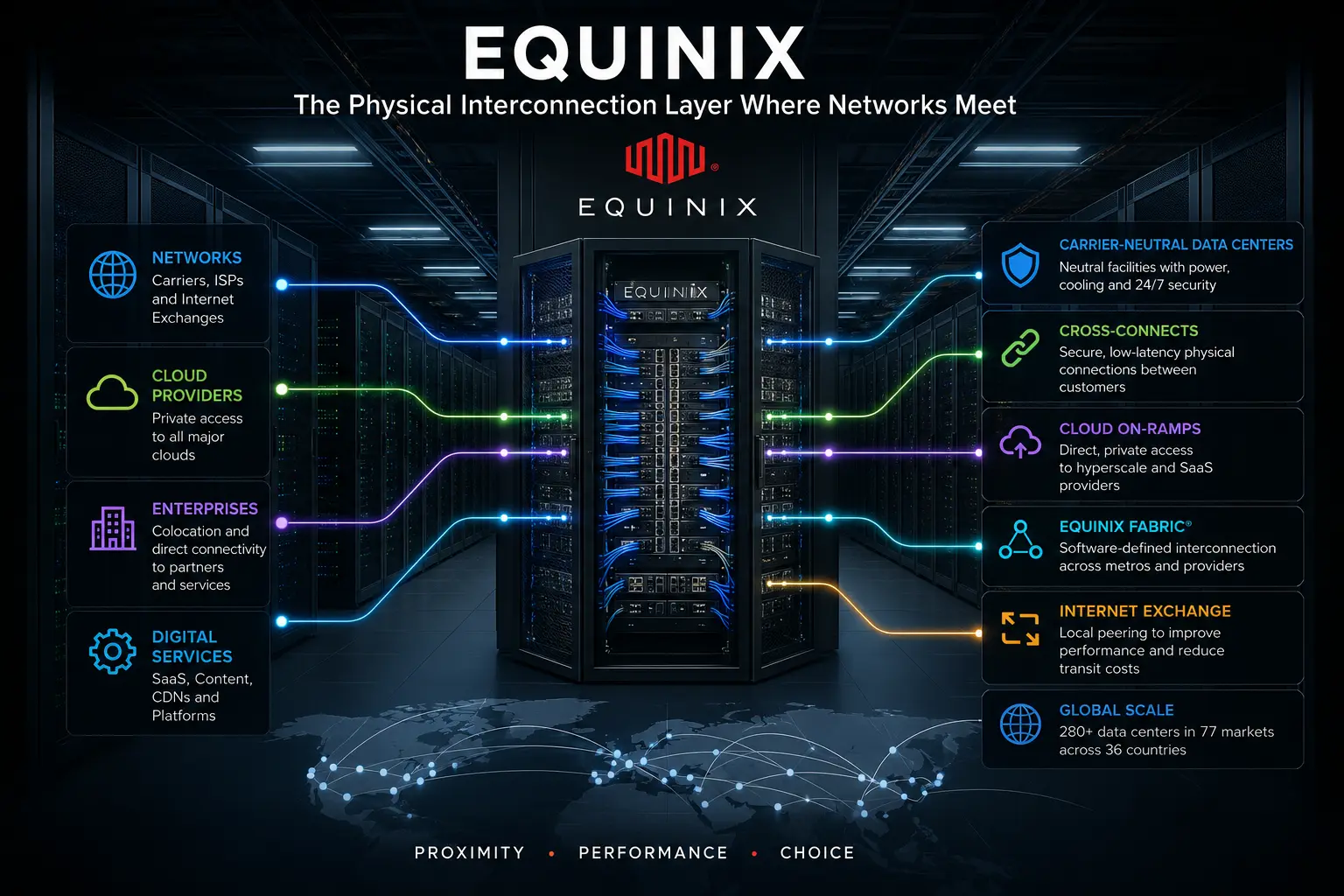
- The company’s defining infrastructure role is operating carrier-neutral International Business Exchange data centres where enterprises, network providers, clouds, content platforms and financial systems colocate equipment and establish physical or virtual interconnections. At the end of 2025, Equinix reported 280 data centres in 77 markets across 36 countries, more than 10,500 customers, over 2,000 network service providers and more than 500,000 interconnections. In the second quarter of 2026, it reported a record 9,700 net interconnection additions.
- Equinix controls its facilities, power and cooling systems, physical cross-connect process, parts of the metro transport layer and software-defined services such as Equinix Fabric. It does not control customer BGP policy, cloud-service behaviour, application architecture, the public internet beyond its sites or the independent carriers whose fibre creates much of each facility’s value.
- The platform’s growth reflects a network effect: every additional cloud, carrier, enterprise or service provider can make a location more useful to others. The same effect creates switching costs and physical concentration. Public sources establish facility count, customer scale, recurring revenue, capital investment and stated uptime, but do not reveal the share of global traffic traversing Equinix, complete cross-connect topology, customer-level dependency, independently verified physical diversity or the propagation pattern of every facility failure.
A company built around the need for a neutral meeting place
Equinix was created during the commercial internet’s first large expansion, when networks were multiplying faster than the number of places available for them to exchange traffic. The founding problem was not simply where to put servers. Telecommunications carriers, internet service providers and content companies needed secure facilities with dependable power, cooling and fibre access, but they also needed an operator that was not itself trying to become the dominant carrier in the room. A neutral site could allow competitors to connect while preserving their separate commercial and routing authority.
That model distinguished interconnection-oriented colocation from ordinary corporate data-centre outsourcing. A conventional hosting facility could rent floor space and keep equipment powered. An interconnection centre also had to attract multiple carriers, make connections between customers operationally routine and maintain confidence that no preferred network would control access. The building became more useful because of the participants inside it. Real estate was necessary, but the product was the ability to reach an ecosystem without constructing a separate path to every counterparty.
The concept anticipated a recurring internet pattern. Independent systems often become more useful when they can coordinate through a shared, narrowly defined layer. That shared layer does not need authority over the participants’ businesses; it needs predictable rules and reliable execution. Equinix’s proposition was that the facility operator would supply the environment and connection process while customers retained control of their networks, equipment and commercial relationships.
This division remains central to the company’s position. Equinix can maintain a meet-me room, install a cross-connect and provide software interfaces for ordering connectivity. It cannot tell two autonomous systems which routes to exchange, determine which traffic a cloud service accepts or guarantee that an application will perform well after the connection is established. Its platform matters because it reduces the friction of meeting, not because it absorbs every decision made after that meeting occurs.
Carrier neutrality turned a building into an ecosystem product
“Carrier-neutral” is sometimes treated as a marketing description for a facility with several network options. Its operational meaning is more demanding. The operator must make it possible for customers to buy connectivity from competing carriers, reach peers directly and change providers without having to leave the building. The value of neutrality therefore depends on the diversity and continuing presence of third-party networks, not simply on a contractual promise from the landlord.
A neutral facility can attract networks because other networks and customers are already present. Enterprises arrive to reach carriers and clouds. Cloud providers establish access points because enterprises and network operators are nearby. Content platforms connect to access networks to reduce transit distance. Financial firms value predictable proximity to exchanges, market-data feeds and counterparties. Each participant may have a different reason for entering the facility, but together they create a market in which adjacency can be purchased as a service.
Equinix’s 2025 annual filing said more than 2,000 network service providers offered access to internet routes inside its IBX data centres. That figure demonstrates choice at platform level, but not uniform diversity at every location. A mature hub such as Ashburn, Frankfurt, London, Singapore or Silicon Valley may contain a dense collection of carriers and service providers. A newer market may begin with far fewer options. Neutrality is therefore a continuing operating and commercial achievement that depends on local fibre construction, demand and the willingness of carriers to invest in each site.
The company’s risk disclosures make that dependency explicit. Equinix is not a telecommunications carrier and relies on third parties to bring carrier services into its facilities. A site can be technically strong and still struggle to develop an interconnection ecosystem if diverse fibre does not arrive. The neutral operator controls access to the room and the process of connection; the richness of that room depends on independent companies deciding that participation will generate enough value to justify their capital and operating costs.
The IBX is a facility, an operating discipline and a market
Equinix calls its carrier-neutral colocation sites International Business Exchange, or IBX, data centres. The name reflects an ambition to make each facility more than a warehouse for equipment. An IBX combines physical infrastructure — land, structure, electrical distribution, cooling, fire protection, security and cabling — with procedures for installing, operating and connecting customer equipment. It also provides the commercial framework through which customers order space, power and links to other participants.
The physical layer is unforgiving. Servers require continuous electricity within defined voltage and quality ranges. Heat must be removed at the rate it is produced. Backup systems need fuel, testing and maintenance. Fire protection has to reduce risk without unnecessarily damaging equipment. Access control must permit authorised technicians while preventing intrusion. Fibre pathways need to be documented, protected and maintained. A failure in any one of these systems can affect customers whose own applications and networks are otherwise healthy.
Operations turn that engineering design into availability. Preventive maintenance, change control, incident command, remote-hands procedures, inventory accuracy and staff access can matter as much as the redundancy diagram. Equinix reported more than 99.9999 per cent operational uptime across its global data centres for 2025. That is a company-reported measure of facility performance under its methodology. It does not mean every customer service was available for the same proportion of time, because customer equipment, carriers, routes, clouds and applications introduce additional failure domains.
The market layer emerges once the site contains enough counterparties. A customer is no longer choosing only a rack. It is choosing a position relative to specific clouds, carriers, exchanges, suppliers and users. This produces a form of location value that is not visible in square footage. Two facilities with similar power and security can offer very different strategic utility because one contains the organisations a customer needs to reach directly and the other does not.
Space and power are sold together but constrained differently
Colocation is commonly described as renting space, power and cooling. Those resources are linked, but they do not scale in the same way. Floor area can remain available while electrical capacity is exhausted. A hall designed for older equipment may contain room for additional cabinets but lack the power distribution or heat-removal capability required by newer high-density systems. The economic unit increasingly becomes deliverable power in a specific location rather than raw square footage.
Equinix generally bills infrastructure offerings according to the space and power a customer consumes under fixed-duration contracts. This produces recurring revenue and aligns price with the two resources most directly controlled inside the facility. It also means capacity planning must account for the interaction between cabinet density, electrical redundancy, cooling architecture and customer growth. A facility cannot simply fill every visible space if doing so would push the building beyond its safe operating envelope.
The company’s 2025 risk disclosures state that power, rather than space, is already a limiting factor in many older IBX data centres. Upgrading a site depends on local utility supply, the time required for new connections and whether the building’s electrical and mechanical systems can support greater loads. Redevelopment may be possible, but it can require construction around live customer equipment and may still not produce the density demanded by the latest hardware.
This constraint changes the meaning of global footprint. A count of data centres shows where Equinix has a presence; it does not reveal how many megawatts remain available, which halls can accept high-density deployments or how quickly more power can arrive. Customers therefore need to consider location and usable capacity together. Equinix has to preserve the interconnection value of older hubs while adapting buildings created for a lower-power generation of computing.
Cross-connects are short cables with long strategic effects
The most characteristic Equinix product may be the cross-connect: a point-to-point cable link between two customers in the same data centre. Physically, the connection can be a relatively short run of fibre or copper through managed pathways. Economically, it can replace a more complex route through external carriers, reduce the number of intermediate networks and create a direct relationship between systems that previously reached each other through the public internet.
A cross-connect does not create a network by itself. Each customer still needs routers, interfaces, addressing, security policy and an agreement about what traffic will pass. Equinix installs or manages the physical link and maintains the facility environment. The customers or their providers control the logical service carried across it. This is why it is accurate to say Equinix enables interconnection without controlling the routing decisions made by those connected parties.
Its strategic effect comes from repeatability. When thousands of organisations can order direct links through a standard process, private interconnection stops being a bespoke construction project for every pair. The facility operator supplies known cable paths, documentation, demarcation and service procedures. Customers can concentrate network equipment in one location and reach multiple counterparties without extending separate long-haul circuits to every external site.
The same convenience creates dependency. A customer with many cross-connects cannot necessarily move by lifting one server and changing an address. Every physical relationship may need to be recreated, tested and coordinated with the other party. Some counterparties may not exist in the destination facility. A short cable can therefore become part of a wider architecture whose value is tied to place. Switching cost grows from accumulated relationships, not only from the duration of the service contract.
Direct links can shorten a path without eliminating the public internet
Private interconnection is often described as bypassing the public internet. The phrase is useful when it means traffic between two parties does not traverse ordinary internet transit for that segment. It becomes misleading when it implies that the wider network no longer matters. A customer still needs access circuits to the Equinix facility, long-haul transport between metros where required, routing control and often public connectivity for users or services outside the direct relationship.
A cross-connect can reduce path uncertainty because the endpoints are in the same building and the physical route is defined. It may lower latency, remove transit charges for particular traffic or reduce exposure to congestion on unrelated networks. Those benefits depend on where the applications and users are located. If data still needs to cross an ocean or reach a distant last-mile network, the local direct link removes only one portion of the total path.
The distinction is particularly important for cloud connections. An enterprise may connect privately from an Equinix deployment to a cloud access point, avoiding public-internet transport for the on-ramp. The cloud provider still controls the service beyond that handoff. Its internal network, regional architecture, capacity and application behaviour remain outside Equinix’s authority. Private access changes the entry path; it does not transfer operational control of the cloud.
This layered view prevents exaggerated claims. Equinix can make particular relationships more direct and predictable. It cannot guarantee end-to-end application performance because the full system includes components it neither owns nor observes completely. The useful measure is whether the platform removes avoidable distance and coordination cost within a defined portion of the path, not whether it replaces the internet as a whole.
Carrier density is both the platform’s value and its dependency
The presence of many network providers is central to Equinix’s advantage. Customers can compare services, buy redundant paths and reach networks serving different geographies or user populations. Carriers benefit because one installation can provide access to a concentrated pool of potential customers. This density can reduce the cost of establishing each additional relationship and make a mature facility more attractive than a technically similar site with fewer participants.
Density, however, is not the same as diversity. Several carriers can share a street conduit, building entrance, long-haul route, subsea cable or power utility. A customer may buy services from two different brands and still discover that the links fail together. Equinix can provide information about facility and carrier options, but independent path verification often requires coordination with the networks themselves. The number of logos in a marketplace does not prove separation of physical risk.
The company also depends on carriers continuing to invest. Equinix’s annual filing notes that carriers evaluate a new data centre according to the revenue opportunity available there. If demand is weak, a provider may delay construction, offer limited capacity or withdraw. That can slow development in new markets and weaken the attraction of the neutral platform. Equinix cannot manufacture network diversity through policy alone; it has to create enough customer concentration to make fibre deployment commercially rational.
The relationship is reciprocal. Carriers make the facility useful, and the facility makes carrier investment more productive. Equinix coordinates the location and connection process without absorbing the carrier’s network obligations. That is a powerful but bounded role: the platform can cultivate an ecosystem, yet the ecosystem remains a coalition of companies with separate balance sheets, technical decisions and failure modes.
Internet exchanges and private links solve different problems
Some Equinix facilities host internet exchange services that allow multiple networks to peer through shared switching infrastructure. An exchange can make it efficient for a network to reach many peers through one port, particularly when traffic volumes do not justify a dedicated circuit for every relationship. Private cross-connects, by contrast, create direct point-to-point links and may be preferred for high-volume, sensitive or tightly controlled traffic.
The two methods complement each other. A network may use an exchange for a broad set of peers and private connections for its largest traffic partners. It may also buy transit from a carrier for destinations not reached through either arrangement. Each option has different economics, capacity characteristics, operational responsibilities and routing policies. Part of the facility’s value lies in allowing those choices to coexist nearby.
Equinix does not determine whether two autonomous systems peer. Peering requires agreement between the networks, suitable policy and compatible technical configuration. The exchange operator supplies switching and operational support, while participants decide which routes to advertise and accept. A facility can reduce the transaction cost of reaching the exchange but cannot compel cooperation between networks whose commercial interests differ.
This matters when Equinix sites are described as places that “host the internet”. A major interconnection campus may contain route servers, transit providers, private peers, cloud on-ramps and content caches, and substantial traffic can pass through systems located there. The campus still does not become a central router for the global internet. It is a dense collection of independent control planes whose physical adjacency makes coordination easier.
Equinix hosts routing decisions but does not make them
Routing on the public internet is governed by the policies of autonomous systems using BGP and related operational practices. A carrier decides which routes to announce, which customers or peers to prefer, how to engineer traffic and what security controls to apply. Equinix can supply the place where routers connect and operate shared services such as an internet exchange, but it does not inherit authority over customer routing because that equipment sits inside an Equinix building.
This boundary can become blurred when infrastructure is described as a “platform”. Software platforms often control an execution environment and can impose uniform behaviour. An interconnection platform coordinates access to physical and virtual links while leaving many important decisions to participants. Equinix’s control is strongest over facility availability, order fulfilment, cabling and its own network products. It weakens at the point where customer routers and third-party carriers determine traffic flow.
The distinction also determines incident response. If a cross-connect is dark, Equinix can test the physical path and repair its portion. If the link remains up but routes are missing, the customer and counterparty need to inspect configuration and policy. If users in one region experience poor performance, the cause may sit inside a remote carrier or cloud network. A common location improves the ability to cooperate, but it does not merge operational teams or telemetry.
Equinix therefore influences routing indirectly. By attracting networks to the same facilities, it makes more private interconnection economically practical. That can alter traffic patterns, reduce transit dependence and change which routes are attractive. The company shapes the conditions in which routing choices are made without becoming the entity that makes those choices for the internet.
Low latency comes from placement, not from a brand
Equinix markets proximity to networks, clouds, partners and users as a means of reducing latency. The mechanism is real. Placing systems in the same facility or metropolitan area can shorten physical distance, remove intermediate networks and reduce the number of queues or policy transitions along a path. Direct access to a cloud region or financial venue can make delay more predictable than reaching it through a distant public route.
The outcome is still conditional. Latency depends on the complete path, including customer equipment, carrier architecture, congestion, application behaviour and the destination service. A direct connection can be misconfigured or undersized. A nearby cloud access point may lead to a service region farther away than expected. An application may perform poorly because of database design even when network round-trip time is low. Physical proximity creates an opportunity; it does not override every other layer.
Metro boundaries also need careful treatment. Two facilities described as serving the same city can be separated by considerable fibre distance and connected through a metro service with its own redundancy and maintenance exposure. A campus may function as one logical ecosystem while relying on multiple buildings, landlords, substations and cable routes. Customers need to understand which latency and diversity assumptions apply to the actual deployment rather than relying on the metro label.
A defensible performance claim therefore identifies the part Equinix can influence. The company can reduce the distance and connection complexity between participants located on its platform. It cannot promise uniformly low latency or stable paths across every cloud, carrier and application. Proximity is an architectural input, not an end-to-end result.
Ecosystem density creates a self-reinforcing network effect
Equinix’s core economic advantage is often described as a network effect. A facility containing many networks, clouds and enterprises becomes more attractive to another participant because the newcomer can reach more counterparties. That participant then adds value for those already present. The positive feedback can make established interconnection hubs difficult to replicate even when competitors can build facilities with comparable power, cooling and security.
The effect works at several levels. A network provider gains potential customers. A cloud provider gains enterprise access points. A software company gains private routes to customers and partners. An enterprise gains choice among carriers and direct access to digital services. A financial platform gains proximity to other market participants. Those benefits are not created by Equinix alone; they emerge from the composition of the community the company has attracted and retained.
Scale figures show the cumulative result. Equinix reported more than 10,500 customers and over 500,000 interconnections at the end of 2025, while its public site in July 2026 displayed approximately 513,000 interconnections. The numbers are company-reported and do not disclose bandwidth or criticality. One connection may support a modest management service while another carries a major production workflow. Even so, the volume indicates that the platform’s value is built from a large web of relationships rather than a small number of flagship facilities.
Network effects can persist because they shape future investment. A customer deciding where to place its next deployment considers where its partners already operate. A carrier deciding where to add capacity considers customer concentration. A cloud provider deciding where to expose another access point considers enterprise demand. Each decision can reinforce the metro’s existing position, raising the cost of creating an equivalent ecosystem elsewhere.
The same network effect increases switching costs and concentration
The feature that makes a mature Equinix site attractive can make leaving it difficult. A customer may depend on dozens or hundreds of physical links, cloud connections, address arrangements, access circuits and operational procedures associated with one campus. Moving equipment requires new space and power, parallel connectivity, data migration, route changes, security review and coordination with counterparties. The destination needs to offer not only a cabinet but a comparable ecosystem.
This is not ordinary software lock-in. Exporting configuration cannot reproduce physical adjacency. A list of cross-connects describes the relationships, but each counterparty must be available and willing to connect at the new location. Some services may exist only in selected facilities. Customers can build multi-site architectures, but doing so adds cost and may still leave them dependent on Equinix in more than one place.
Concentration therefore needs to be measured at workflow level. Equinix disclosed that no single customer accounted for 10 per cent or more of 2025 revenue, reducing exposure to one buyer. Financial diversification does not show how many customers depend on the same metro, utility, meet-me room, Fabric control plane or cloud access point. Systemic importance can be substantial even when revenue concentration is low.
For customers, the important question is not whether Equinix is a dominant supplier in the abstract. It is which business functions would fail or become expensive to rebuild if a particular facility, metro or platform service became unavailable. For policymakers and industry analysts, the question is whether nominally decentralised digital services converge on a small number of physical meeting points whose dependency is poorly measured.
The dot-com model survived because interconnection outlasted speculation
Equinix was founded in 1998 and entered the market during the dot-com boom, when capital flowed rapidly into internet companies and data-centre capacity. That period created both demand and overbuilding. Many businesses built around optimistic traffic assumptions failed when the market corrected. Equinix’s survival and later growth reflected the durability of the underlying interconnection problem after many speculative business models disappeared.
Networks still needed places to exchange traffic. Enterprises still required dependable environments for equipment. As internet services moved from novelty to operating necessity, the value of carrier-neutral facilities became less dependent on any one class of start-up. The customer mix broadened across telecommunications, content, finance, cloud, software and large enterprises. Interconnection became a recurring infrastructure requirement rather than a wager on one category of web business.
The company also had to manage the capital intensity of expansion. Data centres require substantial upfront investment and take time to fill. Building too far ahead of demand can depress returns; building too late can push customers towards another facility. The early market showed that capacity alone is insufficient. A site needs to sit where customers need to meet, attract a viable carrier ecosystem and reach utilisation that supports continued operation and expansion.
That history matters as Equinix expands into another period of intense infrastructure spending driven partly by AI. The technologies differ, but the capital discipline is similar. Demand forecasts can be strong while the location, density and timing of real workloads remain uncertain. Long-term value depends on matching physical construction to durable interconnection demand rather than assuming every announced computing trend will become occupancy.
Global expansion combined construction with acquisitions
Equinix did not reach its current footprint through a single method. It constructed new IBX facilities and expansions in established metros, entered markets through greenfield projects and acquired operators whose sites, customers and network ecosystems could be incorporated into the platform. The combination allowed faster geographic growth than organic development alone, while creating a portfolio with different ages, designs and local operating histories.
The 2010 acquisition of Switch and Data added 34 data centres in the United States and Canada. The 2016 acquisition of TelecityGroup expanded Equinix across Europe, although competition approval required divestitures. In 2017, the company completed a $3.6 billion purchase of 29 data centres from Verizon across 15 metropolitan areas. Later transactions extended its reach through Canada, India, West Africa and Latin America, while organic projects added capacity in both existing and new markets.
Acquisitions can accelerate ecosystem density because customers and carriers arrive with the facility. They can also introduce infrastructure that was not designed to Equinix’s current standards. The 2025 annual report warns that acquired centres may contain legacy power systems and require substantial repair or upgrades. Equinix states that legacy designs have contributed to power outages in the past. Integration is therefore not only a branding or billing exercise; it is a physical risk-reduction programme carried out around live customer equipment.
The strategic test is whether an acquired site can become part of a connected metro and global operating model without losing local strengths. Some markets depend on particular carrier relationships, regulation or customer communities. Standardisation can improve reliability and customer experience, but Equinix cannot assume every facility will quickly converge on the same capacity, fibre diversity or interconnection density.
Acquisitions also inherited heterogeneous failure domains
A portfolio acquired from another operator contains more than property. It includes maintenance history, spare-parts practices, landlord agreements, utility relationships, cabling records, customer expectations and technical debt. Equinix can impose common operating procedures, but some constraints are embedded in building geometry or external infrastructure. A facility’s power feed, riser layout or fibre entrance may be expensive or impossible to redesign fully while customers remain in production.
This heterogeneity complicates global uptime claims. A common service standard can be applied across the estate, but the risk profile of a purpose-built new site differs from that of an older converted building. Redundancy labels such as N+1 do not establish whether components share upstream dependencies or whether maintenance can be carried out without exposing the load. Customers with critical deployments need site-specific engineering evidence.
Acquisitions can also alter local market structure. When a global provider purchases a regional operator, customers may gain access to a larger platform and common services but lose an independent alternative. Competition authorities required asset divestitures during the Telecity transaction, reflecting concern that interconnection facilities can possess local market power when ecosystems are difficult to move.
Global scale therefore does not erase local infrastructure. Equinix can unify contracts, portals, security standards and product names, but electricity, fibre routes, municipal permits and customer adjacency remain tied to place. Portfolio growth increases the number of locations under management while making it more important to understand which risks are genuinely diversified and which are repeated across the estate.
REIT treatment changed the financial container, not the operating problem
Equinix elected to be taxed as a real-estate investment trust for U.S. federal tax purposes beginning with the 2015 taxable year. The election reflected the long-lived property base beneath the business: buildings, land interests, electrical systems, mechanical plant and improvements supporting recurring occupancy. It also created a structure in which qualifying income can be distributed to shareholders without the same entity-level federal tax treatment as an ordinary corporation, provided Equinix continues to satisfy detailed income, asset and distribution tests.
The REIT label can obscure the operating character of the platform. A conventional landlord can lease a unit while remaining relatively indifferent to the identity of the neighbouring tenant. Equinix’s economic value depends on the opposite condition. A carrier, cloud access point, enterprise, content platform or financial market participant becomes more useful to others because it is present in the same facility or metro. The property generates differentiated value only when Equinix operates a trustworthy environment and cultivates an ecosystem dense enough to justify recurring interconnection.
The structure also affects capital allocation. Data centres consume large amounts of capital before the associated revenue matures, while a REIT is expected to distribute a substantial portion of taxable income. Equinix therefore combines operating cash flow with debt, equity, joint ventures and asset transactions to finance expansion. Choosing which metro receives power, land and construction capital becomes a judgement about where future digital relationships are likely to form.
Financial analysis and infrastructure analysis are therefore inseparable. The balance sheet determines which facilities can be built and upgraded; the interconnection ecosystem determines whether those facilities become more than powered space. Equinix has to satisfy investors seeking durable cash flow while meeting customer demand for capacity in markets where utilities, permits and equipment can take years to secure.
Capital allocation is a map of expected digital demand
A data-centre expansion represents a long-lived commitment to a particular geography. Once land, substations, generators, cooling systems and fibre entrances are installed, that capital cannot simply be moved to another metro if demand changes. Equinix can phase construction and pre-sell capacity, but every project still embeds assumptions about cloud adoption, enterprise architecture, network density, regulation and local power availability.
The company’s development pipeline illustrates the scale of those commitments. At the end of 2025, Equinix said it had dozens of major projects under way across more than 30 markets, with retail cabinet and xScale megawatt capacity scheduled over several years. Its second-quarter 2026 release said 52 projects were under way across 33 markets after nine projects had been added since April. These are company-reported plans rather than guarantees that every phase will open on schedule or generate the expected return.
The portfolio logic is not simply to build wherever electricity is cheapest. Interconnection demand is concentrated where users, networks, clouds, subsea cables, financial systems and enterprises already meet. A remote site with abundant power may suit large-scale training or storage while being less useful as a low-latency exchange point. A dense urban market may offer excellent connectivity and severe constraints on land, utility capacity and construction. Equinix’s platform depends on linking these site types rather than assuming one building model can serve every workload.
For leadership, the development pipeline provides an early indication of how Equinix sees the next phase of digital infrastructure. Investment in mature metros reinforces established hubs. Entry into new regions can decentralise access and support data-residency requirements. Large hyperscale campuses indicate confidence in cloud and AI demand. Delayed or cancelled projects can reveal that power, permits, financing or customer commitments are weaker than headline demand suggests.
xScale separates hyperscale economics from the retail interconnection floor
Equinix’s xScale data centres target a narrower customer group than its retail IBX facilities. They serve large cloud and hyperscale deployments requiring substantial blocks of power and purpose-built capacity. Those customers have different economics from enterprises buying individual cabinets and cross-connects: larger commitments, lower revenue per unit of power and greater influence over facility design.
Separating xScale from the retail estate helps protect the interconnection model. A hyperscale tenant can consume tens of megawatts without creating the same diversity of counterparties as thousands of smaller customers. If capacity were evaluated only according to power sold, a large wholesale deployment could crowd out the ecosystem density that makes the retail platform distinctive. xScale allows Equinix to pursue large cloud and AI workloads while preserving IBX locations as access points where enterprises and networks meet those platforms.
The relationship between the two layers is the strategic proposition. A hyperscaler can place core capacity in an xScale site while maintaining access nodes in nearby IBX facilities. Enterprises colocated in the IBX can then establish private connections to the cloud provider without putting all their own infrastructure inside the hyperscale campus. Physical and commercial separation allows Equinix to combine wholesale scale with retail adjacency.
The model does not eliminate concentration. It can deepen the role of a small number of cloud providers whose demand shapes new construction. It also creates dependencies between facilities that may be presented as one platform but have different ownership, financing and customer profiles. xScale’s value depends partly on whether its large deployments continue to generate interconnection demand in the surrounding IBX ecosystem rather than becoming isolated power blocks.
Joint ventures distribute capital and complicate accountability
Equinix has expanded xScale largely through joint ventures with institutional investors. In 2024, it announced a greater-than-$15 billion U.S. programme with CPP Investments and GIC, designed over time to add more than 1.5 gigawatts of hyperscale capacity on large campuses. The company also has xScale partnerships in Europe, Asia-Pacific and the Americas. These structures allow external capital to finance construction while Equinix contributes development, sales, operational and interconnection expertise.
Joint ventures can reduce the amount of capital Equinix must provide directly for every megawatt and match infrastructure with investors willing to accept long-duration property exposure. The arrangement is attractive where a facility has a committed or highly visible customer and where Equinix can retain the platform relationship without owning the entire asset.
Operational responsibility becomes more complex. Customers may experience the facility as part of Platform Equinix while the legal asset sits in an unconsolidated venture. Equinix may manage the site, sell services and connect it to nearby IBX locations, but governance rights, funding obligations and returns are shared with partners. During a construction delay, cost overrun or strategic disagreement, the control structure differs from that of a wholly owned facility.
Joint ventures are common in capital-intensive infrastructure and should not be treated as unusual. The ownership distinction still matters. Customers evaluating resilience need to know who operates the site and which contractual entity provides the service. Investors need to separate recurring operating revenue from development and fee income associated with ventures. Policymakers assessing concentration need to distinguish brand reach from asset ownership. The customer interface may look unified while the capital structure underneath it is deliberately distributed.
AI changes the capacity unit from cabinets to power and cooling
Artificial-intelligence demand has accelerated a shift already visible in data-centre engineering. Retail colocation can be counted in cabinets, but high-density accelerator clusters are better understood in megawatts, cooling capacity and network bandwidth. The number of racks can be small relative to the amount of electricity and heat involved. A hall that appears underused by floor area can already be fully allocated by power.
Training workloads often favour large campuses with access to substantial electricity and specialised cooling. Inference can have a different geography. Some applications benefit from being close to enterprise data, cloud services, users or regulated jurisdictions. Equinix’s strategy is to position xScale campuses for large core deployments and IBX locations as interconnection points through which data, applications and users reach those systems.
Equinix does not provide the AI model, accelerator design or application logic. It provides the environment in which those components can be placed and connected. This boundary matters because infrastructure marketing can imply that an “AI-ready” facility delivers an AI outcome. Workload performance still depends on accelerator architecture, cluster design, storage, software, data pipelines and network topology as well as facility power and cooling.
AI demand can strengthen the interconnection proposition if enterprises need private access to several model, cloud and data providers. It can also strain the platform if power is diverted towards a small number of very large customers, high-density retrofits disrupt existing halls or utilities cannot deliver sufficient capacity. The durable signal is not the number of AI announcements. It is whether new power produces recurring ecosystems and whether customers can connect workloads without creating a new concentration that becomes difficult to unwind.
Grid access now determines expansion as much as building availability
Equinix’s filings identify electricity as a central constraint on both existing facilities and new developments. Generation, transmission and distribution limits can delay projects or prevent expansion. Utilities may require long lead times, impose new conditions or be unable to supply the requested capacity. Transformers, switchgear, generators and other equipment can also face supply constraints.
This changes site selection. Fibre and market demand remain essential, but land without a credible power path is not yet a data-centre site. Developers need to understand grid queues, substation plans, regulatory approval and the local politics of allocating electricity among households, industry and digital infrastructure. Announcing control of land does not establish that usable power will arrive when required.
Existing facilities face the same problem from another direction. An older IBX may contain physical room for additional cabinets while the utility feed or internal distribution system is fully committed. Upgrading can require larger external service, new electrical plant and more cooling, often around live customer equipment. Practical facility capacity is therefore the minimum of floor area, power, cooling and operationally safe upgradeability.
Grid dependence also limits the idea of a completely standardised global platform. Equinix can apply common engineering and procurement disciplines, but each metro has different utilities, energy markets and permitting regimes. Capacity that can be delivered in one region within 18 months may take several years elsewhere. The company’s growth rate is increasingly tied to institutions outside the technology sector that control the physical prerequisites of computing.
Cooling and water make compute density a local resource issue
Power entering a data centre eventually becomes heat. Higher rack density therefore increases the obligation to remove that heat without interrupting service. Air cooling remains common across much of the installed base, while direct liquid cooling and other designs are becoming more important for dense accelerator systems. Equinix has been expanding support for liquid-cooled deployments, but readiness varies by building and phase.
Liquid cooling can improve heat transfer and support higher densities. It does not make the environmental or operating problem disappear. Pumps, heat exchangers, manifolds, water quality, leak detection and maintenance become part of the failure surface. Customer hardware must be compatible with the facility design. Retrofitting an operating hall requires coordination between the building operator, equipment vendors and tenants whose existing systems may use different methods.
Water use also varies according to climate and cooling architecture. Some facilities depend more heavily on evaporative methods; others use air-cooled or closed-loop systems. A global average can conceal local stress in a water-constrained region. Equinix has begun providing customer water reports and site-level metrics, which can improve transparency, although those reports remain dependent on methodology and coverage.
The local legitimacy of expansion will increasingly depend on how power and water use are explained. Communities may value employment, tax revenue and digital capacity while questioning the allocation of scarce resources. A company can procure renewable-energy certificates and still rely physically on the local grid during periods of constraint. Infrastructure strategy therefore includes utility and community relationships as well as engineering efficiency.
Cloud on-ramps make hyperscaler access location-dependent
One of Equinix’s most important adaptations was turning private cloud access into a routine interconnection product. Enterprises can place routers or other infrastructure in an IBX facility and connect to services such as AWS Direct Connect, Microsoft Azure ExpressRoute and Google Cloud Interconnect. The company has stated that its platform hosts a leading share of private on-ramps to major cloud providers.
The mechanism changes how hybrid architecture is built. Instead of sending all cloud-bound traffic over ordinary internet transit or arranging a separate external carrier circuit to each provider, a customer can aggregate connectivity at a neutral site. Physical cross-connects or Fabric virtual connections can then provide access to one or more cloud service endpoints. The customer retains control of its cloud accounts, routing and application design.
Private access can improve predictability and reduce exposure to public-internet congestion for the relevant part of the path. It does not make the cloud service local in every sense. The application may still run in a distant region, and the cloud provider controls the internal path after the on-ramp. True redundancy requires more than two logical circuits if both terminate in the same facility, metro or provider edge.
The strategic value lies in creating options. An enterprise can reach several clouds and network providers from one operating location, which may make future changes easier than relying on a single dedicated provider circuit. Yet that option has a physical anchor. If the enterprise’s whole multi-cloud architecture converges on one campus or one Fabric port pair, provider choice can coexist with concentration at the interconnection layer.
Equinix Fabric virtualises ordering, not the physical network
Equinix Fabric is a software-defined interconnection platform that allows customers to create virtual connections across supported metros and service providers. A customer with a Fabric port can use a portal or API to connect to clouds, networks, its own deployments or another participant. Provisioning can be considerably faster than ordering a new long-haul circuit for each relationship.
The product shifts connectivity from a one-off physical project towards an on-demand service. Bandwidth can be selected from defined tiers, and one port can support several virtual relationships. This makes interconnection more accessible to teams accustomed to cloud APIs and allows network architecture to change at software speed.
The physical path has not disappeared. Fabric still relies on ports, cross-connects, switches, metro transport, long-haul carriers, power and control systems. Capacity must already exist between the relevant locations. A virtual circuit can be provisioned quickly because the underlying infrastructure and commercial relationships have been established in advance. Software reduces ordering friction; it does not remove distance or scarcity.
This matters for resilience. A dashboard can show two virtual connections that share a chassis, fibre route, building entrance or metro transport provider. Equinix documents primary and secondary architectures and supports customer-selected redundancy, but the customer still needs to choose and verify the design. Virtual diversity should not be inferred from two service identifiers. It has to be traced back to independent physical and control-plane paths.
The Fabric control plane creates a new correlated failure domain
Physical cross-connects are relatively static. Once installed, they may continue carrying traffic even if an ordering portal becomes unavailable. Software-defined interconnection introduces a control plane that creates, changes and monitors virtual circuits. This increases flexibility while creating another system whose correctness matters to many customers simultaneously.
A control-plane error can have a different blast radius from a single cut cable. Incorrect automation, authentication failure, database inconsistency or a faulty change can affect provisioning or services across several metros. Hardware can be redundant while shared software and configuration remain potential sources of correlated failure.
The customer’s responsibility also changes. Network teams need permissions, API credentials, change controls and monitoring for a service that can be altered quickly. The ability to create connectivity in minutes is valuable, but an unauthorised or mistaken change can also propagate faster than a traditional circuit order. Identity and policy management become part of physical network governance.
Fabric therefore extends rather than replaces cross-connect discipline. Mature users need inventories that map virtual circuits to ports, facilities, counterparties and business services. They need to test failure and recovery rather than assume the provider’s redundancy model automatically matches the application. The abstraction that simplifies connection can make underlying dependencies harder to see.
Internet exchange services coordinate peering without owning participant policy
Equinix operates internet exchange services in selected metros. Participants connect to a shared switching fabric and can establish bilateral peering or use multi-lateral peering through route servers. The exchange reduces the need for a dedicated physical circuit to every smaller peer and can make local traffic exchange more efficient.
The service illustrates the company’s responsibility boundary. Equinix operates the switch, route servers, port infrastructure and associated policies. Each network remains responsible for its autonomous-system number, route announcements, filtering, capacity and commercial peering choices. A route server can distribute routing information; it does not become the origin of participants’ routes or decide their wider traffic policy.
Equinix has added controls such as RPKI validation on multi-lateral route servers and BGP communities that let participants influence which routes are propagated. These mechanisms can reduce certain routing errors and provide a structured way to manage exchange policy. They cannot prevent every leak, hijack or misconfiguration elsewhere on the internet.
Peering is also not identical to private interconnection. A shared exchange port is efficient for reaching many networks, while a dedicated cross-connect can provide capacity and isolation for a high-volume relationship. Mature architectures often use both. Equinix benefits from hosting the physical environment in which participants can choose among them, but the performance and economics of each relationship remain controlled by the networks involved.
“Cloud neutral” does not mean free from dependency
Equinix describes its platform as cloud-neutral because customers can reach several cloud providers instead of being limited to one proprietary cloud. The description is meaningful at the colocation and connectivity layer. A customer can place owned equipment in a neutral facility and connect privately to multiple hyperscalers, SaaS platforms and carriers.
Neutrality does not make the customer independent of cloud-specific architecture. Data formats, identity systems, managed databases, serverless functions and proprietary APIs can create lock-in above the network. A private circuit to a second provider does not make an application portable if its state and operating tools remain tied to the first.
The facility itself can become another dependency. A multi-cloud design that reaches every provider through the same IBX or Fabric port concentrates the physical meeting layer even as it diversifies service providers. Moving away may require rebuilding cross-connects, cloud on-ramps and operational processes elsewhere. The architecture can be more flexible than a single-provider circuit without being costless to change.
The useful interpretation is therefore bounded. Equinix can increase choice by colocating competing services and standardising access. It cannot guarantee commercial neutrality across the wider market or remove platform-specific dependence. Customers need to evaluate independence separately at the facility, network, cloud, data and application layers.
Data sovereignty depends on placement, routing and authority
Regulation and customer policy increasingly require data or workloads to remain within particular jurisdictions. Equinix responds by operating facilities across many countries and offering connectivity that can keep selected paths and processing closer to required locations. In 2026, the company also announced an expansion of Fabric capabilities framed around network-level data sovereignty.
Physical location is only one part of sovereignty. The legal entity operating the facility, the cloud region used, support personnel with access, encryption keys, routing paths and the jurisdictions governing service providers can all matter. A server placed inside a country can still depend on foreign control planes or remote administrators.
Equinix can provide local facilities, private paths and contractual controls within its own service. It cannot determine how a customer application replicates data, how a cloud provider structures support or how governments interpret law. Sovereignty remains a property assembled across multiple vendors, systems and policies.
The company’s global footprint can nevertheless be strategically useful. An enterprise may apply a common operating model across several jurisdictions while keeping selected workloads local. The value lies in consistency of facility and connection processes, not in making legal differences disappear. Global reach provides a way to manage jurisdictional variation rather than evidence that one contract overrides it.
Renewable-energy coverage is a procurement measure
Equinix reports renewable-energy coverage for a large share of its electricity consumption and has entered power-purchase agreements intended to support new wind and solar capacity. Its 2025 filing said 96 per cent of global electricity consumption in 2024 was covered by renewable sources and described 29 PPAs across 12 countries by the end of 2025. The company also reports power usage effectiveness and has issued green bonds for eligible projects.
These measures provide useful evidence about procurement and efficiency. They do not mean every data centre receives renewable electricity every hour. Most facilities draw from regional grids whose generation mix changes over time. Certificates and contracts match consumption to renewable attributes over an accounting period; they do not create a dedicated physical connection from each renewable generator to each server.
Power usage effectiveness measures the relationship between total facility energy and the energy delivered to IT equipment. A lower figure generally indicates less overhead for cooling and other building systems. It does not measure the efficiency of the customer’s computation or the social value of the workload. A highly efficient facility can still consume more total energy as capacity increases.
The meaningful strategic question is whether Equinix can expand while reducing carbon intensity, improving grid additionality and preserving reliability. Renewable coverage, PPA volume, hourly matching, PUE, water use and total consumption need to be read together. No single indicator captures the physical consequence of a rapidly growing platform.
Physical concentration is most visible at metro and campus level
The internet is logically distributed, but interconnection demand clusters in a limited number of metropolitan hubs. Ashburn, London, Frankfurt, Amsterdam, Singapore and Silicon Valley became valuable because networks, clouds and enterprises accumulated there. Equinix operates major campuses in many of these locations and benefits from the resulting density.
Concentration can exist even when a company reports hundreds of facilities. Several buildings can share a utility substation, floodplain, fibre corridor, labour pool or metro transport system. Two cages in separate halls may provide equipment redundancy while remaining exposed to one regional event. Facility count is therefore not a direct measure of independent failure domains.
Customers need to distinguish building diversity, campus diversity, metro diversity and regional diversity. Each protects against a different event. A second cross-connect in the same meet-me room protects against some port or cable failures. A second building can protect against local mechanical failure. A second metro can protect against broader power, fibre or natural-disaster events, although it may introduce additional latency and application complexity.
Equinix’s platform can make multi-metro deployment easier because the company supplies a common commercial and operating interface. It cannot decide how much redundancy a customer purchases or whether the selected sites share external dependencies. Concentration risk emerges jointly from the provider’s footprint and the customer’s design.
Reliability claims need a denominator and a responsibility map
Equinix reported more than 99.9999 per cent operational uptime across its global data centres in 2025. The figure suggests a mature facilities operation, but it has to be read through the company’s methodology. A global aggregate can conceal individual site events, definitions of planned maintenance and customer services that failed because of equipment or carriers outside the facility boundary.
The responsibility map starts with the building. Equinix operates power distribution, cooling, security and many cross-connect pathways. Landlords, utilities and fuel suppliers may control upstream dependencies. Customers operate their servers and routers. Carriers operate fibre and transport. Cloud providers operate the service reached through the connection. An application outage can occur while the data-centre uptime metric remains intact.
Public incident information is incomplete. The annual report acknowledges risks from human error, equipment failure, cyber incidents, fire, water, extreme weather and legacy power design. It also says Equinix has experienced outages related to acquired legacy designs. These disclosures establish that failures are possible and have occurred; they do not provide a comprehensive public database of event frequency, duration and propagation.
A serious resilience assessment therefore requires site-specific design, maintenance practices, incident history, utility diversity, fuel arrangements and fibre routes. The provider’s global uptime figure is one input, not a substitute for architecture. Customers also need to test whether their own equipment and failover procedures work when the facility remains operational but a carrier, cloud on-ramp or control plane does not.
Cost determines who can participate directly
Equinix’s model reduces some connection costs by concentrating counterparties, but participation can still be expensive for smaller networks and enterprises. Colocation, power, cross-connects, ports, remote hands and carrier circuits create recurring charges before a customer sends meaningful traffic. Mature metros may command premium pricing because alternatives lack comparable ecosystem density.
The economics can reinforce the platform’s network effect. Large participants can justify a presence across several facilities and negotiate volume arrangements. Smaller networks may use remote peering, resellers or a single port, accepting additional dependencies to reach the same ecosystem. The market may remain open in principle while the cost of direct participation affects who can exercise that choice.
Cross-connect pricing is particularly consequential because each new relationship can generate recurring revenue for the facility operator. The cable itself is inexpensive compared with the value created by the adjacency. Customers sometimes argue that high recurring charges tax an interaction produced by the presence of two tenants. Equinix can respond that the service includes controlled pathways, documentation, maintenance and the platform whose density made the relationship practical.
The policy question is not whether a private operator may charge for its service. It is whether local market power becomes strong enough that customers cannot obtain equivalent interconnection without accepting the terms of one facility ecosystem. Competition authorities examined this issue during major acquisitions. The useful evidence is metro-specific: available alternatives, migration cost, carrier diversity and whether critical counterparties are present elsewhere.
Interconnection matters beyond its direct revenue share
Equinix earns most of its revenue from recurring colocation and interconnection services. Its 2025 filing reported $6.475 billion in colocation revenue and $1.655 billion in interconnection revenue within $8.739 billion of recurring revenue. Interconnection was smaller than colocation in direct accounting terms, but it helps explain why customers choose the space and why they remain.
A cross-connect can increase the value of a cabinet without the accounting system assigning all of that value to interconnection. Customers colocate because they can reach clouds, networks and partners. Once those relationships have been established, moving the cabinet can disrupt several business services. The recurring cable charge is therefore only one part of the economic effect.
The company’s second-quarter 2026 report said monthly recurring revenue grew 11 per cent year over year and that it added a record 9,700 net interconnections during the quarter. It also reported $2.625 billion in quarterly revenue, with growth affected partly by one-time xScale fees. These are strong company-reported demand indicators, but they do not reveal how much traffic each new connection carries or how many replace disconnected links.
Interconnection count is therefore better treated as a relationship indicator than a traffic measure. Ten low-bandwidth administrative links and one high-capacity cloud path can carry very different operational importance. The public record does not disclose the distribution. Sustained net additions still matter because they indicate customers continue to establish more relationships on the platform.
Backlog creates visibility but also delivery obligations
Equinix reported approximately $15 billion of remaining performance obligations at 30 June 2026, with most contracts initially running for one to five years and then renewing. The figure excludes some variable and terminable revenue, including much interconnection revenue, and is therefore not a complete measure of future business. It nevertheless illustrates the long-duration contractual base beneath the platform.
Long contracts support financing. Lenders and investors can evaluate recurring cash flows against the capital required for facilities. Pre-sales can justify construction, while scheduled price increases can help offset inflation in power, labour and equipment. The same arrangements can make customer exit slower, particularly when physical migration has to be coordinated with contract termination.
A large backlog can signal strong demand and future revenue. It can also create delivery obligations dependent on construction and utility schedules. Revenue may be recognised later than expected if deployments slip. Equinix’s filing explicitly notes that timing can change because of deployment dates, contract modifications, renewals and terminations.
Infrastructure users therefore need to know whether capacity commitments match application timelines and whether alternatives remain available. Equinix needs to convert bookings into operational capacity without compromising reliability. Contract visibility reduces commercial uncertainty; it does not eliminate execution risk.
Operational labour connects facility design to service continuity
A redundancy diagram does not maintain itself. Data-centre reliability depends on technicians, engineers, security personnel, customer-support teams, project managers and vendors carrying out work under controlled procedures. Staff test generators, replace batteries, manage alarms, escort visitors, install fibre and respond to incidents around the clock.
Human error remains a disclosed risk because maintenance can defeat redundancy when the wrong system is isolated or an instruction is misunderstood. Mature operators use method-of-procedure documents, peer review, change windows, training and stop-work authority to reduce that risk. These processes are operating assets even though they do not appear in a cabinet count.
Global scale complicates consistency. Labour markets, contractor capability, language, regulation and acquired-site culture differ. Equinix can standardise training and incident management, but local teams still operate local equipment under local conditions. A company-wide reliability claim ultimately depends on thousands of decisions made far from headquarters.
The same labour allows customers to abstract away some physical work. A multinational enterprise can order remote hands rather than sending its own engineer to every country. That convenience can also reduce internal operational knowledge. Leadership needs to understand which tasks have been delegated and whether the organisation can audit or replace them. Outsourcing physical work does not outsource accountability for the business service that depends on it.
Platform expansion makes Equinix a deeper control intermediary
The early Equinix proposition centred on neutral space and cross-connects. Fabric, cloud on-ramps, internet exchange services, Network Edge and managed infrastructure extend the company’s role into connection orchestration. Customers can increasingly use one portal and set of APIs to create relationships that previously required several carriers and manual orders.
This reduces friction and can make network architecture more responsive. It also means more decisions pass through Equinix systems. Permissions, service profiles, virtual circuits and monitoring data become part of the customer’s operating model. The company still does not control the application, but it may control a growing number of the paths through which that application reaches clouds and partners.
The development resembles platform formation in other infrastructure markets. A physical asset attracts participants; software then organises transactions between them. The operator gains information about demand and can introduce additional services. Customers gain convenience while becoming more dependent on the operator’s identity, billing and control systems.
The strategic boundary is whether the platform remains a neutral coordinator or uses its position to favour particular services. Public documentation presents access to many providers, and Equinix generally benefits when ecosystem participation expands. Neutrality should nevertheless be evaluated through pricing, interoperability, portability and the ease with which customers can establish direct alternatives.
Equinix’s influence comes from adjacency, not ownership of the internet
Descriptions of Equinix as a place “where the internet lives” capture the density of important systems inside its facilities. They can also overstate its authority. Equinix does not allocate IP addresses, govern domain names, define BGP policy for independent networks or operate the applications hosted by customers.
Its influence is infrastructural. It decides where to invest, how facilities are operated, which interconnection products are available and how customers order them. Those decisions affect which relationships are easy to establish, which metros become attractive and how much it costs to connect. The company can influence the topology of commercial opportunity without issuing routing commands.
That distinction matters for accountability. A cloud outage is not automatically an Equinix failure because the cloud provider controls its service. A routing leak between networks is not automatically caused by the facility that hosts their routers. Conversely, a power incident or cross-connect error inside an IBX should not be attributed to “the internet” in general. Responsibility follows the layer able to act.
The most useful description of Equinix is therefore neither passive landlord nor sovereign network. It operates physical and increasingly software-defined meeting infrastructure whose value emerges from independent participants. That middle position explains both its durability and its systemic importance.
Why BTW tracks Equinix
BTW tracks Equinix because much of digital infrastructure becomes visible only when a logical diagram is translated back into buildings, power and commercial relationships. A cloud region, private network, content platform or financial service may appear virtual to the user while depending on a limited number of physical sites where networks and systems actually meet.
Equinix provides a clear case of how infrastructure influence can accumulate without formal control. The company built neutral facilities, attracted carriers and enterprises, converted adjacency into recurring connections and added a software layer that makes those relationships easier to create. Each step increased usefulness and dependency at the same time.
The company is also a test of whether a distributed internet can become physically concentrated without becoming centrally governed. Hundreds of facilities provide geographic reach, but the most valuable ecosystems remain clustered in selected metros. Customers retain routing and application authority, yet practical exit can become difficult once many relationships converge on one campus.
The strategic issue is therefore not whether Equinix is “good” or “too large”. It is whether operators, customers and policymakers can measure the dependencies its platform creates. Facility counts, uptime and interconnection totals are useful. They do not reveal physical diversity, workflow criticality, migration cost or how failures propagate across networks and clouds sharing the same meeting layer.
Principal evidence and unresolved questions
The principal evidence for this profile consists of the supplied Equinix deep-research briefing; Equinix’s annual report on Form 10-K for the year ended 31 December 2025; its second-quarter 2026 earnings release and Form 10-Q; official documentation for cross-connects, Equinix Fabric, internet exchange services, cloud connections and xScale; corporate materials on leadership, expansion and sustainability; and public descriptions of major acquisitions and joint ventures. These sources establish the legal entity, current leadership, reported footprint, operating model, financial structure and disclosed risks.
The evidence is strongest where filings provide audited or regulated disclosures. Product documentation is authoritative about the services Equinix says it offers but does not independently verify every resilience or performance claim. Company-reported counts establish scale without revealing the operational importance of individual connections. Uptime and sustainability measurements depend on definitions, scope and methodology.
Several important data points remain unavailable. The public record does not disclose the percentage of global internet traffic passing through Equinix, the full physical topology of cross-connects and metro transport, the independent diversity of utility and fibre routes, the distribution of traffic or revenue across individual interconnections, or the workflow-level dependency of customers. Detailed incident propagation and migration cost are also not published systematically.
Those gaps define the monitoring agenda. Does Equinix continue to add net interconnections as AI and cloud infrastructure expand? Can it obtain power without weakening local legitimacy or climate commitments? Do xScale joint ventures reinforce the retail ecosystem or shift the business towards a smaller number of hyperscalers? Can customers use Fabric and multi-cloud access without concentrating every path on one control plane? The answers will determine whether Equinix remains chiefly the neutral place where networks meet or becomes a deeper coordination layer whose systemic importance exceeds the transparency available about it.
Member Briefing
Deeper Profile Context
Sign in with the right membership level to unlock the full briefing and source notes.
Only for Strategic Circle
Strategic Circle
Open to all readers. Unlock profile briefings after joining and signing in.
Join Strategic CircleOnly for Leadership Alliance
Leadership Alliance
For qualified IP-asset owners and management; sign in to unlock alliance briefings.
Join Leadership Alliance