
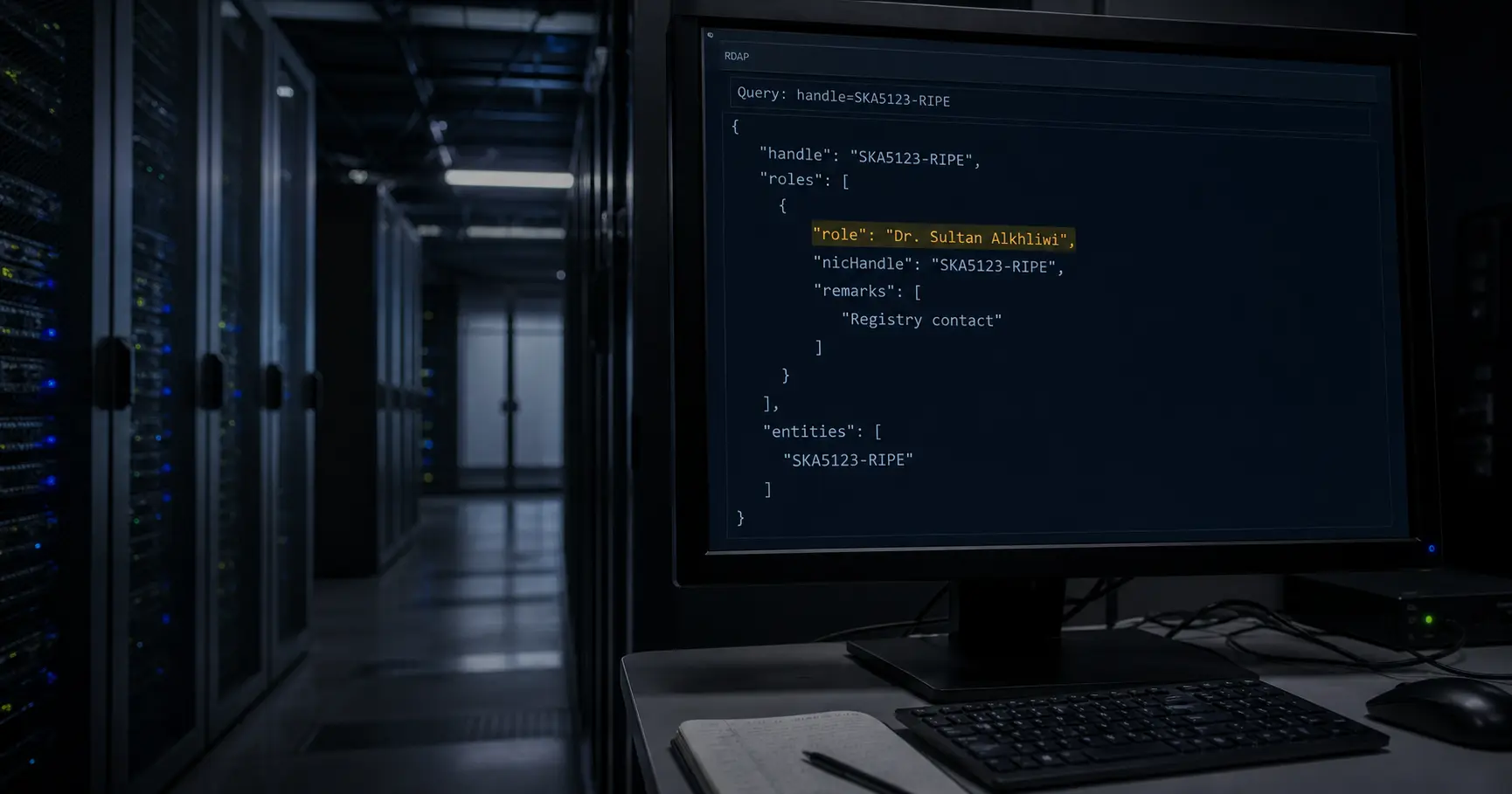
Dr. Sultan Alkhliwi is a thin registry contact observation drawn solely from a public RDAP record for AS210248. The person appears with admin and tech roles but without employer, biography, or routing corroboration. The profile serves as a reference point for detecting changes to the contact surface and for noting when fresh public evidence emerges. Readers should treat the record as potentially stale and must not infer private control, employment, or direct infrastructure authority from this listing alone.
Dr. Sultan Alkhliwi
Dr. Sultan Alkhliwi is the named technical and administrative contact for AS210248 in a single RDAP registry record, with no employer, routing footprint, or biographical corroboration in public sources. The listing serves as a reference point for tracking changes to the administrative surface of the autonomous system, but it does not confirm active control or current employment.
Why It Matters
A change in the RDAP contact details would immediately alter the baseline for AS210248 administrative control, potentially indicating a transfer of responsibility or a change of operator. New corroborating evidence, such as an employer link or routing activity, could either confirm or erase the person's relevance to the autonomous system.
What Sources Show
Dr. Sultan Alkhliwi appears in public internet infrastructure records only as a technical and administrative contact for autonomous system AS210248. The listing comes from a single Regional Internet Registry RDAP entry, with the handle DA8062-RIPE, and no additional employer, organizational affiliation, or routing footprint has been found to corroborate the person’s current role. The record represents the entire public evidence surface at this time.
The contact entry matters because it is the only known public pointer to a human responsible party for AS210248, a number resource with potential operational significance. Any change to this record — a new handle, altered role, or added organization name — would force a reassessment of who controls or administers that autonomous system. Monitoring the record provides a low-cost baseline for detecting administrative changes.
The RDAP source at https://rdap.org/autnum/210248 is an official, low-risk registry record that lists Dr. Alkhliwi with both administrative and technical roles. The record is publicly accessible and machine-readable, but it contains no biographical context, no employer field, and no Entityal entity. No secondary sources — such as company websites, professional social profiles, academic pages, or routing registries — mention this individual in connection with AS210248.
The operational control surface is confined entirely to the registry entry. Without employer verification or active routing announcements, it is not possible to confirm whether Dr. Alkhliwi directly manages network equipment, makes peering decisions, or holds decision-making authority. The listed roles suggest a potential point of contact for abuse or technical queries, but they do not establish formal operational control.
If the RDAP record were to change — for instance, if the contact handle were removed, replaced, or if an organization name such as a company or university appeared — the public baseline for AS210248 administration would shift immediately. Conversely, the emergence of new public evidence, such as a LinkedIn profile or employer page linking the person to a network operator, could either strengthen or dissolve the current contact-only assessment.
Analysts should monitor the RDAP record for any modification, particularly to the contact handle DA8062-RIPE, the associated roles, or the addition of an organisational attribute. The appearance of a personal website, academic affiliation, or employer page confirming the person’s current position would significantly expand the evidence set. The extended absence of change would increase the likelihood that the record reflects a historical rather than active responsibility.
The principal uncertainty is staleness: registry contact data often lags behind operational reality, and the person may have moved on without the record being updated. The absence of any corroborating public footprint further weakens the signal. Readers should not infer active control, employment, or operational authority from this single listing; the profile is a monitoring anchor, not a confirmed active role.
Operating Surface
The individual is recorded with admin and tech roles for AS210248 in a RIPE RDAP entry; no organisational affiliation, peering data, or personal website has been found. The role is a contact surface only and does not demonstrate operational ownership or decision authority over the autonomous system.
This person is tracked because any alteration to the registry entry — including handle, role, or organization — would shift the public understanding of who administers AS210248. As a monitoring anchor, the record offers a low-cost signal for detecting administrative transitions, though current evidence does not show active involvement.
Watchpoints
The subject represents a thin public contact observation that serves as a reference point for tracking AS210248 administration. No active control or employer linkage is established, making the value lie entirely in future change detection. Any registry update or new public connection would shift the profile from a passive monitoring target to a more significant operational node.
Monitor the RDAP record for handle changes, role alterations, or organisation attribution. Track emergence of any personal web presence, professional profile, or employer link that ties the individual to network operations. Extended record stability without new evidence would increase the likelihood of staleness.
Employer association is entirely absent; no personal or academic website, no social professional profile, no PeeringDB or routing data. The subject's current involvement with AS210248 is unconfirmed beyond the registry entry. Any new first-party or third-party public record could fill these gaps.
Sources
- Registry RDAP / WHOIS record - public-source identity and registry context for Dr. Sultan Alkhliwi.
Signal Brief
- Signal: Dr. Sultan Alkhliwi
- Region:
- Market Class: Global Cloud Services Trends
Operating Footprint
- public operating records
- official service pages
- documented relationships updates
Market Context
- A change in the RDAP contact details would immediately alter the baseline for AS210248 administrative control, potentially indicating a transfer of responsibility or a change of operator. New corroborating evidence, such as an employer link or routing activity, could either confirm or erase the person's relevance to the autonomous system.
- Operational relevance: Medium
- Time Horizon: Next quarter
What To Watch
- official company sources
- public registries
- operator-published records
Member Briefing
Deeper Trend Context
Sign in with the right membership level to unlock the full briefing and source notes.
Only for Strategic Circle
Strategic Circle
Open to all readers. Unlock trend briefings after joining and signing in.
Join Strategic CircleOnly for Leadership Alliance
Leadership Alliance
For operators, investors, and policy teams that need relationship evidence, failure paths, and source notes. Sign in to unlock.
Join Leadership AllianceSnapshot
Category
Global Cloud Services TrendsThe individual is recorded with admin and tech roles for AS210248 in a RIPE RDAP entry; no organisational affiliation, peering data, or personal website has been found. The role is a contact surface only and does not demonstrate operational ownership or decision authority over the autonomous system.
Content Type
EventPrimary Domain
MarketImpact
MediumA change in the RDAP contact details would immediately alter the baseline for AS210248 administrative control, potentially indicating a transfer of responsibility or a change of operator. New corroborating evidence, such as an employer link or routing activity, could either confirm or erase the person's relevance to the autonomous system.
Confidence
High confidence (95%)Confidence score guide
Several public sources