
Summary
- DHSC’s 8 October commissioning guide gives buyers of grouped-living telecare a detailed set of questions on compatibility, connectivity, resilience, security, service levels and testing, but it is non-statutory and does not prescribe one procurement model.
- The guide says no independent body validates conformance with NOW-IP. It leaves commissioners to test bidders’ claims and allocate responsibilities across suppliers, housing providers, maintenance partners and alarm-receiving centres.
The tender is becoming the safety boundary
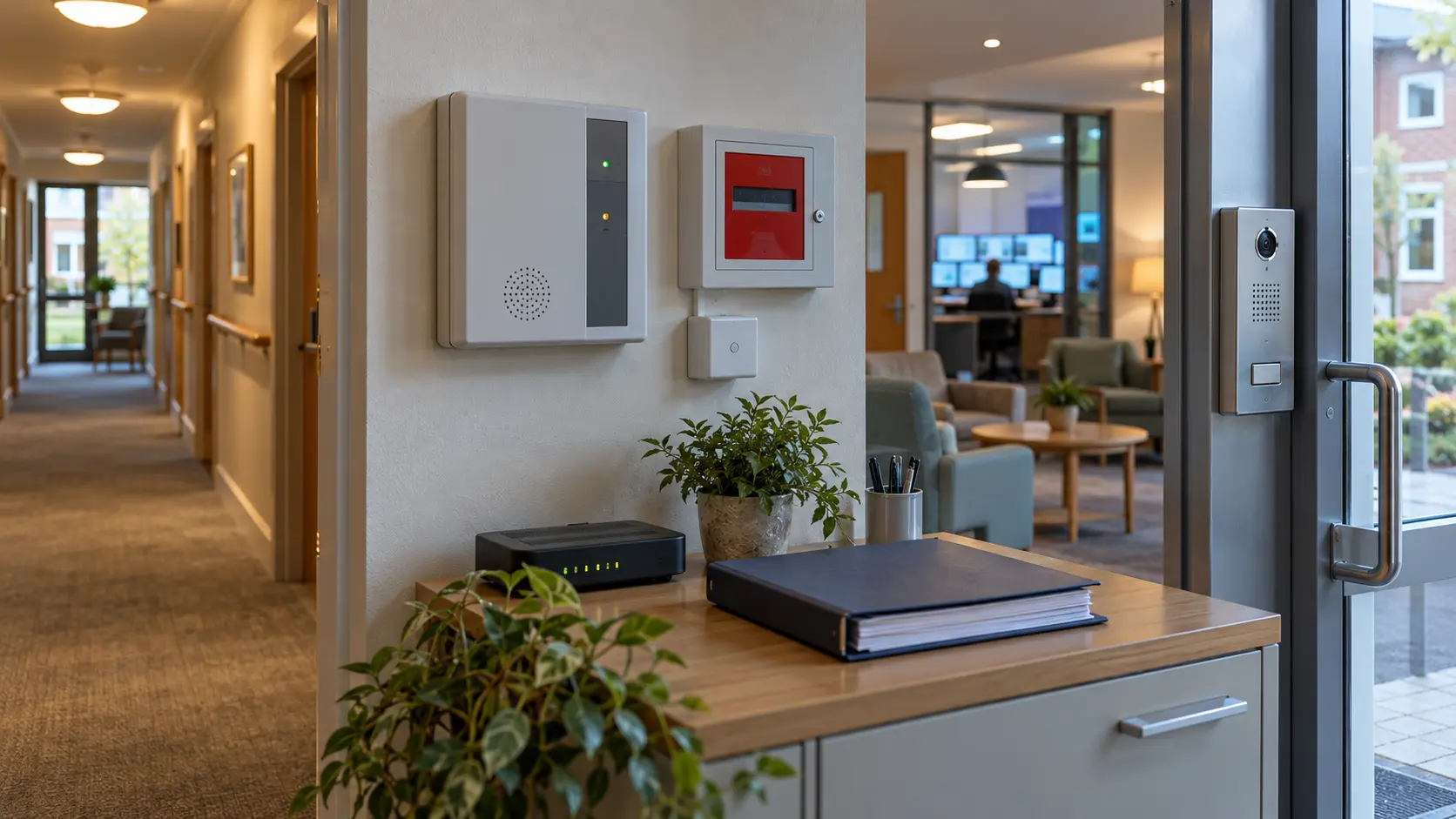
A digital alarm can be ready in the catalogue and still lack a proven route from a building to the centre that receives calls. For a grouped-living scheme, that route may depend on a master alarm, internal wiring, the building’s broadband, backup mobile connectivity, battery power, maintenance, software updates and the alarm receiving centre (ARC). Those components may come from different organisations.
That is the problem addressed by the Department of Health and Social Care’s Digital telecare commissioning guidelines: grouped living alarm devices, published on 8 October. It is written for commissioners and procurement teams planning, buying or reviewing telecare. DHSC says the document supplements existing standards, assurance schemes and local governance. It is non-statutory, and its requirements should be adapted to local services and users.
A second DHSC guide published on the same day addresses housing providers during the digital phone switchover. It estimates that about 500,000 people, roughly one quarter of UK telecare users, rely on grouped-living or warden-call alarms. Based on a sample of alarm-receiving centres in winter 2025–26 and May–June 2026, around three-quarters of grouped-living alarms remained analogue. The sample is a warning about exposure, not a census of every building.
A standard without an outside validator
The commissioning guide points bidders toward full support for NOW-IP, the named standard for grouped-living digital alarms. It also identifies a limit in the assurance chain: there is no independent body that validates whether an alarm meets that standard, so commissioners must rely on what bidders say. Manufacturer-specific variations can increase interoperability and maintenance risk; the guide asks bidders to disclose them.
That does not mean a buyer is powerless. The document asks for details of existing equipment that must be upgraded or replaced, acceptance-testing resources, support arrangements and evidence that a product works in a live operational setting. Where possible, testing should use the ARC proposed for the service and take place before the contract is awarded. A standards declaration is therefore one input to acceptance, not a substitute for it.
The same distinction applies to the 99.9% annual availability level discussed in the guide. It is a suggested procurement measure for relevant supplier-provided connectivity, not a statutory service guarantee. The buyer must define the fault, set the required level and measure availability from the grouped alarm solution to the ARC, rather than only at a device-management portal. The guide says this particular availability requirement is not relevant when the housing provider supplies its own broadband.
One service, several owners
The guide describes how a supplier may maintain software, a separate partner may handle onsite support, the housing provider may supply broadband and another supplier may provide backup mobile connectivity. It also tells commissioners to surface incompatible fire panels, lift lines and other existing equipment before deciding what a replacement will cost. In a connected building, replacing telecare can affect more than the alarm call itself.
The paired housing-provider guidance adds the property-level tasks: inventory devices and connected systems, tell communications providers which lines carry telecare, review fire-safety implications, test with the ARC, monitor failures, consider power cuts and keep residents informed. An analogue master unit may serve as many as 40 flats. Removing or replacing it without a suitable substitute for linked functions could leave a separate building system exposed.
These documents make the hand-off more visible, but neither supplies a public register of which providers have completed the work or whether each live alarm path passes an end-to-end test. The phone switchover is due to finish by January 2027; a migration date alone cannot establish that a device reaches its ARC after installation.
The emerging control is local procurement: a written responsibility map, disclosed deviations from the standard, an acceptance test using the intended ARC, and service data that describe faults from the user-facing alarm path. DHSC has given buyers a framework for asking those questions. The evidence of adoption and performance will have to come from the contracts and systems they put into service.
Sources
Member Briefing
Deeper Profile Context
Sign in with the right membership level to unlock the full briefing and source notes.
Only for Strategic Circle
Strategic Circle
Open to all readers. Unlock profile briefings after joining and signing in.
Join Strategic CircleOnly for Leadership Alliance
Leadership Alliance
For qualified IP-asset owners and management; sign in to unlock alliance briefings.
Join Leadership Alliance