
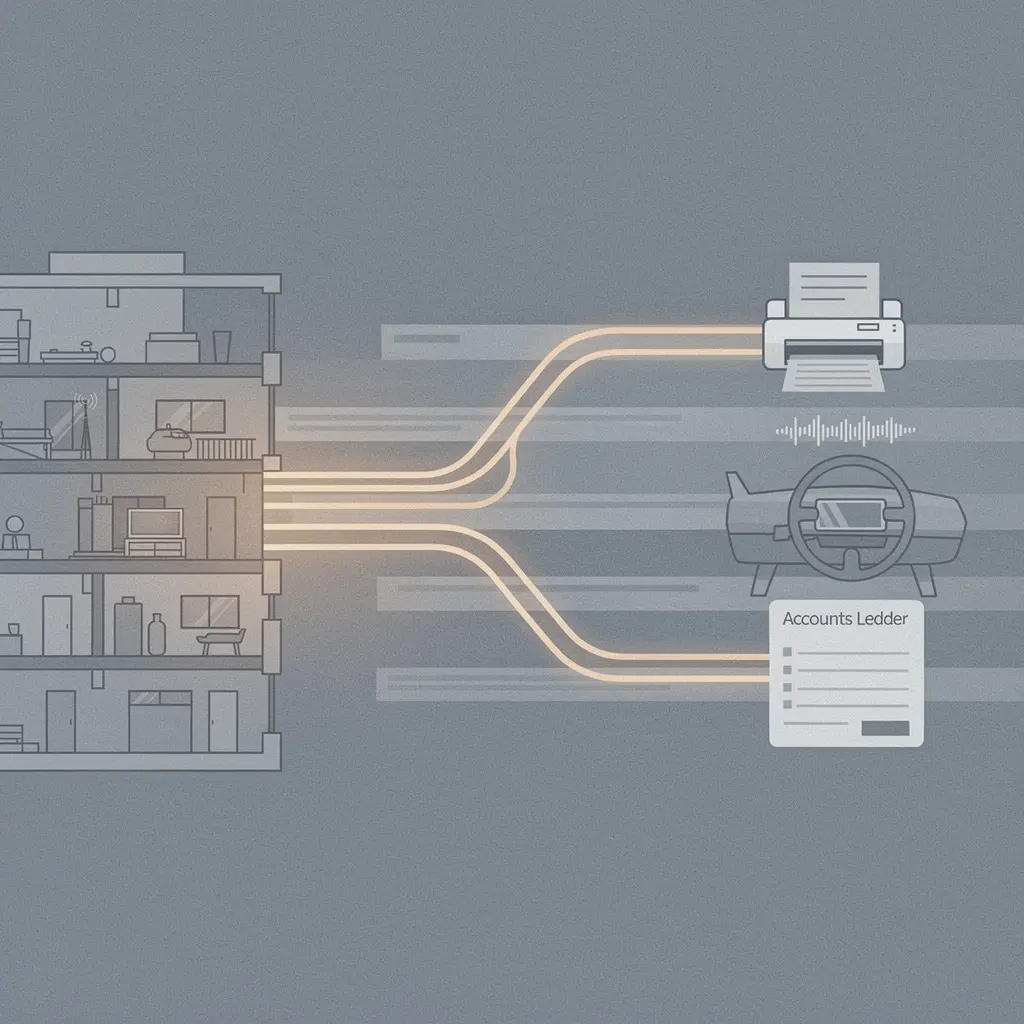
Summary
- DFKI is a registered GmbH, entered on 14 September 1988 at Amtsgericht Kaiserslautern under HRB 2313, with share capital of EUR 2,080,000, and is not part of Fraunhofer, Max Planck, Leibniz or Helmholtz.
- The October 2021 commitment of up to EUR 22 million per year is described as institutional-style support in the joint federal–state declaration, while the responsible federal ministry's own page describes DFKI's federal money as project funding — a materially different instrument.
- Identifiable transfer cases exist and carry dates, including Insiders Technologies (1998), semvox (2008, absorbed by CARIAD in 2023) and b4value.net (2004, DATEV majority acquisition effective January 2024). The widely quoted aggregate of more than 100 spin-offs and 2,500 jobs is self-reported and has no published counting method.
A GmbH, not a Fraunhofer institute
DFKI's legal identity is mundane, and it is the reason the funding question is complicated rather than settled. The institute is a Gesellschaft mit beschränkter Haftung registered at Amtsgericht Kaiserslautern under HRB 2313, entered on 14 September 1988, with share capital of EUR 2,080,000 and its registered seat at Trippstadter Straße 122, 67663 Kaiserslautern, according to a commercial mirror of the German commercial register (Handelsregisterauszug). The same registry-derived page records a 2025 amendment to the articles covering non-profit status, supervisory board and management.
On its own company profile, DFKI states that it was founded in 1988 as a non-profit public-private partnership and that funding arrives from the European Union, the Federal Ministry of Research, Technology and Space (BMFTR), the Federal Ministry for Economic Affairs and Energy (BMWE), the German federal states and the German Research Foundation (DFG), as well as from cooperation with industrial partners (DFKI company profile). That profile also records that the federal government and the states of Rhineland-Palatinate, Saarland, Bremen and Lower Saxony sit on the supervisory board, alongside universities, Fraunhofer and industry.
A Bundesrat decision document from 2020 puts the structural point sharply. It notes that DFKI is an independent GmbH outside the Fraunhofer, Max Planck, Leibniz and Helmholtz associations and therefore cannot use the Wissenschaftsfreiheitsgesetz, the statute that grants Germany's large science organisations budget flexibility and self-governance in staffing and procurement (Bundesrat Drucksache 289/20). The company form is what allows industrial shareholders — and what withholds the autonomy instrument that peer institutions enjoy.
Two accounting languages for the same money
The clearest evidence gap is not the size of public support but its character. In October 2021, the Federal Ministry of Education and Research and seven federal states declared their intention to support DFKI, as a mediator between basic research and industrial research on AI, with a total of EUR 22 million per year, half of it from the federal government (BMBF press release 209/2021). DFKI's own account of the same outcome says the institute will be funded by BMBF with up to EUR 11 million per year and receive the same amount from the host states over seven years, and repeats the institute's self-description as the only institution financed with industrial participation (DFKI news item).
The federal ministry's own AI page draws a line between instruments that the two accounts blur. It states that the five AI competence centres based at universities have received institutional funding since 1 July 2022, with the federal government providing up to EUR 50 million annually, and that the DFKI receives project funding from BMFTR totalling up to EUR 11 million per annum (BMFTR artificial intelligence page). Institutional funding and project funding are not the same commitment. Project money is acquired against defined work and carries no guarantee of renewal; institutional money is a standing position. For an institute whose public rationale includes continuity of research capacity between basic and applied work, the distinction determines what happens between funding periods.
Both figures are commitments, not audited spend. The 2021 documents describe an intention, and the ministry page uses "up to" limits.
What the dated numbers actually measure
The institute's finances appear in public in at least four non-equivalent forms, which is why no single trend line can be drawn from them.
The 2020 Bundesrat document records a 2019 balance-sheet total of roughly EUR 133 million and operating performance of roughly EUR 59 million, of which about 19 per cent came from industrial contract research (Bundesrat Drucksache 289/20). That is the most specific public statement about how much of DFKI's activity is bought by industry, and it dates from the pre-2022 funding period.
A DFKI exhibitor profile prepared for Hannover Messe in February 2024 reports a 2022 "Finanzvolumen" of EUR 82.6 million, about 928 core staff and about 634 student staff, and names shareholders including the universities plus companies such as SAP, Deutsche Telekom, BMW, Volkswagen, Bosch, Microsoft, Intel, NVIDIA, Google, Airbus and ZF (Hannover Messe 2024 DFKI profile). It also names DFKI Industrials GmbH, EIT ICT Labs Germany GmbH and GraphicsVision.AI GmbH as participations.
A third-party aggregator compiling German business filings reports DFKI revenue of about EUR 88.2 million in 2024 with a small loss of about EUR 331,000, revenue of about EUR 55.7 million in 2023, and a commercial-operations line of about EUR 11.268 million, or 12.8 per cent (firmendata DFKI record). That is a commercial aggregator, not a primary source, and the definitions behind its lines are not published.
"Finanzvolumen", "Betriebsleistung", balance-sheet total and filed revenue are different measures. The 2022 financial volume of EUR 82.6 million and the aggregator's 2022 and 2023 revenue figures do not reconcile because they are not measuring the same thing. Treating them as one series would manufacture a growth or contraction story that the documents do not support.
The transfer record: named cases with dates
Here the evidence is firmer than the aggregate headline, and narrower. Identifiable cases exist, and several end not in an independent company but in absorption by an established one.
Insiders Technologies, founded in 1998, describes itself as a spin-off of DFKI and develops software for document-centric business process automation; the company separately claims more than 5,000 customers (Insiders Technologies). semvox GmbH was founded in 2008 as a DFKI spin-off, builds voice-assistance technology and was taken over by CARIAD SE in May 2023; the company describes its technology as equipping more than 20 million cars (semvox). b4value.net was founded in 2004 at DFKI Kaiserslautern, and DATEV acquired 75 per cent of its shares with retroactive effect from 1 January 2024, with the remaining 25 per cent planned for 2027 (idw report on the DATEV acquisition).
More recent cases appear in a dated roster rather than in financial disclosures. At Viva Technology in Paris in June 2025, DFKI and Inria jointly presented twelve start-ups, including the DFKI spin-offs alangu, Ayand AI, Gretchen AI, intelligentX, insightIQ and telekinesis (Saarland Informatics Campus). The sector spread — sign-language translation, drug development, deepfake detection, robot programming — is itself informative: transfer at this institute is not one product line but a portfolio of unrelated applications.
Against these named cases stands the institute's headline transfer claim. DFKI's spin-off page states that more than 100 spin-offs with more than 2,500 jobs have emerged since 1988, that more than half are currently active as independent companies, and that many were taken over by established companies and enrich their product portfolios (DFKI spin-offs). The page that carries this claim does not, in the portions available, publish a named list, and it does not state how a spin-off or a job is counted.
What the aggregate claim cannot support
The aggregate figure is not evidence of the mechanism; it is a claim about it. Three specific limits apply.
First, the method is absent. There is no published definition of what qualifies as a spin-off, whether associated jobs are counted at founding or at present, and whether acquired companies remain in the count. The same page's number varies across snapshots of DFKI's own materials — 80-plus, 90-plus, 100-plus and 110-plus all appear in different versions — which is consistent with a live count rather than a contradiction, but also shows that the figure moves without explanation.
Second, the deployment-scale numbers are self-reports. The figures for customers (more than 5,000), vehicles (more than 20 million) and institutional users (more than 140) are published by the companies or the institute. They are not independently audited in the sources reviewed here, and they are not accompanied by measurement dates. They are directions of travel, not verified adoption levels.
Third, the acquisition path and the independence path are counted together. If more than half of the spin-offs remain independent while the most prominent newer cases — semvox and b4value.net — have been absorbed by larger owners, then "spin-off" describes two different outcomes: a durable independent company and a technology transfer event that ends in a domestic or foreign acquirer taking the asset. Both are real forms of deployment. They are not the same evidence about whether an institute builds scalable companies.
What would confirm or falsify the deployment claim
A reader who wants to audit the mechanism rather than accept it should look for four things, in order of strength.
Audited annual statements with a stable definition of industrial contract research, which would establish how much of DFKI's activity is bought by private industry year over year and whether the share of roughly 19 per cent recorded for 2019 has moved. The public record currently offers no continuous series of that kind.
An independent evaluation covering transfer outcomes rather than funding adequacy. DFKI's funding was renewed after an international evaluation, but the published materials describe the funding decision, not the transfer findings.
Product documentation that names institute-originated technology in shipped systems, together with the vendor's own release dates. The semvox case is the strongest example because an acquirer with a public product line took over the asset; the customer and vehicle counts still require the vendor's word.
Registry and transaction records for each claimed spin-off — commercial register entries, acquisition filings, insolvency notices. These are absent from the aggregated count. A spin-off count that cannot be reconciled with registry entries remains an institutional claim, and the claim itself is auditable only where such records exist.
Falsification is symmetrical. The mechanism claim would weaken if an independent evaluation found that transferred technology rarely reached production, or if a named case's product line were discontinued after acquisition, or if the industrial contract-research share were shown to have fallen while the aggregate spin-off count continued to rise.
Conclusion
The direction of travel at DFKI is credible: a 1988 GmbH with university and corporate shareholders, a federal–state commitment of up to EUR 22 million per year, and named companies — Insiders Technologies, semvox, b4value.net and the 2025 Viva Technology roster — that exist, trade and in two cases were bought by larger owners. What is not established is the conversion rate. The institute's headline number is self-reported and methodologically open; its financial measures are not comparable across years; and the federal instrument behind its largest public commitment is described by the responsible ministry as project funding, not institutional funding. Those are the three questions a reader should hold open. BTW's directory record for the institute is maintained here (DFKI directory entry).
Member Briefing
Deeper Profile Context
Sign in with the right membership level to unlock the full briefing and source notes.
Only for Strategic Circle
Strategic Circle
Open to all readers. Unlock profile briefings after joining and signing in.
Join Strategic CircleOnly for Leadership Alliance
Leadership Alliance
For qualified IP-asset owners and management; sign in to unlock alliance briefings.
Join Leadership Alliance