
Summary
- Cyber Internet Services (Private) Limited has a much stronger public trail than many regional access providers: APNIC registers AS9541 to the Karachi company, RIPEstat shows the AS announced with broad IPv4 and IPv6 visibility in July 2026, PeeringDB lists regional network-service-provider metadata and international exchange presence, Nokia describes Cybernet as a fixed-line telecom provider with FTTX, metro optical and international POP reach, and RapidCompute identifies itself as a division of Cyber Internet Services Pvt. Ltd.
- The paid unit is not bandwidth in isolation. The customer is buying a local access and field-support account: installation, fibre handoff, premises work, router and Wi-Fi discipline, outage recovery, cloud or hosting adjacency, upstream troubleshooting and a support relationship that reduces the cost of failure. The cheaper substitute is a national operator, mobile broadband, satellite for some sites, another local ISP, an in-house link, or delayed installation.
- The evidence can prove identity, visible network resources, international peering posture, cloud adjacency and Pakistan market pressure. It cannot prove the private facts that would decide the margin: customer count, line utilisation, installation lead time, support response, outage history, churn, contract economics, upstream purchase terms and account-level renewal behaviour.
The Outage Visit Is The Product
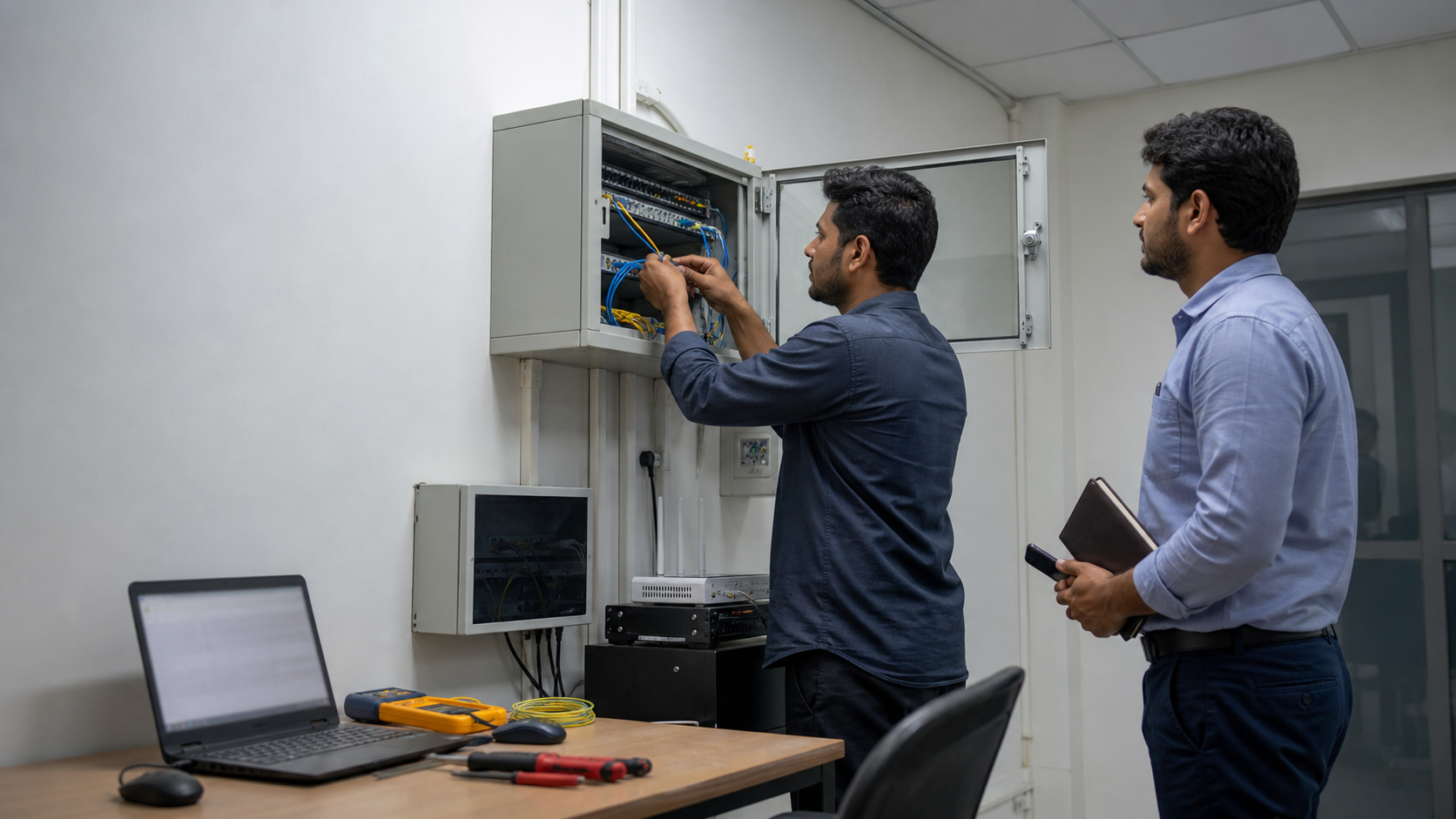
A small Pakistani business usually does not discover the real price of an internet provider when the sales person quotes a monthly fee. It discovers the price when a new branch cannot open because the fibre is not ready, when an upstream route makes a cloud service slow, when a payment terminal fails after a router swap, when staff tether from mobile phones because the fixed link is down, or when a renewal decision turns on one question: who will answer and who knows the site? Cyber Internet Services (Private) Limited matters because the service that can be sold under the Cybernet name is not only a circuit.
It is the account around the circuit.
The official and semi-official evidence gives the company a clear public identity. APNIC's RDAP entry for AS9541 names CYBERNET-AP, describes "Cyber Internet Services (Pvt) Ltd.", and gives Cyber Internet Services (Private) Limited as the registrant at Lakson Square in Karachi. Cloudflare Radar's AS9541 overview identifies CYBERNET-AP as Cyber Internet Services, places it in Pakistan, links the company website, and shows related AS names including AS24440, AS56052, AS58614 and AS58746. Nokia's October 2023 release on Cybernet's 600G commercial network describes Cybernet as a fixed-line telecommunications provider in Pakistan and lists services that range from internet and EVPN to MPLS, peering, IP transit, cloud and carrier-node hosting. RapidCompute's site says RapidCompute is a division of Cyber Internet Services Pvt. Ltd. at the same Karachi address. These sources do not prove profitability, but they do prove that the company is more than a dormant registry entry.
The commercial burden is specific. The customer buys a local access and field-support account: access, installation labour, premises coordination, support memory, upstream troubleshooting and service continuity. The cheaper substitute is a national operator, mobile broadband, satellite in special cases, another local ISP, an in-house private link or a decision to wait. The cost driver is not a single router or prefix. It is labour, right-of-way friction, fibre repair, customer-premises visits, power, data-centre and cloud integration, international capacity, peering, customer support and the cost of retaining accounts after bad incidents.
The strongest evidence class is public network, company, vendor and regulator evidence. The three missing proof categories are economics, reliability and retention: service-line revenue and margin, outage and response performance, and customer count, utilisation or churn.
That framing keeps the analysis honest. Cybernet has visible scale signals, but the visible network is still only evidence. It cannot say whether a Karachi household renewed because the installer was fast, whether a Lahore enterprise kept a dedicated link because the route to a cloud workload improved, whether a bank liked local support, or whether a support queue was slow enough to push customers back to a bigger operator. Those facts live inside ticket logs, contracts, utilisation reports and renewal data. Public records can show the mechanism. They cannot close the judgement.
What The Public Identity Proves
The company's strongest identity evidence is APNIC. The AS9541 RDAP record is not marketing copy. It is a regional internet registry record that gives the AS name, country, registrant and abuse contact. It also shows registration and last-changed dates. The registrant address and RapidCompute footer both point to Lakson Square in Karachi, which gives an external consistency check across a network registry and an operating service site. That matters because a company-profile article about a private operator should not rely on a brand name alone when the legal name is different from the retail name.
The APNIC record is still bounded. It proves control or registration of an autonomous system resource; it does not prove the number of paying customers, the volume of traffic on a given day, or the service quality of a broadband plan. A registry can lag reality, and a resource can be underused or repurposed. In Cybernet's case, however, the record is reinforced by live external measurements. RIPEstat's AS overview for AS9541 reported the AS as announced at the July 8, 2026 query time. RIPEstat's routing-status endpoint reported 709 IPv4 prefixes, 222 IPv6 prefixes, 224,768 IPv4 addresses and 168 observed neighbours at that same query time. This is substantial visibility for a regional provider, even though it is not a profit statement.
Hurricane Electric's BGP Toolkit page for AS9541 gives a second network view: it identifies Cyber Internet Services (Pvt) Ltd., lists Pakistan as country of origin, reports seven internet exchanges, shows hundreds of announced prefixes and observed peers, and names visible peers such as Pakistan Telecommunication Company Limited, Zain Omantel International, CTGNet, Cogent, Akamai, Level 3, Arelion, NetIX and Hurricane Electric. The exact figures differ from RIPEstat because collection methods and timing differ. That difference is useful rather than damaging. It reminds the reader that routing data is a moving measurement, not a company balance sheet.
PeeringDB adds a voluntary market-facing view. Its network entry for AS9541 names "Cyber Internet Services", gives "CYBERNET" as an alias, classifies the network as a regional network-service provider, lists IPv6 support, gives a selective peering policy, and shows self-reported traffic in the 1-5 Tbps band with heavy inbound ratio. PeeringDB's exchange-LAN records list entries at DE-CIX Frankfurt, HKIX, DE-CIX Marseille, NetIX, SH-IX, UAE-IX and Equinix Singapore. Its facility records list Marseille, Muscat, Fujairah and Singapore sites. These are useful because they fit Nokia's description of an international POP footprint, but they must be read as public interconnection metadata, not audited utilisation.
The same restraint applies to Cloudflare Radar. Cloudflare's AS page estimates an AS customer population using APNIC data and shows AS9541 with an estimated 6 million users. That is a useful modeled signal about relative reach. It is not the same thing as Cybernet's subscriber count. It should not be converted into revenue without knowing household sharing, business customers, NAT, wholesale arrangements, traffic mix and how the estimate is built. For the economic case, Cloudflare's page is best used as a signal that AS9541 has meaningful user-facing presence, not as a precise census.
The Customer Buys A Managed Access Account
Cybernet's commercial unit is easiest to see by combining Nokia's service description with RapidCompute's service adjacency. Nokia says Cybernet offers internet, EVPN and MPLS services at international POPs, and lists Carrier Ethernet, IPLC, DIA, MPLS, wholesale voice, peering, IP transit, cross-border capacities, submarine transits, cloud and carrier-node hosting. RapidCompute's homepage lists compute, storage, networking, Kubernetes, security, migration, management, Teleport and business applications at rapidcompute.com. RapidCompute's networking page describes virtual private cloud, load balancing, DNS management and hybrid or multi-cloud uses. The service surface is access plus operations, not a single retail broadband SKU.
That matters because it changes the unit of account. A household may see broadband as a speed and price choice. An enterprise sees a different bundle: fibre, a router, static addressing, Wi-Fi coverage, DNS, firewall rules, cloud reach, branch connectivity, uptime expectation and support escalation. A hosting customer sees a bundle of compute, storage, network policy, security and compliance responsibility. A wholesale customer sees peering, route quality, capacity and settlement discipline. The common paid unit is the managed account around connectivity.
The cost of that account is high because field and support labour do not scale like traffic. A provider can add capacity at falling unit cost if utilisation is predictable, but every new installation creates site-specific work: survey, permission, cable route, equipment, power, handoff, testing, customer education and later repair. When a link fails, the provider must diagnose whether the failure is inside the customer's premises, the access network, a city route, a metro optical segment, a core router, a data-centre port, DNS, cloud configuration or an international path. That diagnosis is labour-intensive.
It is also the reason customers pay for an account rather than only buying the cheapest megabit.
RapidCompute's compliance page makes the same point from the cloud side. It says RapidCompute supports five security standards and compliance certifications, including ISO 27001, ISO 27017, ISO 27018, PCI DSS, GDPR and Cloud Security Alliance alignment, and it describes a shared responsibility model in which the provider manages host operating system, virtualisation layer and physical security while customers manage their own operating systems, patches, applications and security groups. Whether every certificate is current would require certificate-level validation, but the page is enough to show that Cybernet's cloud-facing division sells operational responsibility, not just packets.
The support surface is also visible. RapidCompute's contact page separates cloud consultation, alliance inquiry, marketing collaboration, legal affairs, and accounts and assistance, all using a common support phone channel and departmental email links. That page does not prove service quality. It does show that the public service model expects customers to ask for help around sales, billing, legal and technical matters. In a regional ISP account, that support architecture is a cost centre and a retention tool at the same time.
The commercial prize is retention. If Cybernet installs the access, hosts the workload, understands the customer's firewall and has an escalation path for upstream problems, a customer has a reason to stay even if a headline broadband substitute is cheaper. If support is slow, if repair visits are missed, or if upstream dependence is passed through without clear communication, the account loses its switching cost. The economics therefore turn on behaviour after installation, not only on network reach.
Supplier dependence cuts differently by customer type. A household mostly notices installation delay, evening speed, Wi-Fi quality, billing friction and repair communication. A small business notices those things plus payment terminals, cloud applications, hosted email, point-of-sale systems and the cost of staff sitting idle. An enterprise account notices routing policy, service-level commitments, escalation path, change windows, incident communication, static addressing, backup circuits and how quickly the provider can distinguish a local access fault from a wider upstream event.
The same network resource can support all three markets, but the economics are not the same. A consumer account may be won by price and lost by repeated inconvenience. A business account may tolerate a higher price if the provider reduces uncertainty and coordinates suppliers better than the customer could do alone.
That distinction changes what competition means. Cybernet is not only competing with another ISP's advertised monthly plan. It is competing with a procurement officer's memory of the last outage, with a branch manager's ability to use mobile broadband as a workaround, with an IT manager's desire to consolidate access and hosting, and with a finance team that may not value route quality until an incident makes it visible. The value of a managed account is therefore episodic. It is easiest to sell just after a bad incident and hardest to defend when the service has been quietly working.
The provider must earn renewal during calm periods by making the hidden work legible without turning ordinary support into noise.
The customer's side of the bargain is also messy. Many buyers do not need carrier-grade language. They need an installation date, a stable link, a reachable support contact and a price that makes sense against their other options. Cybernet can win those accounts if the company makes complexity disappear. It can lose them if complexity appears as repeated technician visits, unclear blame, slow escalation or poor communication during outages. That is why the public network evidence is necessary but not sufficient. The buyer experiences the company through account management and repair, not through an AS record.
Network Visibility Is Not Margin
Cybernet's network evidence is strong by the standards of a private regional ISP. RIPEstat reports live AS visibility, visible IPv4 and IPv6 announced space, and a large observed neighbour set. PeeringDB reports exchange participation across European, Middle Eastern and Asian locations. Nokia reports a 600G DWDM optical deployment connecting main metro sites and says the platform can scale total network capacity to 28 Tbps. Hurricane Electric reports hundreds of prefixes and observed peers. These facts support the view that Cybernet has a serious operating network.
They do not prove that every access account is profitable. A network can be visible and still have weak retail economics if installation costs are high, if customer acquisition is expensive, if churn is fast, if support costs are poorly controlled, or if wholesale capacity commitments are mis-sized. Conversely, a smaller visible network can be profitable if it focuses on high-value enterprise accounts with low churn. The public routing table cannot tell the difference.
The 600G Nokia deployment is especially important because it points to the cost side. Nokia says the new optical network connects Cybernet's main metro sites, supports consumer and enterprise demand, and uses Nokia's optical transport and router platforms to improve capacity, latency, reliability and operating efficiency. That is the language of cost discipline. A metro optical upgrade is not a marketing decoration; it is capital spending intended to reduce per-bit cost, improve utilisation and make capacity growth cheaper.
The economic question is whether the resulting network supports enough retained accounts to cover the capital and operating costs.
PeeringDB's self-reported 1-5 Tbps traffic band should be read the same way. It is a signal that the network wants peers to see it as material. It is not audited revenue. It does not distinguish retail traffic from wholesale, cache traffic from paid enterprise capacity, peak from average, or high-margin private connectivity from low-margin consumer data. It is still relevant because a provider with meaningful inbound demand can reduce transit exposure if peering and caching are well managed.
The visible exchange set suggests the commercial problem Cybernet is trying to solve. DE-CIX Frankfurt and Marseille, HKIX, NetIX, UAE-IX and Equinix Singapore are not useful to a small local account unless they improve reach, reduce transit cost, improve latency, attract peers, or support wholesale and cloud customers. International exchange presence can reduce cost and improve performance, but only if traffic is engineered well and the provider can use the reach to support paying accounts. Otherwise, it is a badge with recurring port and transport costs.
The supplier side is where a visible network can either protect margin or leak it. International transit, exchange ports, cross-connects, transport to remote interconnection sites, vendor support, optical equipment, customer-premises hardware and cloud platform costs all have different bargaining dynamics. Some costs fall as volume rises. Some are lumpy and must be paid before demand arrives. Some become more expensive when redundancy is added. Some are denominated or effectively priced against foreign currency exposure while customer revenue is local.
Public routing evidence cannot expose those terms, but it explains why scale alone can mislead. A network can look impressively connected and still be under pressure if its upstream cost, equipment refresh cycle or underfilled capacity sits ahead of customer demand.
The customer side can also turn scale into a problem. A provider with many small accounts needs billing discipline, installation scheduling, support triage and cheap repeatable repair. A provider with fewer enterprise accounts needs account management, custom change control and senior engineering availability. Consumer scale rewards standardisation. Enterprise scale rewards memory and judgement. RapidCompute's cloud surface adds a third demand pattern: customers may expect platform support, compliance language and network troubleshooting from the same broader organisation.
The margin question is whether Cybernet can keep those support modes distinct enough to be efficient while presenting them as one coherent service to the customer.
There is also a risk of false precision. Prefix count, peer count and traffic bands can be counted, but they are not the unit of economic value. A marginal customer may consume little international bandwidth but require repeated site visits. Another may consume heavy cloud or video traffic but rarely contact support. A third may pay for reliability and never touch the full capacity of the link. Without revenue by segment and cost by account type, public network scale cannot be turned into an average margin.
The practical conclusion is cautious. Cybernet's network is publicly visible enough that it should not be treated as a tiny reseller with no backbone story. But visibility is not a substitute for private utilisation, outage and margin data. The article should price the company through the account: does the visible network make installation, support and renewal economics better for customers?
Upstream Dependence Becomes A Customer Problem
The title's point is not that upstream dependence is unusual. Every access provider depends on suppliers: fibre routes, power, ducts, poles, buildings, equipment vendors, international cables, exchange ports, cloud platforms and upstream networks. The question is whether the provider can turn that dependence into a managed customer service, or whether the dependence becomes the customer's problem.
Cybernet's public posture suggests it is trying to manage dependence through international reach. Nokia lists Cybernet POPs in Barka, Marseille, Fujairah and Singapore and says the company provides an advanced peering platform powered by Nokia routers. PeeringDB independently shows AS9541 exchange entries in Frankfurt, Hong Kong, Marseille, NetIX, SH-IX, UAE-IX and Singapore. Submarine Networks' PEACE cable page describes a Pakistan-East Africa-Europe system from Pakistan to France, extended from Pakistan to Singapore, designed with high-capacity transmission technology and route-diversity claims. Cybernet's public service description includes submarine transits, but the public record used here should not be stretched into an ownership or margin claim.
International reach reduces one type of dependence and creates another. A provider that can reach multiple exchange and cable locations may have more options than a provider buying only one national upstream. But each extra location creates cost: port fees, cross-connects, long-haul transport, routing expertise, equipment, monitoring and support. The more complex the network, the more valuable operational discipline becomes.
Pakistan's recent submarine-cable incident shows the point. On July 2, 2026, PTA said it was monitoring internet traffic disruption caused by a fault in the SEA-ME-WE 5 international submarine cable system and that some users could experience degradation while traffic was rerouted through alternate international links on pta.gov.pk. On July 3, PTA said the SMW5 fault had been rectified and internet services restored to normal operating capacity on pta.gov.pk. Cybernet is not the subject of those PTA releases, and the incident should not be described as Cybernet's fault. The releases are useful because they show the operating environment: international cable events can become user experience events, and rerouting is part of the job.
For a Cybernet customer, the relevant question is not whether an international fault exists. It is how the provider communicates, routes, prioritises and repairs when dependence shows up. An enterprise account might care whether a route to Singapore or Dubai degrades. A cloud customer might care whether DNS and load balancing still work. A household might care only whether video calls stop freezing. The provider's economic value is the ability to translate upstream complexity into a lower failure cost for each customer segment.
That is why upstream bargaining matters. If a provider has enough traffic, peers and international points to negotiate better terms or route around congestion, it can convert scale into customer value. If the provider carries high fixed costs but lacks enough retained traffic, the same architecture becomes financial pressure. Public records show the architecture. They do not show the bargaining outcome.
This is the supplier-dependence problem in economic form. A provider may have a domestic access network, but it still buys or coordinates elements of international reach, equipment, colocation, power, submarine-cable exposure, exchange access, transit and peering relationships. The customer generally cannot see which supplier failed. The customer sees the Cybernet account. The provider therefore carries reputational risk for suppliers it does not fully control. That risk is manageable only if the company has enough redundancy, monitoring, engineering depth and customer communication to translate supplier failure into a bounded service event.
The value of redundancy is not simply technical. It is an insurance product embedded in the account. Extra ports, alternate paths, spare equipment, backup upstreams and staff coverage all cost money before the customer sees the benefit. A price-sensitive customer may refuse to pay for that insurance until an outage proves why it mattered. A provider that overbuilds for customers who will not pay for resilience destroys margin. A provider that underbuilds for customers who depend on continuity loses trust.
Cybernet's public capacity and interconnection evidence suggests it has built a serious network posture, but the commercial question is whether customers are paying for the resilience that posture implies.
Customer dependence runs in the other direction as well. If a business hosts workloads with RapidCompute, uses Cybernet access, relies on provider DNS and has support history with the same organisation, switching can become costly. That can improve retention, but it also raises the standard of care. The more services a provider touches, the more any incident feels like a failure of the relationship rather than a narrow network event. The account becomes stickier and more fragile at the same time.
Pakistan's Substitute Set Caps The Price
The customer has alternatives, and Pakistan's market data makes those alternatives hard to ignore. PTA's homepage telecom indicators, updated as of May 2026, show 206 million mobile cellular subscribers, 158 million mobile broadband subscribers, 162 million broadband subscribers, 3 million fixed telephone subscribers, mobile broadband penetration of 62.82 percent and broadband penetration of 64.53 percent at pta.gov.pk. The obvious commercial implication is that mobile broadband is a large substitute for fixed access at the edge, even when it is not a perfect substitute for enterprise-grade service.
For many households, a national mobile operator or a fixed incumbent can discipline price. Mobile broadband may not match fibre for latency, consistency, data volume or shared household load, but it can keep a customer online long enough to delay installation or threaten churn. For some small businesses, mobile is a temporary backup rather than the main service. For a kiosk, small office or home worker, it may be enough. That forces a fixed provider to justify installation friction and monthly price through stability, support and speed.
For enterprise customers, the substitute set is broader. A buyer can choose PTCL or another national provider, another local ISP, a mobile backup, a satellite service for special sites, a direct cloud product, a data-centre cross-connect, an in-house private link, or a deferred project. The cheaper substitute may not be technically equivalent, but it sets the bargaining conversation. If a customer's downtime cost is low, cheap access wins. If downtime is costly, the provider with better support, better route quality and faster repair can command a premium.
PTA's list-of-operators page shows the breadth of license categories and published lists: cellular mobile, RBS, CVAS, LDI, infrastructure, integrated, tower, VPN and district-level internet service categories. This page does not, by itself, prove Cybernet's active license details. It does show that the market is regulated through multiple license categories and that competitors and substitutes exist across fixed, mobile, value-added and infrastructure layers. A private provider must sell within that structure.
The price ceiling is therefore not set only by Cybernet's cost. It is set by the customer's next best option. If a national operator can install faster, offer better bundle pricing or recover faults more predictably, Cybernet's account premium is weak. If Cybernet can install where the customer needs it, knows the building, provides a better support contact, and combines access with cloud or enterprise services, the account can beat a cheaper line. The public evidence supports the possibility of that premium. It does not prove its durability.
Competition is not only a head-to-head ISP comparison. It is also a budget-allocation fight inside the customer. A household may choose a cheaper plan and spend the savings elsewhere. A small business may accept lower bandwidth if mobile backup covers the rare failure. An enterprise may split vendors to avoid dependence on one provider. A cloud customer may move part of the workload to a global platform while keeping local access from a domestic provider. Each choice limits Cybernet's pricing power even if Cybernet's service is technically better.
That is why bundled value matters. A provider can defend price if it solves several adjacent problems at once: access, uptime, route quality, local support, hosting, cloud networking, backup, compliance conversation and escalation during incidents. The bundle is not valuable because every customer buys every product. It is valuable because it gives the provider more ways to explain why the account should not be judged only by the cheapest link. The danger is that bundling can become vague. If the buyer cannot identify the practical benefit, the bundle collapses back into a bandwidth price comparison.
Pakistan's mobile-broadband scale also changes the renewal conversation. Mobile is not a perfect fixed-line substitute, but it is a credible fallback for many households and small businesses. That reduces the panic value of a fixed connection and increases pressure on installation and repair. A customer with a working mobile option may wait longer before buying a fixed link, but may also churn faster after repeated fixed-line inconvenience. For Cybernet, this means field performance and communication are not soft factors. They are part of the price defence.
Field Labour And Support Memory Are The Scarce Inputs
The most important scarce input in a local ISP account is often not international capacity. It is field labour and support memory. A fibre route may be owned, leased or coordinated through third parties; a router can be bought; transit can be purchased. But local execution requires people who know neighbourhood constraints, building access, customer equipment, power conditions, cable routes and support history.
This is where Cybernet's FTTX and support story matters. Nokia says Cybernet owns a large FTTX network across Pakistan, though that statement appears in the "About Cybernet" section of a vendor release and should be treated as company-supplied context rather than audited infrastructure inventory. Even so, FTTX implies field work: last-mile deployment, customer drops, optical network terminal installation, troubleshooting and repair. The cost is not only capital equipment. It is the continuing labour of keeping many small physical links usable.
Field labour creates both advantage and risk. A provider that records sites well can repair faster than a competitor starting cold. It can retain customers because its technicians know the premises. It can upsell Wi-Fi, cloud backup, security, managed router service or a better service plan because it understands the account. But field labour is also expensive, and service variance can damage the brand quickly. A missed appointment, repeated fault or poor escalation can erase the goodwill from a cheap monthly plan.
Support memory is equally valuable for enterprise accounts. When a customer has static routes, site-to-site VPNs, DNS dependencies, hosted workloads, compliance constraints or payment systems, the provider that remembers the customer's environment reduces the cost of every future incident. RapidCompute's shared-responsibility language shows how this can work in cloud: the provider manages platform layers and the customer retains duties around applications, operating systems and firewall configuration. That division needs support memory or it becomes blame-shifting.
The labour economics are sharper than they first appear. A site visit has scheduling cost, travel time, parts uncertainty, access risk and opportunity cost. A technician sent to one building cannot be sent to another. A senior engineer pulled into a customer escalation is not spending that hour improving capacity planning or preventive maintenance. If repeated faults are concentrated in a few neighbourhoods, buildings or customer equipment types, good records can turn support history into lower future cost. If records are weak, every incident starts from zero and the provider pays the learning cost again.
Support memory also has a sales value. A provider that understands a customer's site can propose a second link, a managed router, cloud backup or a better service plan at the moment the customer is most aware of risk. That can raise account revenue without cold-selling. The same fact can create resentment if the customer feels the provider is selling upgrades instead of fixing the original problem. The difference is trust. Cybernet's public evidence shows a broad enough service surface for this account expansion to be plausible. It does not show whether customers experience it as helpful coordination or as complexity.
The most valuable support system is one the customer rarely notices. It prevents repeat visits, keeps contact notes, maps physical dependencies, distinguishes local faults from upstream events and tells the buyer what is happening before the buyer has to ask. That kind of operating discipline is hard to observe from public pages. It is also hard for competitors to copy quickly because it depends on accumulated local knowledge and internal habits. If Cybernet has it, the company has an advantage that network counts understate. If it lacks it, the network counts overstate customer value.
The missing facts are decisive. Public sources do not show installation lead times, first-time fix rates, median repair intervals, support-ticket backlog, customer satisfaction, renewal rate or churn. Without those, an article cannot say Cybernet's field support is strong or weak. It can only say that field support is the economic hinge. If labour is productive and retention is high, the account model works. If labour is inefficient and churn is high, the same model consumes margin.
Cloud Adjacency Changes The Account
RapidCompute makes Cybernet more complicated than a simple broadband profile. The cloud division says it has operated since 2011 as a locally rooted cloud service provider, and its about page describes four geo-redundant availability-zone locations across Karachi, Lahore, Peshawar and Rawalpindi. It also describes support for mission-critical businesses and communities. The claim should be read as RapidCompute's public positioning, not an independent audit of availability-zone design. Still, it changes the economic reading of Cybernet.
Cloud adjacency can increase retention because the customer may buy access, compute, storage, networking, DNS, backup and support from related service surfaces. A business that hosts locally may care about in-country latency, data residency, local support and regulatory familiarity. A public-sector or financial customer may value a provider that understands local compliance and can talk through physical security, network isolation and shared responsibility. RapidCompute's compliance page speaks directly to those concerns.
Cloud adjacency can also dilute focus. A provider selling consumer access, enterprise connectivity, wholesale services, peering, transit, cloud compute, DNS and security has many operating surfaces. Each surface needs product management, support, billing, incident response and documentation. Broad service range creates wallet share only if the provider can coordinate it. Otherwise, customers experience the breadth as complexity.
The economics depend on cross-sell discipline. If Cybernet can use its access footprint to sell cloud services, and use cloud relationships to sell better access, the company can raise average revenue per retained customer. If the services remain separate silos, the cost of selling and supporting each line may rise faster than revenue. The public record does not provide segment revenue, customer overlap or gross margin by service line, so this remains an inference rather than a conclusion.
The strongest positive signal is strategic fit. A fixed access provider with international peering and domestic metro capacity has a natural reason to offer cloud and managed network services. A cloud provider with local availability zones has a natural reason to care about last-mile quality and upstream resilience. The strongest negative signal is missing measurement. Without public uptime reports, incident history, customer concentration, revenue mix and retention data, the cloud adjacency should be priced as optionality rather than proven margin.
Cloud also changes supplier dependence. A broadband provider can often describe a fault as a line issue, a wider routing issue or a customer-premises issue. A cloud provider must also deal with compute availability, storage behaviour, virtual networking, firewall rules, DNS, backup, operating-system responsibility and application boundaries. RapidCompute's shared-responsibility language is commercially important because it draws a line between provider duty and customer duty. That line protects the provider from impossible obligations, but it can also become a source of dispute when a business outage sits across multiple layers.
The best case is a local trust premium. A Pakistani customer that wants domestic support, local data handling, familiar billing and a provider that understands local connectivity constraints may value RapidCompute precisely because it is attached to Cybernet's broader network context. The worst case is a support burden without enough cloud margin. If customers buy low-cost cloud resources but require high-touch support, the service can consume the same scarce engineering time that protects enterprise connectivity accounts.
The public record does not resolve that tension, so the correct conclusion is conditional: cloud adjacency is strategically logical, but not automatically profitable.
Regulation And Quality Pressure
Pakistan's regulator gives two useful pieces of context: licensing structure and quality pressure. The PTA list-of-operators page shows multiple categories of fixed, mobile and value-added licensing. The homepage indicators show a large broadband market. The fixed-line broadband QoS release is more directly relevant: PTA said it completed Q1 2026 fixed-line broadband quality surveys across 31 major cities, including AJ&K and Gilgit-Baltistan, at pta.gov.pk. PTA said most broadband service providers were compliant with key KPIs including network availability, jitter and latency across local and international segments, but it also observed elevated bandwidth utilisation during peak hours, congestion, reduced speeds and increased latency among certain providers.
That release is not company-specific. It should not be turned into a claim that Cybernet passed or failed a survey unless the detailed survey names it. Its value is market-level: quality of service is monitored, congestion is an active issue, and the regulator expects corrective measures. A provider selling a support account must operate under that pressure.
The same applies to international cable risk. PTA's July 2026 SMW5 statements show that submarine-cable faults can affect service quality, that traffic may be rerouted through alternate links, and that restoration can normalise capacity. Cybernet's international posture may help it manage some external dependence, but it cannot eliminate cable risk. The economic value lies in resilience planning, routing discipline, customer communication and the ability to prioritise affected accounts.
Regulation also shapes customer expectations. A buyer may complain to PTA, compare providers, or use public QoS language to press for better service. That raises the cost of poor performance. It may also help serious providers by making quality visible. If the market learns to ask about latency, jitter, availability and congestion rather than only advertised speed, a provider with better operations can defend price. If buyers focus only on headline monthly charges, the account model becomes harder.
The unresolved regulatory question is license-specific. Public pages used here show categories and indicators, but they do not provide a direct, concise Cybernet license extract in the accessible text. APNIC, RIPEstat, PeeringDB, Cloudflare, Nokia and RapidCompute provide stronger company-specific evidence. The license detail would still be useful because it would clarify exactly which service authorisations support the current product set.
Market Signals Are Useful Only At The Edge
Sparse market signals can tempt an analyst to overstate service quality. Consumer internet providers tend to accumulate informal complaints and praise in map listings, forums, app-store comments, social posts and local conversations. Those signals can be useful because churn often begins with slow installation, poor repair communication or repeated evening congestion. They are also biased. Unhappy users are more vocal; satisfied users are quiet; screenshots age; comments may refer to a city, a reseller, a temporary outage or a competitor.
For Cybernet, the responsible use of informal signals is therefore narrow. Public interconnection metadata, official regulator pages and vendor releases carry the main factual burden. Informal chatter, if collected by an editor or analyst, should be used only as a weak indicator of where to ask questions: Which cities see the most complaints? Are complaints about installation delay, evening speed, billing, router replacement, cable cuts, customer support or international latency? Do enterprise customers complain about route quality or only consumer households? Are there repeat references to restoration time after local cuts?
The accessible public material used here does not verify a reliable review corpus. That is a finding, not a gap to hide. It means the public case should not say Cybernet's service is loved or disliked by customers. It should say the customer-experience question is central and still private. The strongest public quality evidence remains PTA's fixed-line broadband QoS release, which is market-wide, and the network records, which show capability rather than experience.
PeeringDB itself is also a market signal with limits. A self-reported traffic band, peering policy and exchange list help other networks decide whether to peer. They are not audited throughput. They are nonetheless relevant because a network that reports regional scope, IPv6 support, selective peering and multiple exchange locations is publicly presenting itself as a serious interconnection counterparty. That presentation supports the thesis that Cybernet wants to sell reliability and reach, not only retail access.
Cloudflare Radar's estimated user population is another weak signal. It is useful as a modeled external estimate of reach, but it is not subscriber count or revenue. The best use is comparative: AS9541 is visible enough to matter in Pakistan's internet ecosystem. The wrong use would be to multiply the estimate by an assumed monthly fee. That would turn a measurement signal into a false financial model.
Informal market signals should be read as triage, not proof. If a pattern of complaints appears around evening speed, the serious question is whether peak access contention, upstream congestion or customer Wi-Fi is responsible. If complaints cluster around installation, the question is whether the bottleneck is civil work, building permission, technician scheduling, fibre availability or customer coordination. If complaints focus on billing, the issue may have little to do with network quality but still drive churn.
If praise focuses on a named support team or a quick repair, the question is whether that performance is systematic or the result of one good local unit. Each signal points to a follow-up question; none should be promoted into a conclusion without corroboration.
The same caution applies to silence. A quiet public profile does not prove satisfaction. Many enterprise customers do not post public reviews, and households may complain through private support channels or local conversations. Conversely, a noisy review set can overrepresent a small group of frustrated users. For a private regional provider, the absence of a reliable public review corpus means the analysis should put more weight on observable structure and less on reputation anecdotes. That is why this profile emphasises account economics, supplier dependence and missing operating data rather than pretending to know sentiment.
There is still value in monitoring weak signals over time. A sudden change in the type of complaint can reveal stress before formal data appears. Repeated references to long repair windows would challenge the field-support thesis. Repeated references to stable business service or effective escalation would support it. References to international latency during cable events would test whether upstream diversity is visible to customers. The point is not to quote stray comments as fact. The point is to know which operational hypotheses informal evidence should test.
What Would Change The Judgement
The most important missing facts are private. First is customer count by segment: consumer broadband, SME, enterprise, wholesale, cloud and hosting. A network can look large because it carries many low-margin customers or because it carries fewer high-value accounts. Without segmentation, scale signals are ambiguous.
Second is utilisation. RIPEstat and BGP Toolkit show announced space and observed peers; PeeringDB shows self-reported traffic band. What matters commercially is paid utilisation: peak versus average, access oversubscription, cloud workload density, port utilisation, transit versus peering mix, cache efficiency and how much expensive international capacity is filled by profitable accounts. High utilisation can improve margins. Bad utilisation can create congestion and churn.
Third is installation and repair performance. For a local access account, installation lead time, failed installation rate, mean time to repair, first-time fix rate, repeat fault rate and customer-contact quality are more important than a route table. A provider that installs fast and repairs honestly can retain customers in a competitive market. A provider with poor field discipline will lose accounts even if the core network is sophisticated.
Fourth is churn and renewal behaviour. The entire thesis depends on support memory and local account value. If customers stay after the first contract term and buy additional services, the account model is working. If churn is high after installation incentives expire, the provider may be subsidising acquisition without earning enough lifetime value.
Fifth is upstream cost and bargaining power. Public records show peers and exchange presence, but not contracts. The decisive facts are transit price, port costs, cross-connect cost, long-haul transport, cable capacity terms, settlement-free peering value, redundancy and repair priority. A provider with better upstream terms can defend retail price or improve margin. A provider with poor terms may pass cost into customer price or congestion.
Sixth is support cost per account. RapidCompute and Cybernet's broader service surface suggest many support categories. That can create high-value relationships, but it also creates support burden. The relevant metric is not the number of services advertised. It is whether the support organisation can resolve incidents without excessive senior labour per ticket.
Seventh is capital discipline. Nokia's 600G and 28 Tbps scale language points to meaningful capacity investment. The question is whether that capacity is matched to demand. Overbuilding can help long-term growth but pressure near-term returns. Underbuilding protects capital but creates congestion. The right answer depends on demand forecasts and customer retention, not public slogans.
Eighth is supplier concentration. A provider can look resilient from the outside while depending economically on a small number of upstream terms, equipment relationships, high-cost routes, colocation decisions or wholesale arrangements. The commercial issue is not whether suppliers exist. They always do. The issue is whether Cybernet can switch, bargain, reroute and repair without exposing customers to long uncertainty. Evidence of diversified upstream contracts, stable equipment support, spare-part availability and disciplined renewal of exchange and transport arrangements would materially strengthen the case.
Ninth is customer concentration. A few large accounts can make a regional provider look financially healthy while increasing renewal risk. Many small accounts can diversify revenue while raising support cost. Cloud accounts can create sticky workloads but also concentrated technical obligations. The ideal evidence would show revenue and margin by segment, top-customer exposure, average contract length and renewal behaviour after major incidents. Without that, the customer base remains a black box.
Tenth is competitive win-loss data. Public pages can identify substitutes, but they cannot show why customers choose one provider over another. The decisive evidence would be recent wins and losses against national fixed operators, mobile substitutes, other local ISPs, global cloud services and internal IT alternatives. If Cybernet wins because it installs faster and supports better, the thesis strengthens. If it wins mostly on discounting, the thesis weakens. If it loses on price but keeps high-value accounts on support, the business may be smaller but better.
If it loses high-value accounts after service incidents, visible network scale would matter much less.
Eleventh is incident communication quality. During submarine-cable faults, metro cuts or upstream instability, a provider's technical capability matters, but the customer's memory often turns on communication. Did the provider acknowledge the event quickly? Did it separate affected services from unaffected services? Did it give practical workarounds? Did it explain restoration without overpromising? Did account managers know which customers were exposed? A company that communicates well can retain trust even when it cannot prevent every failure.
A company that communicates poorly can lose trust even when the underlying fault is external.
Twelfth is product simplicity. A broad service surface can create revenue opportunity, but it can also confuse buyers. The evidence that would help is product packaging: clear access tiers, enterprise options, managed router terms, backup-link options, cloud-networking bundles, support levels and renewal pricing. Simplicity lowers sales friction and makes renewal easier. Complexity raises support cost and gives competitors room to undercut with a cleaner offer.
The Bottom Line
Cyber Internet Services (Private) Limited should be priced as a regional connectivity and support account with unusually visible network evidence for a private Pakistan operator. The APNIC, RIPEstat, PeeringDB, Cloudflare, Nokia and RapidCompute records line up well enough to support a serious operating profile: legal identity, active AS, broad public routing visibility, international exchange presence, metro optical investment, cloud adjacency and a support-facing service surface.
The business case is narrower than that evidence may first suggest. Cybernet's public value is not "it has many prefixes" or "it appears at exchanges." The value is whether those resources reduce the customer's cost of installation, outage recovery, cloud access, route quality and renewal anxiety. A customer pays for a managed account when the provider can make the cheaper substitute feel risky.
The main risk is that the public record cannot prove customer experience. It cannot show whether installations are fast, whether field teams arrive, whether support is responsive, whether evening congestion is controlled, whether enterprise routes are stable, whether cloud support is effective, or whether customers renew at profitable prices. Those are the facts that would turn the thesis into a firm judgement.
The supplier risk is equally important. Cybernet can look like a strong operator and still be economically exposed if upstream costs rise, if imported equipment becomes expensive, if transport or exchange commitments are underfilled, if power and field costs outpace revenue, or if customers expect high-touch support without paying for it. The customer's supplier-risk problem becomes Cybernet's brand problem. Cybernet's supplier-risk problem becomes the customer's service problem. The company earns its account premium only if it absorbs enough of that translation cost to make the buyer's life simpler.
Until then, the defensible conclusion is disciplined. Cybernet matters because it sits at the point where local field labour, international upstream dependence, cloud adjacency and Pakistan's competitive broadband market meet. The company can create economic value if it converts that complexity into a reliable account customers keep. It destroys value if upstream dependence, installation friction and support cost are simply passed to the customer. The public evidence supports the mechanism; the private evidence would decide the margin.