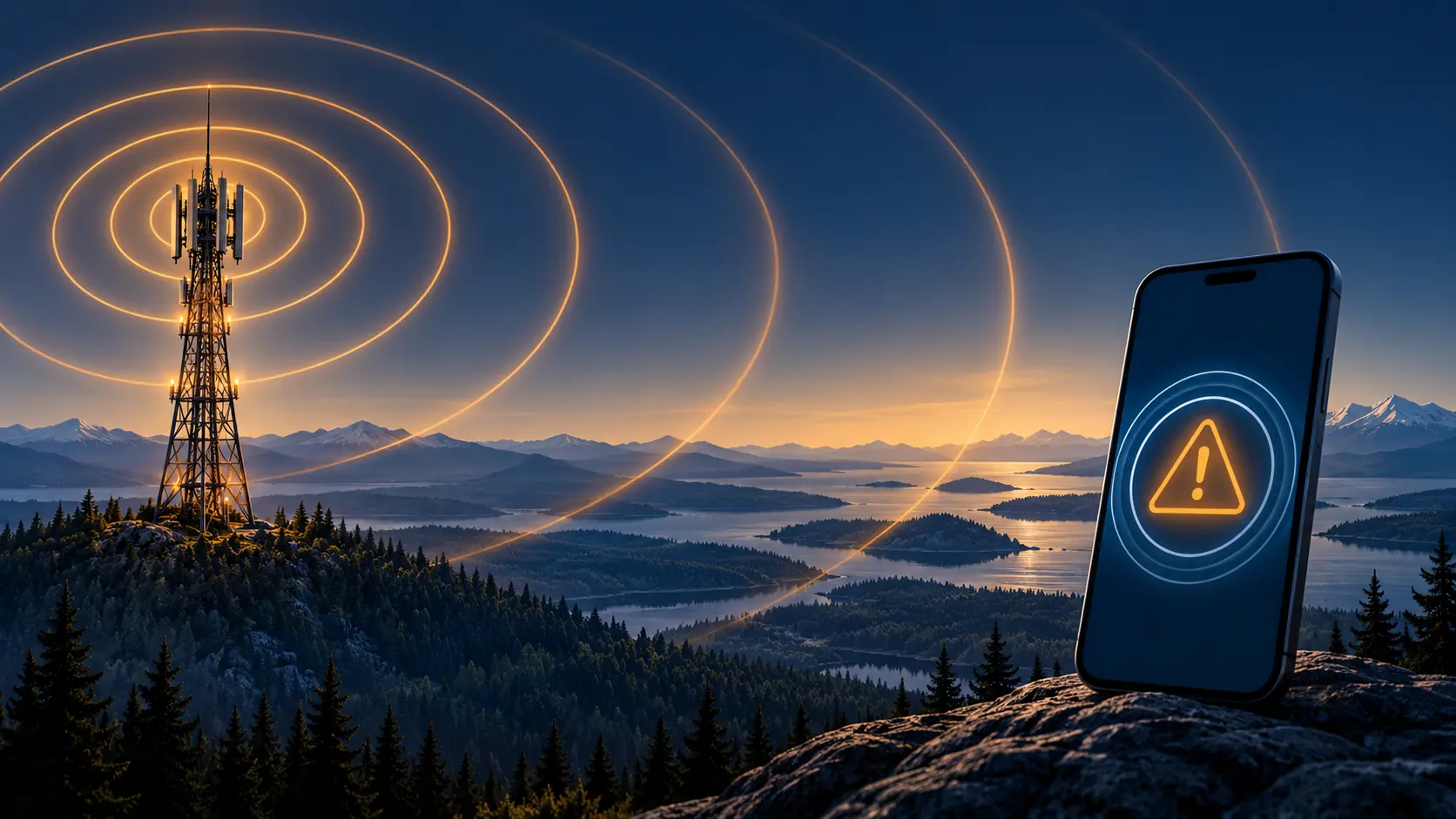
Canada's telecom regulator has given Iristel twelve months to make its LTE networks scream. In Telecom Decision 2026-282, issued 29 October 2026, the CRTC rejected all three of the company's proposed escape routes from Wireless Public Alerting — National Contribution Fund support, an exemption for wireless providers with fewer than 50,000 LTE subscribers, and a mandatory wholesale alert feed — and ordered the service live on LTE or newer networks by 29 October 2027, with the gap disclosed to customers in the meantime.
The Short Version
- Decision 2026-282 denies Iristel's requests for contribution-fund support, an exemption below 50,000 LTE subscribers and a mandatory wholesale alert service.
- The CRTC orders LTE-or-newer public alerting within 12 months and requires interim customer disclosure through several named channels.
Why a Siren Is Not a Policy Document
An emergency alert is not a paragraph in a regulatory filing. It is a radio broadcast that has to land on a handset in a basement, in a moving car, in a wildfire evacuation queue — and it has to land there whether or not the carrier that owns the tower felt like paying for the interface. That is the whole point of a public alerting condition: the warning is only as good as the weakest handset on the weakest network inside the alert area.
Which is why the CRTC's answer to Iristel was not a discount. It was a date.
What Decision 2026-282 Actually Requires
The obligation traces back to Telecom Regulatory Policy 2017-91, which made wireless public alerting a condition of service for wireless service providers — carriers and non-carriers alike. Section 24.1 of the Telecommunications Act gives the CRTC the power to attach conditions to services offered by persons other than Canadian carriers, including conditions on access to emergency services. Decision 2026-282 takes that existing scaffolding and bolts a fresh implementation clock onto Iristel's side of it.
Twelve months from 29 October 2026. Not a study, not a consultation, not a working group. A working alert path on LTE or newer, by 29 October 2027.
The Three Escape Hatches, Bolted Shut
Iristel brought three ways to soften the landing, and the regulator closed all three.
The first was money from the National Contribution Fund. The CRTC accepted the underlying economics — smaller providers do carry a heavier cost burden per subscriber — but declined to convert that sympathy into a subsidy.
The second was a threshold exemption for wireless providers below 50,000 LTE subscribers. This is the one that matters most, because it is where two legitimate concerns collide in a single order: cost relief for the provider becomes a coverage exception for the public. The CRTC chose coverage.
The third was a mandatory wholesale alert feed, a buy-it-in rather than build-it-in route. The regulator did not accept it as a workable stand-alone answer, which leaves the integration work inside Iristel's own network rather than in a supplier's catalogue.
Disclosure Is the Only Control Until the Siren Works
The interim rule is unusually visible, and deliberately so. Until the system is in place, Iristel must tell customers that emergency alerts are unavailable while they use its networks. The decision names the channels: the company website, terms of service, point of sale or service activation, and direct communications with customers.
Read that list as an engineering instruction rather than a marketing one. The gap has to be disclosed where a customer chooses, starts or continues service — not buried in a PDF on a page nobody visits. A customer who activates a SIM on an Iristel-backed network should learn about the missing siren at the moment of activation, not during the emergency it would have warned them about.
The Test That Has Not Been Published Yet
The order settles what the regulator requires and when it is due. It does not yet show that alert messages reach compatible handsets across Iristel's LTE footprint. What is missing is the boring, decisive artefact: an implementation filing or a public end-to-end test record naming participating LTE-or-newer networks, compatible devices, alert-area delivery and failure handling.
Until one of those appears, the twelve-month clock is a schedule, not a service. And a schedule is exactly the kind of thing that gets mistaken for progress: terms pages updated on day one, handset delivery still untested on day three hundred.
A deadline is a promise with a date on it. A siren is a promise that keeps it. Canada now has the first, and is waiting on the second.
Sources
Member Briefing
Read the full trend briefing
Members read the full briefing with the source notes behind every finding.
Strategic Circle
A daily briefing in your language, built from changes we have verified.
Join for USD 20/monthCancel anytime.
Members also get the full research library, a daily briefing on the networks they follow and the private forum.