
Summary
- Common Republican Processing Center is economically important because its public UZCARD role is not a generic payments brand. Current UZCARD material describes "Common Republican Processing Centre" JSC, operating under the UZCARD brand, as a national payment system providing payment transaction processing services across Uzbekistan at https://api.uzcard.uz/en/news/uzcard_and_mastercard_memorandum/. The UZCARD payment-system rules define the operator as the legal entity that ensures operation of the UZCARD payment system on the basis of a Central Bank licence, and define clearing, processing, acquirer, issuer, POS, ATM and settlement-bank functions in one rule set at https://api.uzcard.uz/wp-content/uploads/2025/08/Pravila_PS_UZCARD_V_2_2eng.pdf.
- The paid unit is an Uzbek payment-processing, card-switch and settlement-continuity account. Banks, merchants and payment organizations pay for the ability to keep local card acceptance, QR acceptance, ATM/E-POS authorization, clearing files, settlement positions, fraud controls, dispute evidence and account-crediting flows working when cash, international card networks, bank-owned processing, QR wallet rails and delayed settlement are all available but imperfect substitutes.
- The public evidence supports a serious continuity thesis, but it also leaves gaps. UZCARD's own service releases show SoftPOS growth, real-time POS-transaction notifications for banks, Tez QR expansion across UZCARD and HUMO cards, scheduled maintenance windows, and fraud-security communications. Central Bank statistics show the national payment environment at 72.7 million bank cards, 443,958 POS terminals, 45,543 ATMs and self-service kiosks, and 177.5 trillion sum of POS/E-POS turnover in January-April 2026. What remains private is the commercial price schedule, uptime record by service, chargeback ratios, fraud-loss allocation, bank concentration, settlement-failure frequency and the margin Common Republican Processing Center earns from each type of account.
The sale is a settlement promise, not a tap
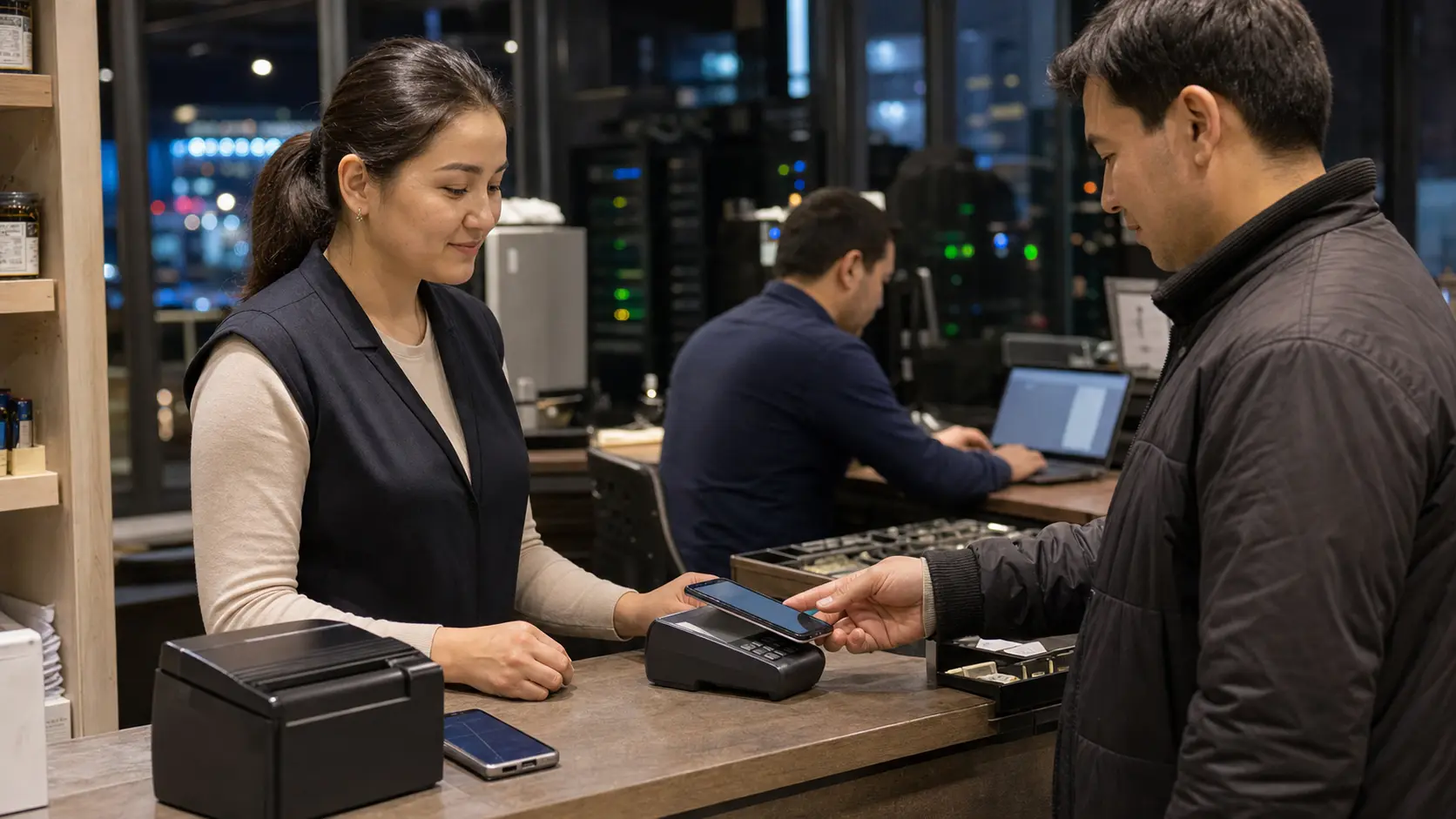
Start with a merchant in Tashkent that sells groceries, medicine, fuel, restaurant meals or delivery orders late into the evening. The buyer has a domestic card in one bank, the merchant has an acquiring arrangement through another, and the staff member does not care which institution eventually holds the liability. What matters is whether the authorization returns quickly, the receipt can be trusted, the buyer does not have to search for cash, the end-of-day report balances, and the acquirer can credit the merchant without a manual argument the next morning. That moment is where Common Republican Processing Center's economic unit begins.
The paid unit in this article is an Uzbek payment-processing, card-switch and settlement-continuity account. It bundles authorization routing, card-switch logic, merchant acceptance, settlement files, bank account crediting, dispute evidence, fraud monitoring, operating-day closure, and uptime coordination across banks and payment organizations. A merchant may see only the terminal, a QR code or a smartphone SoftPOS screen. A bank sees a stream of messages, files, net positions, account postings, exception cases and customer calls. The processor is valuable only if it turns those pieces into a repeatable domestic settlement system.
That unit has to compete with substitutes from the first transaction. International card networks bring global acceptance, mature dispute rules, tokenization, fraud tooling and cross-border recognition. Bank-owned processing can keep economics inside a bank group and may be tailored to the bank's own apps, ATMs and merchants. Cash still clears immediately in the hands of the seller, especially where trust in electronic settlement is thin. QR wallet rails can bypass some card-device costs and pull payments into app ecosystems.
Delayed settlement can preserve operational flexibility for banks when immediate merchant crediting is expensive or risky. UZCARD's case is that a domestic card switch can keep enough of the local market faster, cheaper, more sovereign and more resilient than relying on those alternatives alone.
The public record makes that case worth testing. UZCARD's May 2026 Mastercard cooperation release says "Common Republican Processing Centre" JSC, operating under the UZCARD brand, is the national payment system and provides payment transaction processing services across Uzbekistan at https://api.uzcard.uz/en/news/uzcard_and_mastercard_memorandum/. The UZCARD payment-system rules define the UZCARD payment system as a set of relations that ensure payments through interaction between the operator, participants and payment organizations using procedures, infrastructure and rules at https://api.uzcard.uz/wp-content/uploads/2025/08/Pravila_PS_UZCARD_V_2_2eng.pdf. The same rules identify the operator as JSC "Unified Republic wide Processing Centre" and state that it ensures the operation of UZCARD in Uzbekistan on the basis of a Central Bank payment-system-operator licence.
For this directory entity, the most conservative reading is that Common Republican Processing Center is the registered network-resource identity and UZCARD is the public payment-system identity attached to the operating business. The BTW directory page at https://btw.media/en/directory/common-republican-processing-center-llc-uz records COMMON REPUBLICAN PROCESSING CENTER LLC as a private company associated with ASN and IP network resources in Uzbekistan. BGP tools list AS212089 as COMMON REPUBLICAN PROCESSING CENTER LLC, registered to uz.uzcard, with originated prefix 185.178.51.0/24 at https://bgp.tools/as/212089. RIPE's Uzbekistan member list includes COMMON REPUBLICAN PROCESSING CENTER LLC at https://www.ripe.net/membership/member-support/list-of-members/uz/. Those records do not prove payment revenue, but they support the infrastructure identity behind the payment brand.
The economic question is therefore narrower than "is UZCARD famous?" It is whether banks and merchants will keep paying for a local processing account that sells settlement continuity. In a market where electronic payment use is growing, the strongest account is not simply the one with the most cards. It is the one that reduces the number of times a merchant has to say "the terminal is not working," the number of times a bank has to reconcile a disputed posting manually, and the number of times a regulator worries that a retail payment failure could turn into a public confidence problem.
Uzbekistan gives the switch a large operating surface
The scale of the operating surface matters because a payment switch is a fixed-cost business before it is a brand. The processor needs technology, security, staff, testing, network links, scheme rules, bank integrations, settlement procedures, fraud processes, incident response and a compliance function. Those costs are easier to absorb when the market has enough cards, terminals, ATMs, merchants and transaction value. The Central Bank's May 2026 payment-system statistics show that as of 1 May 2026 Uzbekistan had 72,710,067 bank cards issued into circulation, 443,958 installed POS terminals, 45,543 installed ATMs and self-service kiosks, and 177,491,866.17 million sum of POS/E-POS transactions in January-April 2026. The source page and downloadable file are at https://cbu.uz/en/statistics/paysistem/3874158/.
Those numbers are not UZCARD-only figures. They describe the national card and acceptance base reported by the Central Bank. That distinction matters. Common Republican Processing Center is not the only domestic payment infrastructure in Uzbekistan; HUMO, banks, wallet operators, payment organizations, international networks and the Central Bank's own settlement infrastructure all sit in the market. But the aggregate numbers show why a card-switch account is economically meaningful. A processor that touches even a large minority of that activity is selling continuity across a very large daily retail surface.
Central Bank materials frame the broader rails. The Central Bank's page on the Interbank Payment System says that system conducts electronic payments in national currency among banks through correspondent accounts opened at the Central Bank, and that the rules of the system are defined by the Central Bank at https://cbu.uz/en/payment-systems/interbank/. The Central Bank's tariffs page lists the clearing settlement system of the Central Bank, MUNIS, and refers to clearing according to the "Uzcard" and "HUMO" payment systems at a tariff from bank liabilities; it also lists the Unified QR-online System merchant commission rate at https://cbu.uz/en/payment-systems/tariffs-for-payment-services/. The bank-card switch has to sit beside those public rails rather than replace them.
The legal and regulatory lane reinforces that point. Azizov & Partners' 2026 overview of electronic payment systems in Uzbekistan defines a payment system as relations that ensure payments through the interaction of a payment-system operator, participants and payment organizations using operator rules, procedures and infrastructure. It says Uzcard, Humo and Upay are national payment systems, identifies Unified All-Republican Processing Center LLC as Uzcard's operator, and describes payment-system participants as banks that make settlements and conclude participation agreements with the operator at https://azizovpartners.uz/en/memos/electronic-payment-systems-of-uzbekistan/. The same overview describes licensing and payment-service obligations, including due diligence, record retention, confidentiality and protection of identification means.
This creates a regulator-pressure business model. The operator is not merely selling merchant convenience; it is operating inside a licensed payments structure that must be credible to banks, the Central Bank, merchants and users. The public rules do not permit a casual "best effort" processor.
UZCARD's rules say the operator defines rules, monitors compliance, provides control over payment infrastructure services, organizes the risk-management system, carries out risk assessment, ensures uninterrupted payment-infrastructure services, guarantees service continuity and security, determines net clearing positions and transmits net-position registers to the settlement bank. That is the language of an operating utility, not a decorative fintech app.
This is also where substitutes discipline price. If UZCARD charges banks too much or creates too many exceptions, banks can push more traffic into HUMO, international card schemes, bank-owned wallet flows, account-to-account transfers, QR-based payment rails, or cash-friendly merchant practices. If it underinvests in security and uptime, regulators and banks can treat the system as a risk. If it cannot move quickly with app-based payment habits, wallets and bank apps can take the visible customer relationship. The switch's bargaining power depends on making domestic card settlement less painful than those alternatives at the margin.
Merchant uptime is the product customers actually feel
Merchant uptime is not only server uptime. It includes terminal availability, authorization latency, card acceptance, QR acceptance, bank-side response, mobile app interaction, receipt generation, end-of-day reporting, account crediting and clear customer communication when a planned maintenance window or external service issue touches the transaction path. A merchant does not price those items separately. The merchant prices them through lost sales, queue length, staff time, customer frustration, cash-handling cost and settlement uncertainty.
UZCARD's own releases show that it understands the merchant uptime problem. On 19 January 2026, UZCARD announced an online notification service for businesses that lets banks receive real-time information about merchant sales made at POS terminals, with transaction data automatically transmitted to banking systems at the time of payment. The release says the service lets banks immediately credit funds to merchant accounts, improves cashless payment experience, increases turnover and transaction activity for retail businesses, supports analytics and forecasting, and reduces the burden on businesses during transition to electronic payments. It says the pilot was conducted with Infin Bank using real transaction flows, and that additional banks were connecting. The release is at https://api.uzcard.uz/en/news/notification_service_for_businesses/.
That release is commercially important because it defines a real buyer pain. Settlement continuity is not abstract if a merchant needs working capital. If a business receives cash, it can use the money immediately, but cash has counting, theft, change, collection and tax-record burdens. If the business accepts a card and waits for settlement, the sale is cleaner but liquidity moves into the bank's settlement process. A notification and immediate-crediting flow is a way to make card acceptance feel more like cash without losing digital auditability.
The processor's account becomes valuable because it shortens the time between acceptance and usable revenue.
SoftPOS is the same logic applied to terminal cost and merchant onboarding. UZCARD's 29 January 2026 SoftPOS release says banks and technical partners are implementing new methods for accepting cashless payments, and that SoftPOS lets card payments be accepted through an Android smartphone with NFC instead of a dedicated terminal. The release names micro-businesses, self-employed workers, couriers, delivery services, waiters and mobile specialists as target users. It says payment volume using UZCARD cards via SoftPOS exceeded 9 billion sum by the end of 2025, twenty times more than in 2024, with Anor Bank at 74 percent of the SoftPOS payment structure, Ipoteka Bank at 9 percent and Hamkor Bank at 7 percent. It also says Tashkent merchants accounted for 81 percent of SoftPOS transactions while Khorezm, Jizzak, Namangan and Samarkand showed regional growth. The source is https://api.uzcard.uz/en/news/uzcard_softpos/.
The SoftPOS data shows how merchant uptime and merchant acquisition connect. A physical POS estate is expensive to procure, distribute, maintain and replace. Smartphones are already in merchants' hands, but using them as payment acceptance devices pushes more responsibility into app stability, device security, NFC support, bank integration and real-time authorization. For a small seller, the ability to activate the acceptance app on another device after a smartphone failure is not a technical curiosity; it is uptime.
For the bank and processor, it means the switch must manage more edge cases across more device types, more software versions and more fragmented merchant practices.
Tez QR adds another substitute and another integration burden. UZCARD's 15 January 2026 Tez QR release says the service had been expanded with HUMO cards in the VIA, Beepul and Click SuperApp mobile applications. It says users can select the funding source from either UZCARD or HUMO cards, scan a QR code displayed on a POS terminal, and confirm the transaction in a mobile app without a physical card. The release describes UZCARD's Tez QR service as integrating multiple payment instruments into a unified digital environment, and it is available at https://api.uzcard.uz/en/news/tezqr_expands_capabilities/. The QR rail competes with cards for the user moment but also supports UZCARD if UZCARD owns enough of the routing and integration work.
The cost paragraph follows directly from those services. To sell merchant uptime, Common Republican Processing Center needs switching infrastructure, databases, links to banks, security tooling, support staff, rule-management staff, testing environments, certification work, help desks, incident response, fraud analytics, dispute records and software updates. It also needs enough relationship management to persuade acquiring banks and technical partners to adopt new services.
The direct public costs are not disclosed, but the cost categories are visible from the services: POS notifications require real-time data transmission into bank systems; SoftPOS requires partner integration and security controls; QR acceptance requires app and terminal coordination; scheduled maintenance requires communication and operational discipline.
The merchant's willingness to pay is therefore not based on affection for a card brand. It is based on whether the account makes the store's mixed tender environment easier. A buyer may ask to pay with UZCARD, HUMO, an international card, a QR app, a wallet balance or cash. A merchant may want the sale credited immediately, may want fewer devices on the counter, may want lower acquiring cost, and may want fewer calls from customers about failed payments. If UZCARD keeps that mix working, it has pricing power. If a QR wallet or bank app gives a merchant faster credit, lower cost and fewer failures, that substitute weakens the account.
Bank settlement is where switching becomes infrastructure
The payment switch becomes infrastructure when a transaction leaves the checkout and becomes an interbank settlement obligation. UZCARD's rules describe a front-end system that processes authorization requests from POS terminals and ATMs, routes authorization requests to hosts, interacts with payment networks and other systems, and controls terminal device status. They describe a back-office system that manages clients, cards and trading organizations, performs settlements between participants, interacts with automated banking systems and generates reports.
The same rules define clearing as collecting and processing financial transactions and preparing information for interbank mutual settlements between participants.
The settlement passages are the strongest public proof that the product is more than merchant acceptance. The UZCARD rules say the operator forms and sends to the settlement bank the register of net positions based on payment clearing. They say the settlement bank forms orders based on the net-position register on the day of receipt, and that members authorize the settlement bank to debit funds from their accounts on the basis of orders generated by the payment system. They also describe automated interaction between the settlement bank and the payment system through file preparation, processing, archive extraction and formation of participant claims and liabilities. Those provisions are in the rules at https://api.uzcard.uz/wp-content/uploads/2025/08/Pravila_PS_UZCARD_V_2_2eng.pdf.
For banks, this is a balance-sheet and operations question. The issuer bank wants its cardholders' transactions authorized correctly and wants fraud and disputed transactions handled within rules. The acquirer wants its merchants to be credited, its terminals to be registered properly, and its merchant dispute interests represented. The settlement bank wants participants to have enough funds for net obligations. The Central Bank wants the broader payment market to remain stable. The processor sits in the middle with message formats, files, risk controls and net-position registers.
This explains why bank-owned processing is both a substitute and a limit. A bank may operate parts of its own card, app, ATM or merchant infrastructure. It may have its own digital wallet, merchant service desk, fraud team and data warehouse. But a bank-owned system is not enough when the cardholder, merchant, issuer and acquirer are not all inside the same bank. The domestic switch creates a shared rule book and settlement process. A bank-owned processor can be efficient inside its own estate, but it cannot by itself solve every interbank and cross-participant acceptance problem. That is the domestic switch's reason to exist.
The same logic applies to international card networks. Visa, Mastercard and UnionPay bring mature global authorization, clearing and dispute practices, and they are valuable in Uzbekistan for travel, online commerce, cross-border acceptance and global interoperability. UZCARD's own Mastercard memorandum recognizes the need to expand acceptance, cross-border capabilities and cybersecurity, and frames Mastercard's global technology beside UZCARD's local market expertise at https://api.uzcard.uz/en/news/uzcard_and_mastercard_memorandum/. But a domestic switch can price what international networks do not optimize for: local currency settlement in everyday domestic commerce, domestic policy comfort, domestic bank participation and local service continuity.
The 2025 UZCARD-Elcard cross-border service shows how that boundary can move. UZCARD said it and Kyrgyzstan's Elcard launched transfers between cards of the two national payment systems, first through Universalbank's UNIRED app in Uzbekistan and Elcard Mobile in Kyrgyzstan, with bilateral transfers and exchange-rate features. The official UZCARD release is at https://api.uzcard.uz/en/news/uzcard_elkart_money_transfer/. Cross-border transfers create a product that competes with international remittance rails while using national schemes. The economic question is whether such intersystem arrangements can be reliable, priced well and scaled beyond promotional use.
Settlement continuity also makes delayed settlement a real competitor. A bank can choose to credit merchants later if immediate crediting raises liquidity, fraud or reconciliation risk. That may protect the bank but makes cards less attractive to cash-constrained merchants. UZCARD's online POS notification service is commercially relevant because it explicitly addresses immediate access to merchant revenue. The more banks can credit merchants at the time of sale, the less cash retains its liquidity advantage.
The more settlements lag or exceptions multiply, the more merchants will prefer cash, QR wallets with faster account crediting, or bank-specific acquiring arrangements.
The private metric that would change the judgement is the actual failed-settlement and exception rate. Public rules tell us how settlement should work. Public service releases show products designed to improve settlement visibility. Central Bank statistics show a large transaction base. What outsiders cannot see is how many transactions fail to settle cleanly, how quickly exceptions are repaired, how often banks dispute net positions, how much liquidity is tied up by delayed settlement, and how much merchant churn is caused by settlement pain.
Those metrics determine whether the account is a high-value continuity product or merely a necessary utility fee.
Fraud, disputes and trust are part of the switch bill
Fraud and dispute handling are not side services. They are part of the economics of acceptance. A merchant that accepts electronic payments wants finality, but card systems need ways to handle stolen credentials, incorrect postings, authorization errors, non-receipt, terminal misuse, suspicious merchant categories, refund disputes and records requested by banks or authorities. The cost appears as fraud losses, chargeback exposure, support staff, evidence retention, blocked transactions, customer friction and compliance work. The processor's value is partly the ability to reduce that cost without killing legitimate transactions.
UZCARD's rules directly address fraud. They say each participant must report fraudulent bank-card transactions to the payment-system operator to prevent fraudulent transactions or compromise of card details. They give the operator the right to initiate verification of compliance with the rules in relation to identified fraud cases. The security section says security and protection of information covers the operator, settlement bank, issuers, acquirers, cardholders, merchants and communication systems. It also requires measures to protect data during card issuance and prevent compromise. These provisions are in the UZCARD rules PDF at https://api.uzcard.uz/wp-content/uploads/2025/08/Pravila_PS_UZCARD_V_2_2eng.pdf.
The dispute passages are just as important. The rules say issuers participate in dispute resolution for transactions made with the issuer's card in acquirers' device networks, and acquirers represent merchants' interests in dispute settlement processes for transactions made at points of sale. They list evidence for transactions, including ATM printer ribbon in paper or electronic form, POS terminal cheque copies, statements of funds flow on card accounts, electronic files and authorization log files. They require mandatory pre-trial settlement before court if parties cannot resolve disagreements.
That is not a consumer-marketing feature, but it is essential for bank confidence.
The UZCARD acquiring-abroad standard adds another layer for international acceptance. Searchable excerpts of the PDF at https://api.uzcard.uz/wp-content/uploads/2026/02/Standard_Acquiring_Bank_Cards_of_UZCARD_PS_Abroad_RA_ver_1_002_2.pdf show requirements for supporting documents for disputed transactions, information-security controls, staff training on cybersecurity, fraud prevention and social engineering, 24/7 readiness for security incidents, business-continuity and disaster-recovery plans, priority restoration of card-transaction processing during critical incidents, and retention of investigation materials including clearing files, logs and technical evidence. That standard is especially relevant where co-badged cards, international devices and cross-border scenarios add complexity.
UZCARD's public user-security notice on 10 February 2026 gives a practical version of the same concern. It said financial institutions, public authorities, banks and payment organizations implement strategies for stability and financial-crime prevention, and that user-fund protection tools may occasionally interrupt online payment, transfers and bank functions. It said temporary changes in external government identification and data-verification services could restrict operations requiring verification, while UZCARD payment infrastructure and card transactions continued as usual. It reminded users that bank, payment-organization and UZCARD staff do not request passwords, confirmation codes or bank-card details. The source is https://api.uzcard.uz/en/news/informatsiya-dlya-polzovatelej-platyozhnyh-servisov/.
That notice shows the tension inside fraud control. Stronger verification protects users and banks, but it can break the payment experience if external identity or data services become unavailable. Too little friction invites fraud. Too much friction sends users back to cash or to another app that feels smoother. The valuable processor is not the one that approves everything; it is the one that lets banks and payment organizations distinguish risky transactions from ordinary commerce with enough speed and documentation to preserve trust.
Dispute handling also shapes merchant pricing. If a merchant thinks every card transaction can be reversed unpredictably, it will price that risk into goods or push customers toward cash. If a bank thinks a merchant category is abusing codes, splitting transactions or misrepresenting goods, it will demand monitoring and sanctions. UZCARD's rules describe monitoring for misuse, including checks of operations and terminal settings, MCC codes, service-type correctness and transaction parameters. That monitoring can annoy some merchants, but without it the switch becomes a channel for inflated, disguised or fraudulent traffic.
The same controls can produce a competitive advantage. International card networks have deep fraud and dispute systems, but they are global rule sets. A domestic processor can adapt to local bank practices, local merchant categories, local identity services, local cash habits and local regulatory expectations. Bank-owned processing can be tailored even more tightly but may lack cross-bank neutrality. Wallet rails can simplify some disputes by keeping users inside a closed app, but they can create their own merchant acceptance and settlement issues.
UZCARD's opportunity is to make domestic card dispute handling predictable enough that banks and merchants prefer using the common switch rather than fragmenting into separate silos.
The unresolved issue is loss allocation. Public rules show procedures and responsibilities, but they do not disclose fraud-loss rates, chargeback volumes, time-to-resolution, merchant category risk, bank reimbursement practice or how much cost is recovered through tariffs. A processor can appear stable while pushing too much dispute cost onto banks or merchants. It can also appear expensive while actually reducing fraud enough to justify the price.
The private figure that would change the thesis is the all-in fraud and dispute cost per successful transaction, compared with cash leakage, wallet fraud, bank-owned processing disputes and international scheme chargeback exposure.
Regulator pressure favors domestic continuity, but it also raises the bar
Uzbekistan's payment market is not a free-floating app marketplace. It is a regulated system in which the Central Bank licenses payment-system operators and payment organizations, controls important settlement infrastructure and publishes payment-system statistics and tariffs. Legal commentary from Azizov & Partners says payment-system operators are legal entities that ensure the functioning of a payment system in Uzbekistan and have received a licence, while banks need a separate operator licence if they carry out that activity beyond ordinary banking. It also notes conditions around due diligence, payment documents, record retention, confidentiality and protection of user identification means at https://azizovpartners.uz/en/memos/electronic-payment-systems-of-uzbekistan/.
Esplora Legal's 2024 overview says Uzbekistan updated payment-organization regulation so payment-system operators and payment organizations could operate as joint-stock companies from 1 July 2024, while charter capital requirements rose from July 2025. It lists payment services including receiving and making payments using a bank account, issuing bank cards, receiving and processing payments made using electronic money, processing payments in electronic form and transmitting information to a bank for payment or receipt of funds, and making money transfers through money transfer systems. The article is at https://esploralegal.com/regulation-of-payment-organizations-in-the-republic-of-uzbekistan/.
For Common Republican Processing Center, regulation is both protection and pressure. It protects domestic processing by making payment services a licensed activity rather than a casual software business. It gives banks a reason to use licensed rails and common rules. It lets the Central Bank view retail payments through statistics, tariffs and settlement infrastructure. It supports a policy preference for local reliability and financial inclusion. But it also raises the cost of compliance, capital, security, reporting, data handling, incident response and documentation.
The Central Bank tariff page makes the public-sector price signal visible. It lists tariffs for the Interbank Payment System, the clearing settlement system MUNIS for clearing according to Uzcard and HUMO payment systems, the retail payment system, the Instant Payment System and the Unified QR-online System. The Unified QR-online System merchant commission rate is listed at 0.65 percent, while the MUNIS row refers to clearing according to "Uzcard" and "HUMO" payment systems at 0.005 percent from bank liabilities. The page is at https://cbu.uz/en/payment-systems/tariffs-for-payment-services/. These figures are not UZCARD's full commercial tariff, but they show that domestic rails are priced and supervised as public payment infrastructure.
Regulator pressure also explains why downtime matters politically. A payment system can fail in a way that is technically narrow but socially visible. If ATMs, POS terminals, co-badged cards or international card connections pause at the wrong time, users do not distinguish between bank, processor, mobile operator, identity database, international scheme and merchant device. UZCARD's 3 July 2026 notice said maintenance in international payment systems on 6 July 2026 from 02:00 to 02:30 could create short through-connection delays in ATM operations and international payment card systems within UZCARD infrastructure, as well as temporary delays in co-badged cards abroad. The notice is at https://api.uzcard.uz/en/news/maintenance_activities_on_06_07_2026/.
That notice is more revealing than a boastful uptime claim. It shows a planned window, names affected surfaces, and explains that even international payment systems can create domestic user experience issues. UZCARD's 20 April 2026 notice also said some services experienced disruptions due to unscheduled maintenance on a provider's side, while the payment system operated normally, and that access had been restored at https://api.uzcard.uz/en/news/interruptions_in_the_providers_service/. Such notices are not proof of flawless continuity. They are proof that continuity management is part of the public-facing product.
Regulator pressure pushes payment infrastructure toward resilience and interoperability. The UZCARD-HUMO integration example from Microcreditbank shows how policy can force practical changes. The bank said it completed integration of UZCARD and HUMO national payment systems in connection with a March 2023 presidential resolution on creating additional convenience for public payments, and said clients could use Visa, Mastercard, UnionPay, Uzcard and Humo cards through 530 MKBANK ATMs across Uzbekistan. The bank notice is at https://mkbank.uz/en/press_center/news/uzcard-va-humoning-integratsiyasi-yakunlandi/. That type of integration reduces the monopoly value of any single scheme but increases the value of processors that can interoperate cleanly.
The domestic processor therefore sits between two policy goals. The first is sovereignty: Uzbek payment activity should not depend solely on foreign card networks or foreign cloud and data paths. The second is competition: no domestic scheme should be so closed that merchants and users face unnecessary friction. UZCARD's strongest path is to be a domestic continuity provider that interoperates with HUMO, banks, QR rails, international networks and cross-border partners. Its weakest path would be to behave like a closed incumbent while wallets and bank apps solve merchant problems faster.
Cash, wallets and international rails keep the price honest
The cash substitute remains powerful because it settles instantly between buyer and seller. It is not always cheaper for the economy; it creates collection, security, counterfeit, reporting and change-management costs. But for a small merchant with thin working capital, cash has one obvious strength: it does not wait for a bank file. UZCARD's merchant account has to make electronic payment settlement feel close enough to cash to justify accepting the fee and the device or app process.
The online POS notification service is the clearest public attempt to make that case because it is explicitly about banks crediting merchant accounts immediately.
QR wallet rails are a different kind of price discipline. A QR payment can reduce the need for a card to be present, and in some markets QR codes have turned merchants into app-acceptance points without expensive hardware. UZCARD's Tez QR expansion shows that UZCARD is not ignoring this threat. It is trying to participate in QR rather than treat QR as outside competition. The risk is that wallet operators, super-apps or banks can use QR acceptance to make the payment system invisible. If customers open Click SuperApp, Beepul, VIA or a bank app, the brand in the customer's mind may be the app rather than the switch.
International card networks create a more sophisticated discipline. Mastercard's cooperation with UZCARD is a partnership, but it is also a benchmark. Mastercard brings global merchant acceptance, cross-border capabilities, cybersecurity tooling, tokenization experience and long-established scheme governance. Visa and UnionPay play similar roles in the broader market. If a domestic scheme cannot keep fraud and disputes predictable, banks and merchants can rely more heavily on international rules where the economics allow.
If international scheme fees, foreign dependence or cross-border constraints become unattractive, the domestic switch gains.
Bank-owned processing disciplines price from the other direction. Banks with strong digital channels can make their own app, wallet, card issuance, merchant onboarding and account-crediting flows attractive. TBC Bank, Uzum Bank, Anor Bank, Kapitalbank, Hamkorbank and other institutions have different digital strategies and different incentives. The Central Bank's May 2026 statistics show large differences in cards, terminals, ATMs and POS turnover by bank, with Aloqabank, National Bank, TBC Bank, Ipoteka-bank, Xalq bank, Hamkorbank and Uzum Bank all visible in the national file at https://cbu.uz/en/statistics/paysistem/3874158/. A processor must serve banks that may also want to own more of the merchant and consumer relationship.
Delayed settlement is less visible but still powerful. A bank that delays merchant crediting can reduce operational and fraud risk, but it may lose merchant trust. A merchant that accepts delayed settlement may tolerate it while card volumes are incremental. Once cards become core revenue, delay becomes a cost. UZCARD can charge for services that reduce delay if merchants and banks believe the reduced delay brings measurable turnover, loyalty and cash-flow benefits. It cannot charge indefinitely if the delay is created by the processor's own complexity.
The cross-border substitutes are also moving. UZCARD and Elcard's 2025 card-to-card transfer service connects Uzbekistan and Kyrgyzstan through national schemes at https://api.uzcard.uz/en/news/uzcard_elkart_money_transfer/. Paysend's 2025 launch of instant payouts to Uzcard and Humo cards shows an international fintech viewing local card schemes as payout endpoints at https://paysend.com/uk-us/news/paysend-launches-payouts-humo-uzcard-cards. Those examples create a two-sided signal. They show that domestic schemes matter to cross-border providers, but they also show that international aggregators can own the customer and merchant interface while local schemes provide the final mile.
This is why Common Republican Processing Center's account should be judged on operating leverage rather than branding alone. The more payment methods fragment, the more valuable a common domestic processing layer can be if it handles routing, settlement, fraud and records across them. But fragmentation can also take value away if banks, wallets and international networks create separate closed loops. The processor's job is to remain the least painful, most trusted way to make local payment obligations final.
Network-resource evidence supports criticality, but only lightly
The company is visible in network-resource records, and those records are useful supporting evidence. BGP.tools lists AS212089 as COMMON REPUBLICAN PROCESSING CENTER LLC, registered to uz.uzcard, with one originated IPv4 prefix, 185.178.51.0/24, and an upstream relationship visible at https://bgp.tools/as/212089. RIPE's member list for Uzbekistan includes COMMON REPUBLICAN PROCESSING CENTER LLC at https://www.ripe.net/membership/member-support/list-of-members/uz/. The BTW directory record at https://btw.media/en/directory/common-republican-processing-center-llc-uz likewise ties the entity to ASN/IP network resources and Uzbekistan.
Those records should be used carefully. An ASN does not prove transaction volume, revenue, market share or uptime. A /24 does not show how UZCARD's full payment architecture is hosted. Payment systems can use private links, bank leased lines, data centers, cloud services, third-party providers and multiple domains that are not all visible in public BGP records. Network-resource evidence is therefore not the main commercial proof. The main proof comes from UZCARD's payment-system rules, Central Bank materials, public service releases and bank integration evidence.
Still, the network-resource record matters because payment switching is a communications business. Authorization requests, settlement files, dispute evidence, fraud alerts, transaction notifications, QR confirmations and bank-system connections all depend on networks. An operator that holds its own internet number resources has at least some direct infrastructure footprint rather than existing only as a marketing label. In a domestic continuity thesis, that matters at the margin.
Supplier dependence remains a real risk. UZCARD's own notices refer to international payment-system maintenance, provider-side disruptions and external government identification and data-verification services. SoftPOS depends on Android smartphones with NFC, bank apps, technical partners and device security. QR payments depend on app ecosystems, POS terminal display, mobile networks and payment-organization cooperation. Settlement depends on the Central Bank settlement bank and participant bank balances. The processor can reduce fragmentation, but it cannot eliminate every external dependency.
The UZCARD rules show some of the dependency management. They define interfaces with participant automated banking systems, intersystem interaction with partner payment systems, file uploads, operational day closure, settlement bank procedures, risk management, security and dispute documentation. The rules also say the operator enables electronic-message exchange between members and their customers, determines net clearing positions, transmits registers to the settlement bank and sends execution confirmations to participants. Those are the mechanics of dependency orchestration.
The merchant and bank customer do not buy "network resources" as such. They buy assurance that the networked payment chain will keep working. If a telecom provider fails, if an app update breaks SoftPOS, if an identity service slows verification, if an international scheme schedules maintenance, or if a bank has insufficient funds for settlement, the processor's value is measured by how quickly it isolates the issue, communicates, reroutes, records and restores. Public BGP evidence is only a small clue that the entity has infrastructure responsibility.
The private metric that would change the judgement is the topology of critical dependencies. A buyer would want to know data-center redundancy, bank link redundancy, provider concentration, disaster-recovery tests, security incident history, mean time to restore by service, failed authorization rates by channel, and whether critical settlement and authorization services can continue during external provider outages. Public sources show the rule framework and some communications, but not the resilience topology.
The boundary of the public evidence
The public evidence proves several things directly. It proves that UZCARD is publicly presented as a national payment system operated by "Common Republican Processing Centre" JSC and that it provides payment transaction processing services across Uzbekistan. It proves that the UZCARD payment-system rules define operator, participant, issuer, acquirer, clearing, processing, front-end, back-office, QR, POS, ATM, settlement-bank, fraud, dispute and risk-management functions.
It proves that Central Bank materials describe a large national payment environment and publish card/POS/ATM/turnover statistics, interbank payment-system information and tariffs involving Uzcard, HUMO and QR rails. It proves that UZCARD is launching services around merchant notifications, SoftPOS, Tez QR, cross-border transfers and cybersecurity cooperation.
The evidence implies, but does not fully prove, the commercial strength of Common Republican Processing Center's account. Service launches imply market demand, but not revenue. Central Bank statistics imply a large addressable operating surface, but not UZCARD-specific share. The SoftPOS release gives useful figures for one channel, but SoftPOS is still described as a small market share. Maintenance notices show operational transparency, but not annual uptime. Rules show how fraud and disputes should be handled, but not actual loss ratios or resolution times.
BGP records show infrastructure identity, but not payment criticality by themselves.
The private metrics that would change the judgement are clear. First, UZCARD-specific transaction value, authorization volume and active card count by bank would show scale. Second, merchant acceptance share by POS, E-POS, SoftPOS and QR would show whether the switch remains central as wallets expand. Third, average settlement time and immediate-credit adoption by bank would show whether electronic payments are becoming cash-like for merchants. Fourth, fraud-loss and dispute-resolution data would show whether the system is pricing trust effectively.
Fifth, uptime by service, planned and unplanned outage minutes, and incident root causes would show whether continuity is real. Sixth, tariff and revenue data would show whether the processor captures enough value to fund the required infrastructure.
There is also a corporate-form boundary. Some older public materials and network records use LLC language for Common Republican Processing Center, while current UZCARD releases and rules use JSC or Joint Stock Company wording for "Common Republican Processing Centre" or "Unified Republic-wide Processing Centre." The directory entity is COMMON REPUBLICAN PROCESSING CENTER LLC, and the directory record is tied to that name and network-resource identity.
This article therefore treats the LLC directory entity and the UZCARD operator public identity as evidence of the same operating continuity surface, while avoiding a legal conclusion about any corporate conversion beyond what public sources themselves state.
The strongest buyer case is an Uzbek bank or merchant portfolio that needs domestic card acceptance, immediate merchant-crediting data, cross-bank settlement, documented dispute rules, local fraud coordination, QR and SoftPOS expansion, and enough domestic control to avoid relying solely on foreign schemes. The weakest case is a merchant or bank that can route most valuable payments through its own app, a wallet, cash, an international card network or a cheaper acquiring arrangement without losing settlement quality. UZCARD wins when common domestic settlement beats fragmentation.
Final judgement: a defensible local switch account under price pressure
Common Republican Processing Center matters if UZCARD's domestic payment account keeps Uzbek card and merchant settlement more reliable than the substitutes. The public evidence supports that thesis. UZCARD's rules describe a full payment-system operating role, not a thin brand. Central Bank statistics show a huge national surface of bank cards, POS terminals, ATMs and POS/E-POS turnover. UZCARD releases show practical service work around real-time merchant POS notifications, SoftPOS, QR, Mastercard cooperation, Elcard transfers, scheduled maintenance, provider-disruption communication and user security.
Bank and regulator sources show that interoperability, settlement and payment-system licensing are live pressures in Uzbekistan.
The account's value is clearest for banks and merchant portfolios that cannot accept fragmented settlement. A bank needs cardholders to transact at other banks' merchants. An acquirer needs merchants to trust account crediting. A merchant needs uptime, reconciliation and dispute evidence. A regulator needs retail payments not to become a public confidence issue. A domestic switch earns its fee when it reduces the operating friction across those parties.
The substitutes remain strong and must appear in any final judgement. International card networks are better for global acceptance, travel, foreign merchant reach and mature cross-border dispute rules. Bank-owned processing can be cheaper or more tailored inside a bank's own ecosystem. Cash still wins when immediate physical finality matters more than digital records. QR wallet rails can make app-based payment cheap and visible at the merchant counter. Delayed settlement can protect banks from fraud and liquidity risk even if merchants dislike it. UZCARD has to beat those options in the daily local account, not in every payment use case.
The price should therefore be conditional. UZCARD can justify a premium where it gives banks and merchants domestic settlement continuity, immediate merchant-crediting data, reliable authorization, fraud coordination, dispute records, SoftPOS and QR expansion, and clear incident communication. It cannot justify a premium merely because it is domestic or historically important. The more wallets, banks and international schemes improve local acceptance, the more Common Republican Processing Center must prove uptime and settlement quality through measurable outcomes.
The final answer is commercially coherent but not complete. Common Republican Processing Center's payment-processing account is a defensible continuity product in Uzbekistan's payment stack. It prices the ability to keep local card, POS, E-POS, QR, ATM and bank settlement flows usable under regulator pressure and market fragmentation. The unanswered commercial metrics are price, margin, uptime, fraud cost, dispute cost, settlement delay and bank concentration. If those private metrics are strong, the account is critical infrastructure with real pricing power.
If they are weak, cash, QR wallets, bank-owned processing, international card networks and delayed settlement will keep compressing the value of the switch.