
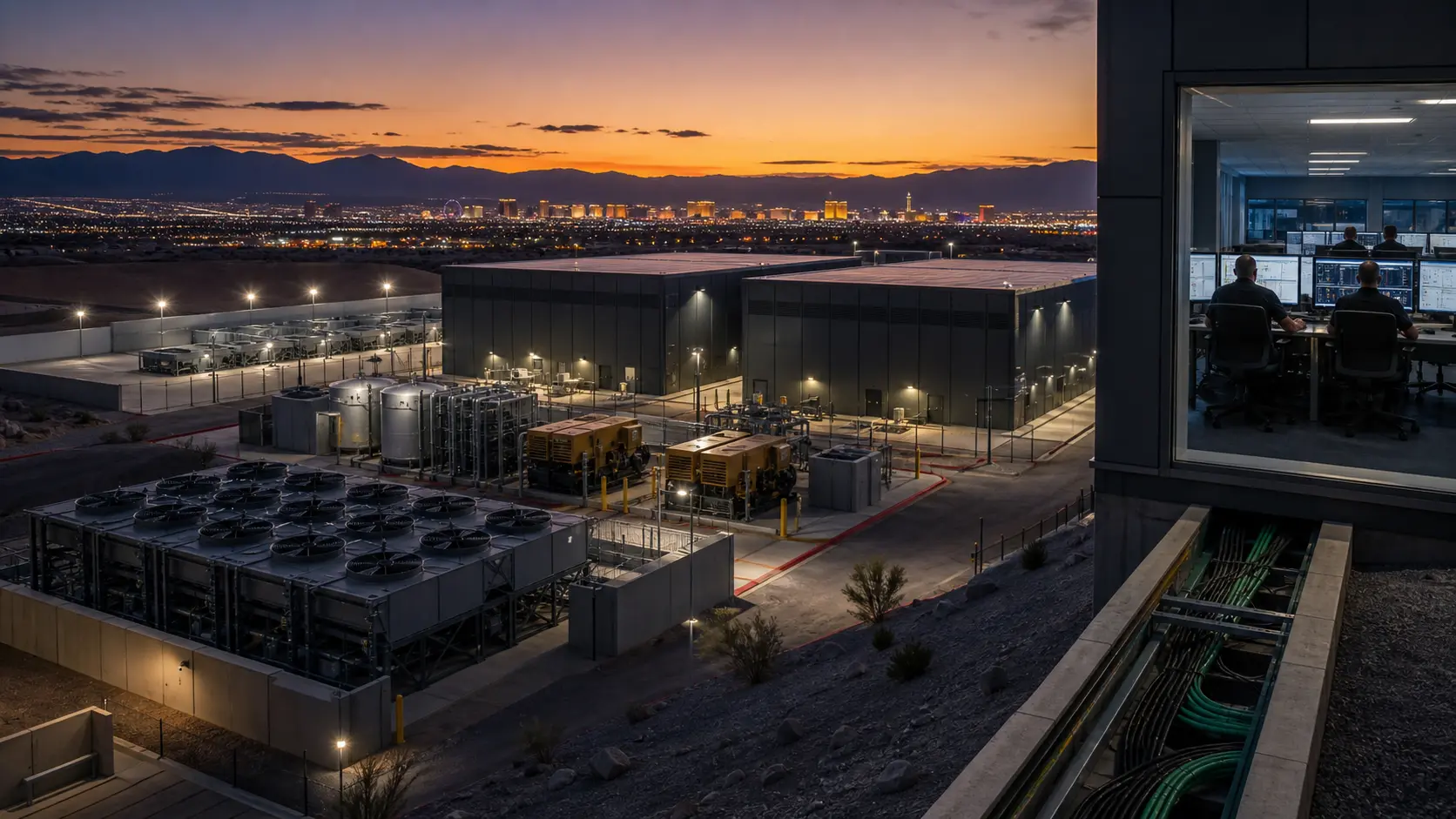
Summary
- What it says: A West Coast enterprise looking for a continuity site used to see Las Vegas as a practical compromise: close enough to California for executives, carriers and vendors, far enough from coastal earthquake and wildfire clusters, and dense enough with power and fiber to keep producti
- Main topic: Regional ISP economics; Hosting economics; SME service continuity; Data centre investment
- Context: Datacenter
The continuity sale was always the Las Vegas sale
Imagine a California software company after a board-level resilience review. Its main engineering team sits in Los Angeles or the Bay Area, its commercial systems already depend on public cloud regions, and its finance team has been told to explain what happens if a regional earthquake, power shutoff, wildfire smoke event or carrier incident knocks out a primary office, a primary cage or the local staff who know how to recover it. The easiest answer is not always a second cloud region.
In 2012 and 2013, for a mid-market enterprise with owned gear, regulated data, legacy appliances or customer-facing systems that still needed physical colocation, the practical answer could be a hardened room in Las Vegas, reachable by car or short flight, fed by long-haul fiber, outside California's coastal hazard profile and near enough to troubleshoot under stress.
That is the market Cobalt Data Centers tried to occupy. Public records describe Cobalt as a Las Vegas data-center operator associated with V5 Technologies and the Cheyenne Avenue facility at 7710 W. Cheyenne Ave. ARIN's organization record identifies "Cobalt Data Centers" under the handle CDC-122, with a Las Vegas address, the V5 Technologies comment and a 2011 registration date at https://whois.arin.net/rest/org/CDC-122.json. The corresponding RDAP entity page at https://rdap.arin.net/registry/entity/CDC-122 keeps the registry trail alive even though the operating story later moved into litigation and asset uncertainty. That is an important distinction: Cobalt is not a current public hyperscale campus in the way Switch, Google or Flexential market their Nevada footprints. It is a company record with enough facility, customer, registry and court history to explain a very specific Las Vegas thesis.
The thesis was not simply "cheap desert space." The best version was more precise. Las Vegas offered a disaster-recovery geography for West Coast enterprises that wanted distance from California seismic and coastal risk without accepting the latency, staff travel and vendor coordination burden of a remote East Coast or Midwest site. It also offered an unusual concentration of gaming, hospitality, payments, health-care and local government systems that had strong uptime incentives and compliance concerns. Cobalt tried to package that geography with carrier-neutral colocation, redundant power, security, compliance posture and customer service. Contemporary reporting from Data Center Knowledge said Cobalt opened the first of two planned Tier III-compliant Las Vegas data centers in early 2013, with the Cheyenne site described as a 34,000 square foot facility backed by 5.5 megawatts of critical power at https://www.datacenterknowledge.com/business/cobalt-opens-cheyenne-data-center-in-las-vegas.
The problem is that geography creates value only if it can be monetized before fixed costs, power obligations, cooling constraints and customer-acquisition friction consume the runway. A continuity site must be close enough, safe enough, network-rich enough and trusted enough. It must also be sold into conservative buyers who can compare it against a dominant local incumbent, a broader national provider, a cloud migration project or a delay. Cobalt entered a market where the disaster-recovery pitch was credible, but where the economics were brutal from the start.
The numbers make the case sharper. A West Coast buyer choosing Las Vegas was not just buying a different dot on a map. It was buying a two-to-five-hour travel radius from many California offices, a facility with enough generator and UPS infrastructure to support recovery workloads, and access to a carrier market that Cobalt described as more than a dozen providers rather than a single local loop. In return, the buyer accepted a smaller-provider risk. Cobalt's 5.5 MW Cheyenne site was meaningful for enterprise recovery, but it was tiny beside later Nevada demand: NV Energy's 2026 resource-plan summary says the utility had received about 22,000 MW of data-center interest inquiries and about 6,000 MW of signed Rule 9 agreements, while the same filing put Nevada Power's 2025 peak load at 6,168 MW at https://www.nvenergy.com/publish/content/dam/nvenergy/brochures_arch/about-nvenergy/rates-regulatory/recent-regulatory-filings/2026-irp/NPC-SPPC-Volume-6.pdf. In that context, Cobalt was not trying to become the whole Nevada market. It was trying to make one Las Vegas recovery node financially dense enough to survive.
Cobalt was built around a real facility, not just a directory record
The public trail shows a company that moved beyond a paper plan. Data Center Knowledge reported in September 2011 that Cobalt had launched in July, acquired 2.4 acres in Las Vegas, and planned a $60 million colocation center on East Sahara Road. That planned Sahara project was framed around 60,000 square feet, at least 10 megawatts of grid power and access to long-haul carrier fiber in a local "Telco Row" area, with the article available at https://www.datacenterknowledge.com/business/cobalt-plans-las-vegas-data-center-project. That was the larger, more ambitious version of Cobalt: a new entrant aiming for a material Las Vegas footprint, not merely a small server room.
The site that actually opened first was Cheyenne. The Las Vegas Review-Journal's launch coverage described CEO Mike Ballard giving tours at the 34,000 square foot facility, with white cabinets already installed, blue-lit data areas and the company expecting around 20 employees. It also reported that the site had previously been built for PurchasePro, a dot-com business that collapsed years earlier, and that Cobalt expected total spending on the data center to exceed $25 million to $30 million. That local account is at https://www.reviewjournal.com/business/cobalt-data-centers-opens-hub-for-collocation-cloud-computing/. The same story matters because it gave early pricing context: services could range from roughly $500 per month to $40,000 per month depending on cabinet space, Internet usage and power.
Facility details from multiple sources point to a serious retrofit. The Cheyenne opening report described room for more than 450 cabinets, 300 watts per square foot density throughout, higher-density availability up to 600 watts per square foot, six generators, 4.5 MVA of UPS capacity and a modular 2(N+1) electrical design. ENR Southwest later covered the Cobalt Cheyenne project as a manufacturing-category best project, noting the 34,000 square foot existing-building remodel, UPS systems, generators, bus duct, Vesda fire detection, access control, 5.5 MW support and 9 MVA generator capacity at https://www.enr.com/articles/12531-best-project-manufacturing-las-vegas-data-center-powered-by-innovation. Burke Construction's own project profile describes a 16,000 square foot tenant improvement with new fiber backbones, CRAC units, HVAC upgrades, backup generators and NV Energy improvements over more than three acres at https://burkecgi.com/project/cobalt-data-center/.
Those numbers also show why the facility had to sell more than cheap space. The headline construction spend of $25 million to $30 million against 5.5 MW implies roughly $4.5 million to $5.5 million of capital per critical MW before counting customer acquisition, ongoing power, staffing, maintenance, taxes, insurance and financing cost. Spread over the 450-cabinet figure, the same spend implies about $55,000 to $67,000 of build cost per cabinet before operating expense.
The average critical-power math is similarly unforgiving: 5.5 MW divided by 450 cabinets leaves a little over 12 kW per cabinet if the site is filled evenly, while the reported 300 to 600 watts per square foot density suggests the most valuable customers were not generic low-power racks. The economics needed high-density, high-trust contracts, not merely a long list of small server closets.
Those details do not prove that every part of the facility reached the original business plan, but they do change the interpretation. Cobalt was not just a brand in an industry directory. It was a capital-intensive attempt to convert a Las Vegas building into a carrier-rich, high-availability colocation site. It had enough public presence to attract local press, construction recognition, customer announcements, a gaming-hosting authorization and later antitrust litigation.
The company is tracked because the ARIN record and transfer log establish an internet-number-resource trail, while the facility record explains why that registry presence mattered commercially.
That distinction is especially important because current public data is uneven. Some third-party data-center directories still list Cobalt facility pages, including Cheyenne at https://cloudandcolocation.com/datacenters/cobalt-data-centers-las-vegas-data-center-cheyenne/ and Sahara at https://cloudandcolocation.com/datacenters/cobalt-data-centers-las-vegas-data-center-sahara/. Those pages are useful market artifacts, but they should not be read as proof of current operations without fresher confirmation from the owner, landlord, customer contracts or utility interconnection records. Public court and industry reporting indicate Cobalt's local operating life was short. The research value is in the asset-location economics and the market structure, not in pretending Cobalt is a current growth platform.
Facility history reinforces that caution. The Cheyenne building had already lived one technology cycle before Cobalt, having been associated with PurchasePro before Cobalt's retrofit. The company name in ARIN is tied to V5 Technologies as a DBA, not to a standalone public operating-company disclosure with recurring financials. Later public reporting and securities filings describe the business as defunct by 2015, while DCD later reported that Core Scientific moved into the former Cobalt site according to a legal filing.
The asset appears to have had continuing data-center utility; the Cobalt operating company did not become the durable platform.
Registry evidence shows a footprint that later unwound
The most durable public record is the ARIN organization record. It identifies the Cobalt name, the Las Vegas address, the V5 Technologies comment and the CDC-122 organization handle. It does not by itself prove present commercial service, customer count or live network operation. It does prove that the name entered public internet-number-resource administration. In a sector where colocation firms often combine building infrastructure with IP transit, customer cross-connects, remote hands, managed services and private network arrangements, that registry trail is meaningful.
The transfer trail is just as important. ARIN's public transfer file at https://ftp.arin.net/pub/stats/arin/transfers/transfers_latest.json shows resource transfers out of Cobalt Data Centers in late 2015 and early 2016. The records include 104.245.16.0 through 104.245.19.255 and 192.198.28.0 through 192.198.31.255 moving to Hyper Networks LLC on December 22, 2015, and 162.218.108.0 through 162.218.111.255 plus 204.9.116.0 through 204.9.119.255 moving to DR Fortress, LLC on January 8, 2016. Those ranges are network resources, not companies, and they should not be modeled as the subject. They do, however, support the business chronology: Cobalt had associated number resources, and those resources left after the operating story deteriorated.
One common source of confusion is AS11507. Old third-party lists associate AS11507 with "COBALTNAP" or Cobalt Data Centers. The current ARIN RDAP result for AS11507 at https://rdap.arin.net/registry/autnum/11507 resolves to Medicine Hat College, not Cobalt. That should not be dismissed as noise. It is a warning about stale internet-infrastructure references. If a directory, BGP list or archived peering page still connects Cobalt to a resource, the current registry state has to be checked before making a live-network claim. The safer conclusion is historical: Cobalt had a registry and network-resource footprint during its operating window, and parts of that footprint later transferred or ceased to map cleanly to the brand.
This is where Cobalt becomes more interesting than a simple failed-facility story. A colocation company sells physical certainty, but the evidence trail is partly digital and administrative. ARIN dates, transfer records and third-party AS references reveal a company that was trying to be more than a landlord for cabinets. It wanted to be a network-rich site. It promoted broad carrier access and a Las Vegas peering thesis. Data Center Knowledge's opening report described Cobalt's Las Vegas Peering and Internet Exchange, LV-PIX, as part of the company's pitch for local technology infrastructure at https://www.datacenterknowledge.com/business/cobalt-opens-cheyenne-data-center-in-las-vegas. A 2012 company announcement carried by Telecom Ramblings said the Cheyenne site would offer access to more than 12 national and local carriers at https://newswire.telecomramblings.com/2012/08/cobalt-data-centers-announces-state-of-the-art-data-center/.
The registry record also clarifies what not to say. It is not enough to call Cobalt an active network operator today based on old AS lists. It is not enough to infer current customers from old customer announcements. It is not enough to convert IP ranges into standalone actors. The evidence supports a more disciplined interpretation: Cobalt's economic case depended on control over a Las Vegas facility, access to network resources and carrier options, and the ability to convince enterprises that this package was a better continuity site than the alternatives.
The later transfer of number resources and litigation history indicate that the package did not mature into a stable independent platform.
Revenue depended on bundling space, power, network choice and trust
The Cobalt model was a classic colocation bundle, but the revenue mechanics were more delicate than the word "colocation" suggests. The customer did not simply rent floor area. The customer paid for space, power density, cross-connect potential, bandwidth or IP transit options, remote hands, compliance comfort, security controls, office or recovery space, and the confidence that the facility would remain solvent and operational long enough to support a disaster-recovery plan. The Las Vegas Review-Journal's $500 to $40,000 monthly range is therefore more informative than a list price.
It shows a revenue base with wide dispersion, where a small server footprint and a power-heavy cabinet could produce radically different economics.
The spread matters. A single $40,000 monthly contract produces the same headline revenue as 80 $500 contracts, and it probably uses Cobalt's infrastructure more efficiently if it takes meaningful power, bandwidth and managed support. A five-year recovery of the reported $25 million to $30 million Cheyenne spend alone would require roughly $417,000 to $500,000 per month before operating costs, debt service or profit. That could be reached by 11 to 13 customers at $40,000 per month, by hundreds of low-end customers, or by a mixed portfolio.
The higher-value mix is commercially plausible for cloud backup, gaming, health-care and managed-services customers; it is also harder to win because those customers ask harder questions about solvency, carrier diversity, audit posture and competitive stability.
Cobalt's early customer announcements fit that bundle. In February 2013, Cobalt said Data2Cloud had chosen the Cheyenne campus for colocation and Internet services, with the release emphasizing tri-redundant electrical design and broad network availability. That announcement is at https://www.prnewswire.com/news-releases/cobalt-data-centers-signs-cloud-provider-191862621.html. In April 2013, Cobalt announced that Orlando-based Zeneva had chosen Cobalt for a West Coast interconnection and operations hub, using Las Vegas as a connectivity and continuity location; the public release is at https://www.prnewswire.com/news-releases/zeneva-company-selects-cobalt-data-centers-as-cloud-interconnection-hub-204834741.html. Data Center Dynamics later reported that Cobalt received authorization from the Nevada Gaming Control Board to host regulated applications for gaming licensees, a sign that the company was trying to convert local gaming compliance into a differentiated product at https://www.datacenterdynamics.com/en/news/cobalt-data-centers-given-nevada-nod/.
Those announcements do not establish long-term retention. They do show the customer categories Cobalt needed: cloud and backup providers that could resell services, gaming and hospitality firms with local regulatory needs, health-care and compliance-sensitive users, and West Coast or national enterprises that wanted a Las Vegas operating node.
The sales thesis had to combine "near California" with "not California," and "local enough for gaming" with "carrier-rich enough for national traffic." A small Las Vegas provider could not win only on square footage; it needed to win on service flexibility, compliance comfort and the ability to say yes when a larger incumbent's contract, cross-connect policies or pricing structure felt rigid.
The cost side made that difficult. Cobalt was selling a fixed-cost facility with expensive power equipment, cooling, security and staff before it had enough monthly recurring revenue to spread those costs across a large base. Review-Journal reporting put the overall spending above $25 million to $30 million for Cheyenne. The earlier Sahara plan contemplated $60 million.
The Cheyenne facility had 5.5 MW of critical power but only 34,000 square feet; that means revenue quality depended heavily on how quickly Cobalt filled cabinets with customers that used enough power and bandwidth to justify the infrastructure without overloading cooling or requiring new capital.
The underlying unit economics were unforgiving. Power-heavy customers drive revenue but also stress electrical, UPS, generator, cooling and maintenance costs. Light customers reduce technical stress but may not cover the fixed expense of a Tier III-style build. Compliance-focused customers create stickiness but require audits, documentation, security practices and staff maturity. Disaster-recovery customers may pay for standby capacity, but they can also be slow to sign because the value is proven only in rare events. Cobalt's business needed a portfolio of all of these, and it needed it quickly.
For a continuity buyer, this translated into a practical make-or-buy calculation. If a company could avoid building its own secondary room, avoid a second operations staff, rent a recovery footprint only at the density needed, and buy cross-connects to existing carriers, Cobalt's monthly bill could be cheaper than owning a private backup site. But if the buyer needed 10 to 20 cabinets, multiple carrier circuits, audit evidence, office recovery space and a long-term guarantee, the bill moved toward the high end of the range. That is where provider durability became part of the price.
A low monthly quote was not enough if the customer believed a larger competitor would still be operating when the disaster-recovery plan was actually tested.
Power was the desert advantage and the desert bill
Las Vegas data-center economics begin with power. Cobalt's public materials emphasized redundant electrical architecture because that is what customers buy in a continuity site. Data Center Knowledge described six generators and 4.5 MVA of UPS capacity at Cheyenne; ENR described 9 MVA of generator capacity, 4.5 MVA of UPS and a 5.5 MW supported facility. The planned Sahara site was framed around at least 10 MW of grid power. These figures are not just engineering trivia. They are the inventory that Cobalt had to monetize.
Power also explains why Cobalt's location thesis still feels relevant in 2026. Nevada is now dealing with a much larger data-center load debate. NV Energy's 2026 Integrated Resource Plan summary says the preferred plan proposes 4,370 MW of new solar, 5,405 MW of battery storage, 180 MW of geothermal and 1,223 MW of peaking turbines to meet growth and reliability needs; the filing is available at https://www.nvenergy.com/publish/content/dam/nvenergy/brochures_arch/about-nvenergy/rates-regulatory/recent-regulatory-filings/2026-irp/NPC-SPPC-Volume-6.pdf. The same summary says large customer service requests, mainly data centers, are driving unprecedented load growth, with projects concentrated in industrial growth areas including Apex in the Nevada Power service territory.
The same filing gives the scale contrast. NV Energy says data-center inquiries total about 22 GW, signed Rule 9 agreements total about 6 GW, and individual large-load requests commonly run in the hundreds of MW. It also says projected annual retail energy growth from 2027 through 2046 is 4.9 percent across the combined system, with system peak demand expected to increase by about 9,000 MW. Against that backdrop, Cobalt's 5.5 MW Cheyenne site was roughly 0.09 percent of the 6 GW signed-agreement figure and less than 0.03 percent of the 22 GW inquiry figure. That small share is not a criticism.
It explains the niche: Cobalt was not a hyperscale answer. It was an enterprise resilience product, and it had to compete on location, trust and carrier choice rather than raw megawatt scale.
That modern grid context changes how to read Cobalt's earlier era. In 2013, 5.5 MW gave Cobalt a serious facility story. In today's market, 5.5 MW is small relative to hyperscale and AI-campus demand, but it is still meaningful for enterprise colocation, disaster recovery and specialized regulated workloads. The difference is that power availability has shifted from being a facility feature to being a system-level allocation problem. A company with secured power and a workable interconnection can be more valuable than a company with a larger but speculative campus plan.
Conversely, a company with beautiful disaster-recovery marketing but uncertain utility capacity is selling a promise that may not survive engineering review.
For Cobalt, power was also a customer-acquisition burden. A buyer comparing Cobalt with Switch or ViaWest could ask not only how many megawatts existed, but who controlled the substation relationship, what expansion rights existed, how fuel would be supplied during extended outages, how maintenance windows were handled, and whether the operator's balance sheet could support future upgrades. Switch's public Las Vegas page now says its Core campus will have up to 495 MW of power upon completion at https://www.switch.com/las-vegas/. Flexential says its Las Vegas market includes more than 144,000 square feet of data-center footprint and 10.37 MW of market power at https://www.flexential.com/data-centers/nv/las-vegas. Against providers with broader platforms, a smaller operator had to make the case that service quality, flexibility and location offset scale.
The competitor ratio is stark. Switch's stated 495 MW Core-campus potential is 90 times Cobalt's 5.5 MW Cheyenne critical-power figure. Flexential's 10.37 MW Las Vegas market figure is not a hyperscale comparison, but it is still about 1.9 times Cobalt's Cheyenne power and comes with a broader multi-market platform. Cobalt's planned Sahara 10 MW site would have moved it closer to the Flexential-style enterprise-colocation tier, but the public record shows Cheyenne as the operating proof point. That made each megawatt, each carrier entrance and each signed customer disproportionately important.
The most honest judgment is that Cobalt saw a real power-location opportunity before the market fully repriced it. But it also entered with a power-cost structure that demanded fast trust formation. In colocation, power is not a generic input. It is the basis for contract terms, cabinet density, service-level promises, backup systems, insurance, maintenance, customer audits and future expansion. Cobalt's facility facts were strong enough to make the opportunity plausible. They were not enough by themselves to guarantee survival.
Heat and water made the Las Vegas pitch more complicated
The desert continuity story has a hidden tradeoff: the same geography that reduces some natural-disaster risks intensifies cooling and water scrutiny. Las Vegas can be attractive because it avoids many coastal hazards, but a data center still has to reject heat day after day in a region where summer temperature, water scarcity and public tolerance for large industrial loads all matter. Cobalt's Cheyenne facility used air-cooled CRAC units with integrated air-side economizers according to Data Center Knowledge's photo feature at https://www.datacenterknowledge.com/business/inside-the-cobalt-cheyenne-data-center. Cloud and Colocation's facility summaries describe both air and water cooling concepts in Cobalt's Las Vegas materials, including details on chilled water at the planned Sahara facility. The exact current engineering state would need fresh inspection, but the strategic issue is clear: cooling design determines whether a desert site is an operating advantage or a political and utility liability.
Southern Nevada has become more explicit about this constraint. The Southern Nevada Water Authority says the Colorado River Basin is experiencing the worst drought in recorded history, with Lake Mead down roughly 160 feet since 2000, at https://www.snwa.com/water-resources/drought-and-shortage/index.html. The authority also says its board supported a moratorium on evaporative cooling mechanisms in new commercial and industrial buildings in the Las Vegas Valley, because those mechanisms are water intensive and account for nearly 10 percent of Southern Nevada's Colorado River allocation; that policy page is at https://www.snwa.com/conservation/understand-laws-ordinances/index.html. This is not an abstract sustainability point. It changes site-selection math.
The Las Vegas Review-Journal's 2025 coverage of Nevada's data-center boom reported that Southern Nevada's evaporative cooling ban was solidified valley-wide in February 2024 and that new data centers using such water-intensive cooling would not receive development approval. The same story described local concerns that data centers could strain both power and water supplies, and noted the role of utility capacity in current site decisions at https://www.reviewjournal.com/local/local-nevada/nevadas-data-center-boom-is-a-power-water-conundrum-3403770/. A 2026 Desert Research Institute report on data-center water and electricity consumption says Nevada had more than 40 data centers divided among at least 16 operators, and that the state had an estimated 713 MW of operating capacity while facing rapid growth at https://www.dri.edu/wp-content/uploads/Data-Center-Report-Final-2.pdf.
The DRI report makes the water risk measurable. It estimates about 40 Nevada data centers across at least 16 operators, with about 712.83 MW of operating capacity statewide and about 426.33 MW operating in Clark County. It lists another 414 MW planned in Clark County, putting the county total at about 840.33 MW when planned capacity is included. On water, DRI's expansion scenarios estimate 5,021 to 37,343 acre-feet of annual cooling water after an eight-year buildout, plus roughly 12,448 acre-feet of indirect annual water use for electricity generation.
It also cites a median Nevada water-right price of $9,800 per acre-foot and translates the cooling-water-right cost range into roughly $49 million to $366 million. Cobalt's Cheyenne site was much smaller than the state buildout modeled there, but the lesson scales down: in Las Vegas, cooling method and water exposure can change the real cost of a megawatt.
For Cobalt, this means the old "safe-zone" language requires updating. Las Vegas may still be a useful continuity site for West Coast enterprises. It may still offer lower exposure to some earthquake, coastal storm and winter-event risks. But a serious buyer now has to ask whether the facility's cooling design, water profile, power contract and heat rejection strategy are resilient under local policy pressure. A site that was attractive in 2013 because it had low natural-catastrophe exposure may be judged in 2026 by whether it can operate through extreme heat without unacceptable water demand or utility-rate exposure.
The desert does not invalidate the disaster-recovery pitch. It prices it. Cobalt's story is a case study in that repricing. The buyer is not just paying for a cabinet in Las Vegas. The buyer is paying for an engineered answer to heat, water and grid risk. If that answer is not specific, audited and contractually credible, the geography alone is not enough.
That pricing has become more visible since Cobalt launched. SNWA says Lake Mead has fallen roughly 160 feet since 2000 and that evaporative cooling is the region's second-largest consumptive water use. NV Energy says large-load additions must carry customer-specific charges, minimum demand and energy charges, security requirements and termination payments so existing customers do not carry new-load costs.
Put together, those public positions turn the old desert pitch into a quantified diligence question: how many kilowatts per cabinet, how much water per megawatt, how much generator fuel for a multi-day outage, what utility obligations, and what expansion rights? Cobalt's 2013 answer was credible enough to sell early customers. A 2026 buyer would need much more evidence before assigning the same value.
Carrier choice was the second pillar of the strategy
If power is the first pillar, carrier access is the second. A disaster-recovery site is only useful if traffic can reach it through diverse paths and if customers can buy connectivity without being trapped in a single network relationship. Cobalt's public pitch leaned heavily on this. The 2011 Data Center Knowledge report said the planned Sahara property sat in an area known for long-haul carrier fiber, with 15 carriers at the curb. The 2012 Cheyenne announcement said customers would have access to more than 12 national and local carriers. Cloud and Colocation's Cheyenne page says the facility was carrier neutral, with a choice of 10 major carriers, four fiber entrances, meet-me rooms and a loop network at https://cloudandcolocation.com/datacenters/cobalt-data-centers-las-vegas-data-center-cheyenne/. The Sahara listing similarly describes four fiber entrances and two meet-me rooms at https://cloudandcolocation.com/datacenters/cobalt-data-centers-las-vegas-data-center-sahara/.
The carrier numbers define the disaster-recovery value. Four fiber entrances reduce single-path building risk. Ten to 15 carrier options reduce procurement dependence on one network provider. Meet-me rooms make cross-connect density part of the product rather than an afterthought. A Las Vegas recovery site for a California customer could be cheap in rack terms and still fail the diligence process if the traffic path depended on one fragile route.
Conversely, a modest 34,000 square foot site could be valuable if it offered independent entrances, more than a dozen carrier options and enough peering or transit choice to keep traffic moving when one provider had an outage.
Carrier choice mattered commercially because Cobalt was trying to sell against a dominant Las Vegas incumbent. A smaller provider can compete if customers believe it gives them more service flexibility, more responsive support, simpler cross-connects or a better route to specific carriers. It struggles if buyers think the incumbent controls the richer ecosystem, the most important partners or the lowest-risk path to scale. Cobalt's own emphasis on LV-PIX and carrier neutrality suggests management understood that the facility had to be more than a powered shell. It needed an interconnection story.
The litigation record shows how sensitive that point became. In the federal antitrust case, Cobalt alleged that Switch used exclusive partnerships and sponsorship agreements with industry leaders and network providers in Las Vegas, including Zayo and CenturyLink, and that Switch policies made interconnection with competing data centers difficult. Switch disputed Cobalt's claims and argued that Cobalt's problems reflected mismanagement, oversupply and facility quality. The January 2021 order at https://law.justia.com/cases/federal/district-courts/nevada/nvdce/2%3A2017cv02349/125346/394/ did not decide every commercial truth in the market, but it did allow core antitrust questions to proceed while narrowing other claims. For readers evaluating Cobalt, the key point is not to take either side's litigation narrative as proven business fact. The key point is that interconnection and partner access were central enough to become part of the dispute.
Carrier dependence also affects cost. Cross-connect pricing, local-loop alternatives, IP transit rates and carrier diversity can decide whether a Las Vegas site is economical for a West Coast enterprise. If a customer must pay extra to reach a preferred carrier, or if latency and route diversity are weaker than expected, the monthly cabinet price becomes misleading. Conversely, a smaller facility with genuine carrier choice can create value even if it lacks hyperscale campus size. That was Cobalt's narrow opening.
The current evidence does not prove Cobalt sustained that opening. It does prove why the opening existed. Las Vegas had enough fiber to support a second-provider narrative. Cobalt had enough facility and registry evidence to look credible. The challenge was converting that into a durable ecosystem before larger providers, litigation, customer caution and capital needs compressed the runway.
Fiber also made the buyer economics less local. A West Coast company could justify Las Vegas only if the link budget made sense: latency low enough for recovery operations, path diversity outside the primary metro, and enough carrier competition to keep monthly telecom charges from erasing colocation savings. Cobalt's "more than 12 carriers" and Sahara's "15 carriers at the curb" claims were therefore not decorative. They were the difference between a credible continuity node and a powered warehouse.
The later ARIN transfers and stale AS references show why this evidence must be dated, but they do not reduce the importance of carrier access to the original thesis.
The customer market was broader than Las Vegas, but Las Vegas gave it hooks
Cobalt's best customers were not necessarily local. They were customers for whom Las Vegas solved a specific operational problem. A California enterprise could place continuity infrastructure in Las Vegas to reduce regional disaster correlation while keeping travel and latency manageable. A cloud backup provider could use Las Vegas to support West Coast customers. A gaming or hospitality company could benefit from proximity, regulatory understanding and local operational support. A health-care or compliance-sensitive user could value physical security, audit posture and controlled access.
A company with systems in Chicago, Texas or California could use Las Vegas as a western node rather than as a headquarters market.
Public reporting supports that mix. The Review-Journal said early customers included cloud computing, voice over Internet protocol and health-care industries. Data Center Knowledge said Cobalt had signed clients in gaming, health care, cloud computing and managed services, and was seeing demand from prospects in Chicago, Texas and California. The Data2Cloud release emphasized backup and disaster recovery. The Zeneva release emphasized a West Coast interconnection and operations hub. The Nevada Gaming Control Board authorization spoke directly to regulated gaming applications.
These were not identical buyers, but they all needed resilience, connectivity and trust.
The revenue implication is that Cobalt could not rely on a single local vertical. Gaming gave local credibility, but gaming customers are demanding and politically connected. Cloud and backup providers could fill racks, but they are price sensitive and often bring their own network expectations. Health-care and compliance customers can be sticky, but they require audit maturity. West Coast enterprises may value Las Vegas geography, but they also compare it with Phoenix, Reno, Salt Lake City, Denver, Dallas, Portland and public-cloud options. Cobalt needed each group to believe it had a reason to choose a smaller Las Vegas operator.
That is why service flexibility appears repeatedly in the early story. Ballard told Data Center Knowledge that the market had been dominated by one company and that focus groups showed customers wanted flexibility rather than a cookie-cutter experience. The phrase matters because it identifies the wedge. Cobalt's competitive plan was not to out-scale Switch. It was to be a high-touch alternative in a market where some customers wanted service responsiveness, smaller-provider attention and direct access to executives. In enterprise infrastructure, that can work.
Many buyers prefer a provider that answers the phone and adapts to unusual equipment, compliance or recovery-room needs.
But service flexibility is expensive when the customer base is thin. Every special request consumes engineering time. Every custom recovery area, office arrangement, security accommodation or carrier turn-up creates operational complexity. In a young facility, the same staff may be responsible for sales, audits, remote hands, vendor coordination, maintenance windows and customer reassurance. That can differentiate a company, but it can also prevent the standardization needed to improve margins. The smaller the provider, the more dangerous it is to become a bespoke infrastructure shop without enough high-margin recurring revenue.
Cobalt's customer logic was therefore sound but fragile. Las Vegas gave it a differentiated hook, especially for West Coast continuity and regulated local industries. The difficulty was turning that hook into enough signed, retained, power-consuming, creditworthy customers before the market judged the company as risky.
Competition set the effective price
No data-center price exists in isolation. A cabinet, cage or cross-connect quote is interpreted against alternatives. In Las Vegas, those alternatives were unusually visible. Switch was the dominant local platform, with a massive campus, brand recognition, patent-heavy engineering narrative and deep customer list. ViaWest, later part of Flexential through industry consolidation, also had Las Vegas facilities. CoreLink and other operators had local or regional footprints. Public data-center maps now show a dense set of facilities and operators in and around the metro. Cloud and Colocation's Las Vegas city page lists Cobalt alongside Flexential, LV.Net, Southwest Data Centers, VegasNAP, TelePacific and Switch at https://cloudandcolocation.com/city/las-vegas/.
Switch's scale in particular shaped the market. Its own Las Vegas page says the Core campus will have up to 495 MW upon completion. A 2017 Switch release said Las Vegas 10 added nearly 350,000 square feet and up to 40 MW, bringing the Core campus above 2 million square feet and up to 315 MW at that point; the release is at https://www.prnewswire.com/news-releases/switch-core-campus-opens-las-vegas-10-data-center-300474380.html. Those numbers dwarf Cobalt's Cheyenne scale. Even if Cobalt offered better service for some customers, the procurement question was obvious: why choose a new entrant when a much larger provider is already established in the same metro?
The scale comparison is not just rhetorical. Switch's 2017 40 MW Las Vegas 10 addition alone was more than seven times Cheyenne's 5.5 MW critical-power figure; the then-stated 315 MW Core-campus figure was about 57 times Cheyenne; the current 495 MW campus potential is about 90 times Cheyenne. Cobalt's planned 10 MW Sahara project would still have been only about one-quarter of Switch's single Las Vegas 10 expansion and about one-fiftieth of the current Core-campus potential.
That is the competitive price Cobalt had to overcome: customers were not comparing "a data center" with "no data center." They were comparing a small high-touch continuity site with a scaled campus ecosystem.
The answer could be diversification. A continuity buyer may not want all Las Vegas systems inside the same campus ecosystem. A customer may want commercial leverage, separate provider risk, or a site where custom needs get more attention. A smaller facility can be attractive if it offers carrier diversity and service flexibility. That is the positive case for Cobalt.
The negative case is bankability. Enterprises buying continuity services evaluate whether the provider will still be there when a disruption happens. A large incumbent with more customers, more capital access and more carrier relationships can look safer even if it is less flexible. A smaller competitor must overcome not only price and facility questions, but also the fear that choosing the challenger creates career risk for the buyer. This is why market share can reinforce itself in mission-critical infrastructure. The biggest provider may win not because every feature is better, but because the buyer's downside is easier to defend.
The court and SEC record show how hard that competitive environment became. Switch's 2018 Form 10-K disclosed the Cobalt litigation and described Cobalt as now defunct, saying the lawsuit alleged monopolization and unfair business practices leading to Cobalt's failure in 2015; the filing text is available at https://www.sec.gov/Archives/edgar/data/1710583/000171058319000010/swch12311810-k.htm. Switch denied the allegations and defended the case. Later DCD coverage reported a $35 million non-cash litigation settlement, paid in stock, tied to the Cobalt lawsuit, with the article at https://www.datacenterdynamics.com/en/news/switch-inc-sees-quarterly-losses-grow-after-35-million-monopoly-lawsuit-settlement/. The settlement does not prove every allegation, but it confirms the dispute was financially material.
For Cobalt's business analysis, competition set the effective price in two ways. First, it constrained what customers would pay for a smaller facility when larger alternatives existed. Second, it shaped partner access, customer confidence and perceived market legitimacy. The sticker price of a cabinet was only the visible part of the economics. The hidden price was the trust discount Cobalt had to offer to overcome scale.
Regulation and litigation turned local geography into strategic risk
Las Vegas gave Cobalt useful local hooks, but local hooks come with local dependencies. Gaming authorization was a positive differentiator. Data Center Dynamics reported in August 2014 that Cobalt had been approved by the Nevada Gaming Control Board to host regulated applications for gaming licensees, and that its Cheyenne facility could support mission-critical gaming applications including authorized wagering systems. That positioned Cobalt inside a local regulated industry where proximity and state approval mattered.
At the same time, gaming, government, economic-development groups, chambers of commerce and network providers were exactly the institutions that could make or break a local infrastructure entrant. Cobalt's litigation against Switch alleged that some of these relationships were used in ways that blocked competition. Switch disputed the claims. The January 2021 federal order shows a mixed procedural result: antitrust claims survived summary judgment on key questions, while state tort claims were narrowed.
The order said the record was extensive and disputed, and that a jury would need to weigh competing expert testimony on market power and anticompetitive effects. That means public readers should treat the case as evidence of contested market structure, not as a simple verdict about who caused Cobalt's failure.
The litigation also exposed the fragility of local reputation. A colocation buyer does not want to be dragged into a provider fight. If a facility is described by one side as inferior and by the other as blocked by anticompetitive conduct, the customer's immediate response may be to wait, choose a larger provider, or move workloads to a national platform. Even when a smaller operator has good technical infrastructure, prolonged uncertainty can become a self-fulfilling risk. Customers delay signing because they are worried about survivability; the operator becomes less survivable because customers delay signing.
Regulatory and public-policy risk has only expanded since Cobalt's operating window. Modern Nevada data-center development intersects with power planning, water policy, tax abatements, local approvals and public concern about who pays for infrastructure. The Review-Journal's 2025 coverage reported debate over whether everyday Nevadans could bear grid-expansion costs, while NV Energy's 2026 IRP describes a large-load framework intended to protect existing customers from costs driven by new large-load service requests. For a current data-center developer, those issues would be central to permitting and utility negotiation.
For Cobalt, they are retrospective context: the company was early to a market whose constraints later became much more visible.
Geopolitical risk is less direct but still present. A Las Vegas continuity site for California, gaming, health-care or cloud customers depends on long-haul fiber routes, western power markets, diesel fuel availability, equipment supply chains, water politics and regional wildfire or heat events. The facility may be outside coastal California's earthquake zone, but it is not outside western infrastructure risk. A serious buyer has to ask whether a Las Vegas site reduces the risks that matter to its own systems, rather than simply moving risk into a different category.
Cobalt's story is useful because it prevents a simplistic conclusion. Las Vegas geography is valuable. Local regulatory credentials can be valuable. Carrier access can be valuable. But local concentration, policy dependence, dominant competitors and public-infrastructure constraints can also turn that same geography into strategic risk.
Non-official signals point to promise, pressure and stale memories
The non-official market record is messy, but it adds texture. Indeed's company page for Cobalt Data Centers lists the firm as founded in 2011, with fewer than 10 employees and headquarters in Las Vegas at https://www.indeed.com/cmp/Cobalt-Data-Centers. Glassdoor reviews, including archived snippets visible through search, describe strong facilities and operational staff but also criticize sales focus and management. Third-party directories continue to show Cobalt facility pages and old network associations. SixXS Ghost Route Hunter pages and BGP-looking-glass lists still surface Cobalt-linked AS references, while the current ARIN RDAP result for AS11507 points elsewhere. These are not primary facts about current service. They are market memory.
The reputation split is commercially relevant. Indeed's small-company signal sits beside a facility that publicly claimed 450 cabinets and 5.5 MW; that ratio suggests a lean operator carrying a complex asset. Glassdoor's review-market fragments at https://www.glassdoor.com/Reviews/Employee-Review-Cobalt-Data-Centers-E813641-RVW8657775.htm point in the same direction: positive impressions of the facility and operations, mixed or negative comments around sales and management. Those signals are not hard proof of why Cobalt failed, but they match the harder economics. A technically credible building still needed a sales engine capable of filling high-value capacity against a much larger incumbent.
Market memory matters because customers often research providers through exactly these fragments. A buyer sees a facility page, an old award, a customer release, a court story, a review, a stale AS list and a directory entry. The fragments can create confidence or confusion. For Cobalt, they do both. The positive fragments show a real facility, a serious build, early customers, construction recognition, regulatory approval and a credible Las Vegas continuity thesis. The negative fragments show a short operating window, litigation, resource transfers, stale network references and uncertain current status.
Non-official signals also help explain the sales challenge. A young data-center company needs market proof. Early customer announcements create proof. Awards create proof. Industry directory listings create proof. But if sales do not compound quickly enough, the same public trail later becomes a record of unfulfilled ambition. The planned Sahara project, the Cheyenne opening, the Zeneva and Data2Cloud announcements, the gaming-hosting authorization and the later settlement coverage form a recognizable arc: launch, facility, customer push, strategic conflict, closure.
The non-official record should not be dismissed just because it is imperfect. In infrastructure markets, informal signals often reveal how the market perceived an operator before formal records caught up. If review-market snippets criticize sales execution, that aligns with a broader concern about whether Cobalt could fill capacity quickly enough. If directories keep Cobalt pages alive years after operations changed, that aligns with the danger of stale facility data. If BGP and AS lists preserve old Cobalt names after registry changes, that aligns with the need to separate historical network evidence from current network claims.
The practical conclusion is not that every rumor is true. It is that Cobalt's public reputation was split between engineering credibility and commercial uncertainty. That split is common in data centers. Many technically competent facilities fail to become durable platforms because sales cycles, customer concentration, capital costs, partner dependence or competitor scale overwhelm the engineering base. Cobalt appears to fit that pattern.
Third-party directory persistence is another reputation signal. Cloud and Colocation and Data Center Map still preserve Cobalt pages, while live registry data and public filings tell a more complicated story. That persistence is useful because it shows how infrastructure brands can remain visible long after the operating company changes status. It is also a risk for buyers and researchers: old facility attributes, old carrier lists and old AS labels can look current unless checked against present registry, ownership and facility evidence.
Cobalt's public footprint is therefore valuable precisely because it contains both the promise and the residue of a short-lived platform.
What would change the judgment
The current judgment is that Cobalt Data Centers was a real Las Vegas colocation entrant with a credible disaster-recovery location thesis, meaningful facility investment, some customer traction, public registry evidence and later signs of commercial failure. The company is most important as a case study in the economics of desert continuity sites: the value comes from geography, power, fiber, compliance and customer service, but the price is set by heat, water, grid dependence, carrier ecosystems, customer trust and local competition.
On the evidence available, the strongest numeric read is this: Cobalt had a 34,000 square foot, 5.5 MW Cheyenne facility with room for more than 450 cabinets, a reported $25 million to $30 million build spend, six generators, 4.5 MVA of UPS, 9 MVA of generator capacity, access to more than 10 carriers and service pricing that could run from about $500 to $40,000 per month. It had a planned 60,000 square foot, 10 MW Sahara project that would have roughly doubled its critical-power story.
It faced a Switch campus measured in hundreds of megawatts, a Flexential Las Vegas benchmark above 10 MW, a Nevada market now measured at hundreds of Clark County operating megawatts, and a utility environment discussing gigawatts of data-center demand. That is the desert-location thesis in numbers: useful geography, credible engineering, but a scale and trust deficit that had to be overcome month by month.
Several facts would change that judgment. First, a current owner or operator record for the Cheyenne facility, with lease history, utility account continuity, customer migration details and present service status, would clarify whether Cobalt's infrastructure lived on under another brand or tenant. DCD reported that Core Scientific later moved into Cobalt's facility according to a legal filing, but that requires facility-level verification for any present-tense claim. Second, a full ARIN resource history for every Cobalt-associated IP range and any associated routing records would sharpen the network chronology.
The transfer file already shows resources moving to Hyper Networks and DR Fortress, but a complete routing timeline would show when Cobalt's network role actually faded.
Third, customer-contract evidence would change the revenue assessment. Public announcements identify Data2Cloud and Zeneva, and court records discuss customer disputes, but the economics depend on contract size, churn, power draw, receivables and whether customers used Cobalt as primary colocation, backup, interconnection or temporary migration space. Fourth, utility and cooling records would improve the cost-base analysis. The public record gives generator, UPS, power and cooling descriptions, but not enough to determine actual energy cost, water use, PUE, maintenance expense or the economics of high-density deployments in the building.
Fifth, the litigation settlement record could change the interpretation of competitive harm versus execution failure. The case settled, and public reporting says the settlement was material. But settlement is not a final factual finding. More detailed trial exhibits, expert reports or settlement terms would help separate market-power effects from internal sales, financing and management issues.
Sixth, local permitting and economic-development records around the planned Sahara site and any later 12.5-acre or multi-building campus plan would show whether Cobalt's expansion story was blocked by capital, customer demand, permitting, competitive pressure or strategic change.
Finally, fresh market interviews would matter. Former customers, carriers, facility engineers, landlords, utility contacts and local competitors could explain whether Cobalt's failure was mainly a demand problem, a financing problem, a partner-access problem, a technical-confidence problem, a leadership transition problem or some mix of all five. The public record points toward a mix. The facility was real. The location thesis was real. The market need was real. The commercial platform did not hold.
That is why Cobalt remains worth tracking even though it is not a current household name in the data-center market. It captures a recurring infrastructure lesson: resilience geography is valuable only when the operator can turn it into durable contracts faster than the fixed-cost clock runs. Las Vegas can be an excellent continuity site for the right workload. Cobalt showed why. It also showed that in a desert market, continuity is never just distance from the coast.
It is power procurement, cooling design, water politics, carrier access, regulatory trust, customer concentration, litigation exposure and the ability to survive long enough for customers to believe the recovery site will be there when recovery is needed.