
Summary
- What it says: Classic Tech and the Price of Cheap Fibre in Nepal
- Main topic: Regional ISP economics
- Context: Asia-Pacific regional ISP
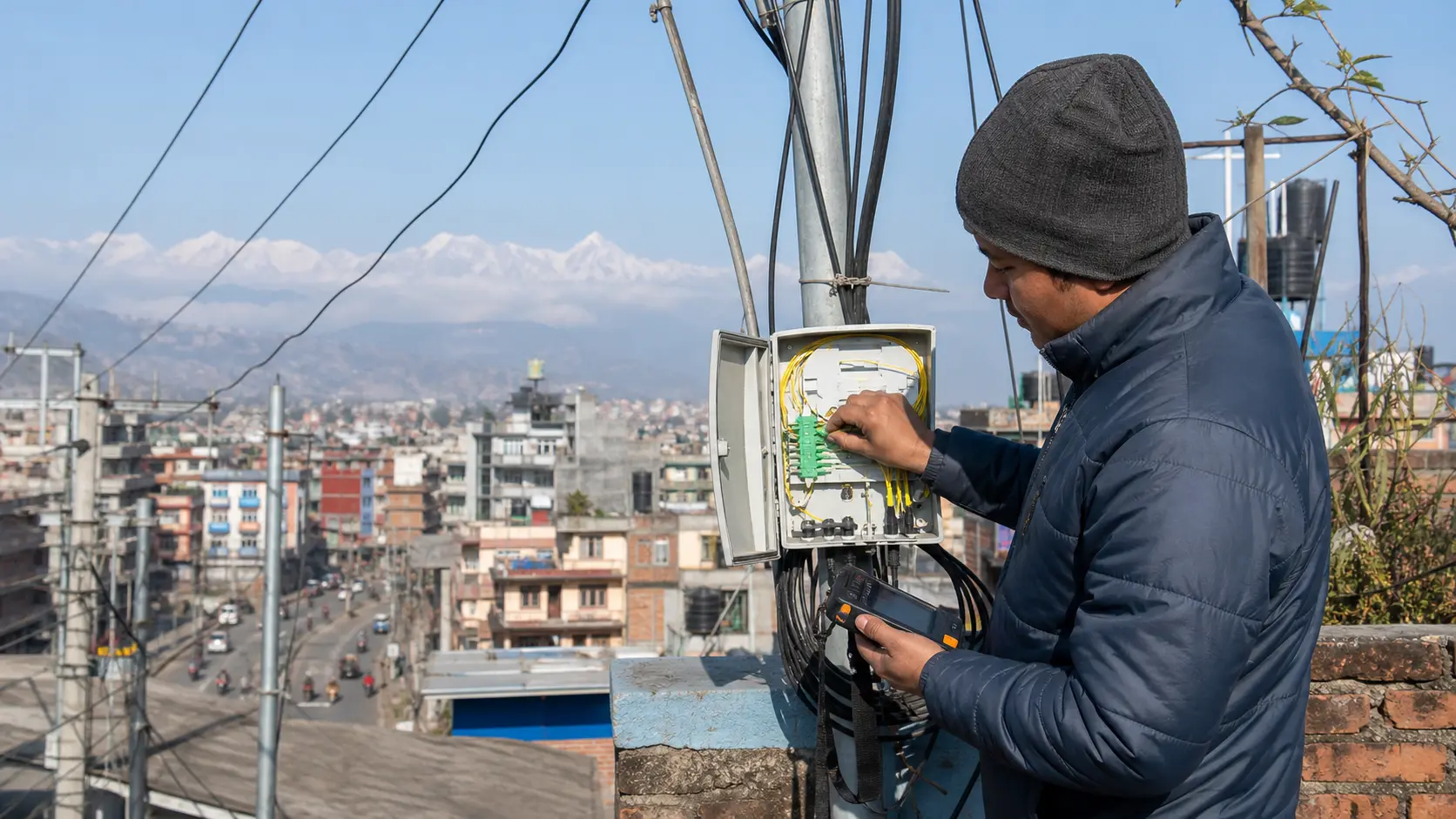
On a Kathmandu street where a small travel agency, a tutoring room and three apartments share the same tangle of overhead fibre, the broadband decision is not abstract. A household can see Classic Tech advertising 50 Mbps at Rs. 369 a month, 100 Mbps at Rs. 627, 200 Mbps at Rs. 1,050 and 300 Mbps at Rs. 1,300 before VAT on its 2026 price pages (https://classic.com.np/best-internet-in-nepal-2026-classic-tech-price-plans-reviews/). A different Classic Tech plan page shows a 125 Mbps annual subscription priced at Rs. 718 a month, with a Rs. 1,000 ONU deposit and a Rs. 500 TV deposit if the customer adds television (https://classic.com.np/%E0%A4%9B%E0%A4%BF%E0%A4%9F%E0%A5%8B-125mbps-12-months/). Those numbers are low enough to make fibre feel like a utility bill. They are also low enough to raise the real question: how much resilience, support labour, upstream redundancy and debt service can be financed from a mass-market Nepali broadband invoice?
That is the useful way to read Classic Tech Pvt. Ltd. The company is not simply a local ISP with a large retail base. It is an example of a harder economic trade: Nepal's fixed-broadband market has reached scale, but the geography, supplier chain and regulation still behave like a frontier infrastructure market. The Nepal Telecommunications Authority's Baisakh 2083 report, based on end-April 2026 data, put Nepal at 30,986,524 broadband subscriptions, of which mobile broadband represented 27,498,552 and fixed wired broadband represented 3,456,331 (https://nta.gov.np/uploads/contents/MIS_Baisakh_2083.pdf). In the top fixed-broadband table, Classic Tech had 286,303 fibre lines, 650 wireless lines, 286,953 total fixed-broadband connections, an 8.23 percent share and fifth place behind WorldLink, Nepal Telecom, Dish Media Network and Vianet. Nepal News' summary of the same NTA data makes the social meaning plain: fixed wired broadband reaches only about half the population after the household multiplier is applied, while mobile broadband dominates the national subscription count (https://english.nepalnews.com/s/science-technology/connected-but-not-equal-nepals-internet-boom-still-leaves-millions-behind/).
Scale has not solved the margin problem. The larger a Nepali fibre provider becomes, the more it must spend on last-mile drops, replacement routers, branch offices, pole attachments, international bandwidth, local technicians, call handling and customer-credit discipline. CARE Ratings Nepal's February 2025 review of Classic Tech described a company with Rs. 921 million of income from operations in FY24, down from Rs. 951 million in FY23, but with a higher PBILDT margin of 28.26 percent after a reduction in bandwidth costs and employee expenses (https://www.careratingsnepal.com/upload/CompanyFiles/PR/202502090241_Classic_Tech_Private_Limited_-_Bank_Facilities_Ratings_Revised.pdf). The same report revised the long-term facility rating to CARE-NP B, kept short-term facilities at CARE-NP A4, and pointed to stretched liquidity, delays in debt servicing, retail revenue concentration, capital intensity and regulatory demands. That is the article's central judgment: Classic Tech's commercial problem is not whether Nepal wants broadband. It clearly does. The problem is whether a mid-tier fixed-broadband operator can turn cheap, visible, prepaid consumer fibre into durable cash after paying for mountain-city operations and upstream risk.
Classic Tech's identity is well evidenced, even though some details remain uneven across public records. APNIC's whois record for AS55915 identifies CLASSIC-NP as Classic Tech Pvt. Ltd., with APNIC organisation ORG-CTPL4-AP, country NP, a New Baneshwore address and a last-modified date of June 30, 2025 (https://wq.apnic.net/apnic-bin/whois.pl?object_type=aut-num&searchtext=AS55915). PeeringDB lists the network as ClassicTech Pvt. Ltd., also known as Classic and CT, with ASN 55915, NSP network type, 35 IPv4 prefixes, 15 IPv6 prefixes, 100-200Gbps traffic levels and a mostly inbound traffic ratio (https://www.peeringdb.com/net/3720). PeeringDB's organisation page places the company in New Baneshwor, Kathmandu, and links the network to the same website (https://www.peeringdb.com/org/4439). These are not marketing claims; they are operational records that show Classic Tech as a real internet-number and interconnection participant.
The company's own public story is a retail-to-enterprise transition. Its home page says it has operated since 2009 and has reached 103 outlets in 74 districts (https://classic.com.np/). A 2026 Classic Tech speed guide gives a similar coverage claim, saying the company operates 106 outlets across 74 districts, while pitching 50 Mbps, 100 Mbps, 200 Mbps and 300 Mbps home packages (https://classic.com.np/which-internet-speed-is-best-for-your-home-in-nepal-2026-updated-guide/). Its corporate page promises dedicated fibre, symmetric bandwidth, 99.9 percent uptime, static IPs, 24/7 monitoring, 4-hour on-site response commitments and use cases for hotels, education, hospitals, gaming centres and intranet networks (https://classic.com.np/corporate/). The advertised service model is therefore not just low-price household internet. It is a blended model: mass retail provides scale and brand, SME and corporate lines should raise average revenue per account, and services to other networks can turn infrastructure into wholesale revenue.
The issue is whether the blend is large enough. CARE's older 2023 report said Classic Tech had converted from Zero Point Remit Private Limited into an ISP in 2010 and a network service provider in 2014, had around 0.23 million active subscribers in mid-July 2022, and received about 90 percent of turnover from retail internet (https://www.careratingsnepal.com/upload/CompanyFiles/PR/202303090324_Classic-Tech-Private-Limited-Rating-Assigned-to-Bank-Facilities.pdf). The February 2025 report reduced the retail share estimate to around 85 percent of total income, but said FY24 service-wise revenue still came mainly from retail: internet services to retail customers and support and maintenance services to retail customers each contributed 42 percent of total revenues, while services to other ISPs contributed 8 percent. That matters because support and maintenance is not a soft add-on in Nepal. It is a field-service cost centre that becomes visible whenever a fibre drop breaks, an ONU fails, a customer moves room, a street cabinet loses power, or an annual-prepaid household expects same-day restoration.
The subscriber numbers also need careful interpretation. NTA's April 2026 table gives Classic Tech 286,953 fixed-broadband connections, but CARE's December 15, 2024 snapshot described 0.17 million active subscribers and a 5.77 percent market share. That gap may reflect timing, definitions, reporting categories, recovery in reported connections, or differences between active financial customers and regulator-counted fixed-broadband connections. It should not be forced into a single straight line.
The safer reading is that Classic Tech is material enough to affect Nepal's broadband market, but not large enough to set the market's economics. WorldLink alone had 1,078,709 fixed-broadband connections and 30.93 percent share in the NTA April 2026 table, while Nepal Telecom, Dish Media Network and Vianet each sat around 10-11 percent. Classic Tech is a serious national-scale operator, but it is still negotiating with a market led by companies that can spread network and support costs over larger bases.
The pricing comparison shows why the pressure is structural. Classic Tech's 300 Mbps home plan at Rs. 15,600 annually before VAT is not far from WorldLink's 300 Mbps annual price of Rs. 15,600 on an internet-only plan (https://worldlink.com.np/internet-plan/standard-package-300-mbps-for-12-monthsinternet-only/). Vianet's WiFi 6 page lists 250 Mbps at Rs. 13,800, 400 Mbps at Rs. 15,600 and 600 Mbps at Rs. 22,500, with prices including VAT (https://www.vianet.com.np/vianetwifi6/). NepaliTelecom's 2026 DishHome Fibernet summary puts a 300 Mbps internet-only annual package at Rs. 11,991 and a 200 Mbps annual package at Rs. 10,177 (https://www.nepalitelecom.com/dish-home-fiber-internet). Third-party plan summaries are less authoritative than operator tariff pages, but the direction is clear: Nepal's large ISPs compete on headline speed and annual bundle price, not on a comfortable premium for reliability. When a 300 Mbps connection is treated as a family commodity, the provider has to find margin in procurement, network density, churn control and labour discipline.
Classic Tech's public tariff pages make the same point from the bottom of the market. A 50 Mbps home connection at Rs. 369 a month before VAT is an aggressively low entry ticket. If a household pays annually, the company can collect cash upfront, but the cost obligation runs for the whole term. The router has to be installed. The fibre drop has to survive weather and street works. The support desk has to answer. The customer portal has to work. The upstream traffic has to be paid for. The customer's expectation is not priced as "best effort" even when the terms say service speeds are up to speeds and may vary with network conditions (https://classic.com.np/terms-and-conditions/). Cheap annual fibre therefore has an embedded financing advantage and an embedded service-liability disadvantage. Prepayment helps working capital today; every unresolved outage spends brand and renewal probability tomorrow.
The commercial arithmetic becomes sharper when one uses CARE's figures. FY24 income from operations of Rs. 921 million was not a huge revenue base for a company reporting national reach, bank facilities of Rs. 1.5 billion and continuing capex needs. CARE said bandwidth charges were roughly 79 percent of cost of sales, and that a 27 percent year-on-year reduction in bandwidth costs helped lift FY24 margin. That is good news, but it also reveals the sensitivity: if bandwidth prices fall, margin improves; if upstream costs, exchange access, international payment conditions or traffic mix deteriorate, margin can be squeezed quickly.
CARE also said employee benefit expenses fell from Rs. 234 million in FY23 to Rs. 168 million in FY24 after support teams were integrated. That suggests management was actively cutting operational cost. It also hints at the risk: field support can be made more efficient, but it cannot be eliminated in a market of rooftop drops and prepaid households.
The balance sheet is part of the operating story. CARE reported an overall gearing ratio of 2.69 times at FY24, interest coverage of 4.00 times and total debt to gross cash accruals of 4.21 times. Those are not emergency numbers by themselves, but the rating language was still blunt about stretched liquidity and debt-service delays. For a fibre operator, leverage is not an accounting abstraction. It is the way coverage is expanded before enough customers exist in a new pocket to pay back the build. A new area needs distribution fibre, splitters, cabinets, customer equipment and branch or partner coverage.
The sales team can sell annual plans quickly if prices are attractive. The payback depends on take-up, renewal, support load, local competition and the cost of keeping the network alive through monsoon, construction cuts and power events.
The network evidence shows a company that is not isolated from the wider internet economy. bgp.tools lists AS55915 as a 15-year-old BGP network with valid RPKI coverage on visible prefixes and shows an upstream labelled Classic Tech Transit, plus peers including Cloudflare and other networks (https://bgp.tools/as/55915). Hurricane Electric's BGP page lists Classic Tech prefixes including IPv4 blocks such as 45.64.160.0/22, 49.236.212.0/22, 103.1.92.0/22, 103.51.16.0/22 and 103.192.76.0/22, and IPv6 2407:5200::/32; it also shows npIX exchange presence in Kathmandu (https://bgp.he.net/AS55915). PeeringDB's npIX DH page lists ClassicTech Pvt. Ltd. at AS55915 with a 10G port and open policy at the exchange (https://www.peeringdb.com/ix/241). These records do not disclose full capacity, redundancy design or paid transit contracts, but they indicate a network trying to keep local traffic local and reduce the cost of popular inbound content.
That local interconnection is commercially important. A retail ISP selling 200 Mbps and 300 Mbps plans to streaming households cannot survive if every video, software update and social feed travels through expensive international transit. Peering, caches and local exchange routes are part of the margin stack. Classic Tech's website promotes IPTV, Wi-Fi 6 and app-based self-service (https://classic.com.np/wi-fi6/). The company app description says customers can view expiry dates, usage, packages and branch contacts, and can create support tickets or call and email for support (https://play.google.com/store/apps/details?hl=en_US&id=com.classic.np.app). Those are not just user conveniences. They are instruments for moving customers from phone queues into managed channels, reducing truck rolls, collecting renewals and lowering churn. In a low-ARPU market, the app and the NOC are part of the same economic system as the fibre cable.
The upstream side is the harder risk. Nepal's internet market depends heavily on routes and suppliers outside the country. The Kathmandu Post reported in September 2024 that Nepali ISPs had faced delayed payments to Indian upstream providers, mainly Tata and Airtel, and quoted an official saying Nepal was heavily dependent on Indian upstream providers while switching to China was not something that could be done overnight (https://kathmandupost.com/money/2024/09/21/internet-shutdown-looms-as-indian-firms-dues-unpaid-for-years). The same report said Indian vendors supplied about 90 percent of Nepal's internet service, with Airtel around 70 percent and Tata around 20 percent. AP reported on May 2, 2024, that broadband services were disrupted in much of Nepal after Indian vendors stopped providing services over payment defaults by private operators, while the state-run Nepal Telecom continued normal operation (https://apnews.com/article/1135220df29dbce698555df2e9cae793). The customer buying a cheap fibre plan may not see this dependency, but the ISP's treasury does.
Classic Tech's own supplier issue became public through Ncell. New Business Age reported in late 2025 that Ncell had warned of suspending bandwidth services to Classic Tech over unpaid dues, citing a Master Service Agreement effective March 25, 2024, and saying a Classic Tech official acknowledged pending payments while arguing that the company had alternatives and would not allow disruption (https://newbusinessage.com/news/46802/ncell-warns-of-bandwidth-suspension-over-classic-techs-unpaid-dues/). The same article cited NTA data at the time showing Classic Tech with 268,000 subscribers and a 7.98 percent market share, and cited CARE figures showing FY24 turnover of Rs. 921 million. The exact commercial terms of the Ncell relationship are not public. What is public is the shape of the risk: a mid-tier fixed-broadband company can be big enough to owe a large supplier, but small enough that a supplier dispute becomes a market-confidence event.
Regulation adds another layer. Nepal's Supreme Court dispute over royalty and Rural Telecommunications Development Fund fees changed the economics of maintenance and support revenue. The Rising Nepal reported in May 2024 that the Supreme Court verdict allowed recovery of royalty and rural telecom development fees from ISPs, and said service providers must pay 4 percent of annual revenue as royalty and 2 percent of annual income into the RTDF (https://risingnepaldaily.com/news/42844). That article also reported more than Rs. 310 million yet to be recovered from Classic Tech. New Business Age later reported that ISPs were preparing to seek installment facilities after the full verdict, and said NTA officials had no direct authority to grant installments without a higher-level decision (https://newbusinessage.com/news/41119/royalty-dispute-isps-to-request-for-installment-facility-to-the-government/). CARE's February 2025 review tied the same issue directly to Classic Tech, noting that royalty and RTDF on maintenance and support charges, which made up about 42 percent of FY24 income, would likely moderate margins.
The RTDF is not merely a tax line. It is part of Nepal's political bargain around connectivity: operators collect revenue from households and businesses, the state demands contributions for rural connectivity and public infrastructure, and the regulator uses reporting to measure national progress. Republica has described the RTDF as a fund collected from licensed telecommunications and internet service providers for rural telecom development, with providers contributing 2 percent of annual income (https://myrepublica.nagariknetwork.com/news/rs-22-bn-collected-in-rtdf). For Classic Tech, this creates a double bind. The company benefits from the national push to expand broadband and from the consumer expectation that fibre should reach beyond wealthy Kathmandu neighbourhoods. But every expansion into lower-density or harder-maintenance areas makes the margin case more dependent on subsidy policy, pole access, right-of-way discipline and the customer's willingness to prepay.
Geography is not a slogan in Nepal; it is a cost driver. Fibre in the Kathmandu Valley can be dense and commercially attractive, but even there aerial fibre, road cuts, building churn and power interruptions can make the last mile fragile. Outside the valley, lower density and more difficult terrain stretch the payback period. The 2015 earthquake showed why resilience has an economic price. APNIC's account of post-earthquake restoration said Nepal's international links and major data centres survived, but last-mile connectivity suffered from downed power lines, damaged towers and severed overhead fibre cables; it also noted that the first night saw no power and much of the internet went offline (https://blog.apnic.net/2016/05/25/restoring-internet-nepal-one-year-quake/). A later academic paper on earthquake impact and telecom infrastructure in Nepal cited estimated ISP damage of US$0.2 million and loss of US$4.67 million, and called for critical-infrastructure planning with location and redundancy options (https://www.sciencedirect.com/science/article/pii/S1757780223004791).
That disaster history should not be used to turn Classic Tech into an emergency-services story. The more relevant point is economic. A cheap fibre connection is priced for normal months, but the network must be built for abnormal days. The Emergency Telecommunications Cluster's Nepal earthquake page describes the humanitarian need for shared internet and security telecommunications after the 2015 earthquake (https://www.etcluster.org/emergencies/nepal-earthquake). First Monday's analysis of Nepali internet after the Gorkha earthquake argued that impressive subscription numbers can mask uneven coverage and usage, especially where terrain and income shape connectivity (https://firstmonday.org/ojs/index.php/fm/article/view/8071/6613). For a retail ISP, resilience means route diversity, spare equipment, battery backup, field teams and customer communications. Each item costs money before it produces a visible upgrade on a speed-test screenshot.
Customer sentiment is where these hidden costs become public. Classic Tech's App Store review page is not a statistically clean service-quality dataset, but it is a useful signal: visible reviews complain about outages, slow customer care, app performance and difficulty getting resolution (https://apps.apple.com/np/app/classic-tech/id1451414259?platform=iphone&see-all=reviews). Google Play reviews show a similar mix of app utility and complaints about internet interruptions and support response (https://play.google.com/store/apps/details?hl=en_US&id=com.classic.np.app). A Reddit thread from mid-2026 discussed anxiety over Classic Tech's status, unpaid dues, prepaid balances and service continuity (https://www.reddit.com/r/technepal/comments/1tigsnf/classic_tech_closing/). None of this proves a specific network failure rate. It does show the demand-side reality of annual prepaid broadband: when customers fear that support or continuity is weak, the ISP's cheapest acquisition tool can become a churn accelerant.
The company's own terms and policies show how the consumer promise is bounded. Classic Tech's Fair Usage Policy says FUP affects a very small percentage of users and gives a 300 Mbps example in which full speed applies up to 2,500 GB in a billing cycle before staged bandwidth adjustments to 220 Mbps, 200 Mbps and 180 Mbps at higher thresholds (https://classic.com.np/fair-usage-policy/). The terms and conditions say plan speeds are up to speeds and may vary based on network conditions, traffic, device performance and other factors; they also say the company does not guarantee uninterrupted or error-free connectivity (https://classic.com.np/terms-and-conditions/). Those clauses are normal for broadband. But they do not erase the consumer's lived expectation that an "unlimited" annual home plan should work whenever school, remittance, gaming, video calls and business messaging need it.
This is where Classic Tech's support labour becomes a margin variable rather than a back-office detail. CARE's report that employee expenses fell materially after integrating network build, infrastructure support and field workers is financially positive. Yet the same company advertises 24/7 support, priority support on packages and corporate 4-hour on-site response. If support is too generous, labour and truck-roll costs eat the subscription. If support is too thin, customer complaints damage renewal and make acquisition more expensive.
The app, call centre, branch network, dealer partners and field teams are therefore part of one operating equation: the company has to resolve faults cheaply enough to preserve margin and quickly enough to preserve trust.
Competition makes that equation unforgiving. WorldLink can lead with scale and a dense brand presence. Nepal Telecom can pair fixed broadband with state-backed telecom reach. DishHome can bundle from a television base. Vianet can compete on Wi-Fi 6 and service positioning. Subisu, Websurfer, Techminds, Wifi Nepal, CG Communications and regional providers fill out the choices. NTA's April 2026 table showed the top fixed-broadband market as both concentrated and crowded: the leader had nearly one-third share, but the top twenty plus "Other" still contained many operators trying to win or defend local pockets.
CARE's 2025 report described a market in which the top five ISPs held 72 percent of share as of December 15, 2024, while the top seven including Classic Tech held 84 percent. That means Classic Tech is squeezed from both sides: it lacks the leader's scale but faces smaller rivals that can price aggressively in selected neighbourhoods.
The unofficial acquisition chatter around Ncell should be read in this context. Developing Telecoms reported in 2024 that Ncell denied market rumours that it had struck a deal to take over Classic Tech while confirming interest in ISP opportunities (https://developingtelecoms.com/telecom-business/operator-news/17343-ncell-denies-rumors-of-deal-to-take-over-isp-classic-tech.html). NepaliTelecom similarly wrote that Ncell denied a concluded Classic Tech acquisition deal but said it was actively exploring ISP opportunities (https://www.nepalitelecom.com/ncell-buys-classic-tech). The important signal is not whether that specific deal existed. It is that mobile operators, fixed ISPs and content-heavy household demand are converging. Ncell's fixed-broadband interest would make strategic sense because mobile data and home Wi-Fi compete for the same household wallet, while Nepal Telecom already operates both mobile and FTTH. For Classic Tech, any partnership or ownership change would be about balance-sheet strength, upstream bargaining power and customer-base monetisation, not just brand.
The cash cycle behind this market is easily misunderstood. Annual prepaid fibre feels attractive because the operator receives money before every month of service is delivered. That cash can finance routers, drops and supplier payments. But prepaid revenue also creates a promise. A customer who paid for 12 months is less likely to tolerate repeated interruptions than a pay-as-you-go mobile-data user, because the household has already committed and expects the ISP to carry the continuity risk. If the provider's customer base is growing, new prepaid collections can hide the cost of supporting older accounts.
If growth slows, the same company must fund faults, churn prevention and supplier bills from a smaller inflow of fresh advance payments. This is why subscriber scale, revenue growth and support quality should be read together, not separately.
Classic Tech's low-end tariffs sharpen that cash-cycle question. A 50 Mbps plan can recruit students, renters, small shops and families that would otherwise rely heavily on mobile data. A 300 Mbps bundle can pull middle-class households into streaming, gaming and work-from-home behaviour that creates much higher evening traffic. The company gets a broader base, but the traffic mix gets heavier. If usage grows faster than revenue per account, procurement savings from bandwidth and caching are not optional; they are the margin plan.
The FUP page's 2,500 GB first threshold for a 300 Mbps example is generous for a normal household, but it also reveals the economic ceiling. An "unlimited" plan is commercially sustainable only when extreme users are managed, popular content is cached or peered locally, and enough households use less than the headline capacity in practice.
The difference between Kathmandu density and district reach is another missing public variable. A cluster of multi-storey buildings in the valley can justify fibre splits, cabinets, branch technicians and spare equipment because many paying accounts sit close together. A semi-urban or hill district can require more travel, more weather exposure and fewer accounts per kilometre.
Classic Tech's 74-district claim is valuable as a brand signal, yet the economics depend on the distribution beneath that number: which districts have deep fibre density, which have only service points, which routes are redundant, and which localities rely on partner or dealer-led sales? The company does not publish route kilometres, take-up by ward, pole-rental expense or repair travel time. Without those facts, the public has to use subscriber share, branch count, tariff level and credit-rating commentary as proxies for the access-network margin.
The enterprise pitch is the obvious way to improve that margin, but it is not automatically easy. Corporate dedicated internet should have better revenue per customer than residential fibre, especially where static IPs, symmetrical bandwidth, managed hardware, VLAN separation, hospital or hotel support, intranet links and monitoring are bundled. A corporate customer may also churn less if the circuit is tied into operations. But enterprise service is credibility-heavy.
A hotel, school or hospital buying an SLA does not want a consumer-style explanation after a failure; it wants escalation, spares, route diversity, documented restoration and an account manager who can make a decision. Classic Tech's corporate page advertises precisely those features. The commercial test is whether the company can prove them often enough to win higher-value accounts without overbuilding costly dedicated capacity for customers that still bargain like households.
The wholesale and ISP-services line is smaller but strategically interesting. CARE's FY24 split put services to other ISPs at 8 percent of total revenue. That is not enough to redefine the company, but it suggests Classic Tech has assets that can be sold beyond direct retail subscriptions. Wholesale revenue can monetise routes, capacity, local presence or backhaul where another provider lacks depth. It can also create counterparty risk if the buyer's own collections are weak. The public BGP and PeeringDB records do not reveal enough to know how much of Classic Tech's network is resold or relied on by smaller providers.
Still, in a crowded market, wholesale can be one of the few ways a mid-tier operator earns from competitors rather than only fighting them for the next household renewal.
The local-content side deserves the same attention. Peering at npIX and relationships visible in public routing databases are not vanity badges. They affect how many packets have to be bought through long-haul transit and how many can be exchanged locally or served from caches. A household does not care whether its video stream arrives through local exchange, a content cache or international transit; it only sees buffering or smooth playback. The ISP cares because the cost and fault exposure differ.
A network with better local exchange discipline can defend cheap high-speed plans more credibly than one that buys too much traffic over expensive upstream links. Classic Tech's mostly inbound traffic profile on PeeringDB fits a consumer broadband network where users pull content down far more than they send traffic out.
This also explains why upstream disputes create more fear than their immediate technical effect. A network can have multiple routes and still suffer if a large paid supplier tightens credit or if foreign-currency access slows settlement. The Kathmandu Post and AP accounts of 2024 show that supplier-payment stress can become a national service problem, not just a bilateral invoice issue. New Business Age's report on Ncell and Classic Tech brought that general vulnerability down to a company level. Even if Classic Tech has alternatives, alternatives have price, capacity and timing limits.
A replacement route can keep services alive while costing more, delivering worse latency or requiring emergency traffic engineering. The margin hit may arrive before the customer notices the network workaround.
Regulatory payments work in a similar way. A court decision or arrears demand does not cut a fibre drop in Lalitpur, but it changes the cash available to maintain that drop. CARE's warning about royalty and RTDF on maintenance and support charges is especially important because those charges are not peripheral to Classic Tech's model. If support and maintenance revenue is treated as telecom revenue for royalty and development-fund purposes, then the part of the invoice that helps fund field labour also carries an additional statutory burden.
Providers can try to reprice, but Nepal's competitive tariff market makes full pass-through difficult. Providers can cut cost, but support cuts show up in complaints. Providers can seek installment facilities, but installments still have to be paid from future cash.
There is also a political-economy asymmetry between public expectations and private margins. Nepal wants fibre to spread because fixed broadband supports education, remittances, small business, public services and disaster communication. Consumers want prices low because household income is limited and mobile data remains a fallback. The regulator wants fees and quality. Suppliers want timely payment. Lenders want debt service. Employees and field contractors want stable work. Each claim is individually reasonable. Together they leave a mid-tier ISP with little unused margin.
This is why Classic Tech's story should be read as infrastructure economics, not only telecom competition. The company is selling a monthly comfort product while operating a capital-intensive network in a geography where faults are physical and supplier risk is international.
The customer-support signal therefore has to be taken seriously without being exaggerated. App-store and Reddit complaints are not audited outage data, and angry users are more motivated to post than satisfied users. But when the same themes recur - slow response, app trouble, line interruptions, uncertainty over prepaid balance - they point to the cost centre that matters most. A broadband company can survive some public negativity if it has low prices and wide coverage. It cannot compound weak sentiment with uncertain continuity, because annual renewal is where the household decides whether cheapness compensated for stress.
In that sense, the support desk is not only defending service quality; it is defending future cash collection.
Classic Tech's competitive options are consequently narrow but real. It can defend low-end retail with cheap entry plans, then use Wi-Fi 6, IPTV and higher-speed bundles to raise revenue per household. It can keep moving support into the app and customer portal to lower call-centre cost. It can deepen local peering and caching so streaming demand does not destroy bandwidth economics. It can pursue SME, corporate and wholesale accounts where price is not the only buying criterion. It can negotiate regulatory and supplier obligations into predictable schedules.
It can use district reach selectively, investing deeper where density and renewal economics justify it rather than treating national presence as a uniform obligation. None of these moves is glamorous. They are the ordinary tools of a fixed-broadband operator trying to make scale pay.
The strategic risk is that each tool depends on execution in a different part of the business. Pricing is commercial. Peering is technical. Supplier terms are financial. Regulatory arrears are legal and political. App self-service is product and support. Enterprise sales require account management and field reliability. Route resilience requires capex. A large incumbent can survive weakness in one area because other areas carry the company. A smaller local operator can avoid some complexity by staying narrow. Classic Tech sits in the middle, where it has national visibility and large obligations but not leader-level market power.
That middle position is why the company is worth tracking.
Classic Tech's strongest case is that it has already crossed several difficult thresholds. It has a recognised national retail brand, APNIC-registered network resources, public peering, visible district reach, a large NTA-reported subscriber base and a service portfolio that runs from cheap home internet to corporate dedicated bandwidth. It also has a cost base that can improve when bandwidth procurement gets cheaper and support operations become more efficient. CARE's FY24 numbers show that margin can move up even when revenue slips, which means management has some levers.
If the company can lift the share of enterprise, intranet, wholesale and higher-speed customers without losing the prepaid retail base, its economics can improve.
The bear case is equally direct. A company with low consumer tariffs, bank facilities of Rs. 1.5 billion, reported liquidity stress, regulatory arrears exposure, high retail concentration and public supplier-payment stories has limited room for error. It may win customers by making fibre feel cheap, but it must then keep those customers through outages, support queues and renewal cycles. It may reduce bandwidth cost, but traffic demand rises as customers move from 50 Mbps and 100 Mbps to 200 Mbps, 300 Mbps and gigabit claims.
It may advertise 99.9 percent corporate uptime, but business customers will test whether that promise has route redundancy, power planning and technician capacity behind it. It may rely on annual prepayment, but customers who fear continuity can treat every renewal date as an exit option.
What facts would change the judgment? First, audited current subscriber reconciliation between NTA-reported connections, active paying accounts and revenue-generating customers would clarify ARPU and churn. Second, disclosure of route kilometres, pole-rental exposure, outage metrics, truck-roll rates and network capex by geography would show whether the company has density advantages or expensive sprawl. Third, current upstream contracts, cache capacity and international route diversity would define how exposed Classic Tech is to Indian transit, local supplier disputes and foreign-currency interruptions.
Fourth, a resolved regulatory-payment schedule for royalty and RTDF arrears would turn a vague liquidity overhang into a measurable cash obligation. Fifth, a proven increase in enterprise and wholesale revenue share would show whether Classic Tech is escaping dependence on price-sensitive retail households.
Until those facts are public, the best reading is disciplined but not dismissive. Classic Tech is a real and consequential Nepali broadband operator. It is not a fragile local reseller with no infrastructure footprint. But it is also not a scale leader with unlimited room to absorb price wars, regulatory charges and supplier shocks. Its business is a test of whether Nepal's fifth-ranked fixed-broadband provider can convert national fibre demand into resilient mid-market economics.
The Kathmandu household choosing between a cheap annual plan and outage risk is therefore asking the same question as the credit analyst, the upstream supplier and the regulator. The connection price is visible. The cost of keeping that connection alive in Nepal is the part that decides the margin.