
Summary
- ChatMix addresses a real operational bottleneck: regional internet providers need to turn high-volume, informal subscriber messages into authenticated customer records, billing actions, fault tickets, status updates and human escalation without forcing staff to jump among channels.
- The strongest public evidence is not the feature list but the integration trail. HubSoft documents ChatMix as a live messaging connector, while VMIX's own materials describe official WhatsApp connectivity, ERP access, conversation history, unlimited attendants, automation, VoIP and Portuguese-language support.
- Reliability remains insufficiently evidenced. Two public complaints in April 2026 describe severe unavailability, several Apple reviews cite notification or synchronization failures, and VMIX publishes no public service commitment, recovery targets, external assurance report or detailed incident history.
- The procurement decision should depend on an instrumented pilot: prove end-to-end delivery states, safe AI boundaries, number ownership, exportability, failover, incident communication and a complete price schedule before allowing ChatMix to become the only door into an ISP's support operation.
A message can be accepted while the subscriber stays in the dark
The most revealing sentence about ChatMix does not come from a marketing page. It appears in HubSoft's integration documentation, in a troubleshooting note for internet providers. HubSoft explains that a successful send status means its own system managed to pass a message to the external platform. If the customer did not receive it, the provider must investigate the messaging platform.
That distinction is the whole ChatMix investment question in miniature.
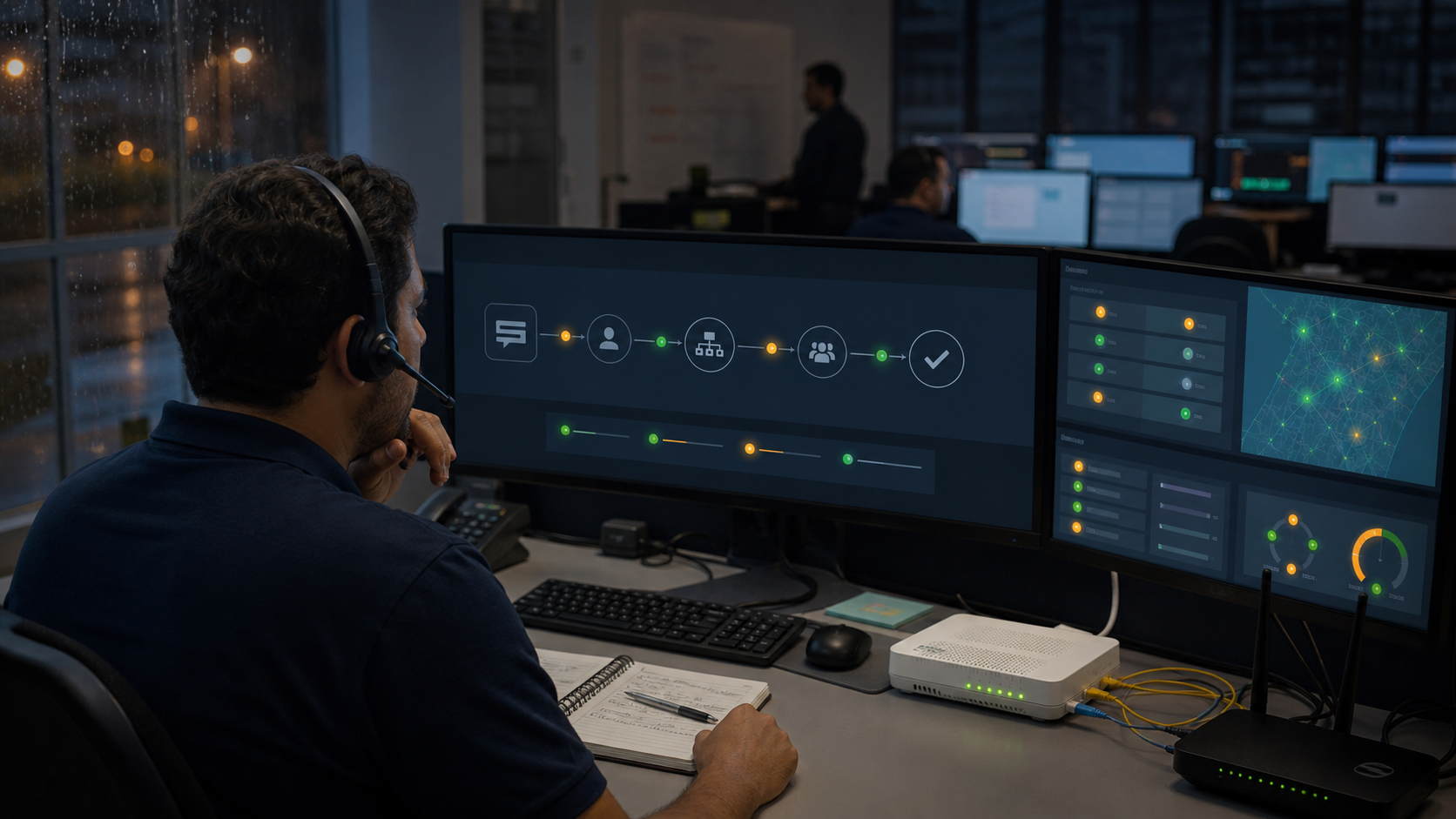
Imagine a regional fiber operator at 7:12 on a wet Friday evening. A feeder cable has been damaged. Hundreds of subscribers open WhatsApp almost at once. Some type “sem internet”; some send a photograph of a dark optical terminal; some leave a thirty-second voice note; some demand a duplicate invoice because they assume suspension for non-payment; and some threaten cancellation.
The operator's network team may already know the affected area, but the support desk still has to identify each subscriber, avoid opening duplicate cases, distinguish a mass incident from a home Wi-Fi problem, answer in useful language, preserve a protocol and move exceptional cases to a person.
An omnichannel desk can make that sequence far better. It can also create a deceptive green light. The ERP may show that a request left its queue. ChatMix may show that it accepted the request. Meta may have accepted a message but not delivered it. A mobile notification may fail even though the browser view is current. An automated response may have been delivered but attached to the wrong contract. A ticket may have been opened without reaching the network team. An employee may believe the subscriber has been informed when the subscriber has seen nothing.
Reliability, therefore, is not one uptime percentage. It is the preservation of meaning and state across a chain. For ChatMix, that chain can include the subscriber's device and access network; WhatsApp, Telegram, Instagram, Facebook or another channel; VMIX's routing and storage layer; an AI-assisted interpretation step; the ISP's ERP; a ticket or billing process; a human queue; a mobile push service; and, where voice is used, telephony infrastructure. Each link can be available while the overall service fails.
ChatMix is interesting because it was built for exactly this messy middle. It is risky for the same reason.
The legal entity and the product do connect
The entity in scope is not merely a brand resemblance. The current VMIX website identifies its owner in the footer as V Mix Desenvolvimento de Software Ltda, CNPJ 43.471.877/0001-73. The company's privacy policy, updated on July 1, 2026, names the same legal entity as the controller of its own digital channels and as the operator of personal data processed through ChatMix on behalf of customers. The dedicated ChatMix product page carries the same legal footer and describes the service as a V Mix product.
The bridge also appears outside the company's own site. Apple's Chatmix listing names Rafael Machado as the seller, links back to VMIX and assigns copyright to “V Mix Desenvolvimento de Software.” A Brazilian company-data service drawing on Receita Federal information lists V MIX DESENVOLVIMENTO DE SOFTWARE LTDA as an active Ibaiti, Paraná, software company opened in September 2021, with Rafael de Oliveira Machado and Gabriel Vieira Cordeiro as administrators.
There is a predecessor or affiliate footprint that buyers should understand rather than ignore. Google Play distributes ChatMix under Visual Mix Ltda, and Visual Mix's company record describes an active Ibaiti software company opened in November 2019 with Rafael de Oliveira Machado among its owners. The chatmix.com.br registration also names Visual Mix Ltda and Rafael Machado. The shared founder, location, domain, product, support contacts and current official transfer of product responsibility to V Mix establish a credible operating bridge. They do not, however, tell a customer which company owns each contract, app-store account, code asset, channel credential or historical liability.
That is not a reason to reject the product. It is a reason to put the current legal boundary into the order form. The contracting entity, data-processing party, support party, intellectual-property licensor, infrastructure operator and party responsible for channel migration should all be stated. A small vendor can change corporate wrappers as it grows; the customer should not have to reconstruct the consequences during an outage or exit.
The evidence also supports VMIX's origin story. A March 2025 report by the Brazilian trade publication RTI says the business began inside an internet provider in Figueira, Paraná. That matters because the product's workflow vocabulary—second copies of boletos, contract access, support tickets, mass notifications and provider-branded subscriber apps—is unusually specific to regional connectivity businesses. It is not simply a generic social inbox with “ISP” added to a sales page.
What ChatMix is trying to become
VMIX's public materials describe three overlapping products or capabilities. The first is ChatMix itself: a shared service console for messages, automation and human handoff. The second is the App do Provedor, a white-label subscriber application with billing, Wi-Fi password, ticket and contract functions. The third is a broader automation and communication layer that can connect to ERPs and, according to RTI, place VoIP calls from the same interface.
On its main site, VMIX advertises team service without a limit on attendants, automated chat, service auditing, mass notifications, ERP integration and a seven-day trial. Its newer ChatMix page says the product uses the official WhatsApp API, remembers conversation history and can pull live information from ERPs and customer-management systems. RTI adds claimed support for WhatsApp, Messenger, Telegram and Instagram; interpretation of voice notes and informal language; contextual response generation; VoIP; reports by channel, employee and department; satisfaction surveys; Portuguese support around the clock; and cloud hosting in VMIX-controlled infrastructure at Equinix in São Paulo.
Those are company claims unless independently corroborated. One important integration is independently visible. HubSoft lists ChatMix as a partner for personalized messages, billing reminders, outage notices and promotions. Its technical guide shows an operator entering a production URL and protected credentials, running a connection test, configuring approved WhatsApp message templates and passing billing links through the connector. That documentation proves a real interface and a practical workflow. It does not prove that every ERP is supported at the same depth, despite the wider compatibility claim reported by RTI.
The mobile product adds another layer of evidence. Apple's listing says staff can attend all channels, transfer conversations among people or departments, exchange media and receive new-service notifications. Its release history shows sustained development: two-factor authentication arrived in 2024; version 3.0 added multiple languages, financial access to PIX, boletos and contracts, a live dashboard and team chat; 2026 releases added tags, notes, history, financial actions, audio transcription in beta, biometric or PIN locking, media improvements and stability fixes. Google Play's Chatmix page likewise describes assignment, open-service views and media exchange, with thousands of downloads.
Taken together, the public evidence supports a product that is more than a static chatbot. ChatMix is trying to be the provider's message-routing desk: the place where identity is resolved, an intent is classified, context is fetched, a routine action is attempted, a result is communicated, and responsibility moves to a person when automation should stop.
That ambition is commercially sensible. It also means the vendor's real product is not the inbox. It is orchestration.
The customer workflow is the architecture
For an ISP, a useful architecture description begins with a subscriber request, not a cloud diagram.
Consider a customer who sends a voice note saying, in colloquial Portuguese, that the internet has been “falling all afternoon.” The system has to associate the phone number with a subscriber, but phone-number matching may return a household with multiple contracts or a person messaging from a different number. It has to determine whether “falling” means intermittent optical signal, poor Wi-Fi, a regional outage, account suspension or a device issue. It may have to read account status from the ERP, check an open incident, send troubleshooting steps, create a service ticket and preserve everything for a human.
Each action has a different risk level. Reading an outage notice is low risk. Sending a duplicate invoice is usually bounded. Promising a repair time is more consequential because it can create a false commitment. Changing a Wi-Fi credential affects access. Granting a temporary financial unblock affects revenue and policy. Cancelling a contract, altering service or touching network equipment is higher still. A single “AI enabled” label obscures those differences.
The official WhatsApp Cloud API collection published by Meta on Postman helps expose the channel side of the chain. Businesses operate through a WhatsApp Business Account and registered phone number, send through Meta endpoints and receive events at a configured webhook. The phone registration process requires two-step verification. A successful send returns a message reference; later events are needed to understand what happened after acceptance. This architecture is why “the request succeeded” is not the same as “the subscriber received and understood the answer.”
Telegram has a similar boundary in different form. Telegram's webhook guide explains that the business must expose a reachable encrypted endpoint and maintain certificate and network compatibility. Telegram's privacy policy states that third-party bots can receive messages and other user information when people interact with them. In an omnichannel system, each channel therefore brings its own identity semantics, delivery events, policy rules and data path.
ChatMix has to normalize those differences without erasing them. A sound service record should distinguish at least these states: received from subscriber; matched or not matched to a customer; accepted by ChatMix; passed to a channel; accepted by that channel; delivered; read where available; interpreted by automation; ERP query succeeded or failed; requested action succeeded or failed; assigned to a department; accepted by a person; resolved; confirmed by the subscriber; and reopened. Timeouts, duplicates and late events should remain visible rather than being collapsed into a generic “sent” or “closed.”
This is where observability becomes a customer feature. The service supervisor should be able to answer: How many outage messages are waiting? Which replies were accepted but not delivered? Which automation attempts could not reach the ERP? Which conversations were transferred repeatedly? Which subscribers received contradictory answers? Which employees are looking at stale data? Which bulk notice is lowering WhatsApp quality? Which mobile users stopped receiving notifications after an update? Which queue is growing faster than it is draining?
VMIX advertises auditing and reports. Public material does not show the underlying state detail, export format, alerting rules or retention. A buyer should not infer them from dashboard screenshots. The pilot must demonstrate them with deliberate failures.
Implementation begins with channel custody, not a login
The first implementation decision is who owns the customer-facing identity. An ISP may arrive with a WhatsApp number known by every subscriber, approved message templates, years of opt-in evidence and a business name already verified by Meta. That identity is operational infrastructure. The provider should retain ownership of the business portfolio, phone number, verified display name and consent records, while giving VMIX only the access needed to operate ChatMix. The implementation plan should show how access is granted, reviewed and revoked, and how the number can move if the commercial relationship ends.
HubSoft's instructions make the practical dependency visible. A customer configures a production address and protected credentials, tests the connection, maps ChatMix as the messaging service and works with approved WhatsApp templates. That is more than turning on an inbox. It joins at least four administrative domains: the ISP's ERP, ChatMix, the channel account and the subscriber record. A failure in any one can appear to an employee as a single silent button. The project therefore needs named owners for each boundary and a shared escalation map before live traffic moves.
The next task is to inventory service journeys rather than channels. “WhatsApp support” is too broad to configure safely. Billing-copy requests, payment confirmation, outage reporting, appointment scheduling, contract questions, cancellation threats and suspected fraud each require different data, permissions, language and stopping rules. For every journey, the ISP should document the authoritative source, the allowed automated action, the conditions for human handoff, the maximum waiting time and the evidence retained after closure.
The same journey may start in Telegram, the mobile app or a phone call, but it should not produce a different operational truth merely because the entry channel changed.
Queue design deserves equal attention. Departments in an organization chart rarely match the way demand arrives. A subscriber may begin with “no internet,” reveal an unpaid bill and then report a damaged cable. If routing is based on the first phrase alone, the conversation can bounce among technical support, finance and field service. ChatMix's transfer and departmental features are useful only if the receiving employee gets the full history, the reason for transfer, the actions already attempted and the next responsibility. The pilot should measure repeat explanation and transfer loops, not just average handling time.
Migration also changes employee work. Unlimited attendants, as VMIX advertises, can remove a seat-count constraint, but it does not remove the need for role design. Temporary staff, supervisors, finance employees, contractors and network technicians should not have identical visibility or action rights. A useful role matrix separates conversation access, media access, search, export, template management, bulk messaging, ERP reads, financial actions, customer-data changes and administration. Access should expire when a role changes, and the audit trail should show both the action and the authority used.
Go-live should be staged around reversibility. A provider can begin with one low-risk queue, a limited employee group and a small share of inbound traffic while preserving the old route. It can then add delivery-state monitoring, suggested replies, ERP lookups and narrowly bounded automated actions. Bulk campaigns, broad financial permissions and high-impact account changes should come later. Each stage needs an acceptance measure and a rollback trigger. The objective is not merely to prove that ChatMix works on a normal day; it is to prove that the ISP can recognize degradation and retreat without losing the customer channel.
Support arrangements should be tested as part of implementation. RTI reported VMIX's claim of Portuguese technical support around the clock, but availability, response and restoration are different promises. The contract should identify severity levels, acknowledgment times, update intervals, restoration targets, escalation contacts and the boundary between VMIX, Meta, the ERP supplier and the ISP. During the pilot, the buyer should raise a realistic after-hours incident and observe whether the first responder can diagnose the chain or merely open a ticket for the next business day.
The final implementation deliverable should be a runbook that an ISP supervisor can use under pressure. It should identify channel ownership, integration contacts, fallback routes, emergency broadcast procedures, privacy contacts, evidence-preservation steps, credential revocation and the order for restoring service. Without that operational layer, a successful demo can still become a fragile production dependency. With it, ChatMix has a better chance of turning scattered messages into a controlled service process rather than another screen whose failure has no obvious owner.
AI can shorten a queue or manufacture certainty
The appeal of AI in an ISP support desk is straightforward. Subscriber language is messy, repetitive and urgent. People send voice notes, misspell router terms, describe symptoms rather than causes and expect an immediate answer. A system that can transcribe audio, recognize common intents, retrieve account context and propose a useful response can reduce handling time and keep human staff focused on exceptions.
VMIX claims that ChatMix can understand informal or erroneous messages, interpret audio, execute actions and generate context-aware responses. Those capabilities map well to an ISP's highest-volume work: second-copy invoices, payment confirmation, known-outage notices, appointment checks, basic Wi-Fi guidance, ticket status and routing by department.
The safe boundary is narrower than the sales language suggests. A generated answer is not a network measurement. A confident explanation that “the area is under maintenance” is harmful if the actual issue is a disconnected drop cable. A summary can omit a customer's earlier warning about a burned power supply. An automated flow can repeatedly ask for a reboot when the optical terminal has no light. A voice transcription can mistake an address or account number. An instruction embedded in customer-supplied text or a linked document can attempt to divert the automation from its intended task.
Broad write permissions can turn a language error into a billing, access or contract change.
The NIST generative-AI risk profile treats confident false output, privacy, testing, incident response and continuing oversight as lifecycle concerns rather than one-time setup items. OWASP's current risk list for generative-AI applications similarly highlights manipulated instructions, sensitive-information exposure, unsafe downstream handling, excessive action authority and misplaced trust in generated output.
For ChatMix, practical safeguards should be visible to the ISP, not merely promised by the vendor. Automated answers should cite the source they used inside the service console—such as an ERP status, approved knowledge article or current incident notice—even if that provenance is not shown verbatim to the subscriber. The system should separate read permissions from write permissions. High-impact actions should require a person. Confidence thresholds should vary by task. Unsupported intent should escalate instead of improvising.
Every automated action should be reconstructable after the fact, including the input, retrieved facts, action request, system response and final customer message.
There is also a channel rule, not only an AI rule. WhatsApp's business messaging policy permits automation but requires rapid, clear and direct escalation paths to human service. It also allows WhatsApp to restrict accounts that generate sustained negative feedback or poor-quality interactions. That makes safe escalation and message quality part of service continuity. An overactive automated campaign can degrade the very channel the ISP relies on for support.
A sensible deployment sequence is therefore progressive. Begin with observation and classification. Then allow suggested replies that employees approve. Next automate low-risk, reversible routines with explicit exceptions. Only after measured performance should the ISP consider broader action rights. VMIX's public pages do not disclose task-level accuracy, error rates, evaluation sets, language performance, audio performance or escalation frequency. Those are pilot measurements, not assumptions.
The April 2026 incidents are signals, not a verdict
Public complaint data is sparse, and sparse data demands careful language. Reclame Aqui's company page associated V MIX DESENVOLVIMENTO DE SOFTWARE with ChatMix and showed too few evaluated complaints to calculate a reputation score. That means the site cannot establish an overall failure rate or compare ChatMix fairly with a larger supplier.
It does, however, document two concrete service-continuity failures within fifteen days.
On April 7, 2026, a customer reported ChatMix offline for two days, alleging lost customers and inadequate support communication. VMIX replied on April 9 that service had been normalized, called the event a one-off instability and said it was strengthening support processes. On April 22, another customer reported a day without WhatsApp access, saying sales depended on the channel and that no restoration estimate or explanation was provided. VMIX replied the next day that access was normal and that it would investigate the service interaction.
Neither complaint establishes the technical cause. The first names ChatMix broadly; the second describes WhatsApp access. Possible causes span VMIX software, infrastructure, a channel account, Meta, connectivity, configuration or a combination. Meta's own WhatsApp Business Platform incident history records numerous resolved Cloud API and related service events during 2026, demonstrating that upstream interruption is a normal design consideration. The dates alone do not assign either complaint to Meta.
Apple's evidence is also limited but relevant. The Chatmix app held a 3.1-out-of-5 score from 29 ratings when accessed. Visible reviews in 2025 complained that notifications did not arrive, messages could not be sent after an update or conversations failed to refresh automatically. The release history subsequently mentions synchronization, connection and stability fixes. A few app reviews cannot measure platform-wide reliability, but their failure modes matter because mobile notification is part of the promised workflow.
The proper conclusion is not “ChatMix is unreliable.” It is that VMIX has public evidence of meaningful incidents and no public evidence sufficient to quantify reliability. A serious buyer should request the April incident reports, affected components, duration by tenant, event timeline, contributing factors, corrective actions and evidence that the fixes were tested. The response should distinguish VMIX failures from upstream failures and show how customers are informed when the distinction is not yet known.
The contract should define availability at the customer workflow level, not only whether a login page loads. It should cover inbound message ingestion, outbound send, delivery-event processing, queue access, ERP connectivity, automation, media, mobile notification and voice if purchased. It should state severity levels, response and restoration targets, status-update intervals, service credits, maintenance notice, support escalation and the right to receive a post-incident report.
Owning infrastructure does not eliminate concentration risk
RTI reports that ChatMix is hosted in VMIX's own structure at Equinix São Paulo with firewall controls. Independent routing records add a useful, if incomplete, signal. Cloudflare Radar recognizes AS274512 as V MIX DESENVOLVIMENTO DE SOFTWARE LTDA and links it to ChatMix. A public routing summary for AS274512 shows address space registered to the exact legal entity and more than one observed upstream network.
That suggests the company has invested beyond renting a generic website account. Its own autonomous system can provide greater control over addressing, routing policy and connectivity. It can also create a cleaner basis for redundant transit and monitoring.
It proves much less than a buyer might think. Public routing data does not show which ChatMix workloads use those addresses, whether production spans separate facilities, whether storage is replicated, whether the control plane and messaging workers share a failure domain, whether backups are immutable, whether failover has been exercised, or what recovery time and data-loss objectives VMIX commits to. Equinix presence is not the same as multi-site resilience. Two upstreams are not useful if they enter through the same physical path or depend on the same facility and power domain.
The architectural diligence should therefore follow failure domains. Ask where primary processing, event queues, databases, media, backups, monitoring, authentication and status communications run. Ask which components can fail independently. Ask how the system behaves when Meta is down but Telegram remains available, when the ERP is slow, when the AI service is unavailable, when a single tenant generates a message storm, when a mobile release misbehaves, when a routing path is withdrawn, or when the main site is inaccessible.
The most important control may be outside ChatMix: the ISP needs a fallback path that does not share the same failure. A status page hosted separately, a published phone number, email, a lightweight web form and a procedure for mass outage notices can prevent an omnichannel platform from becoming an omni-outage platform. If VoIP is brought into the same console, the fallback voice route should remain operational when the console is not.
Privacy disclosures need to converge on one data map
VMIX's July 2026 privacy policy is a meaningful improvement in public accountability. It names the legal entity and data-protection contact; identifies phone numbers, conversation content and send-and-receive metadata as ChatMix data; states that the ISP customer controls its subscriber data while VMIX acts as operator; names hosting and messaging providers such as Meta as possible recipients; and recognizes access, correction, deletion, portability and other rights under Brazil's LGPD.
The policy is also broad. Retention lasts as long as needed for stated purposes or legal duties, without a product-specific schedule. Security is described in general terms. The full subprocessor list, storage locations, deletion workflow, backup retention, encryption design, tenant separation, employee access process and assurance evidence are not public.
The app stores introduce a second diligence issue. Apple says the developer declared that the app collects no data. Google Play says the app may share location, personal information and many other data categories with third parties while also declaring no collection, and that data is encrypted in transit and deletion can be requested. VMIX's own policy says the service necessarily processes telephone numbers, conversations and messaging metadata.
These statements may use different store definitions or distinguish mobile-app collection from server-side service processing. They should not be treated automatically as a contradiction or violation. They do show that a subscriber, ISP privacy officer and app reviewer can receive different pictures of the same service. VMIX should provide one product data map that reconciles the disclosures field by field.
The ISP remains responsible for its instructions and legal basis. The ANPD's guide to controllers and operators emphasizes that complex service chains can include subprocessors and that roles follow actual decision-making and processing activity. The ISP should know when ChatMix acts solely on instructions and whether VMIX uses service data for security, analytics or product improvement under a separate basis.
Incident timing must also flow through the contract. The ANPD incident procedure states that a controller generally has three business days to notify the authority and affected people when an incident can create relevant risk or harm; records must be retained for at least five years. An operator cannot wait until the end of that window to notify the ISP. VMIX should have a substantially shorter contractual deadline, a continuously available security contact and a defined minimum information set for preliminary notice.
For implementation, the buyer should require role-based access, enforced multifactor authentication, separate administrator privileges, audit logs, session controls, credential rotation, protected exports, deletion evidence, periodic access review and secure handling of audio and attachments. Version 2.0.14 of the iOS app added two-factor authentication, and recent releases added PIN or biometric locking. Those are positive product signals; enterprise controls still need demonstration at tenant and administrator level.
The pricing advantage may move away from seats
VMIX advertises unlimited attendants and no additional seat cost, which is attractive to regional providers with rotating support, finance, sales and field-service teams. It also offers a seven-day trial. It does not publish a ChatMix price schedule.
The absence of a public price does not mean the economics are unknowable. It means the buyer must identify the real consumption drivers. WhatsApp's current platform pricing page charges by delivered message, destination market and category, with marketing, utility, authentication and service treated differently. A customer message opens a 24-hour service window. Within that window, service replies are currently free from Meta charges; other categories and activity outside the window can create channel cost. Meta also applies volume tiers to some categories.
That structure rewards fast, relevant inbound support but can make billing campaigns, authentication and proactive notices material cost centers. An ISP's worst month is not necessarily its largest subscriber month. It may be a regional outage with millions of inbound and outbound events, or a billing-cycle campaign with many approved templates. Audio transcription, generated responses, storage, ERP calls and VoIP may add separate vendor costs even when seats are unlimited.
A useful quote should therefore separate: base tenant fee; included and additional channels; official WhatsApp fees and markup; messages or credits; AI-assisted conversations; audio processing; phone numbers; VoIP minutes; ERP connectors; custom workflows; onboarding; support level; storage and retention; mobile access; report export; test environment; additional legal entities; and exit services. It should state which costs are passed through, which VMIX can change unilaterally when an upstream changes prices, and how usage is measured.
Public competitors show why this matters. Talqui's ISP page publishes monthly tiers, included message credits, supported ERP connections and different support levels. Those are Talqui's own claims and prices, not proof of superior delivery, but they give a buyer a comparison list for quote transparency. VMIX should be asked to answer the same categories in writing.
Unlimited attendants may still be a strong advantage. A small ISP should not have to ration access to the service desk. But seats are only one unit of value. The platform should be priced against avoided handling time, faster collections, lower abandonment, improved first-contact resolution and reduced cancellation—not merely the number of people who can log in. Those outcomes require baseline and post-deployment measurement.
Lock-in forms around history, identity and operating habit
ChatMix's switching cost is likely to come from five places.
First is channel identity. The ISP's WhatsApp number, business account, verified name, approved templates and customer opt-ins are strategic assets. The ISP should own them directly and grant VMIX only the access needed to provide service. Meta's Cloud API documentation supports number registration and movement, but a technically possible move can still be operationally difficult if ownership or credentials are unclear.
Second is conversation history. ChatMix says it preserves context and audits service. That history can include complaint evidence, billing discussions, promises, attachments and operational knowledge. The contract should guarantee a complete, documented export before termination, plus a tested method to import or archive it elsewhere. Screenshots and a flat transcript are not enough if supervisors need timestamps, delivery states, assignments, tags, protocols and links to ERP actions.
Third is automation. An ISP may spend months encoding department routes, hours, approved answers, exception handling, billing routines and AI safeguards. If those configurations cannot be exported in a documented form, the cost of leaving rises with every improvement.
Fourth is integration. HubSoft's guide shows that ChatMix is connected through production endpoints and protected credentials and that message behavior depends on configured parameters and templates. Changing the messaging layer means retesting billing links, PDFs, schedules, template variables, failure handling and support procedures. The good news is that HubSoft lists multiple messaging providers, so the ERP is not structurally exclusive to ChatMix. The practical migration still requires work.
Fifth is human habit. Supervisors learn dashboards, employees learn shortcuts, departments learn queue conventions, and managers build reports around familiar fields. Mobile apps and VoIP deepen that dependence. Training is a real asset during use and a real cost during exit.
The cure is not to avoid integration. It is to design reversibility at the start. The buyer should run an export during the pilot, document ownership of every channel asset, maintain a current map of automations and integrations, keep an independent subscriber-contact source, and include transition assistance at a fixed price. A parallel-run procedure should explain how to prevent duplicate messages and lost replies while two systems overlap.
Competition makes generic omnichannel features less defensible
ChatMix competes in a crowded Brazilian field. Opa! Suite advertises WhatsApp, Instagram, Messenger and phone in one interface, AI assistance, webhooks and official Meta access. Fortics SZ.chat similarly positions itself around multiple channels, automation, management and integrations. Talqui targets ISPs directly with published ERP connectors, staged AI adoption and transparent plans.
These are vendor statements, not a league table. They do establish that shared inboxes, flows, AI replies, official WhatsApp access, reporting and multi-channel routing are no longer rare. Meta itself continues to add AI support and calling capabilities to business messaging. The durable value for VMIX must come from deeper ISP workflow knowledge, implementation speed, service continuity, support quality and demonstrable integration—not from the word “omnichannel.”
VMIX has credible differentiators. Its origin inside an ISP gives it domain language. HubSoft confirms a working connector. The App do Provedor can create a broader subscriber relationship. Unlimited attendants may fit small operators. Portuguese support and local infrastructure can reduce friction. A product team close to customers can ship quickly, as the mobile release history suggests.
The same traits create risks. A smaller supplier may have fewer independent assurance artifacts, less public documentation, concentrated expertise and less redundancy in support. Rapid releases can improve the product and introduce regressions. A broad claim of compatibility with every ERP is harder to sustain than a published connector matrix with version, scope and owner.
Procurement should force every contender through the same workload. Connect the same ERP sandbox. Import the same approved knowledge. Route the same departments. Process the same billing, outage, sales and cancellation scenarios. Measure the same delivery, response and resolution outcomes. Cause the same upstream and downstream failures. Export the same history. Then compare—not before.
Three hundred companies and two thousand providers are not one installed-base number
VMIX's current main page says more than 300 companies trust the business and displays “300+ companies” among its results. RTI wrote in March 2025 that ChatMix had served more than 2,000 internet providers in Brazil. The larger number is earlier than the smaller one.
The two statements can be reconciled only at the level of their labels, not as a consistent count of active paying ChatMix customers.
The official-site figure measures, in its own wording, companies that trust VMIX. It is portfolio-wide, present-tense marketing language. It does not say that all 300 are ISPs, all use ChatMix, all pay, or all are active in the same month. The RTI figure measures, in its wording, providers served by ChatMix. It is vertical-specific and could be cumulative, indirect or based on a different definition of “served,” but the article does not define the period, contract relationship, active status or counting method. The trade item appears to rely heavily on statements from VMIX's director and supplies no independent customer list.
Because 2,000 active direct ISP tenants cannot logically fit inside a later total of 300 active companies without different denominators, at least one denominator is different. Plausible explanations include cumulative historical reach, providers touched through white-label applications or partners, trials and former customers, a broader meaning of “attended,” or a simple reporting error. None is proven by the available evidence.
The honest installed-base conclusion is therefore: VMIX publicly claims more than 300 company relationships today, while a 2025 trade report relayed a claim of more than 2,000 providers served; neither is audited, and the evidence does not support treating either as active ChatMix tenants. A buyer should request a dated, deduplicated schedule showing current paying ChatMix tenants, active ISP tenants, production phone numbers, trial tenants, App do Provedor customers, former customers and the exact bridge from the 2,000 figure to the 300 figure.
This clarification matters beyond vanity. Customer count informs scale testing, support capacity, concentration, reference quality and incident blast radius. A vendor serving 300 tenants with several hundred active employees has a different operational profile from one serving 2,000 providers. VMIX's site also shows 350 users alongside 300 companies, another reason to ask what “user” means and when the counters were measured.
A procurement test should make failure visible
A seven-day trial is enough to inspect the interface. It is not enough to establish service continuity. An ISP considering ChatMix as a critical desk should run a structured pilot of at least one billing cycle and one controlled incident exercise.
Start with identity. The ISP should create or verify ownership of its Meta business portfolio, WhatsApp account, number, verified name, templates and opt-in records. VMIX should demonstrate delegated access and removal. The same principle applies to Telegram and other channels. No production identity should become hostage to a vendor-held account.
Then test message state. Send inbound text, image, document and audio from known and unknown numbers. Use multiple contracts on one phone. Interrupt the ERP. Delay a channel event. Send the same event twice. Deliver events out of order. Disconnect and reconnect a mobile device. Change an employee's department. Trigger a mass outage queue. The supervisor should be able to see each failure, not only its final symptom.
Test automation separately by risk. Ask ordinary questions with slang, spelling errors and voice notes. Mix billing and technical issues in one message. Provide conflicting account context. Submit an address that resembles another subscriber. Request an action outside policy. Include hostile or misleading instructions in an attachment. The system should decline unsupported action, protect other customers' data, identify uncertainty and transfer cleanly to a person with context intact.
Test the human experience. Measure time to first useful response, time to assignment, time to resolution, transfers per case, reopened cases, abandoned cases and the percentage of automated replies edited by staff. Confirm that a person can override automation and that the customer can reach one directly, consistent with WhatsApp policy.
Test continuity. Disable the ERP connector. Block access to one channel. Simulate VMIX unavailability. Confirm the independent status page and fallback routes. Measure how long it takes VMIX to acknowledge, update and restore. Ask support a difficult question outside normal hours if 24-hour technical support is included. Verify that support has authority to act rather than merely record a ticket.
Test privacy and security. Review the data map and subprocessor schedule. Create least-privilege roles. Revoke an employee. Export access logs. Request deletion in a test tenant. Restore a record from backup and confirm retention behavior. Review how audio, media and generated content are stored. Require evidence for security testing, vulnerability handling and incident notification.
Finally, test exit. Export all conversations, delivery events, assignments, tags, protocols, automations, knowledge content and reports. Remove VMIX's access to a test channel. Move that channel to another service or direct Meta access. Confirm that the number, templates and opt-ins remain under the ISP's control. Price the work before signature.
The result should be a scorecard with evidence, not adjectives. Critical failures—lost messages without alert, cross-customer data exposure, irreversible unauthorized action, inability to recover a number, or inability to export required records—should stop deployment. Lesser failures should become dated remediation commitments.
What to watch after deployment
The first watchpoint is delivery truth. The ISP should monitor the gap between accepted, delivered, read, acted upon and resolved. A rising gap can reveal channel trouble, automation failure or queue overload before complaints arrive.
The second is mobile reliability. Apple reviews and release notes make notification and synchronization a known area to observe. Track notification success by app version and operating system, and maintain a browser fallback for employees.
The third is upstream policy. WhatsApp prices by message category and can restrict low-quality business messaging. Monitor template rejection, quality, blocks, complaints, opt-outs and spend. Do not let marketing volume degrade support reachability.
The fourth is AI drift. Track unsupported answers, employee corrections, escalations, wrong customer matches, repeated loops and unauthorized action attempts by workflow. Re-evaluate after every meaningful change to knowledge, integration or capability.
The fifth is data growth. Unlimited storage is a company claim reported by RTI, but indefinite retention increases cost and exposure. Apply a documented schedule by record type, preserve what telecom and consumer obligations require, and delete what no longer has a purpose.
The sixth is vendor concentration. Watch staff changes, release cadence, public status communication, routing changes, support performance, security notices and the availability of current documentation. VMIX's own network footprint is a positive signal only if redundancy and recovery continue to mature.
The seventh is installed-base transparency. The 300-versus-2,000 discrepancy should be resolved in diligence and revisited annually. Support capacity and service quality should scale with customers, not merely marketing reach.
The investment case is observability with an escape hatch
ChatMix deserves to remain in consideration. The exact legal entity is established. The product-company bridge is credible. The ISP origin is plausible and relevant. HubSoft confirms a practical integration. The mobile software is actively maintained. VMIX has invested in its own network resources, and the product addresses a genuine problem for the fragmented Brazilian broadband market, where small providers accounted for more than half of fixed-broadband access in 2023.
That market also raises the standard. Anatel's current service rules emphasize accessible, reliable, transparent, secure, traceable and resolutive customer service, with protocols and retrievable demand histories. ChatMix can help a small provider meet those expectations only if its own state is more visible than the channels it replaces.
The public record does not yet prove that. It shows powerful claims, credible integration, active development, two serious but sparsely sampled continuity complaints, mobile friction and substantial gaps in public assurance. The company may have strong answers privately. Procurement should require them.
The decisive question is not whether ChatMix can answer a subscriber at 2 a.m. It is whether the ISP can know what ChatMix knew, what it attempted, what reached the subscriber, what failed, who took responsibility and how the service continues when any link breaks.
If VMIX can demonstrate that chain, ChatMix can make ISP service more observable and reliable. If it cannot, the platform may still shorten queues on ordinary days while turning the exceptional day into an opaque concentration of identity, data and outage risk. The right deployment is therefore not blind consolidation. It is consolidation with measured states, bounded automation, independent fallback and a tested exit.