
Summary
- Cable Bahamas is not just selling home broadband or a familiar cable bundle; its core commercial problem is that a small national customer base has to carry a fixed-cost stack that includes fibre migration, mobile investment, island backhaul, customer support, regulator obligations, storm resilience and public-sector continuity.
- The valuation hinge is whether stable revenue, mobile scale, tourism demand and fibre upgrades can cover that redundancy bill before satellite broadband, mobile data and customer frustration make the local network look too expensive for the operational job it performs.
The invoice is buying an invisible spare network
The buyer does not start with submarine routes. A Nassau hotel manager comparing connectivity plans starts with a monthly charge, guest complaints, card terminals at the front desk, streaming demand in rooms, staff WhatsApp traffic and the fear that a power cut or fibre break will make the property look unprofessional. A household in New Providence sees the same problem in smaller form: children need school access, adults need video calls, older relatives still value voice, and entertainment has moved from scheduled television to streaming apps.
The price they see from ALIVFibr or REV competes with mobile data, global streaming services and Starlink. The cheaper substitute is no longer a theoretical future entrant. It is a dish on a roof, a mobile hotspot, a prepaid data plan, or a household decision to drop television and voice entirely.
That comparison is harsh because the buyer is paying for a partly invisible unit. Cable Bahamas has to finance the physical and operational stack behind a service that, on the customer invoice, still looks like ordinary broadband. Its 2025 annual report says revenue was $242.2 million, EBITDA was $87 million, free cash flow was $38 million, and capital expenditures were $53.9 million, with spending directed to network expansion, digital innovation and sustainability enhancements (https://cablebahamas.com/wp-content/uploads/2026/04/CBL_Annual_Report_2025.pdf). The same report says ALIVFibr connected more than 24,000 households in New Providence and that about 95 percent of New Providence homes could access the fibre network by the end of fiscal 2025 (https://cablebahamas.com/wp-content/uploads/2026/04/CBL_Annual_Report_2025.pdf). Those facts make the bill less like a commodity internet price and more like a claim on national infrastructure renewal.
The hidden fixed cost is the island bundle itself. The Bahamas has one dense economic and population centre, then many smaller communities where the same class of customer expects modern service but where route repair, equipment staging, field support and energy resilience cannot be spread over a metropolitan customer base. The Bahamas National Statistical Institute counted 398,165 people in the 2022 census; New Providence alone accounted for 296,732, or 74.5 percent of the population, while Grand Bahama had 46,740 and Abaco had 16,695 (https://cdn.bahamas.gov.bs/tenant/tenantbnsi/documents/official2022censusresultsanddatahighlightssummary15november2024-20250526040636.pdf). That geography is the commercial trap. A provider can look large locally, yet still be small against the global platforms, satellite systems and device ecosystems that set customer expectations.
Cable Bahamas has to persuade customers that the local bundle does a job the substitute may fail at. Starlink can be excellent where terrestrial networks are weak, but it does not rebuild local fibre, maintain a Bahamian field force, carry the same national support burden, or solve every in-home power and installation issue. Mobile data can be quick and flexible, but heavy household streaming, guest Wi-Fi, point-of-sale continuity and multi-device homes still pull toward fixed capacity. The commercial judgement is not that one technology wins everywhere.
It is that Cable Bahamas must make the local network's resilience visible enough that customers accept paying for redundancy before the substitute becomes the reference price.
Small islands make every fixed cost show up in the bill
Cable Bahamas' home market is an awkward size for telecom economics. It is too important to be treated as a niche village market and too small to give a fixed-network operator the scale of a continental cable company. Its own corporate history says the company completed a $30 million public equity raise in 1995, launched broadband in 2000 using a wholly owned submarine fibre-optic cable system, introduced REVOICE in 2011, and was awarded the second mobile licence in 2016 before introducing ALIV (https://cablebahamas.com/our-story/). REV's corporate page adds that the company began as a cable TV provider, later added broadband and fixed line phone service, and describes a network of broadcast systems, cable TV systems and triple-play systems linked by submarine fibre (https://www.rev.bs/about/revamp/).
That history matters because every new technology layer has been added to an older obligation rather than replacing it cleanly in one stroke. The group still has to manage television customers, voice customers, fixed broadband customers, mobile customers, business customers and public institutions. Its 2025 annual report describes an industry landscape shaped by slowing subscriber growth, rising network investment requirements, consumers moving toward mobile-first experiences, and decline in legacy voice and traditional TV products (https://cablebahamas.com/wp-content/uploads/2026/04/CBL_Annual_Report_2025.pdf). The commercial pressure is clear: the high-margin legacy services that once paid for the network are structurally less attractive, while the newer services require heavier capital spending and compete in a more transparent price environment.
The population layout intensifies the problem. New Providence carries most of the people and much of the economic activity. But a national operator cannot design only for Nassau. The 2022 census shows smaller household counts across islands such as Eleuthera, Exuma and Cays, Long Island, Cat Island, Inagua and San Salvador (https://cdn.bahamas.gov.bs/tenant/tenantbnsi/documents/official2022censusresultsanddatahighlightssummary15november2024-20250526040636.pdf). A service truck, fibre splice, battery backup, tower visit or customer installation in a low-density island community has a different payback than the same task in a dense subdivision. Customers may reasonably expect the same application performance everywhere; the operator's cost curve does not cooperate.
The Exuma fibre project shows the commercial shape of this constraint. In September 2023, The Tribune reported that Cable Bahamas partnered with Global Nexus on a more than $5 million sub-sea fibre network to serve 34 Exuma cays from Norman's Cay to Great Exuma, with Cable Bahamas bringing fibre to Norman's Cay and Global Nexus extending the route through cays and public communities (https://www.tribune242.com/news/2023/sep/28/cable-partners-over-5m-exuma-cays-connectivity/). The Tribune report quoted company leadership describing the aim as more capacity and resilience for places where tourism development and population growth raise demand (https://www.tribune242.com/news/2023/sep/28/cable-partners-over-5m-exuma-cays-connectivity/). That is exactly the fixed-cost bargain: build ahead of demand where growth could justify the route, but accept that the route must be paid for before the full customer base exists.
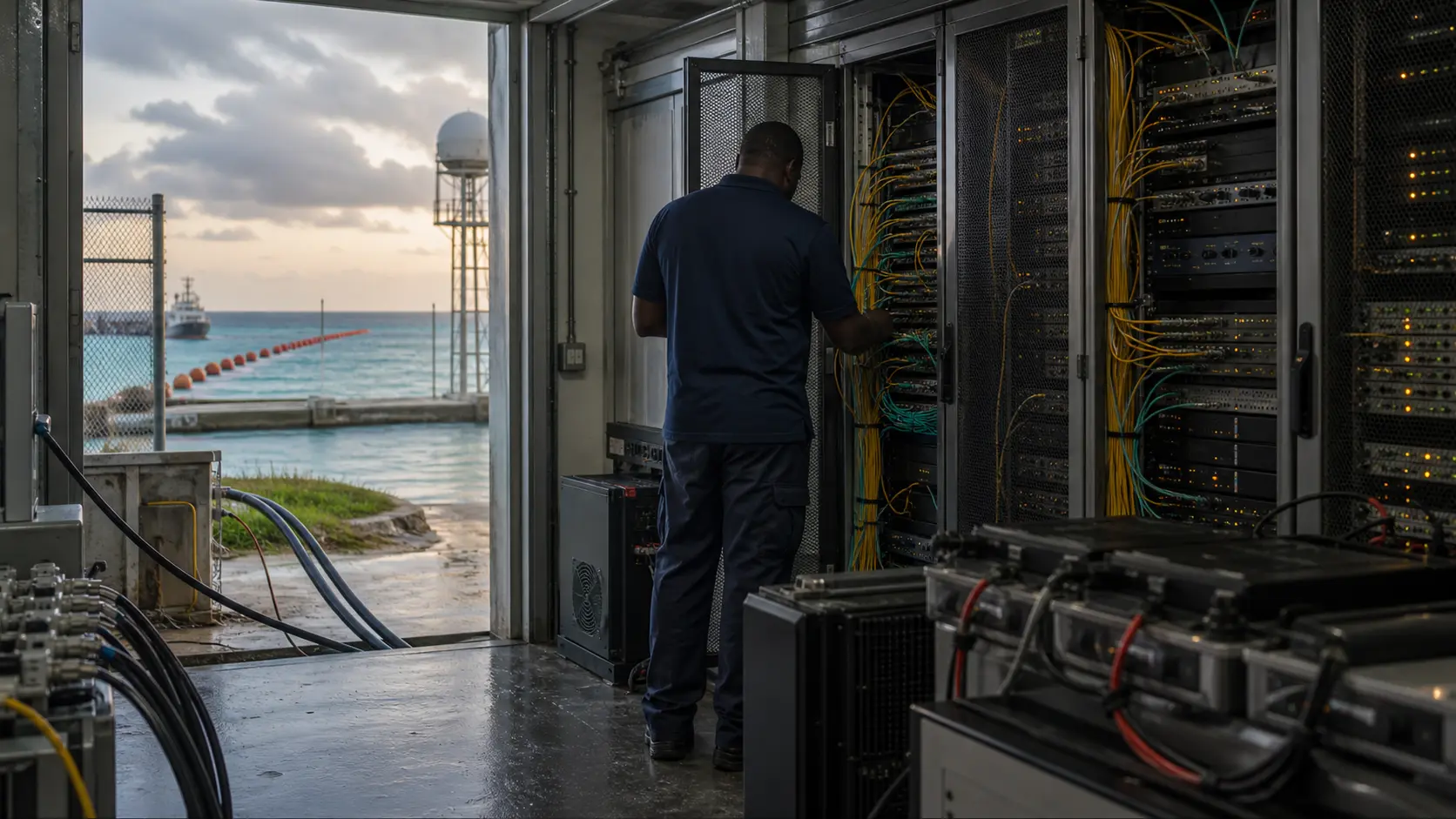
Submarine and inter-island infrastructure also changes the meaning of competition. A provider that owns, leases or depends on these routes is not simply buying internet transit at a wholesale port. It is running a service chain that can be interrupted by fibre cuts, storm damage, electricity weakness, landing-station constraints and repair logistics. Cable Bahamas' story page says broadband was launched on a wholly owned submarine fibre-optic system (https://cablebahamas.com/our-story/), while REV's network description says the network is linked by submarine fibre and connects into South Florida (https://www.rev.bs/about/revamp/). These claims do not by themselves prove route-level redundancy. They do establish that the business is anchored in physical island connectivity, not only retail branding.
The fibre upgrade is a margin repair as much as a speed story
ALIVFibr is marketed as speed, but the investment case is broader than speed. The product page says ALIVFibr offers fibre-optic broadband up to 1 Gbps and bundles broadband, digital TV and voice, with the Infinite 1000 triple-play bundle advertised at $169 plus VAT and the Infinite 500 bundle at $119 plus VAT (https://alivfibr.com/). A January 2025 rates PDF lists standalone Fibr Net products from 100 Mbps to 1000 Mbps and fibre bundles that include internet, TV and voice (https://www.rev.bs/wp-content/uploads/2025/01/aliv-and-rev-rates_01-.pdf). Those prices give customers an easy comparison point. The harder question is whether fibre lowers Cable Bahamas' operating cost, reduces service incidents and creates enough product headroom to keep customers from dropping the bundle.
The company is clearly moving customers away from legacy HFC in selected areas. ALIVFibr programming updates state that the REV network in listed areas would be permanently shut down as customers migrate to ALIVFibr, with the company saying the move from HFC to fibre provides faster speeds, stronger reliability in storms and disasters, and smart Wi-Fi that covers the home (https://alivfibr.com/programming-updates/). REV's own site carries notices telling customers that, as Cable Bahamas expands the ALIVFibr network, REV services in certain areas will be discontinued (https://www.rev.bs/about/revamp/). That is not only a customer-upgrade campaign. It is a cost simplification strategy: fewer parallel access networks, fewer aging plant failures, and a better chance of selling broadband as the primary service.
The technical case is also visible in customer-facing support material. ALIVFibr's FAQ says the optical network terminal needs electricity but includes battery backup for up to eight hours depending on use and shelf life (https://alivfibr.com/faq/alivfibr-internet/). It also says fibre transmits data using light signals and avoids the interference problems associated with copper connections (https://alivfibr.com/faq/alivfibr-internet/). Marketing language should not be treated as engineering proof, but it tells us how the company wants customers to value the upgrade: not as a luxury speed tier, but as a more reliable household platform.
The annual report supports that reading. Cable Bahamas said FY25 fixed services revenue fell 1 percent to $131 million because traditional TV and voice declined, and it expected that pressure to be offset by more fibre broadband uptake as the ALIVFibr rollout continued (https://cablebahamas.com/wp-content/uploads/2026/04/CBL_Annual_Report_2025.pdf). That sentence is the fibre thesis in plain commercial form. Fibre is not only a new product; it is the repair mechanism for the decline of older services. The migration has to move quickly enough that customers who cut the television cord remain broadband customers and perhaps mobile customers, rather than becoming satellite or mobile-only households.
The annual report also says operating expenses rose to $152.5 million from $149.2 million, with network maintenance, spectrum-related costs and marketing investment for ALIVFibr contributing to the increase (https://cablebahamas.com/wp-content/uploads/2026/04/CBL_Annual_Report_2025.pdf). That creates a timing problem. The fibre programme raises costs before it fully proves retention, pricing power and lower fault rates. If customers see the migration only as a price increase or forced equipment change, the operator may spend capital to accelerate churn. If customers see it as a reliability improvement that keeps working when streaming, work, school and payments all depend on it, the operator can convert capex into a more defensible base.
Mobile scale helps, but ALIV's ownership keeps the economics complicated
Cable Bahamas' fixed network cannot be understood without ALIV. The company was awarded the second mobile licence in The Bahamas in 2016 and introduced ALIV that year (https://cablebahamas.com/our-story/). REV's corporate page says Cable Bahamas acquired a mobile service licence under NewCo in 2015 and that ALIV, under Be Aliv Ltd., was formed in 2016 to offer LTE service throughout The Bahamas (https://www.rev.bs/about/revamp/). The current Cable Bahamas annual report says the government, through HoldingCo, owns 51.75 percent of ALIV ordinary shares, while Cable Bahamas owns 48.25 percent and has board and management control (https://cablebahamas.com/wp-content/uploads/2026/04/CBL_Annual_Report_2025.pdf). That structure matters: mobile gives the group scale and relevance, but not a simple 100 percent economic claim on all mobile upside.
Mobile is the group's strongest growth counterweight to fixed decline. The annual report says mobile revenue grew, while fixed services revenue was pressured by traditional TV and voice decline (https://cablebahamas.com/wp-content/uploads/2026/04/CBL_Annual_Report_2025.pdf). The notes to the financial statements disaggregate 2025 revenue into service revenue from prepaid mobile, mobile postpaid, fixed postpaid, equipment, rentals, interconnect and roaming, and other categories (https://cablebahamas.com/wp-content/uploads/2026/04/CBL_Annual_Report_2025.pdf). In the customer-type view, consumer mobile revenue of $90.6 million exceeded consumer fixed revenue of $77.3 million in 2025 (https://cablebahamas.com/wp-content/uploads/2026/04/CBL_Annual_Report_2025.pdf). The company is already a mobile-led consumer connectivity group, not only a cable company with a mobile side project.
The strategic issue is that mobile also competes with fixed. ALIV's plans page advertises prepaid, postpaid and roaming offers with data allowances, unlimited talk and text in selected plans, and regional roaming options (https://www.bealiv.com/store/plans/). ALIV's wireless broadband page presents fixed wireless access for the home in Grand Bahama, Abaco and Eleuthera, and describes it as high-speed home internet delivered over the mobile network (https://www.bealiv.com/wireless/). That makes mobile both a bundle reinforcement and a substitute. If ALIV mobile helps sell fibre, Cable Bahamas gets a stronger household account. If ALIV wireless becomes the cheaper or faster-to-install answer in islands where fibre is absent, the group still captures the customer, but with a different capacity and cost profile. If Starlink captures the high-usage household and ALIV keeps only phone data, the bundle weakens.
The 5G debate shows the limits of mobile economics in the Bahamas. URCA's January 2025 5G roadmap says the CBL Group agreed that 5G can support faster speeds, lower latency, Internet of Things services, e-government and remote-island broadband, but also argued that the 5G business case in The Bahamas is weak because of limited mobile data growth, market saturation and lack of demand for 5G services (https://urcabahamas.bs/wp-content/uploads/2025/01/URCA-ECS-012025-Roadmap-to-enable-5G-deployment-in-The-Bahamas-SoR-and-Next-Steps.pdf). The CBL Group's own redacted response to URCA's 5G consultation raised concerns about the viability of a third mobile entrant, stable two-operator market structure, Family Island economics, spectrum pricing and the need for fibre transmission capacity at cost-based prices (https://urcabahamas.bs/wp-content/uploads/2025/01/Redacted-CBL-Group-Roadmap-to-Enable-5G-Deployment-in-The-Bahamas.pdf). This is the same island fixed-cost problem appearing in mobile form.
Mobile therefore helps Cable Bahamas only if it deepens household and enterprise loyalty without forcing a capex race that the market cannot monetize. The annual report says the group is investing in 5G readiness, enterprise solutions and fibre rollout (https://cablebahamas.com/wp-content/uploads/2026/04/CBL_Annual_Report_2025.pdf). That is a rational portfolio, but it is capital hungry. The small-market question is not whether customers want modern mobile. They do. It is whether enough of them will pay enough incremental revenue for the next generation of mobile capacity, or whether 5G becomes another required upgrade that preserves relevance but does not expand margin.
The financial line says steady demand is not the same as easy money
Cable Bahamas' 2025 numbers look stable at the top and tight underneath. Revenue reached $242.17 million, almost flat against $241.98 million in 2024 (https://cablebahamas.com/wp-content/uploads/2026/04/CBL_Annual_Report_2025.pdf). EBITDA was $87 million and the group reported positive free cash flow of $38 million (https://cablebahamas.com/wp-content/uploads/2026/04/CBL_Annual_Report_2025.pdf). But the same report says the group reported a net loss of $6.7 million, driven primarily by preferred share dividends, and raised $60.9 million in net proceeds through Series Two preferred shares to strengthen liquidity and support investments (https://cablebahamas.com/wp-content/uploads/2026/04/CBL_Annual_Report_2025.pdf). The commercial reading is not distress, but it is not leisure either. Stable demand does not automatically fund redundancy.
The expense mix points to the cost stack behind the public bundle. Operating expenses in 2025 included direct costs, administration, commercial and customer operations, programming, network operations, engineering, and government and regulatory fees; government and regulatory fees rose to $19.2 million from $14.7 million, while network operations rose to $12.2 million from $9.1 million (https://cablebahamas.com/wp-content/uploads/2026/04/CBL_Annual_Report_2025.pdf). These are not optional categories. A telecom operator cannot cut network operations, engineering, compliance and customer care to zero while promising national resilience. Yet every dollar there is a dollar that a satellite or app-based substitute can appear to avoid from the customer's view.
Programming costs also explain why the old bundle is losing strength. The 2025 financial notes list programming costs of $17 million, down slightly from $17.8 million in 2024 (https://cablebahamas.com/wp-content/uploads/2026/04/CBL_Annual_Report_2025.pdf). Meanwhile, ALIVFibr programming updates show content changes, channel removals and support notices that remind customers that television packaging is a living cost centre, not a static add-on (https://alivfibr.com/programming-updates/). Streaming services have taught customers to compare content directly and cancel quickly. Cable Bahamas therefore has to keep television useful enough to support the bundle while not letting content economics distract from the broadband core.
Debt and liquidity also shape the investment runway. The annual report notes capital commitments of $1.49 million related to acquisition of network infrastructure and discusses letters of guarantee and insurance coverage for major risks (https://cablebahamas.com/wp-content/uploads/2026/04/CBL_Annual_Report_2025.pdf). It also discloses reportable segment assets and liabilities across Cable and ALIV, showing a business with meaningful infrastructure and financing complexity rather than a lightweight service reseller (https://cablebahamas.com/wp-content/uploads/2026/04/CBL_Annual_Report_2025.pdf). The operational conclusion is straightforward: the company needs revenue quality, not only revenue volume. A dollar of sticky broadband revenue attached to a high-usage household, business or public agency is more valuable than a dollar of promotional revenue that leaves at the first satellite discount.
The strongest bullish reading is that Cable Bahamas is using fibre to defend fixed broadband, mobile to preserve consumer relevance, and enterprise services to monetize reliability. The strongest bearish reading is that the company is forced to spend on several fronts at once while the customer benchmark shifts to cheaper substitutes. The 2025 annual report's stable revenue does not settle the debate. It sets the line from which the redundancy bill has to be paid.
Tourism raises the peak load without fixing the base
Tourism is Cable Bahamas' most important demand amplifier and one of its least complete solutions. The Bahamas Ministry of Tourism said the country welcomed 11.22 million international visitors in 2024, up from 9.65 million in 2023, with foreign air and sea arrivals up 16.2 percent from the prior year and 54.7 percent above 2019 (https://www.bahamas.com/pressroom/the-bahamas-drives-unprecedented-tourism-growth--welcoming-more-than-11-million-visitors-in-2024). The Ministry also said December 2024 was the best month on record for arrivals and that Grand Bahama and Abaco showed air-arrival growth (https://www.bahamas.com/pressroom/the-bahamas-drives-unprecedented-tourism-growth--welcoming-more-than-11-million-visitors-in-2024). For a telecom operator, this is good news, but it is uneven good news.
Visitors raise network load at hotels, marinas, airports, restaurants, cruise-facing retail and transport nodes. They make Wi-Fi performance part of the guest experience and push businesses to pay for dependable point-of-sale, reservation and security connectivity. Tourism also creates island-specific bursts: a cay with luxury development and seasonal visitors can need high-grade connectivity before its permanent population would justify it on household counts alone. The Exuma fibre project makes that visible. The Tribune reported that Cable Bahamas and Global Nexus framed the Exuma route around tourism expansion, high-demand nodes, public communities, schools, clinics, government administration complexes and broadband quality for residents (https://www.tribune242.com/news/2023/sep/28/cable-partners-over-5m-exuma-cays-connectivity/).
The problem is that tourism demand is not the same as dense, recurring residential demand. Cruise visitors may use local networks only indirectly through ports, vendors, Wi-Fi and business services. Hotel and resort demand may be concentrated in a few contract accounts, not broad enough to pay for every surrounding route. Seasonal peaks require capacity that may sit underused in slower months. The Ministry's 2024 visitor-arrivals PDF, compiled from Immigration Department counts, shows large monthly foreign air and sea arrivals across the country (https://www.tourismtoday.com/sites/default/files/docs/Bahamas%20Visitor%20Arrivals%202024%20%281%29.pdf). Those flows support enterprise opportunity, but they do not eliminate the fixed cost of service to low-density communities.
Tourism also raises expectations. A guest arriving from Miami or Toronto expects video calls, cloud photo backup, streaming, mobile payments and app-based transport to work without thinking about island geography. A resort that cannot support those expectations bears reputational damage immediately. Cable Bahamas can use that pressure to sell business-grade service, managed security and redundancy. Its 2025 annual report highlights ALIV Business, enterprise solutions and a cyber security summit as part of the group's direction (https://cablebahamas.com/wp-content/uploads/2026/04/CBL_Annual_Report_2025.pdf). The opportunity is to convert national tourism demand into higher-quality contracts that help fund the wider network.
But tourism is also a substitute accelerant. Resort operators, private-island owners, marinas and remote businesses are precisely the customers most able to test Starlink or hybrid connectivity if terrestrial service is weak. The more valuable the customer, the more likely it can pay for backup. That does not destroy Cable Bahamas' opportunity, but it forces a different sales promise. The company has to be the primary local platform, not the only option. A premium hotel may keep fibre, mobile and satellite at the same time. Cable Bahamas wins if its fibre or business service is the route the property trusts for core operations.
It loses margin if it becomes one commodity feed in a self-managed backup mix.
Starlink is the substitute that changes what customers compare
The satellite issue is not only that Starlink exists. It is that Starlink changes the mental price list. URCA's 2023 annual report and 2024 plan said BTC and Cable Bahamas remained the primary fixed broadband providers, but 2023 saw satellite internet provider Starlink enter the market (https://urcabahamas.bs/wp-content/uploads/2024/04/URCA-ANNUAL-REPORT-2023-and-2024-ANNUAL-PLAN-URCA-032024.pdf). URCA's March 2024 annual-plan statement said Starlink provided broadband internet at fixed locations in The Bahamas but was not licensed for voice telephony or traditional mobile services (https://www.urcabahamas.bs/wp-content/uploads/2024/03/URCA-ANNUAL-PLAN-2024-STATEMENT-OF-RESULTS_URCA-022024.pdf). That is enough to reset customer comparison for fixed broadband even before satellite becomes a full mobile substitute.
Cable Bahamas has responded aggressively in regulatory filings and public debate. The Tribune reported in July 2025 that Cable Bahamas warned it could be forced to halt network expansion, enter an unsustainable pricing war, exit the market or seek bankruptcy protection if satellite-based providers were not regulated on comparable terms (https://www.tribune242.com/news/2025/jul/14/cable-fears-starlink-may-force-them-out-of-market/). The same report said Cable Bahamas argued that Starlink's licence let it offer fixed broadband anywhere in The Bahamas without the same local infrastructure costs, and that the proposed satellite spectrum fee was far below terrestrial mobile spectrum charges (https://www.tribune242.com/news/2025/jul/14/cable-fears-starlink-may-force-them-out-of-market/). The tone may be defensive, but the underlying economic issue is real: if the terrestrial operator funds national infrastructure while the substitute sells around that cost, the customer sees price and speed before national cost allocation.
URCA is still working through the satellite framework. Its November 2025 second-round consultation on satellite-based electronic communications services describes the electronic communications sector as including fixed and mobile telecom services, broadcasting, spectrum management and numbering, and frames the regulatory task around affordable access, competition, innovation and service availability across The Bahamas (https://urcabahamas.bs/wp-content/uploads/2025/11/URCA-ECS-072025-Second-Round-Consultation-on-Satelite-Framework.pdf). The CBL Group's response to the satellite consultation argued that the regulator should not settle a long-term satellite framework on flawed proposals and should account for fair competition and local operators' investment burden (https://urcabahamas.bs/wp-content/uploads/2025/07/CBL-Response-to-ECS-752024-Satellite-Regulatory-Framework-Consultation.pdf).
Customer chatter shows why the issue is commercially dangerous. Comments under The Tribune's Starlink article include several readers claiming poor local service or comparing office broadband unfavorably with Starlink (https://www.tribune242.com/news/2025/jul/14/cable-fears-starlink-may-force-them-out-of-market/). A Reddit discussion in r/bahamas described the market as having BTC and ALIV/Cable Bahamas, with users debating stability, pricing and the usefulness of new fibre products (https://www.reddit.com/r/bahamas/comments/1t1oav3/cell_internet_service/). These comments are not a survey and cannot prove churn. They show the language of customers who treat satellite and mobile as practical alternatives, not as distant technologies.
Cable Bahamas can still win against that substitute in many contexts. Fibre can provide lower latency, higher household capacity, local support, enterprise service agreements and integration with TV, voice and mobile. ALIVFibr's public product page offers up to 1000 Mbps download and up to 500 Mbps upload in its top triple-play bundle (https://alivfibr.com/). ALIVFibr's support pages emphasize fibre resilience, home Wi-Fi management and battery backup at the customer terminal (https://alivfibr.com/faq/alivfibr-internet/). The company does not need every customer to reject satellite. It needs enough high-value households, businesses and public agencies to see terrestrial fibre as the main service and satellite as backup, rather than the other way around.
Regulation turns dominance into both protection and duty
Regulation is not a side issue for Cable Bahamas. It is part of the revenue model and part of the cost model. URCA's preliminary fixed-market review said the retail fixed broadband market was divided into two geographic segments, with Cable Bahamas having significant market power in New Providence, Grand Bahama, Abaco and Eleuthera, while BTC had significant market power in the rest of The Bahamas (https://urcabahamas.bs/urca-sets-preliminary-position-after-market-review-of-retail-fixed-electronic-communications-services-in-the-bahamas/). URCA's final determination said Cable Bahamas was dominant in retail pay TV services and required to continue offering current pay-TV packages under certain obligations (https://urcabahamas.bs/final-determination-after-market-review-of-retail-fixed-electronic-communications-services-in-the-bahamas/). Dominance can protect a local operator from unfettered erosion, but it also invites pricing rules, service duties and regulator scrutiny.
The 2024 URCA annual report and 2025 plan make reliability a regulatory priority. URCA said it would begin reviewing quality-of-service regulations for electronic communications networks and services in 2025, noting reliability concerns across the country, especially in the Family Islands, and saying the review would consider the effect of electricity reliability on telecom services (https://urcabahamas.bs/wp-content/uploads/2025/05/URCA-032025-URCA-2024-ANNUAL-REPORT-and-2025-ANUAL-PLAN.pdf). It also said implementation of remedies after the fixed-market and pay-TV review would include revision of retail pricing rules and further investigation into lack of consumer switching (https://urcabahamas.bs/wp-content/uploads/2025/05/URCA-032025-URCA-2024-ANNUAL-REPORT-and-2025-ANUAL-PLAN.pdf). That gives Cable Bahamas two messages at once: customers need better reliability, and the regulator is watching the terms on which dominant operators sell it.
The 5G process adds another layer. URCA's 5G roadmap describes a market-led approach, but the regulator also discusses spectrum award procedures, non-price considerations, coverage obligations, infrastructure sharing and the role of low- and mid-band spectrum (https://urcabahamas.bs/wp-content/uploads/2025/01/URCA-ECS-012025-Roadmap-to-enable-5G-deployment-in-The-Bahamas-SoR-and-Next-Steps.pdf). Cable Bahamas and ALIV supported several 5G objectives but argued that coverage bonds, unrealistic obligations and high spectrum costs could damage the business case (https://urcabahamas.bs/wp-content/uploads/2025/01/Redacted-CBL-Group-Roadmap-to-Enable-5G-Deployment-in-The-Bahamas.pdf). For the company, the regulator is simultaneously a referee, tax collector, investment influencer and potential shield against uneven satellite competition.
The regulatory bargain should be judged by investment behavior. If Cable Bahamas keeps extending fibre, improves outage performance, supports public services and delivers better switching outcomes, regulation can preserve a viable local infrastructure market while encouraging competition. If regulation protects legacy positions without visible service gains, customers will read every filing against Starlink as a plea for shelter.
The fixed-market review, satellite framework and 5G roadmap all point to the same public interest problem: The Bahamas needs competition and innovation, but it also needs someone to fund and maintain local networks that work when tourism, public services and households need them most.
Public routing records show the backhaul problem is real
Cable Bahamas' network presence is visible outside its own marketing. ARIN's RDAP record for AS15146 lists the autonomous system name CABLEBAHAMAS, registrant Cable Bahamas, and an active registration dating to March 2000 (https://rdap.arin.net/registry/autnum/15146). RIPEstat's AS overview likewise identifies AS15146 as "CABLEBAHAMAS - Cable Bahamas" and shows it as announced on July 4, 2026 (https://stat.ripe.net/data/as-overview/data.json?resource=AS15146). PeeringDB lists Cable Bahamas, also known as REV, as a Cable/DSL/ISP network with AS15146, an AS-CBL route set, 70 IPv4 prefixes, 273 IPv6 prefixes, 50-100 Gbps traffic, mostly inbound traffic, selective peering policy, one internet exchange connection and three facilities (https://www.peeringdb.com/api/net?asn=15146).
Those registry records do not prove customer experience. They do prove that Cable Bahamas is an actual routed network with public interconnection requirements. BGP.tools describes AS15146 as a Cable Bahamas network with upstream carriers and public route announcements (https://bgp.tools/as/15146). IPinfo identifies AS15146 as an ISP-class network in the ARIN registry and reports hosted IPv4 and IPv6 address space (https://ipinfo.io/AS15146). PeeringDB's FL-IX page lists Cable Bahamas at the Florida Internet Exchange with AS15146 and a 100G connection (https://www.peeringdb.com/ix/954). For an island operator, these public records matter because off-island interconnection is not decorative; it is the route through which local customers reach much of the global internet.
The physical cable environment is equally important. TeleGeography's Submarine Cable Map has a page for the Bahamas Internet Cable System, commonly referenced as BICS (https://www.submarinecablemap.com/submarine-cable/bahamas-internet-cable-system-bics). Submarine Networks describes ARCOS-1 as an 8,700 km Caribbean optical-ring system connecting 24 landing points in 15 countries, including the Bahamas, with landing points at Crooked Island, Cat Island and Nassau (https://www.submarinenetworks.com/en/systems/brazil-us/arcos-1). A Bahamas Financial Services Board report from 2006 described BTC's Bahamas Domestic Submarine Network International as a submerged fibre ring tying 14 inhabited islands together (https://bfsb-bahamas.com/blog/2006/12/new-fibre-optic-cable-network/). These systems are not all Cable Bahamas-owned; they form the wider route environment in which Cable Bahamas buys, sells, peers, competes and builds.
The FCC's 2023 public notice on the Bahamas II Cable System is another reminder that international cable routes are regulated assets, not just technical trivia. The notice says BTC sought a cable landing licence for a non-common carrier fibre optic submarine cable connecting Vero Beach, Florida and Nassau, and it referenced ARCOS-1 and BICS as other competitive cable systems between the United States and The Bahamas (https://docs.fcc.gov/public/attachments/DA-23-713A1.pdf). That matters for Cable Bahamas even when it is not the licence holder in a given route. The availability, pricing and resilience of international and domestic backhaul determine how much redundancy the local retail operator can offer and how much it has to charge for it.
The public routing picture therefore supports the central judgement. Cable Bahamas is not an app riding on someone else's invisible network. It is part of a national and regional connectivity fabric with peering, international backhaul, cable routes, local access plant and field operations. Customers do not need to care about AS15146, FL-IX or submarine landing points to care about the result. But investors, regulators and large customers should care because these records show why a Bahamian broadband bundle carries more cost than a simple price comparison suggests.
Storm resilience is no longer a seasonal expense
The Bahamas' storm exposure turns telecom redundancy from a premium feature into part of the public-service floor. Hurricane Dorian made this plain. The Inter-American Development Bank said in 2019 that the impacts and effects of Hurricane Dorian on The Bahamas were estimated at $3.4 billion (https://www.iadb.org/en/news/damages-and-other-impacts-bahamas-hurricane-dorian-estimated-34-billion-report). ITU described emergency telecom assistance after Dorian, including satellite phones and broadband terminals for affected areas, emphasizing the role of communications in disaster response (https://www.itu.int/hub/2020/05/hurricane-dorian-itu-sends-emergency-telecoms-assistance-to-the-bahamas/). The Emergency Telecommunications Cluster reported widespread destruction in Abaco, including telecommunications towers down, limited or no electricity, and damaged infrastructure in Marsh Harbour (https://www.etcluster.org/emergency/bahamas-hurricane-dorian).
Cable Bahamas' own materials show how storm and power resilience have entered normal product language. ALIVFibr's FAQ says the customer terminal has battery backup for up to eight hours depending on use and shelf life (https://alivfibr.com/faq/alivfibr-internet/). ALIVFibr programming updates describe the fibre transition as bringing stronger reliability in storms and disasters (https://alivfibr.com/programming-updates/). The 2025 annual report says the company began exploring renewable energy options and planned to engage 40 solarized cell sites in the coming year, while also fortifying existing fibre-optic cables to support lasting performance (https://cablebahamas.com/wp-content/uploads/2026/04/CBL_Annual_Report_2025.pdf). These are not abstract sustainability gestures. They are attempts to reduce the vulnerability of telecom service to power and weather.
URCA's 2025 plan reinforces the same point from the regulator's side. The regulator said reliability concerns across the country, especially in the Family Islands, would drive its quality-of-service review and that the review would incorporate electricity reliability because of operational interdependencies between power and telecom services (https://urcabahamas.bs/wp-content/uploads/2025/05/URCA-032025-URCA-2024-ANNUAL-REPORT-and-2025-ANUAL-PLAN.pdf). That sentence turns a customer complaint into a policy issue. A broadband operator can upgrade fibre and still fail the customer if power, backup and field recovery do not hold.
Service notices show the ordinary version of the same risk. REV's service-updates page lists resolved and current service issues by area and includes examples of New Providence outages and recently closed issues (https://www.rev.bs/service-updates/). REV region archives for Eleuthera and ALIVFibr show repeated local outage notices and restoration language (https://www.rev.bs/service_update_region/eleuthera/page/2/; https://www.rev.bs/service_update_region/alivfibr/). Our News reported in May 2024 that Cable Bahamas described an Eleuthera disruption affecting customers from Glass Window Bridge southward and said preliminary assessment indicated sabotage (https://ournews.bs/cable-bahamas-responds-to-service-disruption-in-eleuthera/). A single disruption does not define the network. The pattern shows why resilience has to be designed as an operating system, not a marketing adjective.
The commercial challenge is that customers dislike paying for standby capacity until they need it. A hotel manager sees the cost every month but the avoided outage only during a storm, power problem or fibre cut. A household sees the monthly bill and compares it with satellite. Cable Bahamas' job is to make resilience concrete: better restoration times, clearer communication, in-home battery behavior, business continuity products, and visible improvements in the Family Islands. Without that, the redundancy bill becomes a line item customers try to escape.
Customer-signal evidence points to migration risk, not just price sensitivity
The strongest customer risk is not that people dislike paying. It is that they have learned to reconfigure connectivity. A household can drop TV, keep fibre, add a streaming bundle, use mobile data during outages and keep Starlink as backup. A small business can use Cable Bahamas for a main connection, ALIV mobile for failover and satellite for storm resilience. A remote cay can bypass weak terrestrial access entirely. This makes churn less visible than a simple lost-account count. The customer may stay in the system while steadily reducing the value of the bundle.
Cable Bahamas' own product mix acknowledges that reality. REV's home page offers TV, internet and phone bundles from $92.98 and says REV services are exclusively available to Family Island customers (https://www.rev.bs/). The bundles page shows make-your-own bundles across TV, broadband and talk products, with multiple speed and channel options (https://www.rev.bs/bundles/). ALIVFibr, by contrast, centers fibre internet, TV and phone in New Providence and Abaco, with higher-speed bundles and online account management (https://alivfibr.com/). The product architecture is already split between legacy bundle logic, fibre-first household logic and mobile-first logic.
Customer behavior in public forums suggests the split is active. The r/bahamas discussion on cell and internet service includes users contrasting BTC, ALIV/Cable Bahamas, fixed internet prices and newer fibre products (https://www.reddit.com/r/bahamas/comments/1t1oav3/cell_internet_service/). Comments under The Tribune's Exuma fibre story mention Starlink repeatedly as a practical option in Family Islands (https://www.tribune242.com/news/2023/sep/28/cable-partners-over-5m-exuma-cays-connectivity/). Comments under The Tribune's 2025 Starlink article include frustration with service quality, claims of office internet underperformance and direct calls to compete on price and reliability (https://www.tribune242.com/news/2025/jul/14/cable-fears-starlink-may-force-them-out-of-market/). These comments are noisy. They cannot prove market share. They do show that the substitute is culturally present.
The company's best answer is not only lower price. Price cuts can defend share but worsen the redundancy bill. A more durable answer is sharper segmentation. Dense New Providence households need fibre speed, Wi-Fi quality, streaming compatibility and mobile integration. Family Island customers need clear availability, honest restoration communication and routes that do not collapse when one component fails. Hotels and businesses need service-level commitments, managed security, backup paths and support that understands tourism operations. Public-sector customers need continuity, island reach and tested disaster procedures.
A single generic bundle will not satisfy all of those jobs.
This is where Cable Bahamas' brands can either help or confuse. REV, ALIV, ALIVFibr and ALIV Business each carry a different promise. The corporate site lists the group brands as ALIV, ALIVFibr, ALIV Business, REV and Our TV (https://cablebahamas.com/our-story/). The investor page emphasizes governance, revenue and EBITDA metrics while linking shareholders to filings (https://cablebahamas.com/investors-and-governance/). The customer does not care about corporate structure, but brand clarity affects perceived reliability. If customers understand which network they are on, why migration is happening, what happens during power cuts and how support is handled, the fibre transition can reduce churn. If the brand transition feels like forced migration with confusing pricing, satellite becomes more attractive.
What would make the redundancy bill investable
The central test is whether Cable Bahamas can make redundancy pay without making the substitute more attractive. The annual report gives encouraging evidence: stable FY25 revenue, positive free cash flow, 95 percent New Providence fibre availability, 24,000 households connected to ALIVFibr, mobile revenue growth, and a clear programme of fibre, enterprise, security and sustainability investments (https://cablebahamas.com/wp-content/uploads/2026/04/CBL_Annual_Report_2025.pdf). Public product pages show a usable fibre proposition with 1 Gbps service, smart Wi-Fi, TV, voice and mobile adjacency (https://alivfibr.com/). Public network records show a real routed network with interconnection presence and announced routes (https://rdap.arin.net/registry/autnum/15146; https://www.peeringdb.com/api/net?asn=15146; https://stat.ripe.net/data/as-overview/data.json?resource=AS15146).
The weaknesses are equally visible. Revenue growth was only 0.1 percent in FY25, operating expenses rose, fixed services revenue declined, and the group reported a net loss after preferred share effects (https://cablebahamas.com/wp-content/uploads/2026/04/CBL_Annual_Report_2025.pdf). The 5G business case is contested by the company itself (https://urcabahamas.bs/wp-content/uploads/2025/01/Redacted-CBL-Group-Roadmap-to-Enable-5G-Deployment-in-The-Bahamas.pdf). URCA is reviewing quality of service, infrastructure sharing, satellite competition and fixed-market remedies (https://urcabahamas.bs/wp-content/uploads/2025/05/URCA-032025-URCA-2024-ANNUAL-REPORT-and-2025-ANUAL-PLAN.pdf). Starlink has entered the customer imagination and the regulatory arena (https://www.tribune242.com/news/2025/jul/14/cable-fears-starlink-may-force-them-out-of-market/). Each of those facts narrows the room for pricing mistakes.
The investable version of Cable Bahamas has four features. First, fibre migration must lower fault rates and support costs, not merely raise headline speed. Second, mobile and fibre must reinforce each other through household and business accounts, not cannibalize without discipline. Third, enterprise and public-sector contracts must convert tourism, security and continuity demand into higher-quality revenue. Fourth, regulatory outcomes must recognize local infrastructure costs without protecting weak service. If those features appear together, the redundancy bill can become a defendable national-infrastructure premium.
The uninvestable version is also clear. If customers experience the fibre transition as disruption, if Family Island reliability remains visibly uneven, if satellite becomes the default backup for high-value customers, if 5G spending becomes mandatory without new revenue, and if regulation focuses on defending incumbents rather than improving service, then the bundle becomes harder to sell. At that point Cable Bahamas would still have assets, brands, customers and national relevance, but its pricing power would erode because customers would separate the bundle into cheaper pieces.
The judgement, then, is deliberately conditional. Cable Bahamas is one of the few operators in its market with the local access plant, mobile brand, fibre programme, public route footprint and regulatory standing to carry The Bahamas' connectivity burden. But that burden is expensive, and the public evidence does not yet prove that ARPU, churn control, tourism demand and storm-risk investment will comfortably cover it. The next proof point is not another slogan about speed.
It is whether customers in Nassau, Abaco, Eleuthera, Exuma and the rest of the Family Islands experience enough reliability and clarity to keep paying for the invisible spare network behind the monthly bundle.