
Summary
- BRISK Systems, trading publicly through the Brisk Internet service surface, appears to be a Dhaka-centred broadband ISP whose paid unit is the recurring home and small-business subscription, not an abstract megabit.
- The strongest public evidence is operational rather than financial: Brisk publishes fibre-broadband packages, bill-payment instructions, service terms, a customer app with support tickets and bKash payments, ISPAB membership, and APNIC/BGP records for AS134180.
- That evidence supports a specific thesis: BRISK can hold a local account only if installation, outage handling, support follow-up, payment convenience and reconnection lower the hassle of staying online in a crowded Dhaka market.
- Public sources do not disclose subscriber count, churn, ticket-resolution time, outage rate, collection loss, customer-acquisition cost, gross margin or vendor contracts, so the judgement has to remain conditional and focused on the service workflow.
The subscription is bought to avoid a daily operating drag
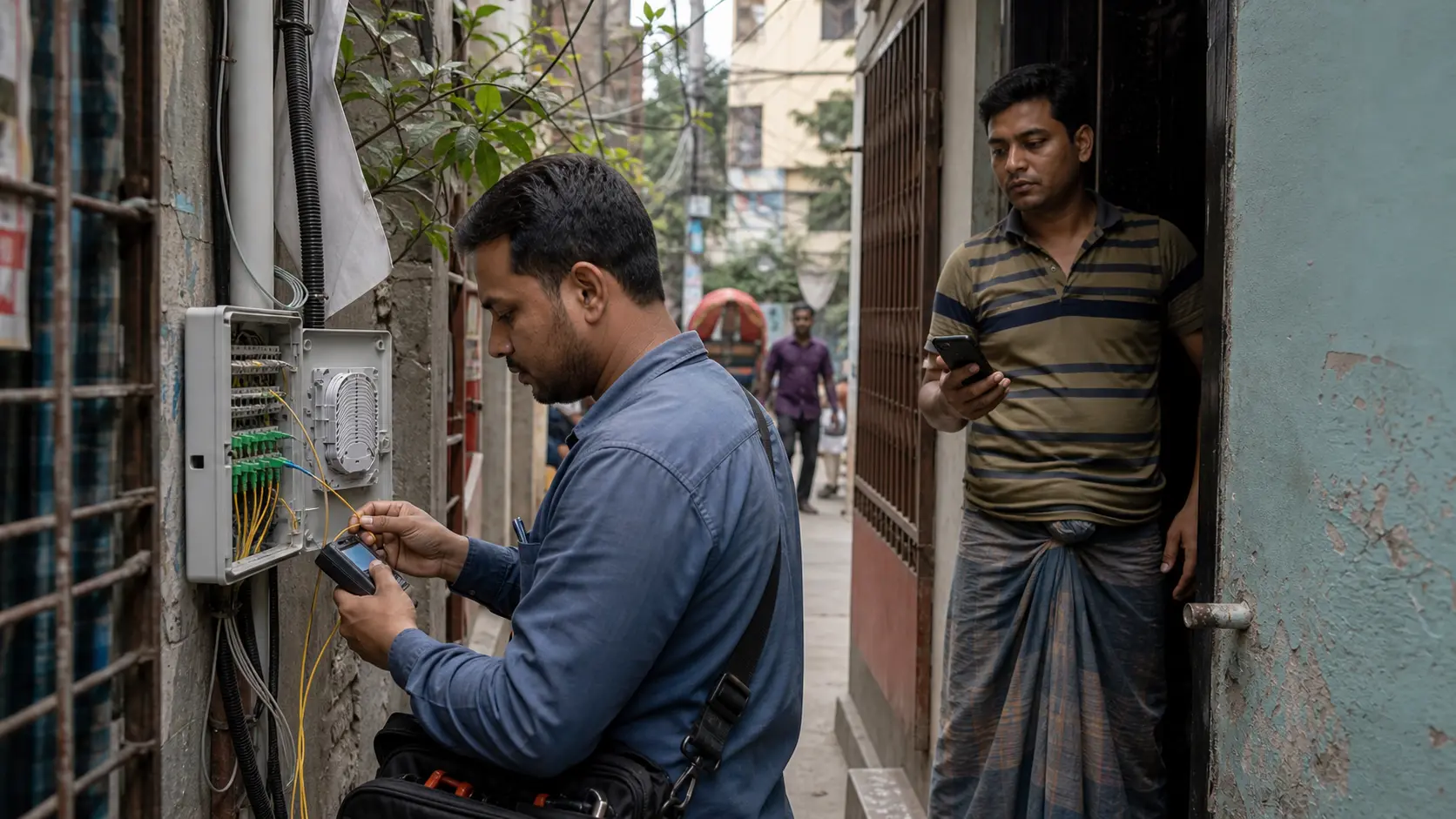
Rafiq is a useful buyer archetype for BRISK Systems. He runs a small pharmacy near Mohammadpur, keeps one laptop for invoices, a phone for supplier messages, a point-of-sale app for payments, and a Wi-Fi router that staff and family members all expect to work. His operating constraint is not the theoretical maximum speed printed on a package card. It is whether the connection is live when a medicine order has to be placed, a prescription photo has to be received, or a mobile wallet payment has to be checked.
His substitute is visible and ordinary: he can order from Amber IT, Carnival Internet or another Dhaka provider, lean on a shared building line, buy a Grameenphone fixed-wireless package, use mobile data, wait for BTCL or a building manager to arrange service, or delay installation until the shop's cash flow is easier.
That is the right opening because the paid unit is the Dhaka home and small-business broadband subscription. The customer buys a fibre-based line, account number, router path, monthly bill, local support channel and reconnection routine. Brisk's own home page sells the service as home internet for browsing, streaming, online classes and remote work, and it places affordability, twenty-four-hour support, easy installation and stable connection on the same public surface (https://briskinternet.net/). The article's question is whether those service tasks can make the subscription worth keeping when similar bandwidth claims are available across Dhaka.
The first 400 to 600 words need to define the unit because local broadband economics can become misleading if the unit is reduced to "20 Mbps" or "40 Mbps." A megabit figure is only a retail label. The cost to deliver it includes the drop cable, router or optical equipment, building access, a field visit, a billing record, a payment gateway, a support queue, a technician's time, upstream capacity, transmission from licensed carriers, local power problems, customer education and the possibility that a customer leaves after one unresolved outage. Brisk's package surface has advertised a Bronze 20 Mbps plan at Tk525 per month including 5 percent VAT, plus Opal, Pearl and Platinum tiers up to 40 Mbps with BDIX speed and a public-IP feature on the higher plan (https://briskinternet.net/package/). Whether that price is attractive depends on the service burden under it.
The customer's avoided cost is annoyance converted into business loss. If installation is late, Rafiq loses time chasing the provider. If a payment does not post before the billing cycle closes, the line can be cut. If a router or fibre drop fails, the buyer pays with mobile data, missed orders or staff downtime. If a support call repeats the same information, the customer starts thinking about another ISP. A monthly broadband bill survives when it reduces those failures more cheaply than the alternatives.
That is why the article frames BRISK's economics around installation, support tickets, payments and retention, rather than around a generic claim that Dhaka needs more internet.
The public record already points in that direction. Brisk's Android app listing says subscribers can open support tickets, message the technical team, pay monthly bills through the bKash online gateway, view payment history, receive disruption and offer notifications, use mobile data to pay after a cut-off, and open a ticket even when disconnected from Brisk's own connection (https://play.google.com/store/apps/details?hl=en_US&id=com.softifybd.brisksystems). A payment app or ticket feature is not proof of quality. It is better read as evidence of the work the ISP has to absorb to keep a local account alive.
Identity evidence is strong enough for a service thesis, not for a financial conclusion
The public identity trail is coherent. The official Brisk Internet site says Brisk Systems is an ISP based across Dhaka Division, started in 2002, and provides connections through fibre optical network with main routes connected by NTTN, the Nationwide Telecommunication Transmission Network (https://briskinternet.net/about/). ISPAB's public member page lists Brisk Systems, Md. Shariful Islam, membership reference G-116, and a nationwide BTRC license type (https://ispab.org/member/brisk-systems). The broader ISPAB member list also places Brisk Systems at 75-76 Rahber Tower, Janata Housing, Ring Road, Adabor, Muhammadpur, Dhaka-1207, with the same general-member context (https://ispab.org/members?page=28). BD Trade Info separately lists Brisk Systems as an internet service provider in Adabar, Dhaka, with older contact details and an address around PC Culture Housing (https://www.bdtradeinfo.com/company/brisk-systems-38904/).
Technical registration matches the same operating identity. APNIC RDAP for AS134180 names BRISKSYSTEMS-AS-AP in Bangladesh and describes it as Md. Shariful Islam T/A BRISK SYSTEMS, with registration in May 2015 and last-changed data in June 2020 (https://rdap.apnic.net/autnum/134180). The registrant entity in the RDAP record is BRISK SYSTEMS, with an address at House 24, Road 8, PC Culture, Shekhertek, Adabar. BGP datasets then show public route visibility for AS134180. Hurricane Electric lists AS134180 as Md. Shariful Islam T/A BRISK SYSTEMS, country of origin Bangladesh, with IPv4 and IPv6 prefixes originated and peers including Summit Communications and Windstream Communication (https://bgp.he.net/AS134180). BGP.Tools likewise identifies AS134180 as an eleven-year-old network peering with other networks and using upstream carriers (https://bgp.tools/as/134180). PeeringDB describes the network as Cable/DSL/ISP, also known as BRISK SYSTEMS, with a 1-5 Gbps traffic-level band (https://www.peeringdb.com/asn/134180).
That is enough to treat BRISK as a real ISP service surface, not a thin listing with a name only. It is not enough to infer scale, profitability or customer satisfaction. A BGP record shows public reachability and allocated resources. It cannot show how many paying customers are active, how often tickets are resolved within the first visit, whether apartment buildings experience repeated fibre cuts, or whether the company collects bills on time. ISPAB membership and a BTRC license category show sector presence and regulatory positioning. They do not show ARPU, margin, churn, or service quality.
The distinction matters because this article is testing an economics thesis, not verifying that Brisk exists. A company can have a nationwide license category and a public ASN while still behaving economically like a neighbourhood-heavy operator. It can own address space and still depend on leased transport, building access and small support teams. It can advertise twenty-four-hour support and still suffer from repeated field delays if enough customers open tickets at once. The hard public evidence places BRISK in the Dhaka broadband market. The private evidence needed to grade the unit economics remains missing.
The most useful reading is therefore bounded. BRISK sells a local broadband subscription with fibre, customer accounts, packages, payment paths and support tools. Its public network surface is visible through AS134180. Its membership and license context are visible through ISPAB and BTRC-linked materials. But the company does not publish audited financials, subscriber cohorts, ticket data, outage statistics or retention metrics. The article's judgement has to ask how the subscription would work if those private numbers are healthy, and what would change the judgement if they are not.
The package price is a retail wrapper around installation and support labour
Brisk's public package page matters because it shows where the customer first sees the economics. The site has advertised a Bronze 20 Mbps offer at Tk525 per month including 5 percent VAT, an Opal 25 Mbps plan around Tk630, a Pearl 30 Mbps plan around Tk730, and a Platinum 40 Mbps plan around Tk840, with features such as lag-free gaming, bufferless streaming, voice chat, unlimited BDIX speed and a free public IP on the higher tier (https://briskinternet.net/package/). The home page repeats the same simple retail language: choose a package, begin the internet journey, and buy a plan (https://briskinternet.net/).
The price ladder reveals both opportunity and stress. A local ISP wants enough monthly revenue to pay for upstream capacity, NTTN transport, distribution equipment, field staff, support, payment processing, rent, taxes, power and network maintenance. But Dhaka broadband buyers see several comparable offers. Amber IT's home-internet page lists 20 Mbps at Tk500 plus 5 percent VAT, 30 Mbps at Tk650 plus VAT, 50 Mbps at Tk800 plus VAT and 100 Mbps at Tk1,000 plus VAT, with fibre optics and twenty-four-hour customer care (https://www.amberit.com.bd/home-internet). Carnival Internet's home page presents higher-speed fibre packages, including a 55 Mbps offer at Tk899 per month with VAT included and an installation charge, while positioning itself around customer service (https://carnival.com.bd/home-internet). BTCL has also moved old lower-speed plans into higher-speed alternatives at similar price points, according to reporting on its 2026 package upgrades (https://www.thedailystar.net/news/btcl-offers-five-times-faster-internet-old-prices-4078896).
In that setting, Brisk cannot rely on nominal speed alone. If Rafiq can get a similar or higher speed from Amber, Carnival, BTCL or a building's existing shared line, the Brisk bill has to buy less friction. Installation becomes part of the paid product. The buyer cares whether the sales call converts into an actual fibre drop, whether the installer arrives when promised, whether the router is configured correctly, whether the customer knows how to pay, and whether a first-week fault is handled without making the buyer regret the switch. Brisk's public copy about easy installation and setup is therefore economically important, even if it is marketing language (https://briskinternet.net/).
The terms page makes the installation economics more visible. Brisk says it provides broadband internet by fibre optical cable and that the customer pays a monthly bill; it also says Brisk owns devices and equipment related to the customer connection and can retain, restore or return cables, switches and devices when service ends (https://briskinternet.net/terms-conditions/). That clause points to a real cost structure. Customer-premises equipment, switches, cables and field work are not free because a tariff page says the monthly bill is modest. If a customer cancels quickly, the provider may have paid acquisition and installation costs without enough months to recover them.
That is why retention is not a separate issue from installation. A local ISP can win a new customer with a low price, but the economics deteriorate if the customer leaves after the first outage, if the customer delays payment every month, or if the provider makes multiple site visits for a router or building-wire problem. A low-cost plan works only if installation is disciplined and support work per account is low. A higher plan can still be unattractive if the customer consumes heavy peak-hour traffic, needs repeated support, or occupies a building where cable damage is common.
The current Bangladesh tariff environment adds pressure. The Daily Star reported in 2025 that BTRC-backed tariff changes would reduce consumer broadband prices, with examples moving 5 Mbps to Tk400, 10 Mbps to Tk700 and 20 Mbps to Tk1,100 in the legacy structure (https://www.thedailystar.net/news/bangladesh/news/broadband-tariffs-set-drop-20pc-3792836). ISPAB later said ISPs would offer 10 Mbps at Tk500 from July 2025 and collect 5 percent VAT from customers, while calling for licensed connections and VAT receipts (https://www.thedailystar.net/business/news/10-mbps-broadband-internet-cost-tk-500-month-jul-1-ispab-3930041). By April 2026, reporting described newer BTRC tariff approvals allowing higher speeds at lower caps for certain approved packages, including 30 Mbps at Tk500 and 100 Mbps at Tk1,000 in one reported case (https://viewsbangladesh.com/btrc-sets-new-internet-prices/). Those reports do not automatically rewrite Brisk's live package page, but they show the direction of competition: more speed per taka, not less.
When price ceilings move downward or speeds move upward at old price points, the ISP's margin problem becomes operational. The provider has to reduce wholesale cost, automate collection, lower support contacts, improve installation conversion, or keep customers longer. Brisk's customer app and bill-pay page are therefore more important than they look. They are not peripheral digital features. They are ways to reduce the labour required to collect a monthly bill and reopen service after a payment event.
Payment convenience is a retention tool, not a decorative app feature
Brisk's bill-pay page gives a direct view of how the subscription is collected. It tells customers to pay through internet and mobile banking and says Brisk Systems has an automatic billing system for online payment updates; the page then walks through bKash and Nagad bill-payment steps (https://briskinternet.net/bill-pay/). The Android app listing repeats the same idea, saying users can pay the monthly bill through bKash without extra charge, see payment history, and get service reconnected automatically if a late payment caused a cut-off (https://play.google.com/store/apps/details?hl=en_US&id=com.softifybd.brisksystems).
This is a strong clue about the economics of a Dhaka broadband subscription. Billing failure creates churn risk even when the network is adequate. A customer who cannot pay easily may let the line lapse, use mobile data, borrow a neighbour's Wi-Fi, or migrate to another provider whose collector visits the building. A customer whose payment posts quickly is less likely to call the office and more likely to treat the connection as a normal monthly utility. Payment convenience lowers support cost, reduces cash leakage and protects recurring revenue.
The bKash context matters because Bangladesh's mobile-financial-services habits shape utility collection. bKash presents itself as a broad payment platform for bills and merchant payments, with app, USSD and web options (https://www.bkash.com/en/products-services/payment). The bKash home page frames the service as a national financial platform with payment, mobile recharge, send-money, cash-out and business services (https://www.bkash.com/en). Brisk's use of bKash is not unusual. The point is that a small ISP has to fit the customer's existing payment routine rather than force the customer into office visits or manual collection.
Nagad serves a similar function on Brisk's bill-pay page. Even when the page text refers to "Breze Online" in the payment flow, the operational signal is clear: the ISP expects monthly collection to happen through mobile-payment menus and a customer account number (https://briskinternet.net/bill-pay/). That creates a practical advantage if it works. The customer can pay from mobile data during an outage or after disconnection, and the ISP can reduce the need for staff to chase small bills. It also creates a reputational risk if it fails. A payment that leaves the wallet but does not post to the broadband account is more damaging than a generic delay, because the customer experiences it as both a financial and connectivity failure.
This is why the app listing's payment-history feature is meaningful. Payment history is not proof that Brisk has low collection loss. It shows the kind of evidence a customer needs when disputing a bill, confirming whether a late payment posted, or deciding whether the provider's billing system is reliable. For a small shop, the ability to show a staff member or family accountant that the bill was paid can reduce friction. For Brisk, every resolved payment question avoids a call, a Facebook message, a technician visit or a lost renewal.
Payment also ties directly to retention. A broadband customer often leaves after a sequence of small frustrations rather than one dramatic failure. First the installation is late, then the customer cannot find the account number, then the payment does not post, then the line is cut, then the support team asks for details again. A digital payment path that works quickly interrupts that sequence. A digital payment path that fails accelerates it. That is why the bill is not just revenue collection. It is part of the service experience that determines whether the customer stays.
The private metrics that would settle this section are obvious but absent: share of bills paid through app, bKash, Nagad, cash and bank channels; failed-payment rate; average time from payment to reconnection; number of payment-related support contacts; arrears by customer cohort; cut-off recovery rate; and churn after late-payment disconnections. Public pages show that Brisk is trying to manage the payment workflow. They do not show whether the workflow is strong enough to reduce churn.
Support tickets expose the real work of keeping a line alive
The app listing is unusually useful because it names the support mechanism. Brisk customers can open a "Support Ticket," message the technical team, and use a client support and ticket system through mobile data if fully disconnected (https://play.google.com/store/apps/details?hl=en_US&id=com.softifybd.brisksystems). It also includes a router connectivity check that tells the user whether the Wi-Fi signal is working from router to phone. These details matter because they split faults into categories: the customer's local Wi-Fi, the router, the fibre drop, the building distribution point, Brisk's access network, the upstream link, or a wider internet event.
That categorisation is where local-support labour either becomes a manageable cost or a margin drain. Many broadband complaints start as "internet is not working," but the remedy can be completely different. A Wi-Fi problem may require customer education, router placement or device checks. A fibre-cut problem may require a field team. A building-switch issue may require access to a locked cabinet. A payment-related cut-off may require billing confirmation. An upstream or NTTN fault may require communication with another provider. A good ticket flow reduces repeat contacts by routing the issue correctly.
A poor ticket flow adds cost by sending the wrong response.
The terms page acknowledges the complexity indirectly. It tells customers that technical issues can arise from bad weather, electrical problems, submarine optical-fiber connection problems and similar disruptions, and asks customers to cooperate until service is restored (https://briskinternet.net/terms-conditions/). That language is broad and company-protective, but it identifies real failure classes. Bangladesh broadband is exposed to last-mile cable cuts, building power issues, local distribution failures, transmission problems and international capacity events. A small ISP cannot eliminate every fault. It can only reduce customer pain by diagnosing quickly and communicating clearly.
Support therefore sits at the centre of the paid unit. The buyer is not paying for a guarantee that nothing ever breaks. The buyer is paying for a lower failure cost than the available substitutes. If a shared building connection goes down and no one owns the ticket, a Brisk account with direct support may be worth the bill. If mobile broadband works instantly but costs more per heavy-use month or becomes unreliable indoors, fixed broadband remains attractive. If a national carrier bundle is cheaper but installation takes longer or support feels less local, a neighbourhood ISP can retain the account.
But if Brisk's support queue is slow, all of those substitutes become stronger.
The public website says "24/7 customer support" and provides the number +8801795094570 and info@briskinternet.net in the site header (https://briskinternet.net/). A Facebook about page describes Brisk Systems as a broadband service provider serving homes and businesses across Dhaka (https://m.facebook.com/brisksystemsisp/about/). A Facebook post indexed by search gave new-connection and call-centre numbers, including 01705-403875 and 01795-094570, which is a weak but useful signal that sales and support have been separated in public communications (https://www.facebook.com/brisksystemsisp/posts/hello-dhakaenjoy-high-speed-broadband-internet-with-low-latency-at-affordable-co/215304821477563/). These are not audited service levels. They are contactability evidence.
Support tickets also change customer behaviour. A subscriber who can file a ticket from mobile data while disconnected may not have to find a phone number, explain the account repeatedly, or wait for an office to open. That lowers the hassle of staying. A subscriber who files a ticket and hears nothing may feel worse because the formal channel created an expectation. Digital support raises the performance standard because the customer can see the request as a case, not a vague phone call.
For small businesses, support time is more expensive than bandwidth. A home user can tolerate an evening of inconvenience. A pharmacy, tutoring room, tailoring shop, small design office or repair counter may lose sales, coordination or credibility. The more a customer uses broadband for payments, supplier messages and customer communication, the more each outage becomes a business incident. Brisk's economics improve if the support workflow converts incidents into renewals: "they fixed it quickly, so we stayed." The economics weaken if each incident creates a reason to keep a backup connection or try another provider.
The missing proof again falls into economics, reliability and retention. Economics: cost per ticket, repeat-contact rate, truck-roll cost, and share of tickets solved without a visit. Reliability: outage frequency by area, mean time to restore, router-fault share, and upstream-fault share. Retention: churn after first-ticket experience, upgrade rate after successful resolution, and payment recovery after disconnection. Brisk's public app shows the operating categories. It does not show performance within those categories.
Network records show public surface and dependence, not service quality
AS134180 is important because it makes BRISK visible as an internet network. APNIC's RDAP record gives the official registry signal: BRISKSYSTEMS-AS-AP, country Bangladesh, active status, and a description of Md. Shariful Islam T/A BRISK SYSTEMS (https://rdap.apnic.net/autnum/134180). Hurricane Electric's BGP Toolkit lists 10 IPv4 prefixes and 18 IPv6 prefixes originated by AS134180, with examples such as 45.250.228.0/24, 103.202.220.0/24 and 2403:6940::/32 (https://bgp.he.net/AS134180). IPinfo shows routed ranges under Md. Shariful Islam T/A BRISK SYSTEMS, notes RPKI-valid status on several visible blocks, and identifies upstreams or peers including Summit Communications and Windstream Communication (https://ipinfo.io/AS134180). WhoisRequest gives a broader inventory of netblocks and describes the organization as allocating 37 IP netblocks under AS134180 (https://whoisrequest.com/ip/AS134180).
The most important thing to say about this evidence is what it cannot say. Technical records can prove that Brisk has a public routing surface, owns or uses registered number resources, and depends on upstream connectivity. They can show that the company is reachable in BGP and that its network identity has existed for years. They cannot prove customer speed, downtime, congestion, internal redundancy, security governance, profitability, data-centre quality or support performance. A well-routed ASN can still have overloaded neighbourhood links.
A small ASN can still provide excellent local service if it manages customers and capacity carefully.
The upstream evidence is useful because it connects Brisk's service promise to Bangladesh's wholesale internet structure. If AS134180 reaches the wider internet through Summit Communications and Windstream Communication, that public dependency has commercial meaning. Summit is also cited in wider Bangladesh broadband discussions as part of the transmission-cost chain, including reports that private provider Fiber@Home and Summit Communications announced price reductions at wholesale levels in 2025 (https://en.prothomalo.com/business/local/ea7pc25rj3). The customer never sees those carrier contracts, but the retail line depends on them.
Bangladesh's official and industry context reinforces the chain. The BTRC guideline portal lists ISP, NIX, NTTN, IIG, submarine cable and other communications guidelines as separate licensing areas (https://lims.btrc.gov.bd/guidelines). The ISP guideline PDF says ISP licenses are categorised as nationwide, divisional, district and upazila or thana, and that a nationwide ISP license allows services anywhere in Bangladesh (https://objectstorage.ap-dcc-gazipur-1.oraclecloud15.com/n/axvjbnqprylg/b/V2Ministry/o/office-btrc/2024/12/70edd8c61d0d45e1b6e08e85090026cc.pdf). Brisk's about page explicitly says its main routes are connected by NTTN (https://briskinternet.net/about/). That means the Brisk bill carries a portion of wholesale transmission and internet-gateway economics even when the customer thinks only about a router in a shop.
The Bangladesh Broadband Connectivity Report published through BTRC-hosted infrastructure provides a broader market frame. It says Bangladesh had 13.74 million ISP and PSTN users by October 2024, total fibre deployment of 173,845 km, total network bandwidth of 6,600 Gbps, and 2,715 ISPs in the market; it also describes fixed broadband as still having room to grow and notes low penetration compared with parts of Asia (https://objectstorage.ap-dcc-gazipur-1.oraclecloud15.com/n/axvjbnqprylg/b/V2Ministry/o/office-btrc/2024/12/2553c9a48743467faaa8b420c2e6ecb5.pdf). That context helps explain why Dhaka can be both attractive and difficult. Demand is real, but competition and operational fragmentation are heavy.
The network evidence also shapes the risk story. A local ISP with no downstreams, limited traffic scale and a small public upstream set may be commercially nimble, but it can be exposed to supplier terms, route outages, power issues, equipment replacement cycles and wholesale-price changes. PeeringDB's traffic band of 1-5 Gbps is not a customer count, but it suggests a modest network scale rather than a national carrier-scale backbone (https://www.peeringdb.com/asn/134180). That may be enough for a focused Dhaka customer base. It also means each operational failure can matter more because there is less scale to absorb repeated support cost.
The strongest technical positive is coherence. The company name, operator name, locations and route records fit together across ISPAB, APNIC, BGP and Brisk's own site. The strongest technical caution is that coherence is not quality. For the subscription thesis, the technical record answers only one question: Brisk has enough public network surface to be treated as an ISP. The rest of the judgement depends on field execution, payment flow and retention.
Dhaka competition turns convenience into the margin battleground
Dhaka broadband is crowded enough that a local ISP has to compete against more than one kind of substitute. The first substitute is another fixed ISP. Amber IT, Carnival Internet, Link3, MetroNet, MiME and many smaller providers all present variations of fibre, unlimited traffic, customer care, BDIX speed, real IP, installation and app support. Amber's home packages and customer-care claims are visible in its current package surface (https://www.amberit.com.bd/home-internet). Carnival presents itself as a major fibre-broadband provider with home packages and an app that supports bill payment, upgrades and customer support (https://carnival.com.bd/home-internet and https://play.google.com/store/apps/details?hl=en_US&id=com.nagorik.carnival). MiME sells Dhaka broadband with self-care, twenty-four-hour support and a dedicated real-IP add-on (https://www.mimebd.com/).
The second substitute is mobile or fixed wireless. Grameenphone's gpfi page describes fixed wireless broadband for home and office use, starting from BDT 1,000 and avoiding wire cuts, interruptions or buffering, with service for multiple devices (https://gpfi.grameenphone.com/about). TBS reported that gpfi launched with unlimited packages at Tk1,000, Tk1,300 and Tk1,900 for maximum speeds of 25 Mbps, 30 Mbps and 40 Mbps, with OTT bundles (https://www.tbsnews.net/bangladesh/telecom/gp-launches-countrys-first-fixed-wireless-broadband-gpfi-unlimited-900291). For a customer whose landlord delays cable access or whose street faces repeated fibre cuts, fixed wireless can be a real alternative even if the monthly bill is higher.
The third substitute is a national carrier or bundle. BTCL's upgraded packages, including speed increases at old price points, put pressure on local ISPs that once competed mainly on neighbourhood presence (https://www.thedailystar.net/news/btcl-offers-five-times-faster-internet-old-prices-4078896). A government-backed national provider may not always beat a local operator on service speed, but it can reset the customer's expectation of value. If the customer hears that old Tk399 or Tk500 plans now carry much higher nominal speeds, a local ISP charging a similar amount for lower published speed needs another reason to be chosen.
The fourth substitute is informal: a shared building connection, a neighbour's Wi-Fi, a mobile hotspot, or delayed installation. These are not always better products, but they are common avoided-cost choices. A student apartment or small shop may accept a messy shared line if it is cheaper and requires no installation visit. A customer may rely on mobile data for a month if moving premises. A building manager may push residents toward one preferred provider. Brisk wins only when direct service feels easier and safer than those compromises.
Competition therefore shifts the margin battleground from bandwidth to workflow. The customer asks four practical questions. Can Brisk install without wasting days? Can I pay without calling someone? If the connection fails, can I open a ticket and get follow-up? If I am cut off for late payment, can I recover the line quickly? The public app and bill-pay pages answer that Brisk has built channels for those tasks. They do not answer whether the channels perform under load.
This is where support labour becomes both a cost and a moat. A national operator may have more infrastructure, but a smaller Dhaka ISP can be closer to apartment managers, field technicians and local customer habits. That closeness can lower installation friction and support time. It can also trap the operator in high-contact, low-margin service if too many customers expect immediate manual help for a low monthly bill. The economics depend on whether local knowledge reduces contacts or simply creates more demands.
There is also a retention asymmetry. A broadband customer who has been installed, knows how to pay, has a ticket history and receives quick reconnection has switching costs. The customer has to schedule another installation, possibly pay a new charge, wait for cable access, learn a new payment flow and risk a gap in service. A broadband customer whose first month is painful has almost no loyalty. Brisk's best chance is to make the first installation and the first support event feel boringly competent.
Regulation and market crowding raise the cost of weak execution
Bangladesh's ISP market has enough licensing and crowding evidence to make weak execution expensive. The BTRC guideline structure formalises ISP categories and conversion obligations, and reporting in 2022 said BTRC directed IIG providers to disconnect bandwidth for 286 ISPs that had not converted licenses under the newer categories (https://www.thedailystar.net/business/economy/news/286-isps-be-disconnected-3065936). Dhaka Tribune reported that BTRC rejected 301 ISP licence applications because of oversaturation, with more than half from Dhaka and nearby areas, and cited ISPAB saying around 2,700 ISPs were operating in the country (https://www.dhakatribune.com/business/280577/btrc-turns-down-application-of-301-isps).
For BRISK, that context cuts both ways. A nationwide license category on ISPAB's member page is a positive regulatory signal (https://ispab.org/member/brisk-systems). It suggests Brisk is not merely an unlicensed cable reseller. But market crowding means a license is not a moat by itself. Many licensed providers can compete on packages, building access and local relationships. A license protects the right to operate; it does not automatically protect price.
Regulation also affects cost. ISP licensees sit in a layered value chain involving IIGs, NTTNs, NIXs, submarine cable or terrestrial international capacity and retail ISP obligations. BTRC's guideline portal shows those functions as distinct regulatory categories (https://lims.btrc.gov.bd/guidelines). The Daily Star's 2025 tariff story described the connectivity chain from international submarine cables and terrestrial cables to IIGs, NTTNs and retail ISPs, and reported that bandwidth consumption had tripled between September 2021 and September 2024 (https://www.thedailystar.net/news/bangladesh/news/broadband-tariffs-set-drop-20pc-3792836). If retail prices fall while field labour, rent, electricity and equipment costs do not, smaller ISPs feel pressure.
The tariff debate shows why price reduction does not automatically become margin improvement. Prothom Alo reported that price cuts at wholesale levels raised questions about how much benefit would reach consumers, with operators pointing to revenue-sharing, bandwidth market rates, spectrum, towers, fibre and electricity as cost factors across the broader internet market (https://en.prothomalo.com/business/local/ea7pc25rj3). For Brisk, the same logic applies at a smaller scale. A lower wholesale bandwidth bill helps, but it does not eliminate technician wages, router replacement, field transport, building access problems, payment handling or customer support.
Compliance and service terms also create relationship risk. Brisk's terms say it may terminate service for illegal or fraudulent use, asks customers to notify five days before a disconnection month, and says technical disruptions can involve weather, electricity or optical-fibre issues (https://briskinternet.net/terms-conditions/). Those clauses protect the provider, but they can also expose friction if customers experience them as one-sided. A local ISP depends on customers believing that terms are applied fairly, payments are recorded accurately and equipment responsibilities are clear.
The government and regulator are trying to push broadband toward better affordability and quality, but that does not remove the local execution burden. If BTRC-approved tariffs create lower advertised prices, customers will expect more speed for the same money. If licensing rules eliminate some weak operators, surviving ISPs may gain demand but also face closer scrutiny. If BTRC or ISPAB encourages VAT receipts and licensed service, digital billing becomes more important. Brisk's app and online bill-payment system fit that direction, but the public record does not show whether the company's internal controls are mature.
Regulatory risk is therefore not only the risk of losing a license. It is the risk that the economics of compliance, VAT collection, consumer complaints, pricing caps and licensed wholesale dependencies squeeze a local broadband subscription. A local provider can survive that squeeze by keeping installation efficient, reducing support repeats and collecting bills cleanly. It struggles if each customer requires too much manual work.
Market signals should be read as symptoms, not verdicts
Unofficial market signals are available, but they need restraint. Brisk maintains a Facebook presence under Brisk Systems - ISP, and the indexed about page describes a broadband provider serving Dhaka homes and businesses (https://m.facebook.com/brisksystemsisp/about/). The Google Play listing has 500-plus downloads for the Brisk Systems app, a small but relevant signal that the customer-management app has a live distribution surface (https://play.google.com/store/apps/details?hl=en_US&id=com.softifybd.brisksystems). Search-indexed social posts advertise Dhaka broadband, new connections and call-centre numbers (https://www.facebook.com/brisksystemsisp/posts/hello-dhakaenjoy-high-speed-broadband-internet-with-low-latency-at-affordable-co/215304821477563/).
These signals can indicate what the market cares about: low latency, affordability, customer support, connection setup and bill handling. They cannot prove service quality. Social posts are promotional. App-store reviews, when available, overrepresent people motivated to complain or praise. Facebook comments can be moderated, duplicated or local to one area. A 500-plus download count is compatible with a small active base, slow app adoption among existing customers, or a customer base that still pays through other channels. It is not a subscriber count.
That said, weak signals can still point to useful watchpoints. The app's description focuses on data usage, package change requests, router connectivity checks, support tickets, messages to the technical team, monthly bKash payment, payment history, disruption notifications and reconnection after payment. Those categories probably reflect recurring customer needs. A provider does not usually add router checks and mobile-data ticket submission unless disconnected customers are a known support scenario. A provider does not emphasize automatic reconnection unless payment cut-offs are part of the monthly workflow.
The careful reading is symptomatic. If future public reviews cluster around payment not posting, reconnection delays, unanswered tickets or slow technician visits, that would directly challenge the thesis. If reviews cluster around raw speed but payment and tickets look smooth, the issue may be capacity planning rather than customer workflow. If social posts keep advertising new connections but the app remains lightly adopted, Brisk may still rely heavily on phone and manual collection. If app adoption grows and ticket language becomes standard, the provider may be reducing cost per account.
Market signals also need to be compared with competitors. Carnival's app listing describes instant bill payment, package upgrades and customer support (https://play.google.com/store/apps/details?hl=en_US&id=com.nagorik.carnival). Amber lists online registration and customer care on its package page (https://www.amberit.com.bd/home-internet). MiME describes self-care and quick support on its site (https://www.mimebd.com/). Brisk's app features are therefore not unique in the market. They are table stakes for a competitive ISP that wants to lower payment and support friction.
The question is execution. If every competitor offers app-based payment and support, the differentiator becomes resolution time, billing accuracy, installation discipline and customer communication. Brisk's public record gives enough to say it understands the workflow. It does not show whether it performs the workflow better than its direct substitutes.
The missing proof falls into economics, reliability and retention
The public evidence leaves three missing proof categories. Economics comes first. Brisk does not publish subscriber count, ARPU, installation cost, monthly bandwidth cost, NTTN charges, equipment replacement cost, payment-channel fees, staff count, field-visit cost, office expense, tax burden or gross margin. Without those numbers, a Tk525 or Tk840 plan cannot be called profitable or unprofitable. The package page shows retail price; it does not show cost per served account (https://briskinternet.net/package/).
Reliability comes second. Public BGP records show route visibility, but they do not show neighbourhood uptime, busy-hour congestion, latency to common content, fibre-cut frequency, router-failure rate, power-backup performance, upstream outage exposure or ticket resolution. The Bangladesh Broadband Connectivity Report shows that the national fixed-broadband market has low penetration, many ISPs and substantial network-development work ahead, but it does not grade Brisk's service reliability (https://objectstorage.ap-dcc-gazipur-1.oraclecloud15.com/n/axvjbnqprylg/b/V2Ministry/o/office-btrc/2024/12/2553c9a48743467faaa8b420c2e6ecb5.pdf). APNIC and BGP sources can make the network visible; they cannot make the customer experience visible.
Retention comes third. Brisk does not disclose churn, average customer tenure, first-month cancellation, renewal after a ticket, payment recovery after disconnection, downgrade rate, package-upgrade conversion or complaint recurrence. The app's support ticket and payment-history features indicate that Brisk is trying to manage retention-critical events (https://play.google.com/store/apps/details?hl=en_US&id=com.softifybd.brisksystems). They do not show whether customers stay longer because of them.
These gaps do not make the thesis weak by default. They define the evidence that would change it. If Brisk showed low repeat-ticket rates, rapid reconnection after payment, high customer tenure, strong first-month retention and controlled field-visit cost, the service-workflow thesis would be stronger. If it showed frequent payment disputes, long restoration times, high first-month churn and heavy manual collection, the same public app features would become a sign of unresolved operating burden. The same evidence can support either conclusion depending on private performance.
The broader market increases the stakes. Bangladesh's total internet subscribers rose to 13.14 crore in April 2026, with broadband subscriptions rising to 1.49 crore from 1.47 crore, according to The Daily Star's report on BTRC data (https://www.thedailystar.net/business/economy/news/internet-subscribers-grew-18-lakh-april-4195621). Growth creates opportunity for local ISPs. But more broadband users also attract national operators, larger fibre brands, mobile fixed-wireless offers and price competition. A local provider can grow if it turns local execution into loyalty. It can also lose share if customers treat all plans as interchangeable.
Final judgement: Brisk's bill is defensible only as a lower-hassle account
BRISK Systems' Dhaka broadband bill is most defensible when it is seen as a subscription workflow. The public record does not support a grand claim about market leadership, scale or superior quality. It supports a narrower and more useful claim: Brisk has the public ingredients of a local ISP account, including fibre-broadband packages, a bill-payment path, customer terms, an Android support and payment app, ISPAB membership, and visible internet-number resources. The business question is whether those ingredients reduce the customer's failure cost enough to retain the account.
For Rafiq's pharmacy, that means the Brisk line has to beat a realistic substitute. Amber IT may offer a similar low-end price with a larger brand surface. Carnival may offer higher advertised speeds and app-based account management. Grameenphone gpfi may avoid a fibre cut or building-access delay. BTCL may reset expectations with faster old-price packages. A shared building line may be cheaper. Mobile data may bridge a short disruption. Delayed installation may be rational if the shop is moving or cash is tight. Brisk wins only if the direct account is less troublesome than those choices.
The four operational gates are clear. Installation has to happen with minimal chasing. Support tickets have to classify and resolve faults without repeated calls. Payment has to post cleanly through bKash, Nagad or the app. Reconnection and follow-up have to be quick enough that a late bill or outage does not become a cancellation. The app is not proof that Brisk succeeds at those gates. It is proof that Brisk knows the gates exist.
The upside case is a disciplined local ISP that uses digital payment and ticketing to lower support labour while using local presence to make installation and repair more responsive than larger substitutes. In that case, a modest Dhaka broadband subscription can be economically sound even without national scale. The customer keeps paying because the account is familiar, reachable and recoverable.
The downside case is a provider trapped between falling retail prices, rising customer expectations, wholesale dependence, field-service cost and crowded Dhaka alternatives. In that case, the same subscription becomes hard to defend. Customers use Brisk when installation is convenient, then shift usage to another ISP, mobile broadband or a building line after the first sequence of payment friction and unresolved tickets.
The current public evidence leans toward a cautious, workflow-based thesis rather than a verdict of strength. BRISK Systems is visible, licensed in the ISPAB record, technically present in BGP, and publicly focused on support and payment convenience. What would change the judgement is not another marketing claim about speed. It is evidence that installation converts quickly, tickets close without repeats, payment recovery is clean, outages are communicated, and customers stay after their first problem. Until those metrics are visible, the Dhaka broadband bill rests on the everyday work of tickets and payments.