
Summary
- Blix Solutions AS is an Oslo-based provider whose public service pages support a cloud-service classification because it sells colocation, server housing, remote hands, IP transit, Ethernet, wavelength services and direct internet access from named data-centre locations.
- The economic account is stronger than a small local rack business. AS50304 is currently visible in RIPEstat, PeeringDB lists 17 operational public exchange connections and 33 interconnection facilities, and the company's own pages describe carrier-neutral data centres with high-density rack power and inexpensive cross-connect logic.
- The investment case is not proven by traffic alone. The useful view is that Blix competes on the bundle of neutral colocation, engineering support, Norwegian control, Nordic edge locations and cross-border network reach, while larger colocation groups, hyperscale cloud, customer-owned rooms and transit-only providers all limit how much pricing power the company can take from any one feature.
A Norwegian rack with a wider route map
The cleanest way to understand Blix Solutions AS is to begin with a customer standing in front of a rack in Oslo. The customer may be a software company that needs to keep servers under its own control, a content or streaming operator trying to reduce Nordic latency, an internet provider that wants a route into local exchanges, or a technical buyer that simply wants somebody else to handle power, cooling, access control and the midnight hardware visit. That customer is not only choosing a building.
It is choosing how physical equipment connects to the rest of the internet, who can reach it on short notice, which carriers can be brought into the rack, how much power density is available, and how painful it would be to move once cables, addressing and customer routes have settled.
That is why Blix is more interesting than its size might suggest. In the Norwegian register it is a small private company with nine registered employees, a 2024 company account showing NOK 48.87 million of operating income, and a registered activity that includes server rental and IT consultancy. Its own public pages, however, present a business built around a much more specific infrastructure promise: colocation in multiple Oslo sites and selected international locations, remote hands, network services, IP transit, point-to-point Ethernet, wavelengths, direct internet access and a BGP network under AS50304.
The value proposition is not the generic claim that Norway has clean power or that data centres are growing. The value proposition is that a customer can install gear in a Blix-controlled or Blix-served rack and buy practical reach that would be awkward to assemble alone.
The distinction matters. A hyperscale cloud region lets a customer consume compute without touching hardware. A landlord-style colocation hall sells space and power while leaving network procurement mostly to the customer. A transit-only provider sells a port but not the physical dependency surface around racks, spares, access and remote intervention. Blix sits in a middle band. It is not a global platform, and it is not a passive room.
It is a technical network and colocation operator that can sell a private cage, shared rack space or a single unit of server housing, then wrap the installation in remote hands, local vendor access, cross-connect choices, IP transit and layer-two transport.
That middle band is commercially important because it creates switching costs that are neither purely financial nor purely contractual. If a customer uses Blix only for a commodity internet circuit, the next provider is always a threat. If a customer uses Blix for rack space, redundant power, remote hands, dark fibre options, cross-connects, IP address support, peering and circuits into several markets, leaving becomes a coordinated migration. Equipment has to move or be duplicated. Addressing may have to be reworked. Transit policies and peering routes have to change. New remote hands need to be trusted.
The alternative facility must be ready before the old service can be retired. That is the account Blix appears to be selling: not just the rack, but the operational confidence around the rack.
Legal identity and operating surface
Blix Solutions AS is registered in Norway under organisation number 993 128 708. Brreg records it as a private limited company, founded in September 2008 and registered in October 2008, with a business address at Lindeberg naeringsvei 26 in Oslo. The register lists the website as blix.com, records it in the VAT register, and shows the company's stated purpose as server rental, consultancy services and related information-technology activity. That purpose is useful because it supports the infrastructure reading of the company without relying only on marketing copy.
The same public record shows the most recent submitted annual account as 2024. The Brreg account data for that period lists NOK 48.87 million in operating income, NOK 44.28 million in operating costs, NOK 4.59 million in operating profit, NOK 3.79 million in annual profit, NOK 10.16 million in total assets and NOK 1.21 million in equity. Those figures describe a profitable but modest operating company, not a heavily capitalised Nordic platform. They also sharpen the strategic question. Blix is not competing with Green Mountain, Bulk Infrastructure, STACK, Orange Business, hyperscale cloud or a large carrier by matching balance-sheet scale.
It has to compete by using knowledge, network breadth and local execution to make a smaller footprint feel operationally larger.
Norwegian telecom regulation adds another part of the operating surface. Nkom says providers of public electronic communications networks or services have a duty to register, and the current provider list includes BLIX SOLUTIONS AS under organisation number 993128708. In that list, Blix is marked for transmission capacity and public electronic communications network, not public telephone service. This fits the visible service catalogue: IP transit, Ethernet, wavelengths and internet access, rather than a consumer telephone proposition. It also means the company is not merely a server-room landlord.
It is presenting and registering activity in the communications-provider layer.
The company's own public service pages are consistent with that registration. Blix says it provides colocation in multiple data centres in Oslo, Stockholm, Copenhagen, London, Amsterdam and New York. It says customers operate and manage their own equipment, can use remote management over the internet, can obtain physical access through an on-call duty service, and can choose 24/7/365 personal access. It also says its engineers provide remote hands for installation, fault management, change management, on-site repair and hardware replacement.
Those details are the core reason the company belongs in a cloud-service category for this article. The classification does not rest on the presence of AS50304 alone. It rests on current, customer-facing hosted-infrastructure operations.
What Blix sells when it sells colocation
Colocation pricing looks simple from outside: space, power, network, cross-connects and service hours. Inside the buying decision, each component carries its own risk. A single server can start as a low-power 1U placement. A private rack can become a power-density question. A cage can become a security and access-control question. A network-heavy rack can become a port-speed and fibre-routing question. A customer with limited staff in Norway can turn remote hands from a convenience into the main reason to buy from one provider rather than another.
Blix's colocation page makes that stack explicit. It describes space from 1U single-server colocation in shared racks up to a private locked cage. It describes power from 200 watts for a single server up to redundant 22 kW per rack. It lists network ports from 100 Mbps to 1 Gbps, 10 Gbps and 100 Gbps. It says Blix sells racks, remote hands and housing in its own suite or shared rack facilities in other data centres. It also says the company works directly with local vendors for cables, connectors, optical modules, server parts and other rack peripherals. This is not a mass-market cloud checkout.
It is a quote-led infrastructure business where the commercial unit is tailored to the customer's physical and network requirement.
That quote-led approach can be attractive for specialised customers because it gives room to solve mixed problems. A streaming customer may need local Norwegian peering and enough headroom to avoid congestion at peak events. A software provider may need predictable server placement, hands-on maintenance and low-latency routes to users or cloud regions. A smaller ISP may need transit, BGP support, L2 transport and a place to house routers without building a facility. A company exiting an office server room may need a migration path that keeps ownership of hardware while removing the hardest facility obligations.
The same approach limits transparency. Blix does not publish a simple retail price grid for racks, power and support. That is normal in business colocation, where quote differences can be driven by power draw, term, cabinet size, access requirements, cross-connect count, bandwidth commit, address use, install work and whether the customer wants only Oslo or a multi-site route. But it means outsiders should not infer margin quality from rack count or traffic figures alone. A 22 kW rack can be valuable if power is priced correctly and cooling is efficient.
It can also compress margin if energy, UPS capacity, generator capacity, cooling plant, maintenance and customer support are mispriced.
For Blix, the strongest pricing argument is the bundle rather than any single line item. A buyer can probably find cheaper transit somewhere, cheaper cloud compute somewhere else, or a larger neutral hall with more carriers. Blix's argument is that the customer can buy a working combination from a technically focused operator: rack space, high power density, local and international network reach, remote hands and practical vendor coordination. The switching cost is built from that combination.
Once the customer's equipment is installed, cabling documented, BGP configured, access routines understood and support habits established, a move has to be justified by a meaningful gain, not only by a small discount.
Facilities: BDC, NR5 and the Oslo concentration
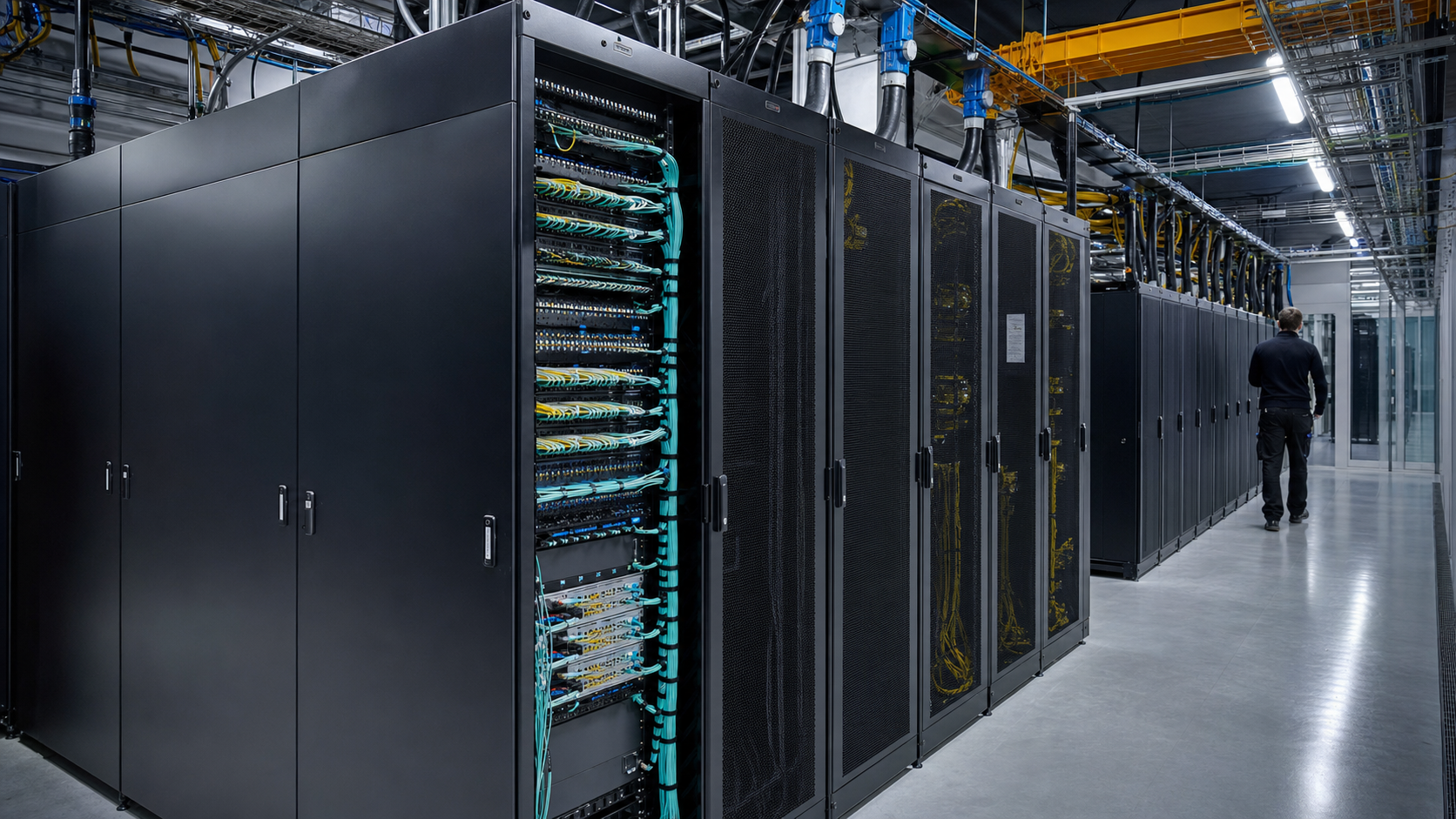
The two most important named facilities in Blix's current public story are Blix BDC Oslo and Blix NR5 Oslo. They are not identical. BDC is presented as the company's own Oslo facility opened in 2021, with more than 1,000 square metres of footprint, 1.5 MW capacity, PUE 1.3, AC3 availability class, hydro power, reused waste heat, solar panels for network equipment, ISO27001:2023 and on-site security. The page lists 32 wider racks and 168 standard-width racks, currently installed 400V 1600 kVA, backup generator, UPS, A and B 11 kW three-phase feeds to each rack, and available 400V AC, 350V DC and 48V DC power systems.
NR5 is newer and higher-density. Blix presents NR5 Oslo as an up-to-3 MW facility opened in 2025, also with more than 1,000 square metres of footprint, PUE 1.3, AC3 availability class, hydro power and ISO27001:2023. The NR5 page lists more than 144 racks up to 80 cm wide and 120 cm deep, with 42U, 48U or 52U height choices. It lists 400V 2000 kVA currently installed, infrastructure for future 3 MW capacity, two backup generators, three UPS systems and A and B 22 kW three-phase feed to each rack.
It also describes redundant meet-me rooms, at least 24 fibres from racks to meet-me rooms, a campus cross-connect from NR5 to BDC, and dark-fibre providers on-net including Blix Fiber, Eidsiva Digital, GlobalConnect, Telia and Telenor.
The facility details are central to the investment reading. BDC looks like the proof of Blix's owned data-centre capability. NR5 looks like the capacity step that lets it support denser racks and larger customers without abandoning Oslo. Together they give Blix a stronger answer to a buyer who asks whether the company is only reselling space in other people's data centres. The answer is that Blix still uses a network of locations, but it also presents owned or branded Oslo facilities with specific power, cooling, security and meet-me-room features.
The risk is concentration. A customer buying from Blix is often buying the convenience of an Oslo-centred operator. The company's own point-of-presence list is broad, but its visible branded colocation weight is still concentrated around Oslo. The same metro contains many alternatives. Baxtel lists nearby facilities around Blix BDC including Orange, Bulk OS-IX, Basefarm, Skygard, STACK, Green Mountain, TeliaSonera and others. That competitive density is a double-edged fact. It improves the local ecosystem for buyers because carriers, fibre providers and service providers cluster in the area.
It also means Blix cannot rely on geography alone. Its differentiation has to be the way the network, hands-on support and neutral access are packaged.
Third-party directories reinforce the point while requiring caution. Data Center Platform lists Blix with headquarters in Oslo, five data-centre locations and activity in six countries, naming Oslo sites including Hambros Plass, Hans Moller Gasmanns vei, Jerikoveien, Sandakerveien and Selma Ellefsens vei. Baxtel lists Blix Solutions AS with four facilities and one market, including BDC, CJH, NR5 and Gullhaugveien.
Inflect's Blix BDC page describes the Jerikoveien data centre as operated by Blix, lists available service categories including internet access, colocation, exchanges and private networking, and describes the facility with 2.0 MW total capacity, cooling, security and multi-carrier connectivity. These directories should not override Blix's own facility pages, but they help confirm that the market sees Blix as a colocation and connectivity provider rather than a pure software consultancy.
Network breadth is the centre of gravity
The strongest public evidence for Blix's market position is the network. PeeringDB identifies Blix Solutions AS as AS50304, an NSP with IRR as-set AS-BLIX, a looking glass at lg.blix.com, 200-300 Gbps traffic levels, balanced traffic ratios and Europe geographic scope. As of the current PeeringDB data inspected for this article, the AS50304 record lists 17 operational public exchange entries and 33 interconnection facilities.
The public exchange list includes 100G entries at NIX1, FIXO, LINX LON1, SONIX Stockholm, TIX Tromso and ERA-IX Amsterdam, plus 10G entries at AMS-IX, FICIX Helsinki, several Netnod Stockholm fabrics, SIX Stavanger, SOLIX, STHIX Stockholm and STHIX Copenhagen, and a 1G entry at DE-CIX New York.
RIPEstat independently shows AS50304 as announced on July 10, 2026, with the holder shown as BLIX Blix Solutions AS. Its announced-prefixes data for the July 10 query shows 114 announced prefixes, including 90 IPv4 and 24 IPv6 entries after excluding routes with very low visibility. One public BGP database gives a live market-facing view in the same direction, showing Blix Solutions AS as a long-running BGP network with hundreds of peers and only a small number of upstream carriers. Hurricane Electric's BGP data similarly shows AS50304 with internet exchange presence and a large originated-prefix count.
None of those sources proves service quality, uptime or customer retention. They do prove that the network is visible, active and meaningfully interconnected.
Blix's own network page describes why the company cares about that breadth. It says customers are terminated on a unique VLAN and IP domain, that the network avoids shared-capacity solutions, that AS50304 has multiple redundant internet connections, and that Blix peers extensively. It also says Blix was the first network in Norway to get a 100 Gbps port to the national internet exchange NIX, citing the 2018 Digi.no article. Digi reported at the time that Blix connected to NIX with 100 Gbit/s capacity, a tenfold increase, and that Eirik H. Blix tied the move to growth in bandwidth-heavy customers, including streaming and CDN customers.
The article also reported Blix's then-service locations as Oslo, London, Stockholm, Copenhagen and New York, and mentioned routes via Sweden, Skagerrak and the North Sea to London.
That 2018 milestone is historical, but it still matters because the current PeeringDB record shows NIX1 at 100G and because Blix continues to present exchange breadth as part of the customer offer. A neutral rack without useful interconnection is a server room. A network with no customer-accessible facility is a transit account. Blix's commercial claim is the combination: customers can place equipment in its data centres and choose their upstream carrier, while Blix can also supply its own transit, point-to-point circuits and local or cross-border network paths.
Carrier neutrality and the customer's choice set
Carrier neutrality is a phrase that can be overused, so it has to be read in operational terms. Blix says customers can put equipment in its data centres and choose their own upstream. It says it provides services to traditional data-centre customers as well as telecom and other internet service providers. In BDC, it lists redundant meet-me network rooms, inexpensive cross-connects, at least 24 fibres from racks to each meet-me room, dark-fibre providers on-net including Telia, Telenor, Hafslund Fiber, GlobalConnect and Viken Fiber, and local peering fabrics including FIXO and NIX1.
In NR5, it lists meet-me rooms, fibre to those rooms, the campus cross-connect to BDC and dark-fibre providers including Blix Fiber, Eidsiva Digital, GlobalConnect, Telia and Telenor.
For a buyer, those details change the negotiation. If the facility were not neutral, the customer would be locked into one provider's network or a narrow set of resold options. If the facility is neutral in practice, the customer can combine Blix transit with another carrier, bring a dedicated fibre service, use a dark fibre provider, peer locally, or use Blix mainly for hands and space. That optionality reduces fear of lock-in at the network layer while increasing the attractiveness of the facility layer.
It is a subtle but important commercial mechanism: neutrality can make the buyer more willing to commit physical equipment, because the buyer does not have to make every network decision at the same time.
The switching cost then appears in a different place. A customer may not be captive to Blix transit, but it may still depend on Blix hands, power, access, cabling records and local familiarity. That is healthier than pure network lock-in because it lets Blix compete on execution. It also means the company has to keep service quality high. If the remote-hands experience is slow, if spare-part coordination is poor, if cross-connect delivery is frustrating, or if billing around power and bandwidth feels unclear, the customer's physical commitment becomes a reason to resent the provider rather than stay.
This is why the company's service language around remote hands and vendor access is not a side note. Blix says its engineers can assist with installation, fault and change management, on-site repairs and replacements. It says it works directly with local vendors for cables, optics, server parts and rack peripherals. In a large facility, those tasks can be handled by a broad operations team. In a smaller technical provider, they become part of the brand. Customers that cannot justify their own Oslo field staff may value an operator whose support team understands BGP, optics, racks and emergency maintenance together.
Cross-border reach from a local installation
Blix's route map gives the article's headline its force. The customer installs hardware in Norway, but the commercial service is not only Norwegian. Blix's point-of-presence list includes Oslo sites, other Norwegian locations such as Kristiansand, Stavanger and Trondheim, Nordic locations in Stockholm, Helsinki and Copenhagen, and international locations in Amsterdam, London, New York, Dallas and Singapore. The PeeringDB interconnection-facility list for AS50304 similarly includes facilities across Norway, Sweden, Denmark, Finland, the Netherlands, the United Kingdom, the United States and Singapore.
The company's own network page publishes a round-trip-delay matrix from Oslo to other network locations. It lists Oslo to Kristiansand at 4 ms, Stavanger at 8 ms, Stockholm and Copenhagen at 7 ms, Helsinki at 12 ms, London at 16 ms, Amsterdam at 22 ms and New York City at 84 ms. The BDC and NR5 pages present even lower selected route claims, including Oslo to London as low as 15 ms on a North Sea route, Oslo to Copenhagen around 7 ms, Oslo to Stockholm around 7 ms and Oslo to Amsterdam as low as 15 ms on the COBRA route.
These are company-published latency claims, not independent measurements, so they should be used as directional evidence of intended network design rather than guaranteed performance.
The Nordic Edge page explains the strategy in more concrete terms. Blix argues that edge placement should be judged not only by geography but by connectivity, because many Norwegian networks rely on central edge routers in Oslo. It presents Stavanger as an edge location connected to local peering exchange SIX, with Microsoft Azure nearby at Green Mountain Rennesoy, local transit customers, private peering circuits and a low-latency wavelength connection from Stavanger to London. It presents Kristiansand as connected to FIXO Kristiansand, fibre wavelengths to Oslo and Stavanger, and a direct route over Skagerrak to Copenhagen.
It also names planned edge locations for 2026 in Trondheim, Narvik, Tromso, Oulu and Tampere.
The useful conclusion is not that Blix owns every route or controls every fibre path. It is that the company sells a network plan in which a Norwegian or Nordic installation can reach users, peers and cloud-adjacent infrastructure through several routes. For customers that need low-latency gaming servers, CDN nodes, content distribution, business connectivity or provider transit, this can matter more than raw square metres. A rack in the wrong neutral facility may be cheap and still create routing friction. A rack in the right network can reduce the number of separate contracts and engineering handoffs.
The economics of power, cooling and remote hands
The data-centre economics are not only about connectivity. Power density, cooling design, resilience and labour decide whether growth is profitable. Blix's pages make high-density rack power a visible part of the offer. BDC lists A and B 11 kW feeds to each rack and up to 22 kW redundant per rack in the broader colocation table. NR5 goes further, listing A and B 22 kW feeds to each rack. The colocation page also lists available sites with maximum IT load per rack, including BDC and NR5 at 22 kW and higher power-feed options at NR5.
High-density power is commercially attractive because many customers want more compute per rack, especially as AI, storage and content workloads increase server draw. It is also operationally demanding. Higher rack density requires cooling discipline, UPS sizing, generator capacity, power distribution, hot-aisle containment or equivalent airflow design, and a commercial approach that charges enough for the actual energy and infrastructure cost. Blix says BDC has hot-aisle containment, hydroelectric power, waste-heat reuse, solar-powered network equipment, 350V DC options and a PUE of 1.3. NR5 is also presented with PUE 1.3 and hydro power.
Those claims support the sustainability and efficiency narrative, but they do not by themselves prove future margins.
Supplier and maintenance dependence is visible in the public record. Fire Eater describes Blix as having bought a property in 2019 and built its own data-centre facility with solar-powered networking equipment and waste-heat recycling, and says Blix chose an Inergen fire-suppression system to protect infrastructure and customer data. NTC Services says it designed and built infrastructure for Blix BDC Oslo and Blix NR5 Oslo in close technical cooperation with Blix.
Those references support the view that Blix has built facility capability, but they also show dependence on specialist suppliers for critical plant, fire suppression and data-room construction.
Remote hands is the labour side of the same account. A customer who buys only power and space may compare providers on price. A customer who depends on remote hands compares providers on response, competence and trust. Blix's public promises around installation, fault management, change management and equipment replacement create a high expectation. Because the company is small, the quality of engineering labour can be a strategic advantage or a bottleneck. A small staff can be fast and deeply technical when the workload is manageable.
It can also become stretched if multiple facilities, edge locations and customer projects demand simultaneous attention.
That labour risk should not be overstated, because small infrastructure companies often operate through partners, contractors and carefully chosen suppliers. But it should be watched. The more Blix sells high-density racks, cross-border circuits, remote hands and custom network work, the more its customer experience depends on operational choreography. A missed handoff, delayed part, failed generator test, cooling incident or confused access request can damage confidence faster than a price increase.
Customer dependence and where Blix creates friction
Blix's customer surface appears to be weighted toward technical organisations rather than consumers. Its own network page says it serves traditional data-centre customers as well as telecom and other internet service providers. The IP transit page says it has CDN traffic from bigger players connected to the network and multiple eyeball fibre networks or FTTH providers in Norway as IP transit customers. The 2018 Digi article reported Blix serving bandwidth-demanding streaming and CDN customers, with Eirik H. Blix unable to name them because of confidentiality agreements.
NTC's 2025 partner article says Blix offers infrastructure for cloud companies and quotes Eirik Blix saying that if a customer has an application, Blix has the rest needed to get it online.
Those customer descriptions are useful, but they are not a customer list. The public record does not allow a firm conclusion about revenue concentration, churn, contract length or vertical exposure. It does allow a reasonable view of likely paid units: rack space, server housing, power, network ports, IP transit, direct internet access, Ethernet, wavelengths, cross-connects and hands-on operational work. That is enough to understand customer dependence without pretending to know the private book.
The strongest customer friction comes when several paid units are combined. A customer that only buys a wavelength can move when another provider offers a better route. A customer that only buys a shared rack can migrate if it has a clear maintenance window and another provider has capacity. A customer that buys a Blix rack, Blix transit, remote hands, local peering access, a custom cross-connect and RIPE/LIR support faces a more complex exit. It must replace the technical design, not only the invoice.
The weakest customer friction is where alternatives are clean. Hyperscale cloud can replace physical hardware for many application teams, especially when the buyer values managed services, elasticity and global platform services more than hardware control. Microsoft Azure has a Norway East region opened in 2019, and AWS's Europe Stockholm region serves Nordic customers from nearby Sweden. Google has announced a Norway cloud region and is developing a major data-centre project in Skien. These platforms do not replace every colocation need. They do, however, reduce the pool of customers that want to own servers for ordinary workloads.
The more durable Blix customers are likely to be those with a reason not to move fully into public cloud: network operators, content networks, gaming infrastructure, SaaS companies with hardware or latency preferences, security-sensitive customers that still want physical control, customers with established server assets, and firms whose migration economics favour colocation. That is not a mass market. It is a focused infrastructure market, and Blix's public offer is built for it.
Competitive alternatives
The substitute set is broad because Blix sells a bundle. Larger Nordic colocation groups compete on scale, brand, expansion capacity and enterprise procurement comfort. Green Mountain, Bulk Infrastructure, STACK, Orange Business, Basefarm, Skygard, Vaultica and other Oslo-area names appear in data-centre directories and industry lists. Baxtel's nearby-facility list around Blix BDC shows how crowded the metro is, including facilities within a few miles and larger campus developments outside central Oslo.
For a buyer that mostly wants large capacity, procurement comfort and a known enterprise brand, those substitutes can be more natural than a smaller network-led provider.
Oslo carrier hotels and exchange-oriented sites are another substitute. A customer that needs maximum carrier density may prefer a facility where the desired networks are already present, even if Blix can provide transit or transport. Blix responds to that by listing many Oslo PoPs and offering point-to-point circuits, wavelengths and cross-connect logic. But the buyer's decision will depend on the actual carrier, cloud on-ramp, exchange and dark-fibre requirement, not on a generic claim of neutrality.
Hyperscale cloud is the most obvious architectural substitute. A company deciding between buying servers for colocation and using Azure, AWS or Google Cloud is deciding between control and service abstraction. Cloud removes much of the physical operational burden and can accelerate product development. Colocation keeps hardware choice, network control and sometimes lower steady-state cost for predictable workloads. Blix is better positioned when the customer values control, network engineering and predictable infrastructure. It is weaker when the customer values managed platform services and variable scale above all else.
Customer-owned server rooms remain a substitute, especially for smaller Norwegian companies with existing offices, staff and equipment. They are less persuasive as power density, resilience, access security and cooling requirements rise. The Blix pitch to that customer is not that colocation is glamorous. It is that the customer can keep hardware ownership while moving facility risk to a specialist. The economic argument improves when the office room faces rising energy draw, weak cooling, limited redundancy, poor physical security or difficult after-hours access.
Transit-only providers compete on price, route quality and port availability. For customers that already have good facility space, Blix's rack and hands offer may be irrelevant. Its advantage is strongest where network and facility are bought together. A pure transit quote can beat Blix on a narrow line item, but it cannot by itself install a server, replace a failed optic, host a rack or provide a meet-me-room path. Conversely, if the customer only needs bandwidth, Blix cannot force the full bundle.
Market signals and recent strategic hints
Blix appears in more places than its direct website. The Norwegian Data Center Industry member page says Blix has provided colocation services in Norway for over 15 years and provides reliable, sustainable network services for demanding customers. It describes Blix BDC Oslo as a data centre with over 1 MW capacity, tier-3-compliant design and N+1 or 2N redundancy on infrastructure components. Third-party data-centre directories list Blix locations and nearby substitutes.
LowEndTalk discussions and hosting offers show Blix's AS50304 appearing as a named transit provider in Norway-related hosting contexts, although those discussions are dated and should be treated only as market colour.
The more important recent signal is the Magnora annual report. Magnora says that in 2025 it acquired 75 percent of Storespeed AS, while Blix Solutions acquired 5 percent, and that Storespeed operates an up-to-1 MW colocation facility in Halden with expansion potential up to 5 MW. Magnora also says a strategic partnership with Blix Solutions enhances operational and connectivity capabilities. Later in the report, the acquisition note says Storespeed was acquired in partnership with Blix Group, which retained a 5 percent non-controlling interest with an option to increase by another 5 percent. This does not make Blix a hyperscale developer.
It does show that its operational and connectivity know-how is being used in a broader Norwegian data-centre expansion context.
The signal should be read carefully. Magnora is a separate company with its own strategy, and Storespeed is not Blix BDC or NR5. But the partnership matters because it points to the economic value of Blix's expertise outside its own branded racks. If a renewable-energy developer or data-centre investor needs operating know-how, customer insight, network access and connectivity capability, Blix can be useful as a specialist partner. That optionality may not yet be a large revenue stream, but it supports the broader thesis that the company is selling infrastructure competence, not only floor space.
Risks that could weaken the account
The first risk is over-reading network size. Traffic levels, exchange ports and prefix counts are strong network evidence, but they do not prove uptime, customer satisfaction, pricing power or profitability. PeeringDB is self-maintained by network operators, although it is widely used and current for AS50304. RIPEstat confirms active announcements but not service quality. Public BGP databases provide useful routing views but can vary by vantage point and update timing. The right conclusion is that Blix has an active and broad network, not that every customer experience is proven.
The second risk is facility scale. BDC and NR5 are meaningful facilities for Blix, but they are small beside Nordic campuses built for large enterprise, AI or hyperscale demand. A customer needing tens of megawatts will not treat Blix's Oslo rack account as a direct substitute for a large campus. A customer needing a single cabinet or several high-density racks may find Blix more relevant. The company therefore has to remain clear about its segment: technical colocation, network-rich deployments, edge and provider accounts, not every data-centre demand category.
The third risk is supplier and power-cost exposure. High-density colocation depends on energy pricing, generator and UPS maintenance, cooling efficiency, spares, fire protection, security and facility upgrades. Blix's sustainability narrative is credible at the level of stated hydro power, waste-heat reuse, Eco-Lighthouse certification, Climate Neutral Data Center Pact participation and supplier references. But sustainability claims are not a substitute for power procurement economics. If energy prices, grid constraints or equipment costs move against smaller operators, the margin on dense racks can tighten quickly.
The fourth risk is competition from cloud and larger operators. Hyperscale cloud absorbs many workloads that once needed dedicated servers or colocation. Larger colocation providers can offer enterprise procurement familiarity, multiple halls and larger expansion paths. Carrier hotels can offer dense interconnection. Transit-only providers can undercut individual network lines. Blix's answer is focus and integration. The risk is that buyers unbundle the offer and choose a larger or cheaper supplier for each piece.
The fifth risk is team depth. A nine-employee public headcount does not describe contractors, partners or all operational support, but it does remind readers that Blix is a specialist operator, not a large staffing platform. That can be a strength for technical customers that want senior engineers close to the problem. It can be a constraint when multiple sites, projects and incidents compete for attention. Customers buying remote hands and operational trust will judge the company on responsiveness.
What would change the judgement
Several facts would materially improve the view. Public disclosure of current rack utilisation at BDC and NR5 would show whether the capacity investment is filling. More detail on contract duration, customer mix and concentration would clarify revenue durability. Independent uptime or incident reporting would make reliability claims stronger. A public list of on-net carriers, cloud connectivity options and cross-connect delivery standards would sharpen the neutrality argument.
A clear update on the 2026 edge locations in Trondheim, Narvik, Tromso, Oulu and Tampere would show whether the Nordic Edge plan is becoming a delivered footprint or remaining a roadmap.
Several facts would weaken the view. Evidence that NR5 capacity is slow to fill, that high-density power is constrained, that customer support is deteriorating, that key fibre or carrier options are unavailable in practice, or that the company is forced to discount heavily against larger competitors would reduce the value of the bundle. So would a decline in visible exchange presence, loss of important peering ports, or shrinking announced-route visibility. None of those negative facts is established by the current public record, but they are the right watchpoints.
The most important uncertainty is the private customer book. Public evidence supports the service account but does not reveal how much revenue comes from colocation versus transit, how many customers take multiple services, or how renewal discussions behave. The article's thesis therefore should be read as an operating thesis: Blix's defensible position is the combination of neutral racks, remote hands and network reach. It is not a claim that the company has already converted that position into large-scale or low-risk earnings.
Final judgement
Blix Solutions AS is a small Norwegian infrastructure provider with an outsized network footprint for its corporate scale. The public record supports a cloud-service classification because the company sells current hosted-infrastructure operations: colocation, server housing, remote hands, network ports, IP transit, Ethernet, wavelengths and direct internet access. The network evidence is strong. AS50304 is active in RIPEstat, widely present in PeeringDB, visible in public BGP datasets and tied to high-capacity exchange ports across Norway, the Nordics and major international hubs.
The economic unit is not "an ASN" and not "a data centre" in isolation. It is a carrier-neutral colocation, transit and interconnection account. A customer installs equipment in a Norwegian rack, but the commercial value comes from the way Blix can connect that equipment beyond Norway, support it physically, and leave the customer with upstream choice. That bundle creates more switching cost than commodity transit and more technical specificity than generic colocation.
Blix's limits are just as clear. It is not a hyperscale cloud. It is not a giant Nordic campus platform. It does not publish enough customer or utilisation data to prove revenue durability. Its best market is likely the technical buyer that needs physical control, network reach and hands-on support in the same relationship. For that buyer, Blix's neutral racks are not simply a place to put servers. They are an operating position in Norway with routes that reach outward.