
Summary
- At about 11:01 p.m. on July 10, 2006, roughly 26 tons of concrete ceiling panels and suspension hardware fell in the D Street portal section of Boston's eastbound Interstate 90 connector tunnel. The panels crushed the passenger side of a car traveling toward Logan Airport, killing Milena Del Valle and injuring her husband, Angel Del Valle. This was a failure of a permanent overhead system in an operating public highway, not a construction-zone accident.
- The National Transportation Safety Board found that Power-Fast Fast Set epoxy had poor creep resistance. The adhesive could carry a brief proof-test load yet deform and fracture under the ceiling's smaller, continuous dead load. Design and submittal review did not isolate the exact formulation or treat long-term creep as a critical failure mode. Overhead installation variables reduced some anchors' capacity, but the NTSB did not identify installation quality as the probable cause.
- Earlier anchor displacement was visible in 1999 and again in 2001. Failed anchors were replaced and proof-tested, but the response did not establish the underlying material mechanism or create continuing monitoring. After the tunnel entered service, the public owner did not implement a timely inspection program above the suspended ceiling. A passed test, a closed deficiency report and a beneficial-occupancy certificate therefore became endpoints instead of inputs to lifecycle surveillance.
- Responsibility was distributed among the Massachusetts Turnpike Authority, MassHighway, the Bechtel/Parsons Brinckerhoff management consultant, Gannett Fleming as section designer, Modern Continental as construction contractor, Conam as proof tester, the distributor chain and Powers Fasteners. The accountability question is not whether each participant had some task; it is whether anyone controlled the complete safety case from product identity through long-term inspection.
- Remedies followed different legal channels. Powers entered a state deferred prosecution agreement and a civil settlement, while other project participants entered separate settlements or resolutions with different scopes. These outcomes are not interchangeable with an NTSB finding, a conviction after trial, victim compensation or a universal valuation of the Big Dig's losses. Engineering reform later included improved adhesive-anchor qualification and installation requirements plus federal National Tunnel Inspection Standards.
A public highway failed years after its installation was accepted
The car carrying Angel and Milena Del Valle was approaching the tunnel's east end when a ceiling module detached. Concrete panels, steel framing, hanger rods and associated hardware struck the vehicle and roadway. Angel escaped with minor injuries; Milena, seated in front on the right, was killed. The NTSB Highway Accident Report HAR-07/02 records the physical sequence, the participating organizations, testing and the Board's probable-cause determination. It also makes the scale concrete: about 26 tons fell, and the collapse occurred about three and a half years after the connector opened to traffic.
That interval matters. The anchors were not exposed to an extraordinary one-time load. Their central duty was to hold the ceiling's weight continuously. A component can therefore look sound at turnover, pass a short load test and still be accumulating time-dependent damage. Public infrastructure assurance has to distinguish installation acceptance from service-life performance.
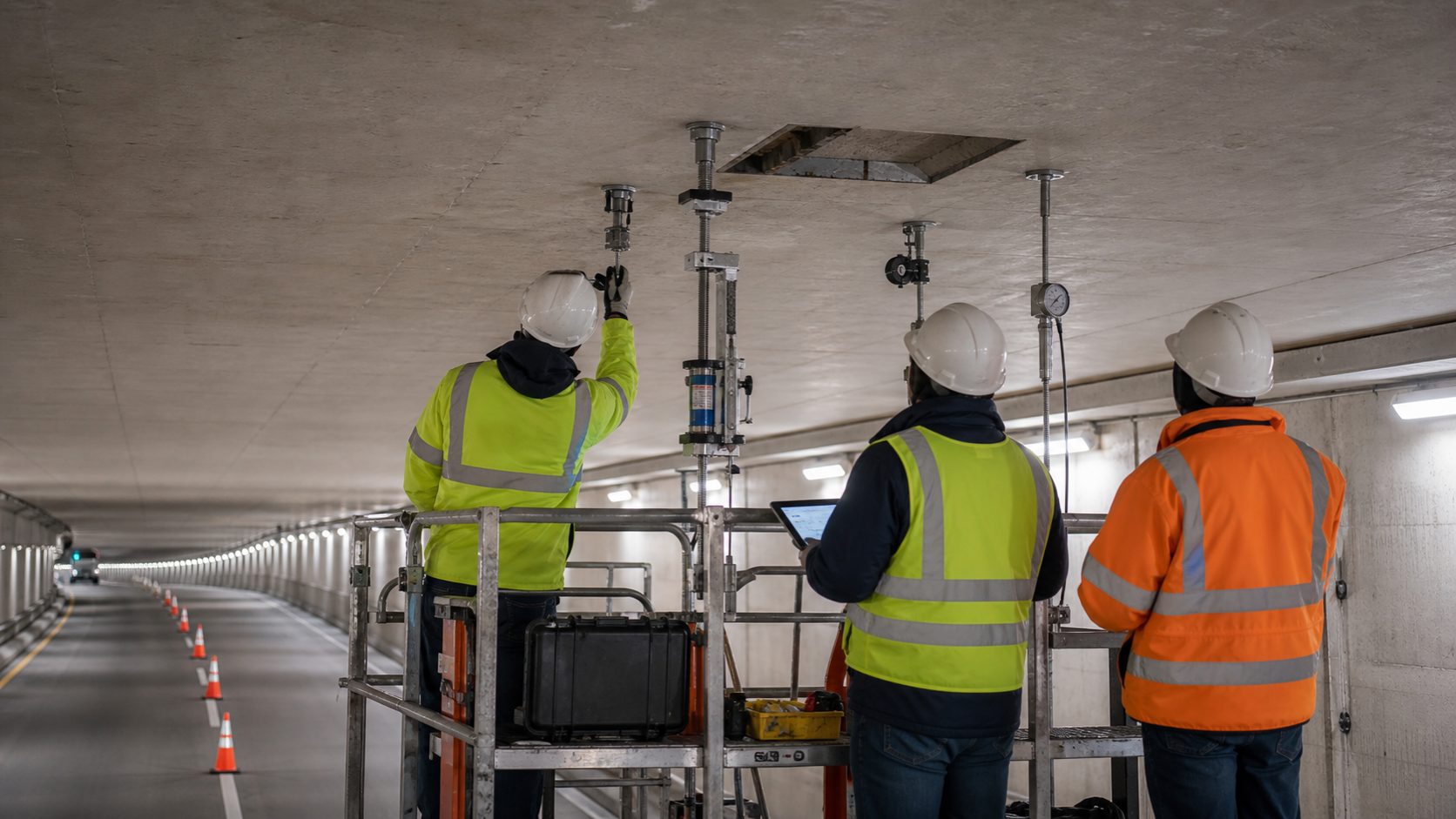
The D Street portal ceiling was a suspended system. Precast concrete panels rested on steel support framing. Adjustable hanger rods connected that framing to brackets at the tunnel roof, and stainless steel threaded rods embedded in adhesive attached those brackets to the concrete. Gravity put the adhesive anchors in sustained tension. Failure of enough anchors at a support transferred load, degraded redundancy and released a ceiling module above live traffic.
The site also embodied an earlier design decision. Unlike other connector sections with embedded channels, this already-built portal lacked suitable cast-in-place attachment points. The finish designer specified post-installed adhesive anchors. That made the qualification and installation of the adhesive a structural design issue, not a procurement detail. Once the ceiling was occupied below, every uncertainty about formulation, hole preparation, voids, embedment and long-term behavior became an owner risk.
The immediate operational response was necessarily conservative. Connector sections and ramps were closed while investigators and engineers identified the failure mechanism and inspected overhead systems. Corrective work allowed openings to begin in November 2006; the last closed section, the eastbound high-occupancy-vehicle tunnel, reopened in May 2007. At the failed portal, authorities removed the ceiling and did not replace it because ventilation analysis found it unnecessary there. Reopening was thus section-specific evidence, not a declaration that every original anchor was acceptable.
Creep made a strong-looking anchor progressively unsafe
Epoxy is a polymer. Under a sudden load it can respond like a hard solid; under a constant load its molecular structure can gradually rearrange, producing deformation called creep. As deformation grows, damage can become irreversible and end in fracture or pullout. Temperature, moisture, chemicals, load level and time can change the rate. A valid safety case for a permanent overhead anchor must therefore demonstrate both short-term strength and long-term behavior in the intended environment.
Postaccident testing exposed the difference. Fast Set and Standard Set versions of the product behaved similarly in short-term tests, but not under constant tension. FHWA researchers installed anchors overhead with careful practice and loaded them at 1,000 to 4,000 pounds. Fast Set anchors continued to displace even at the lowest level; those loaded at 4,000 pounds separated before an 82-day test ended. The calculated maximum service load was about 2,600 pounds. More safety factor applied to a short-term capacity could not cure a material that kept deforming under time.
That is why the event should not be described simply as bolts that were too weak. Steel rods did not need to break for the system to fail. The adhesive bond and adhesive mass changed over time until rods moved out of their holes. The correct control variable was displacement under sustained load across the expected life, not only peak extraction force on a new installation.
The product identity was also material. Power-Fast was sold in Standard Set and Fast Set formulations. The Fast Set material installed in the portal was distributed under the NRC-1000 Gold label. Analytical chemistry, invoices and project records supported the NTSB's conclusion that the failed and sampled anchors contained the Fast Set formulation. A generic submittal naming a product family without pinning down formulation, packaging, batch and performance limitations was not an adequate structural record.
Powers had earlier creep-test information showing the Fast Set formulation failed, and the code-evaluation material available to the project restricted it to short-term loading in language that could be missed among other provisions. Powers' marketing and design information did not clearly communicate the critical difference. Design review, however, also failed to demand a formulation-specific long-term qualification. Durable procurement requires a chain from design load to approved product, exact delivered material, installation record and in-service asset identifier.
Short proof tests answered the wrong lifetime question
Proof testing was extensive enough to create confidence but too brief to answer the decisive question. Conam tested installed anchors to a prescribed tension above expected service load. If an anchor did not pull out or permanently deform during that short application, it passed. Such a test can reveal badly formed bonds, gross installation defects or insufficient immediate capacity. It cannot demonstrate that a polymer will remain stable for years under constant load.
This distinction is the heart of the control failure. The portal contained anchors that had passed stronger proof loads and later migrated under smaller ceiling loads. The test was not fraudulent merely because it did not predict creep; it was incomplete for the hazard being controlled. Accountability lies in matching verification duration and mechanism to the claim being made.
A proof-test plan also needs a response rule. In 1999, several anchors supporting mock-up ceiling modules visibly displaced after installation. A deficiency report was issued, replacement and heavier tests followed, and the event was attributed largely to an installation learning curve without a demonstrated root cause. Additional movement was observed in 2001. Repeating a test that the anchors could pass did not challenge the assumption behind the test.
The NTSB's recommendation letter H-07-15 through H-07-19 translated that lesson into separate controls: standards for adhesive anchors in sustained-tension overhead highway applications should consider site-specific ultimate strength and creep over the structure's expected life; high-consequence use should be prohibited until adequate protocols exist; federal authority should support mandatory tunnel inspection; and tunnel-finish design, construction and inspection guidance should be developed. A recommendation expresses the Board's safety judgment. It does not itself create a statutory duty or prove later implementation.
For an owner, the practical test hierarchy is clear. Material qualification establishes whether a formulation is eligible. Installation-process qualification establishes whether the crew, equipment and conditions can produce the intended bond. Production inspection records what occurred at each anchor. Proof tests sample immediate installed capacity. Sustained-load tests address time. In-service inspections look for movement, cracking, corrosion, leakage and changed conditions. No single layer substitutes for the others.
Overhead installation introduced variability that required direct control
Installing adhesive above a worker's head is harder than installing it downward into a floor. Dust and debris must be removed from the drilled hole; resin and hardener must be correctly proportioned and mixed; adhesive must fill the annulus without damaging voids; the rod must reach the specified embedment; and the material must remain in place while curing. A seal plug that keeps liquid adhesive from falling can also prevent bonding over part of the hole. Temperature and cartridge condition affect working time and cure.
The FHWA's postaccident parametric work showed that off-ratio mixing, poorly cleaned holes, voids, partially separated material and reduced effective embedment could lower short-term capacity. Examination of portal anchors found installation variability. Those facts support controls on installers and inspection. They do not erase the Board's more specific conclusion that poor Fast Set creep resistance precipitated the collapse even when the material was installed using best practices.
That boundary is important because “bad workmanship” can become an easy explanation that leaves product qualification and design governance untouched. Conversely, identifying a defective formulation does not make installation irrelevant. A safe design has to tolerate credible field variability, and inspection must confirm that assumptions about mixing, cleaning, embedment and cure are true.
The first FHWA response strongly discouraged Fast Set and, pending better certification, other adhesive systems in permanent overhead or sustained-tension applications. For existing Fast Set installations, it recommended retrofit or replacement with appropriate mechanical anchors plus rigorous interim inspection. For other or unknown adhesives, it called for risk-informed inspection and potentially site-specific testing. That position appears in the agency's later-cancelled Technical Advisory T 5140.30. “Cancelled” here means superseded by subsequent guidance, not that the historical findings disappeared.
A field record should therefore identify who installed each safety-critical anchor, certification status, product and batch, storage history, hole diameter and depth, drilling method, cleaning sequence, temperature, dispensing verification, gel and cure times, rod placement, inspector presence, test result and disposition of anomalies. Without that lineage, an owner facing a later alert cannot reliably locate affected installations or choose between inspection, testing and replacement.
Delegated design divided tasks without creating one safety-case owner
The Big Dig used many contracts and a layered design-bid-build structure. The Massachusetts Turnpike Authority became owner and operator of the Metropolitan Highway System. MassHighway held contracts and received federal funding. Bechtel/Parsons Brinckerhoff acted as management consultant and owner's representative for day-to-day design and construction administration. Gannett Fleming adapted the ceiling design and primarily reviewed anchor submittals. Modern Continental selected and installed the anchoring system, using a distributor chain that led to Powers and Sika. Conam performed proof tests.
FHWA participated in review and federal oversight.
Each role was real, but a list of roles is not assurance. Someone must reconcile ceiling loads, failure consequences, specification, product evaluation, submittal, field delivery, installation, test limitations, deficiency history, handover and inspection. If each participant validates only its own document, the safety case can fail at interfaces while each process contains signatures.
Submittal review illustrates the point. Project documents referred to Power-Fast without initially resolving Fast Set versus Standard Set. Evaluation material included a short-term-use restriction for Fast Set, yet reviewers did not convert it into a rejection, a formulation-specific clarification or a sustained-load test requirement. Construction began before the submittal process was fully closed. The critical semantic difference between “fast cure” and “qualified for permanent dead load” passed through procurement and technical review without an accountable stop.
Federal oversight did not mean FHWA designed every connection or assumed the owner's operational duty. State ownership did not mean the MTA personally performed every design review. The correct accountability description preserves these boundaries while asking whether public agencies set adequate acceptance criteria, challenged delegated work and retained the records needed to operate safely.
At scale, a delegated project needs a requirements matrix connecting every high-consequence element to its designer, reviewer, installer, inspector, acceptance evidence and lifecycle owner. Changes in entity names, contracts or ownership cannot break that chain. Handover should remain incomplete until unresolved deficiencies, material limitations, inspection access and monitoring requirements are explicitly accepted by the operating organization.
Earlier movement was a warning, not proof of an isolated defect
The preopening anchor displacements were an opportunity to discover creep. Some anchors moved within months despite passing proof tests. Powers representatives visited the site, yet no demonstrated cause emerged. B/PB and Modern replaced and retested anchors, and the deficiency report closed. When movement appeared again, the response still did not establish a formal long-term monitoring program.
An unresolved anomaly should remain open at the system level even if the affected components are repaired. Replacement restores a local condition; root-cause closure explains why it happened, identifies the population exposed to the same mechanism, and demonstrates that corrective action controls recurrence. Here the potential population included many overhead anchors installed with the same formulation, method and review assumptions.
The DOJ settlement statement of facts described project submittals, displaced anchors, deficiency handling, later observations, certifications and turnover. It stated that B/PB did not establish formal monitoring or alert the MTA to the pullout problem when the tunnel was turned over. That document was part of a negotiated federal-state resolution and must be read within its parties and agreed scope; it is not a jury verdict against every named participant.
A reliable anomaly system would have preserved photographs and measured displacement, mapped every affected anchor, quarantined the material population, required independent material review, reopened assumptions after repeat movement, and assigned observation intervals until the mechanism was proven. Trends should be reviewed across contracts because the same adhesive, distributor, installer or detail can appear in multiple structures.
Certification for beneficial occupancy should also disclose residual uncertainty. A declaration that a tunnel can open is a consequential operational decision, not proof that every construction issue is permanently resolved. If a component's failure could kill a road user, an unexplained movement history belongs in the owner's inspection plan, emergency thresholds and asset register.
The public owner inherited an incomplete inspection obligation
The MTA assumed operations, inspections and maintenance in January 2003. Yet access above a suspended ceiling was difficult, responsibilities were still evolving, and a timely comprehensive program did not inspect the D Street portal overhead attachments at regular intervals before July 2006. The NTSB concluded that such inspection likely would have revealed continuing creep soon enough for corrective action.
This was not merely a missed walk-through. An inspection regime has to define the element population, access method, frequency, condition codes, measurement tolerance, escalation threshold and repair verification. A ceiling panel can conceal the connection whose movement matters. Inspecting visible roadway surfaces and life-safety equipment does not necessarily inspect anchor displacement above the finish.
The Massachusetts Inspector General's interim review of the collapse and institutional obligations found weak inspection scheduling and record evidence across MTA, MassHighway and oversight arrangements. It noted that no meaningful I-90 connector inspection schedule was shown and that comparable tunnel practice had included annual review of bolt-fastened ceilings. The interim report was an oversight analysis produced before the NTSB's final report; it should inform governance without replacing the Board's technical probable cause.
After the accident, the MTA issued a policy calling for annual inspection of appurtenances and hanger systems suspended over roadways and three-year inspection of other structural tunnel components. It expanded consulting contracts and engineering staff, developed forms and instrumented some hangers. Those measures addressed access, frequency and organizational capacity. Their durable value depends on complete inventories, consistent condition data, closure of critical findings and recurring independent compliance review.
Owner accountability remains even when consultants conduct inspections. The owner must define competence, prevent conflicts, provide safe access, preserve raw findings, rank risk, fund repairs and verify closeout. A consultant report that sits outside the asset system is not a control. Nor is an inspection interval sufficient if known movement, leakage, vibration, temperature or unusual events require an immediate special inspection.
Closure and reopening required a system-wide evidence map
The collapse forced officials to ask where adhesive anchors had been used, which formulation was present, what load orientation applied and whether a failure could reach traffic. That is an information problem as much as a testing problem. Drawings might specify an anchor family while purchase records identify a formulation; field changes might place adhesive where embedded channels were missing; and concealed installations might be accessible only through destructive or specialized inspection.
The governor's Executive Order 474 created an independent safety review team and advisory panel with broad access to facilities, plans, drawings and reports. It prioritized safety-critical tunnel elements and required reporting. The order established an emergency review structure; it did not itself certify a repair or decide civil liability.
For each closed segment, reopening evidence needed to answer a bounded question: were overhead elements inspected; were suspect anchors removed, replaced, unloaded or instrumented; were ceiling modules necessary; did replacement hardware have adequate capacity and durability; and could the operator detect future movement? Removing the failed portal ceiling was a risk elimination measure. Replacing suspect adhesive anchors with mechanical systems elsewhere changed the failure mechanism. Both required as-built records for future inspectors.
The review also had continuity consequences. Closing a connection to Logan Airport and redistributing traffic affects commuters, freight, airport access, emergency routes, transit interfaces and nearby businesses. Safety has priority, but a planned closure system should provide clear routing, consistent public information, staged reopening criteria and evidence for each decision. Economic pressure is not a reason to lower the threshold; it is a reason to maintain predesigned contingencies.
Reopening should never be read as a promise of zero risk. It is a dated decision that identified hazards are controlled to an acceptable level based on available evidence. Residual risks, inaccessible locations, temporary inspection frequencies and unfinished repairs should stay visible. When later standards change, the asset register should support reassessment rather than requiring a new forensic reconstruction of old procurement files.
Emergency authority had to convert uncertainty into protective action
Immediately after an overhead structural failure, officials cannot wait for a laboratory to complete a creep study before protecting road users. The first decision standard is consequence and plausible commonality: if other panels use a similar attachment and their condition is unknown, closure or physical exclusion is justified while engineers establish the population. This is not a finding that every panel will fall. It is a temporary control for a potentially fatal uncertainty.
Authority must be explicit before an incident. Traffic operators need power to close lanes and portals; engineers need access to drawings and concealed spaces; police, fire, airport and municipal agencies need a shared routing plan; and one incident structure must reconcile inspection, repair and reopening evidence. When ownership, construction management and operating responsibilities are divided, emergency command cannot be left to the contract map that contributed to uncertainty.
Public warning should state what is known, what is not, what is closed, how travelers should reroute and what evidence will support the next decision. Officials should avoid premature universal reassurance and unsupported speculation about individual blame. The same discipline protects both safety and legitimacy: a precise statement can be updated without appearing contradictory when laboratory evidence or inspection scope changes.
Inspection triage should begin with failure consequence, common product and installation lineage, load duration, orientation, redundancy and access. Teams then need controlled forms and location identifiers so that thousands of observations can be aggregated. A photograph without a tunnel bore, station, anchor-group identifier and scale may be impossible to use later. A passing test without the method, applied load, duration and instrument record cannot support comparison.
Reopening packages should be independent enough to challenge the repair organization. At minimum, they should show inspected scope, exceptions, material identification, engineering disposition, completed repairs, quality records, residual monitoring, emergency actions and named approval authority. If sections reopen in stages, each package should stand on its own and the public explanation should not imply that work in a different bore is complete.
Continuity planning begins before failure by mapping alternative routes and vulnerable users. Airport employees, time-sensitive freight, ambulances, service trades and small businesses may have little tolerance for an extended closure. Their needs should shape detour capacity and communication, but not the engineering acceptance threshold. The accountable trade is to reduce secondary disruption while preserving the safety hold point.
Asset data should preserve decisions, not merely documents
The investigation had to connect design drawings, submittals, invoices, test sheets, deficiency reports, emails, installation observations and handover certificates. Each existed for a different administrative purpose. The difficulty was discovering which records described the same physical anchor population and what later decision each record supported.
A lifecycle asset model should assign stable identifiers to tunnel, bore, station, ceiling module, support frame, bracket and anchor group. It should link the approved detail and calculations to the exact product, batch, installer, inspector, proof test, exception and repair. The model does not need to expose sensitive geometry publicly, but it must remain usable by authorized operators, regulators and investigators after consultants and software systems change.
Decision records are as important as measurements. If an engineer accepts a test exception, the record should explain the engineering basis, affected population and monitoring consequence. If a deficiency closes, it should state the proven cause and evidence that corrective action controls recurrence. If cause remains unknown, the system-level hazard should stay open even when a local work order is complete.
Data quality should be measured. Owners can track unmatched product lots, anchors without installation records, inaccessible supports, overdue inspections, repeat findings, temporary repairs beyond their expiration and discrepancies between drawings and field condition. These metrics reveal whether the evidence chain is degrading before a physical component fails.
Retention must follow the asset's life, not the shortest contract. Safety-critical product data and anomaly histories may remain relevant for decades. Migration to a new document platform should preserve identifiers, revisions, signatures and links; scanned boxes that cannot be searched or mapped are weak continuity evidence. When an operator inherits a tunnel, data acceptance should be a formal commissioning gate alongside physical inspection.
Later research changed the acceptable adhesive-anchor control model
The collapse influenced research beyond the particular Power-Fast product. The 2017 MassDOT-sponsored performance study of adhesive and cementitious anchoring systems treated the event as evidence that acceptance criteria needed better long-term performance coverage. Laboratory research can compare materials and failure modes under controlled conditions; it does not certify every installed anchor in a tunnel with different age, moisture, temperature and installation history.
By 2018, industry standards and training had evolved enough for FHWA to revise its earlier broad discouragement. Technical Advisory T 5140.34 points to ACI 318 design provisions, ACI 355.4 qualification, trained or certified overhead installers and continuous inspection for adhesive anchors installed horizontally or upward to resist sustained tension. For existing unqualified installations, it recommends rigorous inspection and site-specific evaluation or retrofit and replacement.
This change is a useful accountability example. The 2018 advisory did not announce that adhesive anchors are inherently safe. It described conditions under which their use could be supported by a more mature control system. Product qualification must match orientation and load. Installers need competence in variables that affect performance. Inspection must occur while concealed work is installed. Owners still establish inspector qualifications and decide how to manage legacy anchors.
The distinction between sustained and transient load also became clearer. Dead load is sustained even if the structural member is described as nonstructural. A horizontally oriented anchor can experience sustained tension from an overturning couple. Preload can relax through adhesive creep. Temporary construction equipment may become effectively sustained if left for months. Classification must follow the force and time history, not the everyday label attached to the object.
Durable evidence should therefore store the design action on each anchor group: direct tension, shear, combined loading, sustained fraction, temperature range, moisture exposure, vibration and consequence of failure. An “approved adhesive” field without those conditions is too weak. Approval is conditional on a tested use case, correct installation and ongoing ownership.
Federal oversight moved from guidance toward mandatory tunnel inspection
At the time of the collapse, FHWA had tunnel inspection manuals and project oversight responsibilities but no national mandatory tunnel program comparable to the bridge inspection system. State and owner practices varied. The NTSB sought federal legislative authority, uniform inspection requirements and guidance for tunnel finishes.
FHWA described its investigation and standards work to Congress in the official Senate oversight hearing record. The agency reported sustained-load testing of Fast Set and Standard Set material, a parametric installation study and action on the NTSB recommendations. Legislative testimony documents what an agency represented at that time; it is not independent proof that every state found and repaired every affected anchor.
Congress later enacted MAP-21. FHWA's national bridge and tunnel inventory and inspection fact sheet explains that 23 U.S.C. 144 requires inspection standards for highway bridges and tunnels, including methods, maximum intervals, inspector qualifications, written reports, inventory data and compliance review. Statutory authority created a national governance framework; it did not retroactively impose its later requirements on 2003 operations.
In 2015 FHWA launched the first standardized national tunnel inspection program. The agency's NTIS announcement says owners must establish programs, maintain inventories, report findings, use qualified personnel and address critical deficiencies. The standards make inspection evidence more comparable and visible to federal oversight. They do not transfer daily maintenance from an owner to FHWA or guarantee that a compliant interval will detect every fast-developing condition.
The institutional lesson is that guidance, law, regulation, manuals and field compliance are separate evidence stages. A manual can exist without mandatory reach. A law can authorize standards before a final rule takes effect. A final rule can define duties without proving execution at a particular tunnel. Accountability reporting should identify which stage a cited document establishes and what operational evidence remains necessary.
Legal resolutions answered narrower questions than the safety investigation
The NTSB determined safety cause and contributing factors; prosecutors and civil parties worked under different elements, burdens and negotiated scopes. These records should be aligned chronologically but never collapsed into a single verdict.
The global federal-state resolution with B/PB and section design consultants covered multiple Big Dig issues, including ceiling-anchor installation and monitoring, slurry walls, concrete and cost recovery. DOJ's January 2008 settlement announcement described approximately $458 million from B/PB and design consultants, including federal and state False Claims Act components, a repair fund, integrity obligations and a limited future-catastrophe reopener. The amount was not solely a valuation of Milena Del Valle's death or solely a ceiling-collapse penalty.
The Commonwealth's one-page global-agreement summary likewise described resolved pending criminal and civil claims, payment allocation, repair and maintenance funds and retained rights for defined future events. Settlement resolves disputed exposure by agreement. Unless a document expressly says otherwise, it should not be reported as an adjudicated finding after trial or proof against unnamed employees.
Powers Fasteners faced a state manslaughter indictment and civil claims. Under the resolution reported by the DOT Inspector General, the company entered a deferred prosecution agreement and corporate compliance agreement, paid $16 million in civil damages, stopped selling and recalled Fast Set, issued warnings and accepted independent monitoring. A DPA conditionally defers prosecution; it is not the same as a guilty verdict or guilty plea.
The official Powers deferred prosecution agreement defined duties, monitoring and the relationship between criminal and civil resolution. Its attached historical material included an earlier FHWA advisory. The agreement's legal effect is party-specific. It does not convict Sika, distributors, designers, contractors, the MTA or any individual not covered by its terms.
Modern Continental and its sureties separately agreed to $21 million for state ceiling-collapse damages and contract closeout; Newman-related companies agreed to $5 million associated with their supplier role. The DOT OIG settlement record also described extended performance bonds and offsets among contract claims. Those figures belong to their own instruments and beneficiaries. Modern's later federal guilty plea concerned different false-statement allegations involving a slurry wall and billing, so it should not be mislabeled as a ceiling-collapse conviction.
The Powers civil release and settlement agreement identified the separate wrongful-death action and carefully defined released parties and claims. That confirms a distinct victim-claim channel but does not, by itself, establish every claimant's gross or net recovery. Public repair funds, government cost recovery, insurer payments, contract offsets, criminal conditions and family compensation cannot be summed as though they were one damages award.
Current inspection evidence must stay connected to the original failure mode
MassDOT now states that it conducts and reports tunnel inspections under NTIS and goes beyond the federal baseline through its own directives. Its current tunnel safety page points to a tunnel inspection handbook and 24-hour Highway Operations Center. This is current program evidence, not a permanent warranty that every concealed component is defect-free.
For the I-90 connector, durable assurance should connect the original anchor map, postcollapse removals and replacements, subsequent inspection findings, critical-finding closeouts and configuration changes. If a ceiling was eliminated, the record should show that ventilation and fire-life-safety functions remained adequate. If mechanical anchors replaced adhesive, inspection procedures should address corrosion, loosening, fatigue and concrete condition rather than continuing to search only for epoxy creep.
An effective tunnel program also separates routine, in-depth, special and damage inspections. Routine frequency provides a baseline. Known anomalies demand shorter intervals. Fire, vehicle impact, flooding, leakage, earthquake or construction nearby may require special access. Critical findings need immediate communication, traffic protection, engineering evaluation and documented closure. Performance metrics should include overdue inspections, inaccessible elements, repeat defects and time from finding to verified repair.
Public transparency needs boundaries. Publishing inventories, condition categories and closure status builds trust, while detailed security-sensitive plans and exact vulnerabilities may require controlled access. The governing principle is traceability: regulators, auditors and authorized engineers must be able to reconstruct why an element was accepted and how its condition changed.
Continuity also includes small businesses and service providers dependent on airport and harbor access. A tunnel operator cannot promise uninterrupted operation, but it can maintain detour plans, staged closure protocols, contractor access, spare components, public communication templates and interoperable emergency procedures. The safest repair is weakened if response planning makes officials hesitate to close an unsafe facility.
Durable proof is a lifecycle safety case, not a stack of certificates
The Big Dig ceiling collapse links material science to institutional legitimacy. The technical trigger was gradual adhesive creep. The governance failure was that no connected control system translated long-term load, product limitations, field anomalies and owner inspection into timely prevention.
For new work, the safety case should identify the function and consequence of every overhead attachment; prefer embedded or mechanical load paths where appropriate; qualify adhesive for the exact sustained-load, orientation and environment; independently review safety-critical details; lock approved formulations to procurement; certify installers; continuously inspect concealed installation; and record each deviation. Acceptance testing should include both immediate capacity and long-term evidence relevant to the material.
For existing work, owners need a complete inventory and risk ranking. Unknown adhesive is not evidence of failure, but it is an uncertainty requiring resolution. High-consequence, nonredundant and inaccessible installations deserve priority. Decisions among monitoring, site-specific testing, load reduction, retrofit, replacement and removal should be documented with assumptions and thresholds. A removed nonessential ceiling can be a stronger control than an elaborate monitoring program.
For organizations, anomaly governance is decisive. A displaced anchor should trigger population analysis, root-cause work, independent challenge and a monitoring plan. Closing a local repair ticket cannot close an unresolved system hazard. Handover must give the operator all open issues, product lineage, access needs and inspection intervals. Regulators should test not only whether inspections occurred but whether findings changed decisions.
For legal and public accountability, records must preserve the question each process answered. NTSB findings guide safety prevention. FHWA advisories and standards define evolving engineering and inspection expectations. Inspector-general reviews examine public governance. Settlement statements and DPAs establish negotiated facts and obligations within specified parties. Civil releases allocate claims under their own terms. None is a substitute for the others.
The proof that a comparable attachment is safer is therefore observable: formulation-specific qualification; sustained-load design calculations; certified installation; contemporaneous inspection; mapped as-builts; anomaly trends; independent review; timely critical-finding closure; and recurring owner and federal compliance evidence. When those records remain linked for the life of the asset, a tunnel owner can act before slow deformation becomes sudden collapse.