Summary
- Babilon-T's public value is not simply that it sits behind an internet and mobile group in Tajikistan; it is that Babilon must make prepaid data usable across difficult geography, uneven device quality, price-sensitive households and rivals that can undercut it on headline gigabytes.
- The economic unit is a repaired data session. The subscriber pays for a tower to be close enough, backhaul to be uncongested enough, spectrum to penetrate the room or valley, a handset to attach cleanly, a dealer to sell the right bundle and a field crew to restore service before churn becomes rational.
- Official Babilon pages show a wide retail surface: legacy GSM/3G/4G positioning, 5G coverage points in selected cities, tariff ladders from small bundles to large monthly data allowances, coverage disclaimers and support channels. Those pages support a coverage-and-repair thesis, not an unqualified quality claim.
- Public routing records for AS24722 and AS204106 are useful boundary evidence for Babilon-T and Babilon-Mobile, but they do not prove internal architecture, tower condition or customer speeds. The proof gap remains economic: whether network repair, support and retention can justify the price of the plan.
The failure that defines the product
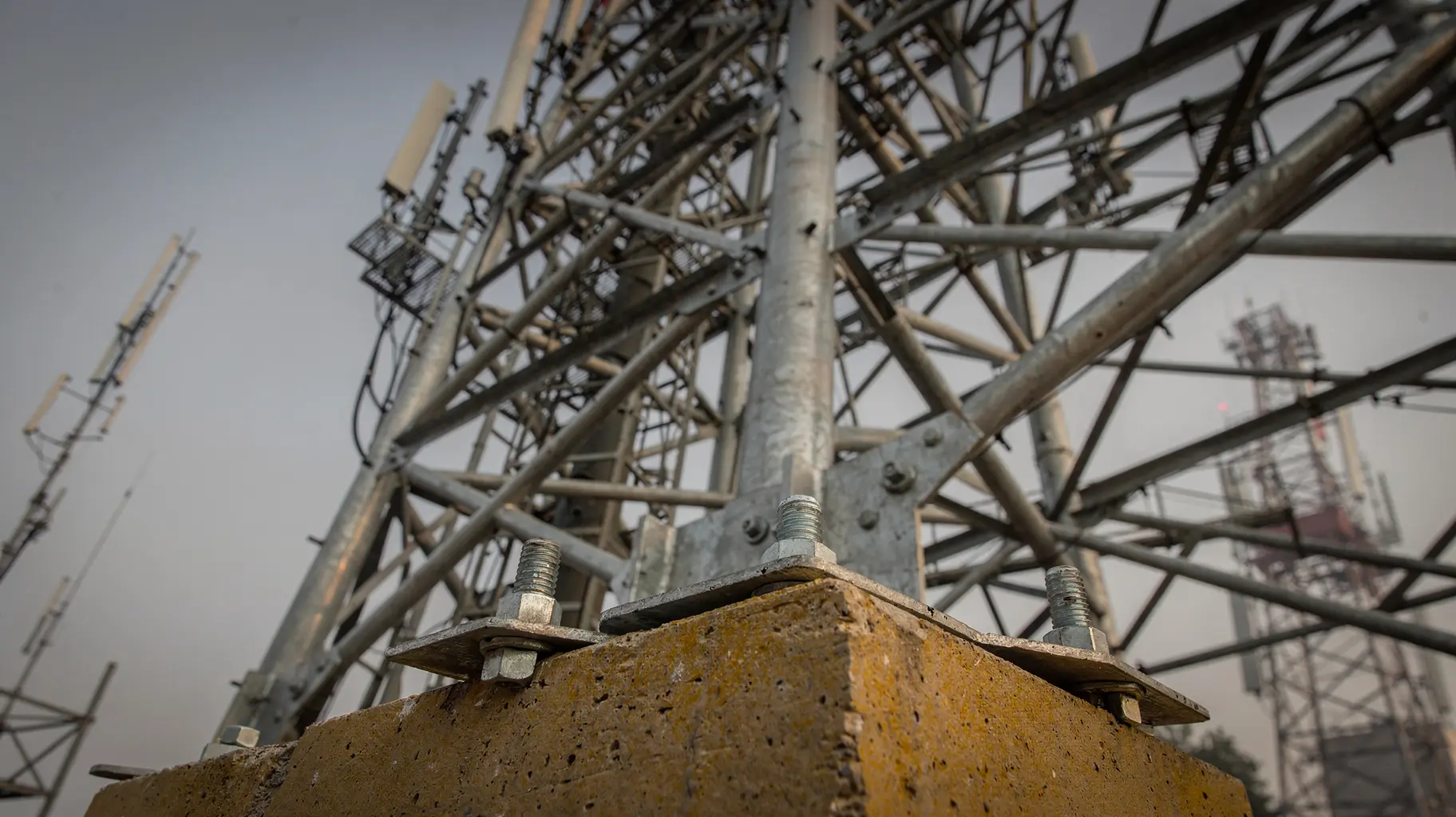
The subscriber is not standing beside a flagship store in central Dushanbe. He is on a job site above a district road, trying to send a photo of delivered materials before the foreman signs off. The phone shows bars, then drops to a spinning upload. The plan still has gigabytes. The account is active. The money has already left the prepaid balance. The problem is that the plan fails in the place where it is needed most.
That is the fair test for Babilon-T. The company is presented on its official fixed-service site, https://www.babilon-t.tj/, as a telecom operator associated with internet, television and business solutions. Its mobile-facing affiliate surface, Babilon-Mobile, describes itself at https://babilon-m.tj/tj/about.php as a major Tajik mobile operator offering GSM 900/1800, 3G-UMTS, 3.5G-HSDPA and 4G-LTE services, with commercial activity beginning on January 1, 2003. The same page says Babilon-Mobile launched commercial 3G-UMTS on July 1, 2005 and points to HSDPA as the technology that made higher-speed mobile internet part of its public proposition. That history matters, but it does not settle the present retail question.
The present question is whether the user should keep paying Babilon for data when the same household can hold another SIM, delay a video upload until it reaches home Wi-Fi, use a cafe network, choose a rival's lower headline price, or simply conserve data because a failed session has made the next megabyte feel risky. In a mature urban market the customer may treat mobile data as an always-on utility. In Tajikistan, where mountains, rural settlement, remittance-linked household budgets and uneven fixed broadband options shape demand, the data plan is closer to an option contract on usable coverage.
Babilon gets paid when the option works often enough.
This is why the paid unit is not the gigabyte. It is the successful account session: attach to the network, keep the signal, pass through the radio layer, find backhaul, reach the service, get billed correctly and recover fast enough after a fault that the customer does not move the next top-up elsewhere. A 100 GB bundle can be cheap if it works at the needed location and expensive if the phone must be carried to a window, a roof, a bus stop or a rival SIM.
The tariff is only the visible price
Babilon-Mobile's tariff page, https://babilon-m.tj/tj/tarif.php?id=1, gives the visible price ladder. It lists plans such as "Javoni 2" with 100,000 MB of paid internet traffic for 100 somoni per month and "Javoni 3" with 200,000 MB for 150 somoni per month. It also lists smaller plans, including "Robita 1" with 1,200 MB for 29.7391 somoni and "Robita 2" with 3,000 MB for 49.5652 somoni. Those numbers are commercially important because they show Babilon selling both abundance and entry-level access. But the visible price is only the part that appears on the poster.
The invisible price is paid in coverage risk. A subscriber who buys the smaller bundle is paying a high implicit price for every failed megabyte, because the bundle is limited. A subscriber who buys the larger bundle is betting that the network will be available often enough to consume the allowance. The operator, in turn, must decide how much rural reach, site power, transport redundancy, tower maintenance, customer support and prepaid distribution it can fund from accounts that may churn at the first sign of a better local signal.
Babilon's own 4G page, https://babilon-m.tj/tj/lte.php?id=1, illustrates the second layer of pricing. The listed "4G LTE" plan has a modest monthly fee, a small included data amount and a per-megabyte charge after the bundle. It also includes notes about billing increments, monthly renewal, accumulated resources and the distinction between 3G UMTS and HSDPA speeds. Those terms remind the reader that mobile data is a metered service wrapped in rules. A subscriber may experience the plan as a monthly product, but the operator experiences it as a stack of radio access, usage accounting, core network policy, payment timing and support calls.
The service pages deepen that picture. MobiConstructor at https://babilon-m.tj/tj/services.php?id=54 lets users compose minutes, SMS and megabytes, while MobiPackages Plus at https://babilon-m.tj/tj/services.php?id=62 sells add-on bundles, including an additional 1,000 MB option. MobiONLINE 70 at https://babilon-m.tj/tj/services.php?id=63 is especially revealing because the page says connection to that service became unavailable for technical reasons from November 1, 2023, while the offer itself had been positioned around daily high-speed messenger use and turbo add-ons. A discontinued or technically constrained product is not a scandal by itself. It is evidence that mobile data pricing is a live operations problem, not a clean catalog.
Coverage is a repair promise, not a map
Coverage pages are often read as geography. Economically, they are a promise about repair. Babilon-Mobile's coverage page at https://babilon-m.tj/tj/coverage.php presents GSM, 3G and LTE coverage areas and includes a disclaimer that the map is obtained after computer research and design, with information varying by location, architectural structures and building construction. That caveat is honest and important. It is also the heart of the data-plan problem.
A map can show that the operator has planned or modeled coverage in a district. It cannot guarantee what happens behind concrete, in a basement shop, across a river bend, after a power interruption, in a narrow valley, during a local event, or when a sector becomes congested by evening video traffic. For the subscriber, those are not engineering exceptions. They are the product. A data plan that works at noon outdoors and fails indoors during the payment rush is a different plan from the one advertised.
This makes repairability the commercial hinge. Repairable coverage means faults are findable, crews can reach sites, spares exist, power can be restored, radios can be aligned, backhaul can be rebalanced, SIM provisioning errors can be corrected and the customer can get a credible answer before the next renewal. It also means Babilon can distinguish a device problem from a tower problem. If the phone is old, the SIM is damaged, the handset lacks the right band, the indoor signal is blocked by construction, or the customer is using a congested app at peak time, the support task is different from replacing a failed site component.
The customer usually sees only "internet does not work."
The 5G page at https://babilon-m.tj/tj/5g.php?id=1 shows why this distinction matters. Babilon-Mobile lists 5G coverage maps for Tajikistan and points to named locations in Dushanbe, Khujand, Bokhtar, Rogun, Khorog and Kulob. In Dushanbe, the page lists many localized points, from market and mall areas to transport and public-service landmarks. The commercial message is modernity. The operational message is selectivity. Early 5G can sharpen brand perception in dense urban pockets, but a subscriber's retained value still depends on 4G, 3G and even fallback coverage across the daily route.
The temptation is to ask whether Babilon "has 5G." The better question is whether Babilon can keep a paid data account usable when the handset is outside the 5G pocket, moving between radio layers, or working in a building where low-band coverage matters more than peak speed. Spectrum and radio technology create the possibility of coverage. Repair creates the habit of paying for it.
Tajikistan makes the last kilometer expensive
DataReportal's 2025 country report, https://datareportal.com/reports/digital-2025-tajikistan, provides the demand frame. It estimates 10.8 million cellular mobile connections in Tajikistan in early 2025, equivalent to 101 percent of the population, and says 89.1 percent of those mobile connections were broadband connections on 3G, 4G or 5G networks. It also estimates 6.07 million internet users, or 56.8 percent penetration, and notes that 71.3 percent of the population lived in rural areas. The headline looks like a saturated mobile market; the usage reality is still uneven.
The World Bank's Tajikistan country page, https://data.worldbank.org/country/tajikistan, adds the affordability lens. It lists a 2025 population of about 10.79 million, GDP per capita around US$1,637 and personal remittances received at 47.2 percent of GDP in 2024. Those figures do not tell us Babilon's ARPU, churn or margin. They do tell us that mobile data competes for household cash in an economy where many budgets are sensitive to migration income, seasonal work and small differences in prepaid price.
That combination changes the meaning of coverage. In a wealthy urban market, a subscriber may hold a premium plan for convenience. In Tajikistan, many users can be rationally experimental: one SIM for calls, one for data, one for a district where the signal is stronger, one for a promotion, one for relatives on-net. The operator must not only build coverage; it must earn the primary top-up. If a student, driver, shopkeeper or construction worker believes that a rival SIM works in the practical places of the day, the next 39, 59, 100 or 150 somoni may move.
This is why the last kilometer is not just rural. It is also the last room, the last stairwell, the last roofline and the last dealer visit. Tajikistan's urban-rural split means coverage investment has to stretch into lower-density areas, but urban density creates its own pressure through congestion and indoor signal. A national telecom operator can lose trust in both places: by not reaching a village, or by reaching a city block without enough capacity to make the data plan feel reliable.
Backhaul prices the tower
A tower without backhaul is a billboard. A site may provide radio coverage, but the data plan depends on the path from that radio site into the operator network and onward to the public internet or to domestic content. Backhaul can be fiber, microwave, leased capacity or a mix of paths. The public material available for Babilon does not prove the company's internal backhaul design, and it should not be treated as if it does. But the economics are clear enough: in mountainous terrain, the cost of moving traffic from a site to the wider network can dominate the cost of lighting up the radio.
Public routing records are useful here because they show the boundary, not the internal map. RIPEstat's AS overview for AS24722, https://stat.ripe.net/data/as-overview/data.json?resource=AS24722, identifies the holder as "Babilon-AS LLC Babilon-T" and shows the AS as announced on July 7, 2026. RIPEstat's whois data at https://stat.ripe.net/data/whois/data.json?resource=AS24722 describes the aut-num as Babilon-AS, tied to LLC Babilon-T, with remarks identifying it as an internet service provider in Dushanbe. The announced-prefixes endpoint, https://stat.ripe.net/data/announced-prefixes/data.json?resource=AS24722, shows many visible prefixes, but that list should be read only as public routing evidence. It does not tell us where towers are, which subscribers are behind which path, or whether a specific village has good service.
The Babilon-Mobile AS record is also revealing in a limited way. RIPEstat's AS overview for AS204106, https://stat.ripe.net/data/as-overview/data.json?resource=AS204106, identifies "Babilon-Mobile CJSC Babilon-Mobile" and shows it announced. The whois record at https://stat.ripe.net/data/whois/data.json?resource=AS204106 lists import from AS24722 and AS51346, and export to those networks. That is not proof of how mobile traffic is engineered end to end. It is a public boundary signal that fixed, mobile and upstream relationships are commercially entangled enough that the user experience cannot be priced by the radio layer alone.
For the subscriber, this appears as delay, buffering, failed uploads, unstable messaging calls or payment app timeouts. For the operator, it appears as capacity planning, peering, upstream cost, outage isolation and complaint triage. A data bundle may be sold in megabytes, but its real marginal cost often arrives as the extra transport needed to make those megabytes usable in the places and hours where customers actually consume them.
Spectrum is a right to attempt service
Spectrum is often discussed as a scarce asset, but for this kind of operator it is also a right to attempt service under physical constraints. Low bands help reach farther and penetrate buildings. Mid bands provide capacity. Higher bands or 5G overlays may create speed and brand differentiation in dense areas, but they do not automatically solve coverage in valleys, behind walls or along long travel routes.
Babilon-Mobile's public technology statements show a multi-generation network story: GSM 900/1800, 3G-UMTS, HSDPA and 4G-LTE on the about page, with separate 4G and 5G pages for retail positioning. Public mobile-network-code references also list Babilon-M under MCC 436/MNC 04 with GSM, UMTS and LTE technologies, and Babilon-T under MCC 436/MNC 10 with TD-LTE 2300 and WiMAX. Such references can help identify the public regulatory and numbering surface, but they should not be stretched into claims about current spectrum holdings, license terms or active capacity by location.
The economics of spectrum show up in customer substitution. If Babilon has enough practical coverage where a customer lives and works, the subscriber may accept a slightly worse headline gigabyte price. If the signal is unreliable indoors or along the travel route, a rival bundle becomes more attractive even if the nominal terms are not much better. Spectrum rights matter because they shape whether coverage can be made repairable at an acceptable cost. They do not by themselves make the plan worth paying for.
This is especially important for 5G. A named 5G area in Dushanbe or a listed city such as Khujand or Khorog is a signal of investment, but the customer may not own a compatible device, may not stay inside the coverage pocket, may not need peak speed, or may care more about whether a messenger call works from a kitchen or shop counter. The paid data plan therefore requires a portfolio: enough high-capacity urban layers to handle demand, enough lower-layer coverage for continuity, enough device support to get customers attached, and enough repair discipline to reduce repeat failures.
Field repair is local labor economics
The repair account is not just a technical ledger. It is local labor. Someone has to visit the site, handle power issues, diagnose antennas, replace equipment, coordinate access, answer a dealer, update the ticket, and explain to a customer why the plan failed. In a country with dispersed rural settlement and mountain corridors, the travel time of a field crew is part of the data price.
This is where the subscriber's story becomes an operating model. If a customer loses data at a roadside workplace and the fault is common to many users, Babilon needs a way to detect the site problem before a cluster of small prepaid renewals disappears. If the problem is a handset locked to the wrong mode, a damaged SIM, a depleted balance, or a bundle misunderstanding, the solution is retail support. If the problem is indoor attenuation, a map cannot solve it, but a support script can set expectations and keep the customer from blaming the entire network.
Babilon-Mobile's retail pages show the importance of service packaging. MobiConstructor lets customers assemble smaller monthly resources. MobiPackages Plus sells top-ups. The 4G page includes balance-checking commands. The homepage at https://babilon-m.tj/tj/index.php provides contact details and support pointers, including a call number and email. These are not decorative. In prepaid markets, the difference between a retained user and a lost user is often the support moment at the edge of confusion: the USSD code that works, the dealer who explains the bundle, the call center that identifies a technical issue, the shop that replaces a SIM without turning the customer away.
Repairability also affects how the company should think about marketing. Selling a large bundle creates an expectation that the network is ready for heavy use. If the operator knows coverage is uneven in a district, a smaller plan with honest support may retain more trust than a big headline allowance that fails in practice. The price of overpromising is churn, and churn is expensive because the customer has already learned how to use another operator.
Prepaid distribution is part of coverage
In a prepaid market, distribution is not separate from network quality. A plan cannot be valuable if the customer cannot recharge at the right time, select the right package, check the remaining balance, resolve an account error or move between tariff options without losing trust. Babilon's public USSD commands, add-on bundles and online account pointers show a product that relies on self-service and small retail interactions. That is normal for mobile, but it means the data plan must be priced through the dealer network as well as the radio network.
The dealer is the person who translates coverage into money. If a user says, "Babilon does not work near my worksite," the dealer may either lose the recharge or rescue it by diagnosing a plan, device or location issue. If a user says, "Which bundle should I buy for messaging, video and family calls?", the dealer is effectively allocating future network load. If a user has two SIMs, the dealer's confidence can decide which one becomes the default data SIM for the month.
This is why promotions can be double-edged. A cheap data package may attract use that stresses a weak cell. A large bundle may generate complaints if backhaul is thin. A messenger-specific or night-time offer may shift usage, but only if customers understand the rules. Babilon's discontinued MobiONLINE 70 page is a reminder that a product can be attractive in concept and still become difficult to maintain technically or commercially.
Prepaid reach also has a geography. A city customer may have multiple top-up channels and shops nearby. A rural customer may have fewer points of support and less tolerance for ambiguity. If the plan fails and the next support interaction requires travel, the effective price of the data plan rises. Repairable coverage therefore includes the human path from complaint to resolution.
Regulation and security are not background noise
Telecom operators in Tajikistan work under a regulatory and public-security context that affects both cost and customer perception. The article does not need to claim a specific license condition for Babilon to recognize that spectrum, numbering, lawful access, cross-border connectivity, international voice controls and content availability shape the operating environment.
The public site itself shows the operator communicating security-related issues to customers: Babilon-Mobile's homepage has carried warnings about fraudsters posing as company employees, and a June 2026 item referenced international-call control in response to customer requests and communications-service recommendations.
For the user, regulation appears as call rules, roaming behavior, blocked or reachable services, identity requirements, SIM registration processes, price changes and customer warnings. For the operator, it appears as compliance labor, system configuration, reporting, security controls and customer communication. These costs are not visible in the data-bundle price, but they affect how much money remains for repair and coverage.
Security also intersects with trust. A subscriber who sees fraud warnings, payment-app problems or confusing account behavior may blame the operator even when the immediate cause is a criminal caller, a bank integration, a handset issue or a third-party service. Babilon's public link for problems with bank applications connected to internet access is a small but telling signal: the customer does not separate telecom reliability from payment reliability. If the network fails during a payment, the data plan feels broken.
The market lesson is that security and repair are joined. A network operator that can quickly identify whether a failure is fraud, app dependency, account status, coverage, congestion or device compatibility protects its revenue. An operator that leaves those categories blurred trains customers to solve uncertainty with a second SIM.
Supplier constraints sit inside the tariff
Every data plan also includes supplier risk. Radios, antennas, batteries, routers, optical equipment, software licenses, spares and vendor support all become part of the service price. Public sources do not provide enough evidence to name Babilon's current vendors or supply-chain dependencies, and it would be irresponsible to infer them from technology labels alone. What can be said is that a national operator's ability to repair coverage depends on procurement and inventory, not only on engineering skill.
This matters for older layers as well as new ones. A 5G marketing point may be easier to notice, but the repair economics of 2G, 3G and 4G still matter because customers attach through the devices they own. In a lower-income market, many handsets remain in service for years. A support issue that looks like network failure may be a band-support problem, a weak battery, damaged radio hardware, old software, a low-quality router, or a device forced into the wrong network mode. The operator can reduce churn only if retail and support staff can separate those problems from actual coverage failure.
Supplier constraints also shape rural repair. A field crew that has the right spare part can turn a complaint into a restored month of revenue. A crew that waits for parts converts the same complaint into a trial of a rival SIM. The economics of spare inventory are therefore tied to customer lifetime value. It may be tempting to hold fewer spares because prepaid ARPU is limited. But the cost of not repairing a high-complaint site can be greater than the inventory saving, especially when local word of mouth moves quickly.
Rivals price Babilon's weak spots
The alternative to Babilon is not one operator. It is a menu. Tcell's site at https://www.tcell.tj/en presents itself with a "fastest and most stable 4G network in Tajikistan" Speedtest award claim and lists monthly bundles such as Salom+ 200 with a large internet package at 200 somoni, Salom+ 130 at 130 somoni and Sipos at 250 somoni. MegaFon Tajikistan's homepage, https://www.megafon.tj/, presents "Vkluchaisya! Sozdavai 2.0" style plans with examples around 100, 130 and 160 somoni, including data allowances such as 36 GB plus another 7 GB, 30 GB, or 80 GB depending on the plan shown. ZET-Mobile's tariff page, https://zet-mobile.com/tariffs, lists lower headline offers such as SUPER MINI at 39 somoni with 15 GB and night data, SUPER MAX at 59 somoni with 25 GB, SUPER PRO at 79 somoni with 35 GB and SUPER ULTRA at 99 somoni with 60 GB. Its internet page, https://zet-mobile.com/internet, also lists standalone data packs from small amounts to 30 GB.
These offers cannot be compared only by gigabytes per somoni. They are geographically conditioned products. If Tcell is stronger in a particular dormitory, its plan is cheaper there even if Babilon's nominal bundle is larger. If MegaFon works better along a commuter route, its plan captures that route. If ZET's cheaper bundle works well enough for messaging and video at home, it can become the default SIM for price-sensitive customers. If fixed home internet is stable in a household, mobile data may be reserved for work, travel and outages, lowering the willingness to pay for a large mobile plan.
The same customer can use all of these substitutes. A dual-SIM phone makes churn partial before it becomes total. The subscriber may keep Babilon for voice, another operator for data, a home router for evening video, public Wi-Fi for downloads and delayed use for nonurgent tasks. That makes retention harder to see. Babilon may keep the number but lose the data wallet.
The practical consequence is that Babilon must price repairable coverage, not abstract loyalty. If it has the best signal at a workplace, it can retain a data account even against lower advertised tariffs. If it loses the workplace, a large plan becomes irrelevant. The customer does not need to formally cancel; he just stops using Babilon as the paid data path.
Fixed broadband is both substitute and anchor
Babilon-T's fixed positioning matters because fixed service can either protect or cannibalize mobile data. A household with reliable home broadband may buy a smaller mobile plan and save heavy downloads for home. A small business with fixed service may still need mobile backup for payments, delivery, messaging and field staff. A weak fixed connection can push more traffic back onto mobile, but only if the mobile layer is trusted.
The official Babilon-T site shell identifies the operator with internet, television and business solutions, but the public text fetch does not expose enough tariff detail to compare fixed plans responsibly. That absence is itself commercially relevant. The public subscriber sees mobile prices more clearly than fixed economics. If fixed broadband is sold through other channels or requires location-specific feasibility checks, the mobile plan remains the visible retail instrument.
The better strategic read is that fixed and mobile repair should reinforce each other. A business customer that uses Babilon-T for fixed internet may also trust Babilon-Mobile for field devices if support is integrated and faults are handled coherently. Conversely, a fixed outage that is poorly explained can damage mobile trust even if the networks are operationally separate. Customers often buy the brand experience, not the network diagram.
Public routing records again provide only a boundary clue. AS24722 is the Babilon-T public internet surface. AS204106 is the Babilon-Mobile surface. Their visible relationship in whois records suggests a group-level dependency surface that customers may experience as one brand. It does not prove the internal topology. The business implication is simpler: if fixed, mobile and upstream support are not coordinated from the customer's perspective, the company pays for that fragmentation through churn and support cost.
What would prove the plan is worth paying for
The proof gap is not whether Babilon exists, has tariffs, has coverage pages or appears in public routing records. Those are established. The proof gap is whether repairable coverage converts into retention. The strongest evidence would be local and operational: trouble-ticket closure times by district, repeat-fault rates by site, indoor complaint clusters, SIM replacement volumes, data-session success rates, prepaid renewal behavior after faults, churn among dual-SIM users, and support resolution quality. None of that is public in the sources reviewed.
Absent those internal numbers, public evidence can still guide the test. Coverage pages with caveats tell us where expectations may diverge from experience. Tariff pages show how much value Babilon promises. Competitor pages show the price of switching. DataReportal and World Bank figures show the affordability and rural-distribution environment. RIPEstat records show public internet boundaries and dependencies, with strict limits on inference. Together, they support a thesis: Babilon's data plan is valuable only where coverage is repairable at the pace of prepaid decision-making.
That pace is short. A monthly subscriber may wait a day if the operator communicates clearly. A small-bundle user may switch immediately because the remaining allowance is too precious. A business user may keep a backup SIM because one failed payment session costs more than the monthly plan. A student may choose whichever SIM works in the dormitory that week. The repair window is therefore not an engineering service-level agreement written for enterprise contracts; it is the emotional interval between "the internet failed" and "I will buy a different bundle."
This is why support labor is strategic. The operator that can explain and fix ordinary failures fast enough can keep revenue even when the network is imperfect. The operator that lets uncertainty sit with the customer loses not only the current session but the assumption that the next top-up is safe.
Churn begins as an allocation decision
Mobile churn is often measured as a cancellation or an inactive SIM. For Babilon, the more dangerous form may be quieter: the customer keeps the number, but allocates the important data traffic to somebody else. A dual-SIM user may still receive Babilon calls, still keep a Babilon balance and still appear as a reachable account, while the profitable data behavior moves to Tcell, MegaFon, ZET, a home router or public Wi-Fi. The churn event is not the day the number goes silent. It is the day the customer stops trusting the plan for the next upload.
That is why the repair account should be attached to use cases, not only to sites. A teacher who needs mobile data for class materials has a different tolerance for failure from a taxi driver waiting for ride messages, a market seller confirming a payment, a student downloading lecture files, or a migrant household coordinating a remittance. Each use case has a moment when delay becomes substitution. If the payment confirmation fails, the shopkeeper may ask for another operator's hotspot. If the family video call fails twice, the household may make the rival SIM the evening data SIM.
If a student cannot upload an assignment from the dormitory, the next monthly plan may be chosen by the roommate's signal strength.
The practical value of repairable coverage is that it slows this allocation shift. A network does not have to be perfect to retain trust. It has to fail in a way that the customer recognizes as temporary, explainable and fixable. That requires three capabilities. First, Babilon must see the fault pattern early enough: a cell that drops sessions, a backhaul link that saturates, a district where indoor complaints cluster, or a payment application that fails across many users. Second, it must route the problem to the right repair owner: field crew, radio planner, core team, dealer support, billing support or customer education.
Third, it must close the loop publicly enough that customers believe the same failure will not define the next month.
Device support is part of that loop. Tajik subscribers do not all carry the same phone, radio bands, software versions or battery health. A user on an older handset may experience a technology transition as worse service, not modernization. A customer with a damaged SIM may blame the tower. A router placed behind thick walls may make a plan look weaker than it is outdoors. A phone set to a preferred network mode may cling to a congested or weak layer. These are ordinary support problems, but they are commercially urgent because the customer compares outcomes, not causes.
If another SIM works in the same device or if a neighbor's phone succeeds, Babilon must explain the difference quickly or lose the data role.
This also affects how a national operator should think about public performance claims. A fast 4G or 5G pocket can attract attention, but retention is driven by repeated ordinary sessions. The customer remembers the place of failure more than the place of peak speed. An operator that invests in glamorous coverage without the repair process behind it creates a fragile promise. An operator that can turn a weak room, a bad SIM, a congested hour or a failed top-up into a resolved support event creates a stronger habit of payment.
The economics are not sentimental. Every support interaction costs money, and some customers will not justify extensive hand-holding. The operator therefore needs triage. High-density faults should move to network repair. Repeated device problems should move to retail education and SIM/device checks. Enterprise or small-business accounts should receive more explicit backup and escalation paths because their failed sessions can cause immediate cash loss. Low-value prepaid accounts still matter because local word of mouth can aggregate them into a district-level brand judgment.
In a market where many customers can test several operators at low switching cost, the cheapest retention tool may be the first credible explanation.
The conclusion is that Babilon's repairable coverage should be measured not only by mean time to repair but by mean time to restored confidence. That is a harder metric, but it is closer to the prepaid data economy. A technically repaired site that customers do not know is repaired may still lose renewals. A support answer that correctly identifies an indoor limitation may retain the user if it helps him choose the right plan, router placement or backup behavior. The data plan depends on this translation layer between engineering and household decision-making.
The investment case and the risk
The investment case for Babilon-T is that Tajikistan still has a large practical demand gap between mobile connectivity and dependable digital use. DataReportal's mobile connection figure shows that SIM access is widespread, while internet penetration and rural population structure show that the market is not simply saturated in usage terms. A company with fixed, mobile and public internet surfaces can monetize that gap if it turns network reach into reliable routines: work messaging, payments, family video, small-business coordination, education and entertainment.
The risk is that price-sensitive customers learn to separate the brand from the data wallet. The rival set is aggressive enough to make that easy. Tcell can point to performance recognition. MegaFon can market large bundles and a polished app. ZET can offer low headline prices and night data, despite visible hygiene concerns on its public pages that sophisticated users may notice. Fixed broadband and public Wi-Fi can absorb heavy use. Delayed data use can reduce consumption. Dual SIM can make partial churn invisible.
Babilon's answer cannot be only a bigger bundle. Bigger bundles intensify the disappointment when coverage fails. The answer has to be repairable coverage: honest maps, enough backhaul, correct spectrum use, maintained sites, stocked spares, trained field teams, retail support, clear USSD self-service, device diagnosis and customer communication that treats a failed session as a revenue event.
For a subscriber on a roadside job site, the plan is worth paying for if the photo goes through, the payment app works, the family call connects and the same result happens often enough that the next top-up feels safe. For Babilon-T, that means the product is not data alone. It is the repair account behind the data. The company can win if customers believe its coverage can be fixed where it breaks. It loses when customers decide the only repair they control is switching SIMs.