
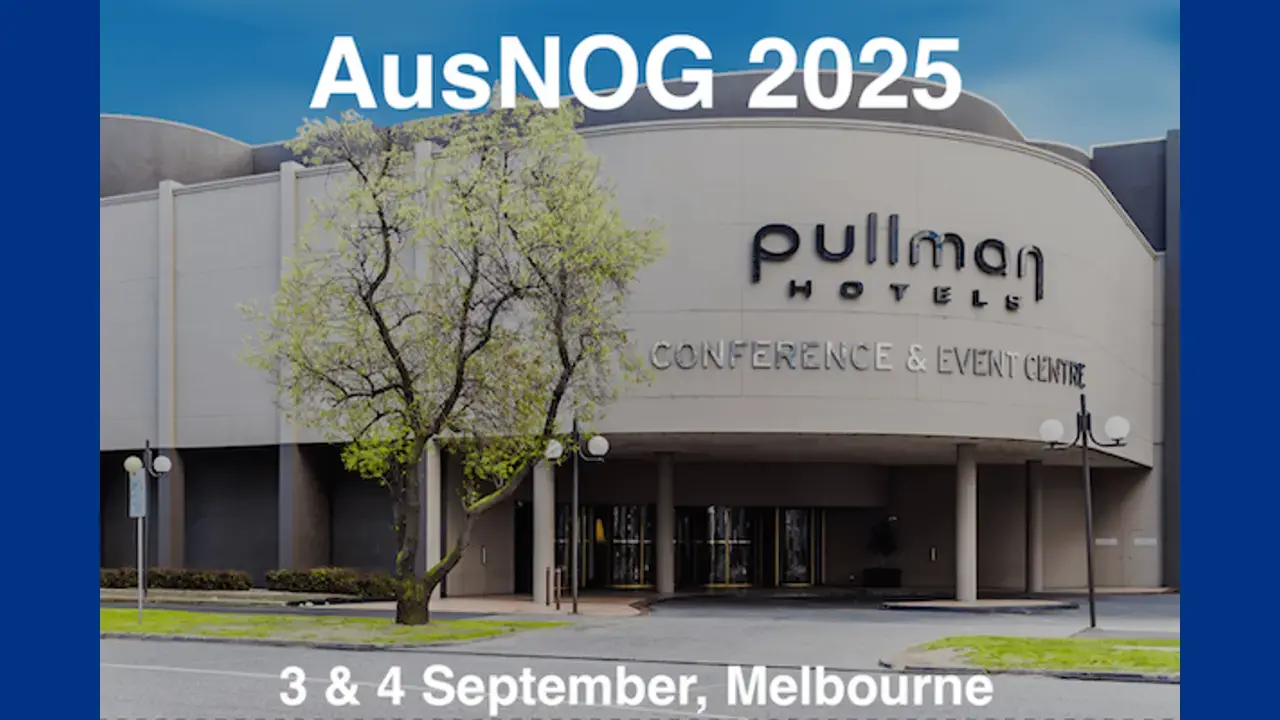
AusNOG 2025 brings network leaders to Melbourne is profiled by BTW Media because public-source evidence links it to internet infrastructure, governance, operational dependencies, or market visibility.
AusNOG 2025 brings network leaders to Melbourne is tracked as a internet infrastructure institution within the internet infrastructure ecosystem.
AusNOG 2025 brings network leaders to Melbourne has public-source relevance to network operations, governance, dependency mapping, or market structure.
AusNOG 2025 brings network leaders to Melbourne is tracked as a internet infrastructure institution within the internet infrastructure ecosystem.
Public-source signals support medium-impact monitoring for infrastructure visibility and dependency analysis.
AusNOG 2025 brings network leaders to Melbourne is profiled by BTW Media because public-source evidence links it to internet infrastructure, governance, operational dependencies, or market visibility.
Public-source signals support medium-impact monitoring for infrastructure visibility and dependency analysis.
| 0.90–1.00 | A | High — direct sources |
| 0.75–0.89 | A/B | Strong |
| 0.55–0.74 | B/C | Medium |
| 0.35–0.54 | C/D | Weak–medium |
| 0.10–0.34 | D | Weak signal |
| 0.00–0.09 | D | Internal monitoring |
Mixed-source
- AusNOG 2025 returns on 3–4 September with two days of technical talks and policy discussions in Melbourne
- The programme includes key sessions on peering, IPv6, routing security, and industry governance reform
What happened: Event returns to Melbourne and programme highlights
The Australian Network Operators Group (AusNOG) will hold its 2025 conference on 3–4 September at the Pullman Conference & Event Centre in Albert Park, Melbourne. The annual gathering serves as a technical and community-led forum for ISPs, engineers, and internet infrastructure stakeholders in Australia and New Zealand. According to the official event site, the two-day programme is designed to foster discussion around operational challenges and infrastructure strategy.
The programme features sessions on RPKI deployment, inter-provider BGP monitoring, IPv6 transitions, and internet exchange point scaling. Craig Saper of Meta will present on datacentre fibre automation, while Leo Vegoda of PeeringDB will address visibility gaps in peering databases. Other speakers will cover themes including automation in network security, governance of internet registries, and collaborative policy development within the APNIC region.
Also read: Capacity Eurasia 2025 set to unite connectivity leaders in Istanbul
Also read: ICANN’s Africa DNS report barely mentions the AFRINIC problem
Why this is important
AusNOG 2025 comes at a time when the resilience and security of internet infrastructure are under growing pressure. Events such as the Optus outage and rising concern over IP hijacking incidents have exposed the need for stronger routing security practices, such as RPKI and BGP monitoring. The industry is also under pressure to adopt IPv6 at scale, particularly as legacy IPv4 resources become more constrained and fragmented.
This year’s focus on policy and governance points to deeper structural issues in how internet resources are managed regionally. AusNOG offers a platform to question accountability at the registry level and push for reform in coordination with APNIC’s policy development process. Sessions by Aftab Siddiqui and others aim to advance discussions on transparency and data accuracy in routing systems. For an industry facing increasing technical and regulatory complexity, this event acts as both a workshop and a watchdog.
Core Entity Brief
- Entity: AusNOG 2025 brings network leaders to Melbourne
- Subject Type: Internet infrastructure institution
- Region: Africa
- Classification: Institution Type
Service Surface / Control Surface
- Public records support monitoring of governance, service, and infrastructure control surfaces.
Governance and Policy Surface
- Public-source signals support medium-impact monitoring for infrastructure visibility and dependency analysis.
- Operational criticality: Medium
- Time horizon: Quarter (30-120d)
Decision Trigger Matrix
- Monitoring focuses on verified service continuity, governance changes, and relationship signals.
Current state favours active tracking due to infrastructure relevance.
Public-source signals support medium-impact monitoring for infrastructure visibility and dependency analysis.
Long-cycle infrastructure decisions likely to remain path-dependent.
Member Unlock
Restricted Profile Intelligence
Login is required to unlock full profile briefings and deep-dive sections.
Only for Strategy Circle
Strategic Circle Access
Open to all readers. Unlock profile briefings after joining and logging in.
Join Strategic CircleOnly for Leadership Alliance
Leadership Alliance Access
For owners and management of IP-holding companies. Login required to unlock.
Join Leadership Alliance


