
Summary
- AsiaTech Telecom Limited's public record supports a narrow but real operating profile: a Hong Kong company site describing networking, Wi-Fi, web design, web hosting, server colocation and 7 x 24 IT support; a Communications Authority services-based operator licence for Internet Access Services and IVANS; APNIC records for AS45855, AS135398 and two IPv4 allocations; and RIPEstat evidence that AS45855 was visibly announcing two prefixes in July 2026.
- The commercial case is not that AsiaTech proves superior scale. The case is that, in a saturated Hong Kong broadband market with many licensed providers, high fibre coverage and strong mobile substitution, a small provider can only earn durable margin if field response, vendor memory, support availability, upstream reliability and account retention make a cheaper access substitute less attractive.
- The strongest missing facts are private: customer count, revenue by service line, installation lead times, outage history, support response times, upstream contracts, gross margin, churn and renewal data. Without those, the evidence can prove capability claims and network-resource presence, but it cannot prove whether the account is economically strong.
The Failure That Turns Bandwidth Into An Account
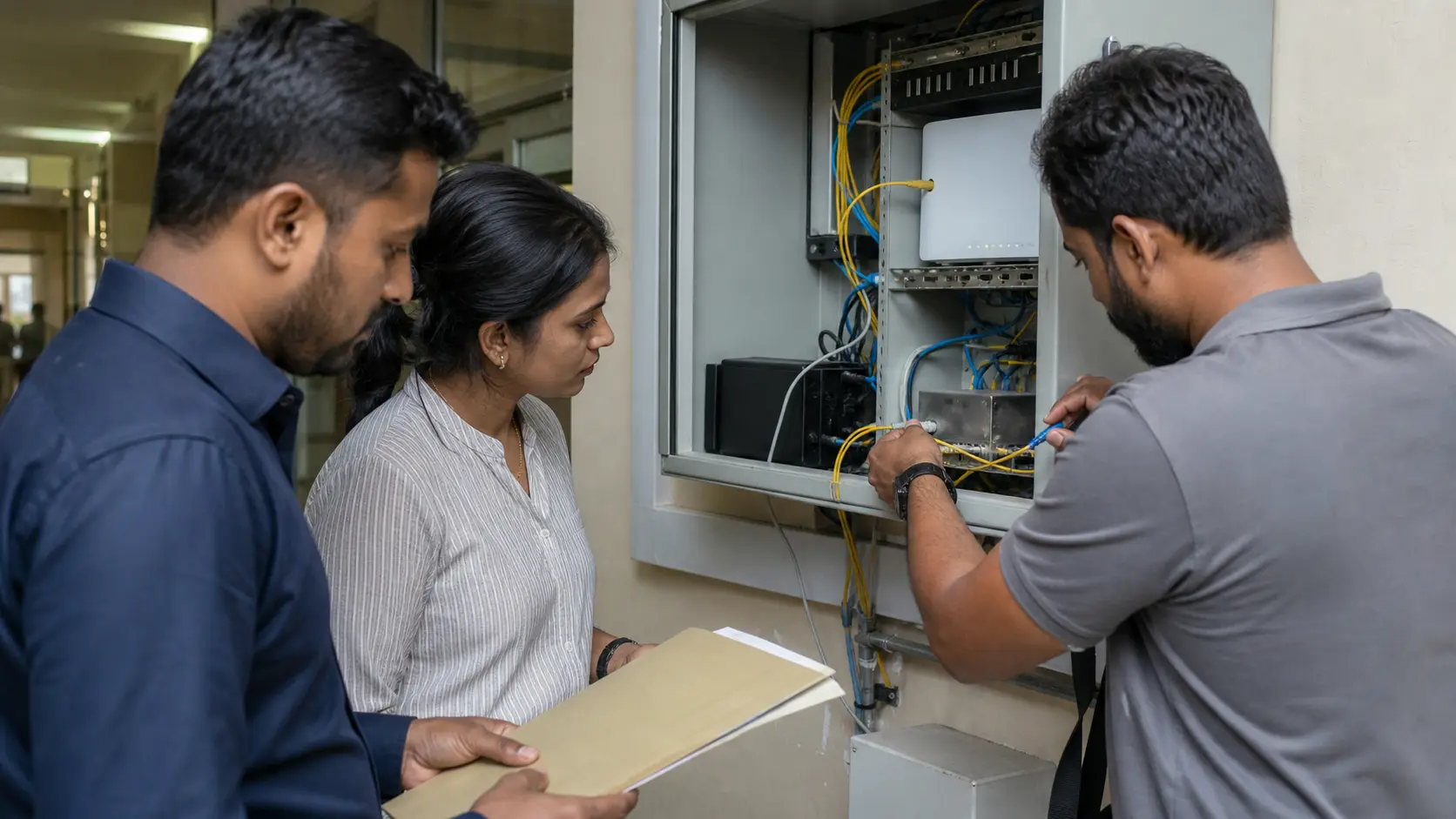
A Hong Kong office does not discover the economics of a local connectivity provider when the sales quotation arrives. It discovers them when the line is late, the firewall replacement breaks a payment terminal, the Wi-Fi redesign exposes a dead zone, or an upstream fault leaves staff deciding whether to tether from phones, wait for the national operator, or call the smaller provider that knows the rack, the router, the building manager and the customer contact. The nominal product may be broadband, VPN, web hosting or colocation.
The paid unit is the local access and field-support account: a bundle of connectivity, installation labour, device knowledge, supplier coordination and recovery behaviour.
That distinction matters for AsiaTech Telecom Limited because the public evidence points to a provider that is not merely selling a generic internet label. Its own website opens with "Network Infrastructure" and "AsiaOne Global Internet Services Provider" language on the home page at asiaone.net. Its products page lists network infrastructure, server colocation, web design, web development and web hosting. Its services page adds network infrastructure, cyber security, data analytics, professional training, marketing and event promotion, and SEO optimisation. Its about page says the business was established in 1995, has nearly three decades of experience, works with Japanese and Hong Kong companies, cooperates with networking vendors, and offers 7 x 24 IT support. These claims do not prove revenue, margin or service quality, but they describe a business whose economic unit is implementation and continuity around access, not only the resale of capacity.
By the third paragraph the burden of proof is clear. The customer buys a local access account backed by field response, support memory, and upstream reach. The cheaper substitute is a national fixed operator, a mobile broadband plan, another ISP, a satellite option for special sites, an in-house private link, or the decision to delay installation and live with a workaround. The cost driver is the labour and supplier dependence around that account: site visits, configuration, troubleshooting, hardware replacement, abuse handling, upstream transport, data-centre exposure and customer support availability.
The strongest evidence class is official and registry evidence: the company site, the Communications Authority licence search, APNIC/RDAP records and RIPEstat routing observations. The three missing proof categories are economics, reliability and retention: service-line revenue and margin, outage and response history, and customer count or churn. Until those are known, the judgement must stay disciplined.
That discipline is especially important in Hong Kong. The public market is dense, regulated and already heavily connected. OFCA's key communications statistics report 369 internet service providers as at June 2026, alongside an estimated 3.07 million registered broadband subscriptions as at February 2026, household broadband penetration above 100%, and FTTH/B residential unit coverage of 97.2% as at June 2026. A market with that much access coverage does not reward a small provider simply for having a line card. It rewards whatever reduces the customer's real operating cost when something breaks, when a building constraint appears, when upstream routing is weak, or when the alternative is cheaper but slower to coordinate.
Verified Identity And What It Does Not Prove
AsiaTech's public identity is unusually useful for a sparse target because the company site and network registries line up on several points. The website footer identifies "AsiaTech TELECOM LTD." and gives a Hong Kong contact page with Room 2, 21/F, One Portside, 29 Tai Yau Street, San Po Kong, Kowloon, a phone number and the [email protected] contact address. APNIC's RDAP record for AS45855 identifies ASIATECH-NET-AS-AP, gives AsiaTech Telecom Limited as the registrant through ORG-ATL11-AP, and places the registrant at Room 904, Grand Business Plaza, 153 Wai Yip Street. APNIC's RDAP record for AS135398 also links the AS to the same AsiaTech Telecom Limited registrant, though the AS name refers to E-Tech Media Company Data Centre. The addresses are not identical to the current website contact address, but that is not unusual for older registry records, office moves or different administrative contacts. It is a point to monitor rather than a contradiction that defeats the identity.
The official business description is broad. On its about page, AsiaTech describes networking, Wi-Fi and web design expertise, relationships with Japanese and Hong Kong companies, networking-vendor partnerships and continuous IT support. On the cases page, it lists project names such as "Fortress Firewall & WiFi Upgrade," Engineering Impact Limited, WellBe (Hong Kong) Limited and Miyama Hong Kong Limited under network infrastructure, plus web design and development examples. These are not independent testimonials. They are company-presented project markers. Their value is not to prove customer satisfaction, contract size or retained revenue. Their value is to indicate that AsiaTech wants the market to see it as an access-and-implementation support provider for business sites, not as a pure commodity circuit seller.
The Communications Authority evidence sharpens that identity. The public Services-Based Operator licence enquiry at app2.coms-auth.hk/apps/sbo_lic_search/onlineEnquiry returns one result for ASIATECH TELECOM LIMITED as at 09/07/2026: licence no. 1444, with ticks for IAS and IVANS other than IAS. OFCA's own ISP list also includes AsiaTech Telecom Limited, licence no. 1444, issue date 2009-12-16. This is stronger than a self-description because it places the company inside Hong Kong's licensed internet service-provider universe. It does not, however, prove that AsiaTech owns last-mile infrastructure, carries material traffic, or has a large active customer base.
That limitation follows from the licensing framework. The Communications Authority's Services-Based Operator page says Class 3 IVANS includes Internet Access Services. Its carrier-licence page explains that unified carrier licences cover facility-based public telecommunications services and may permit licensees to establish circuits and networks across public streets and unleased government land for public services at coms-auth.hk. AsiaTech's visible public position is services-based, not proven facility-based. In commercial terms, that means the article should price AsiaTech as a support, access, hosting and coordination account that may depend on other facilities, not as a national access network.
That distinction makes the evidence more, not less, useful. If a provider is facilities-based, scale and sunk infrastructure can explain part of its margin. If it is services-based, the value must be found in account handling, installation intelligence, supplier bargaining, bundled services, local language and business fit, and the ability to make an upstream or field problem less costly for the customer. That is the correct test for AsiaTech. The company does not need to resemble HKBN, HKT or HGC to matter. It needs to persuade a customer that its smaller account layer saves enough operational trouble to beat cheaper access.
Network Records As Evidence, Not The Business
The network-resource record is real, but it should be read narrowly. APNIC RDAP identifies 110.76.188.0/22 as ASIATECH-NET-HK, allocated portable, used for service-hosting, with AsiaTech Telecom Limited as registrant. APNIC also identifies 202.14.116.0/24 as ASIATECH-NET-HK, assigned portable, described as AsiaTech Telecom Limited and used for service-hosting. These records support the claim that AsiaTech has public internet-number resources associated with hosting and network operations. They do not reveal how much traffic those resources carry, how many customers use them, whether they are profitable, or how reliable the service has been.
RIPEstat helps bound what is externally visible. The AS45855 overview identifies the holder as ASIATECH-NET-AS-AP - AsiaTech Telecom Limited and reports the AS as announced at the observed July 2026 query time. The announced-prefixes endpoint for AS45855 reports two visible IPv4 prefixes, 202.14.116.0/24 and 110.76.188.0/22, in the recent observation window. The routing-status endpoint reports two IPv4 prefixes and 1,280 IPv4 addresses of announced space, no visible IPv6 space and one observed neighbour. This is enough to show live visibility. It is not enough to infer business scale.
AS135398 is a useful contrast. APNIC's AS135398 RDAP record is active and linked to the same AsiaTech Telecom Limited registrant, but RIPEstat's AS135398 overview reported it as not announced at the July 2026 observation time, and the announced-prefixes endpoint returned no visible prefixes. That does not mean the AS is useless or abandoned; an AS can be reserved, dormant, used in a private arrangement, or simply not visible in the observation set. It does mean that the public business case should not rely on AS135398 as proof of current production reach.
The observed-neighbour result also needs restraint. RIPEstat's asn-neighbours endpoint for AS45855 showed one visible neighbour, AS9381. RIPEstat identifies AS9381 as HKBNES-AS-AP - HKBN Enterprise Solutions HK Limited. APNIC's whois-derived public data for AS9381 also maps that AS to HKBN Enterprise Solutions HK Limited. This suggests that, at the observed layer, AsiaTech's visible routing had a concentrated upstream or adjacent dependency. It does not prove the full supplier set, because route collectors see only what they see. But it is economically relevant: a small access and hosting account becomes more fragile if upstream options are narrow, and more valuable if the provider manages that dependence well.
The absence of a public PeeringDB profile under a direct AsiaTech Telecom name search at peeringdb.com is another weak signal. It does not prove AsiaTech lacks peering; companies can peer under another brand, avoid public PeeringDB entries, or use upstream/transit arrangements that do not require a public exchange profile. It does, however, fit the picture of a modest services-based provider whose public edge is not a large visible peering footprint. For a customer, that makes operational questions more important: who is the upstream, what is the outage path, what alternative path exists, and how fast can the provider isolate whether the problem is access, CPE, DNS, hosting, firewall, or upstream reachability?
Why Field Response Is The Cost Driver
The direct price of a small business circuit is rarely the full cost to the buyer. A Hong Kong SME can compare headline broadband offers quickly. It cannot as easily price the cost of a misconfigured firewall, a failed handoff, a landlord access delay, an unmanaged Wi-Fi survey, an upstream route issue, or a weekend support call. AsiaTech's own public language repeatedly pushes the buyer toward that broader cost view. The about page says the company offers 7 x 24 IT support. The product page says network infrastructure requires routers, switches, firewalls and other hardware, and that support and proactive monitoring reduce downtime at asiaone.net/product.aspx. The contact page invites a quote rather than presenting a mass-market tariff at asiaone.net/contact.aspx. This is the language of account work.
For a provider like AsiaTech, the cost base therefore has several layers. First is labour: site surveys, installation, cabling coordination, firewall and Wi-Fi configuration, customer training, troubleshooting, documentation and after-hours support. Second is vendor dependence: equipment suppliers, upstream networks, data-centre operators and possibly facility owners. Third is utilisation: the provider must cover support staff and upstream commitments even when customer demand is uneven. Fourth is bad-event cost: if a customer outage consumes hours of senior attention, the account's apparent margin can vanish.
Fifth is retention: a customer that churns after one installation cycle leaves the provider with the cost of acquisition and configuration but not enough recurring revenue to amortise it.
The company-site service mix reinforces that logic. The services page does not present a single access service. It presents network infrastructure beside cyber security, data analytics, professional training and digital-marketing services. The products page places server colocation and web hosting alongside network infrastructure. This may look unfocused if judged as a national telecom operator. It looks more coherent if judged as a local account provider: the same customer that needs access may also need Wi-Fi, a firewall, a small website, hosting, DNS help, backup arrangements or a person who can talk to the upstream provider and the building technician.
The strongest commercial inference is therefore a bundled-service margin model. AsiaTech can charge for a project, then retain the account through support, hosting, connectivity, maintenance and incremental upgrades. The buyer's alternative is to separate everything: buy a cheaper circuit from a large carrier, hire an integrator for the firewall, use a hyperscale hosting product or a generic web-hosting plan, and call different support lines when something fails. That may be cheaper for a technically mature buyer. It may be more expensive for a buyer that values one local accountable provider.
AsiaTech's margin depends on how many customers fall into the second category and how long they stay.
The public evidence cannot prove that they do stay. There are no public accounts, customer counts, renewal rates, average response times or outage statistics. The company-site claims of "Award Winning," "Professional Staff," "Fair Prices" and "24/7 Support" are marketing claims, not audited measures. The cases page lists projects, but the page does not provide dates, contract size, independent confirmation or service-level outcomes. The responsible conclusion is not that AsiaTech's support is good or bad. It is that support is the cost driver the business must master.
If support is efficient, it creates switching cost. If it is inefficient, it turns every low-margin access account into a drain.
Regulation And Market Saturation Define The Price Ceiling
Hong Kong's regulatory and market context gives the buyer many alternatives. OFCA's key statistics show 28 local fixed network operators as at June 2026, 190 external fixed telecommunications service providers, 369 internet service providers, 34.4 million mobile subscriptions as at February 2026 and a mobile subscriber penetration rate above 400% when machine-type connections are included. Household broadband penetration was above 100% because some households can subscribe to more than one line, and FTTH/B coverage was high. Those numbers mean that raw access scarcity is not AsiaTech's main lever in most ordinary Hong Kong locations.
The OFCA ISP list makes the same point from the supplier side. It shows 334 services-based operator Class 3 ISP licensees and 31 unified carrier licensees, for a total of 365 licences on that page. The exact count differs from the key-statistics figure because the statistics and licence list use related but not identical presentation dates and categories. Either way, the conclusion is the same: the market is crowded. AsiaTech's licence gives permission to participate; it does not itself create pricing power.
The distinction between services-based and facility-based licensing matters here. The Communications Authority says unified carrier licensees may establish telecommunications circuits and networks across public streets and unleased government land for public telecommunications services on the carrier-licence page. By contrast, the SBO page places Internet Access Services within services-based licensing at coms-auth.hk. AsiaTech's public licence evidence is in the SBO lane. The price ceiling on a services-based provider is therefore set by customers' ability to obtain access from facility-based carriers and then buy integration elsewhere.
That ceiling is reinforced by mobile substitution. OFCA's key statistics report mobile broadband subscriptions at nearly the same level as total mobile subscriptions, also as at February 2026. For many small businesses, mobile broadband is not a full substitute for fixed access, especially where latency, static addressing, firewall rules, data volume, payment systems or hosted services matter. But mobile is an emergency substitute and, for some small sites, a negotiating substitute. If a provider's installation delay is too long or its support is poor, the customer may bridge the gap with mobile and postpone the fixed decision.
That hurts a small provider because delay reduces urgency and increases the chance that the buyer returns to a larger brand.
The result is a narrow path for AsiaTech. It cannot rely on scarcity. It cannot rely on network scale visible to the public. It must either win on account fit, installation speed, vendor coordination, Japanese/Hong Kong customer relationships, support availability or bundled services. The same features that constrain scale can help retention. A large operator may offer broad coverage and lower unit cost, but a small provider can know the customer's environment better.
The buyer's question is not "who has the biggest network?" It is "who reduces the cost of this failure, in this building, with this equipment, under this deadline?"
Upstream Dependence Turns Into Customer Risk
The routing evidence points to an upstream-dependence question rather than a definitive weakness. RIPEstat's AS45855 neighbour view showed only one visible neighbour, AS9381, at the latest available observation point. AS9381 maps to HKBN Enterprise Solutions HK Limited in RIPEstat and APNIC public data. The AS45855 routing-status endpoint also reported one observed neighbour, two IPv4 prefixes and no visible IPv6 prefixes. If this is representative of the production edge, AsiaTech's public reach is narrower than that of a multi-homed carrier or a visibly large hosting network.
For customers, upstream dependence becomes risk in four ways. First, an upstream outage can become a customer outage even if AsiaTech's own staff respond quickly. Second, a route-quality problem can be hard for a small customer to diagnose because it may appear as application slowness rather than total failure. Third, the provider's bargaining power over upstream capacity, price and repair priority may be weaker than that of a larger operator. Fourth, a lack of visible IPv6 can become a future-friction issue for customers whose vendors, cloud services or security products increasingly expect dual-stack support.
None of these risks prove current customer harm. They define the questions a buyer should ask.
Hong Kong's peering environment also changes the benchmark. The Hong Kong Internet eXchange publishes aggregate switching statistics and route-server service information at hkix.net. That does not show AsiaTech participation. It shows that the local market has a mature exchange fabric against which transit and peering choices can be assessed. A customer buying from a smaller provider should care whether the provider has efficient local reach, stable upstreams and clean fault isolation. If it does not, a cheap national operator may be safer. If it does, the smaller account can be worth paying for even without a large public footprint.
The economic mechanism is simple. Upstream dependence can either be passed to the customer as risk or converted into a managed service. A poor provider tells the customer the upstream is at fault and waits. A better provider keeps enough diagnostic detail to know whether the issue is local access, the customer's equipment, a route announcement, DNS, hosting, firewall rules or upstream congestion; it communicates clearly; it escalates with the right supplier; and it has alternatives for urgent customers. AsiaTech's public evidence proves only that this is the job it must do. It does not prove how well it does the job.
This is why route records should not be exaggerated. AS45855's two visible prefixes and 1,280 IPv4 addresses can support hosting, access or customer assignment. The records do not prove utilisation. A small address base can serve profitable niche customers if the services are high-touch. A larger base can be underused. Conversely, a tiny visible network can be operationally fragile if it supports customers with tight uptime needs and little redundancy.
The decisive facts would be private: upstream contract terms, traffic peaks, route diversity, DDoS handling, support escalation rights, customer SLAs and how often customers actually experience provider-caused outages.
Customer Dependence And The Project-Led Account
AsiaTech's public cases page is the best available window into customer type, though it must be treated as company-side evidence. It lists network infrastructure projects including Fortress Firewall & WiFi Upgrade, Engineering Impact Limited, WellBe (Hong Kong) Limited and Miyama Hong Kong Limited. It also lists web design and development examples such as XTREME, TheCoup, M38, OISHI JAPAN and HKJP CLUB. The mix suggests a project-led account base: network upgrades, web work, app or site development, and ongoing support for business customers. It does not prove active recurring service relationships.
The project-led model can be attractive because it creates implementation memory. When a provider installs the firewall, configures Wi-Fi, hosts the site and handles support, it accumulates context that a cheaper access provider lacks. That context can lower troubleshooting cost. It can also make switching expensive for the customer, because moving the account means reconstructing settings, passwords, diagrams, vendor contacts and undocumented fixes. For AsiaTech, that is the commercial prize: not the first installation invoice, but the renewal and support account that follows.
The risk is customer concentration and project cyclicality. A provider with a limited public footprint may depend on a small number of accounts, a specific ethnic or language corridor, a few vendor relationships or a small stream of project referrals. The about page's claim of strong connections with Japanese and Hong Kong companies at asiaone.net/about.aspx is commercially plausible in that setting. It implies a niche based on trust, language, local support and business community ties. But it is also unquantified. The public record does not tell us whether the Japanese/Hong Kong channel is a stable renewal base or a marketing phrase.
Customer dependence also shapes support economics. A mature account base lets the provider standardise hardware, documentation and response routines. A scattered project base forces the provider to support too many devices, websites, hosting configurations and customer expectations. AsiaTech's wide public service menu therefore cuts both ways. It can increase wallet share and customer stickiness. It can also dilute expertise if too many services are offered by a small team. The market will pay for breadth only if breadth reduces customer burden. It will punish breadth if it produces slow response or unclear accountability.
The strongest missing evidence is a retained-customer schedule: how many customers buy recurring access, how many buy hosting or colocation, how many buy only one-off web or Wi-Fi projects, and how long accounts stay after the first job. Without that, the article can judge the mechanism but not the outcome. If AsiaTech has a compact base of recurring business customers that value local response, the model can be resilient despite a small public network footprint. If most work is one-off project work with limited retained revenue, the economics are much more exposed to labour utilisation and new-sales pressure.
Pricing Against The Cheaper Substitute
The buyer's cheaper substitute is not one thing. It may be a national fixed operator, another services-based ISP, a mobile broadband package, a direct cloud-hosting purchase, a one-off integrator, an in-house IT employee, or simply a delayed installation. AsiaTech's economic proposition has to beat that mix, not only a single broadband plan. The product and service pages show why: the offer spans access, infrastructure, colocation, hosting and support. The customer is effectively choosing whether to outsource a bundle of coordination to AsiaTech or buy cheaper components separately.
In a saturated access market, the raw bandwidth component is the easiest part to price and the hardest part to defend. OFCA's statistics show high fibre coverage and a large number of licensed internet providers at ofca.gov.hk. That pushes commodity access margins down. The defensible revenue is in what happens before and after the circuit is live: site readiness, router and firewall configuration, Wi-Fi performance, DNS, hosting, backup path, escalation, monitoring and the customer's confidence that someone will answer when the site is down.
AsiaTech's pricing logic therefore likely has three tiers, even though the company does not publish tariffs. First is project revenue: network installation, firewall and Wi-Fi upgrades, web design or hosting setup. Second is recurring service revenue: internet access, hosting, colocation, support and maintenance. Third is incident or upgrade revenue: troubleshooting, device replacement, security hardening, content changes, training and future expansion. The value of the first tier is limited unless it feeds the second. The value of the second depends on churn.
The value of the third depends on customer trust and the provider's ability to charge for urgent labour without damaging the relationship.
This is where cheaper access becomes a useful foil. A national operator can often sell a cheaper or more recognisable connection. It may also have stronger physical coverage, larger support queues and formal service processes. A mobile broadband substitute can be set up quickly but may be unsuitable for static-address, security, throughput or continuity needs. A satellite substitute may help certain difficult sites but usually carries latency, equipment and weather constraints. An in-house option gives control but requires staff skill and availability.
AsiaTech's pitch must be that its account layer reduces the total cost of these tradeoffs.
The market will not accept that pitch without proof. Buyers should ask for concrete terms: installation lead time, after-hours support scope, target response, upstream diversity, backup options, hardware ownership, managed firewall obligations, data-centre responsibilities, termination rights and what happens if AsiaTech cannot resolve an upstream incident. The public record does not answer those questions. It only identifies the right questions. The investment-like judgement is that AsiaTech's margin, if present, is probably earned in avoided coordination cost rather than in cheap bandwidth arbitrage.
Competition From Scale And From Simplicity
AsiaTech competes with scale on one side and simplicity on the other. The scale side includes facility-based networks, large enterprise providers, regional carriers and data-centre-adjacent operators. The OFCA ISP list places AsiaTech in the same public universe as global carriers, data-centre operators, local broadband brands and many small services-based providers. That list is not a market-share table, but it shows the range of alternatives a buyer can consider. A provider with small visible resources must either specialise or lose to scale.
The simplicity side is just as dangerous. Many small companies no longer need a locally hosted website, a bespoke web build or a complex office network. They can buy SaaS, cloud hosting, managed Wi-Fi hardware, mobile broadband and remote IT support. That means AsiaTech's web design, hosting and network-support bundle must be more than convenient. It must solve local problems that generic platforms do not solve: building access, bilingual or trilingual communication, older devices, payment terminals, local accounting systems, Japanese business expectations, vendor calls, and urgent on-site work.
The company-site breadth gives AsiaTech optionality, but it also exposes it to many competitors. Cyber security services compete with specialist MSSPs. Data analytics competes with software platforms. Web development competes with agencies and low-cost freelancers. Hosting competes with cloud and mass hosting. Network infrastructure competes with integrators and carriers. Professional training and marketing services compete with entirely different supplier pools. The common thread that can hold this together is the local support account. Without that thread, the portfolio is too broad to underwrite from public evidence.
The strongest competitive advantage would be high retention among customers that value one accountable local provider. Retention can make a small provider durable because the cost to replace it is hidden in documentation, device knowledge, support relationships and the customer's fear of disruption. That advantage is difficult for public sources to verify. It appears only indirectly in claims of long operating history, project examples and continued licence/resource presence. AsiaTech's about page says it has operated since 1995 at asiaone.net/about.aspx, and APNIC records show old network administration objects dating from 2009. Longevity supports continuity, but longevity alone does not prove current competitiveness.
The commercial risk is that scale providers and simple substitutes squeeze both ends of the account. If large operators improve SME support and bundled managed services, AsiaTech loses part of its service differentiation. If small customers move more functions to cloud platforms and mobile connectivity, AsiaTech loses complexity to manage. Its best defence is not to be everywhere. It is to be the provider for customers whose operational environment is messy enough that field response, supplier coordination and memory matter.
Operational And Regulatory Risk
The licence evidence creates obligations as well as legitimacy. AsiaTech's public SBO result shows IAS and IVANS other than IAS authorisation. The Communications Authority's SBO framework at coms-auth.hk places these services inside a regulated telecom environment. That means the account is exposed to licence conditions, contact-detail accuracy, service authorisation, consumer and business-service complaints, abuse handling and any future tightening of Hong Kong communications rules. These are not visible current problems. They are part of the operating cost of being a licensed provider.
Abuse handling is a specific operational cost. APNIC's RDAP records for 110.76.188.0/22 and 202.14.116.0/24 list abuse contact details through IRT-ASIATECH-NET-HK and show that [email protected] was validated on 2026-03-18. For a hosting or access provider, abuse contact validity is not administrative trivia. It affects reputation, escalation, block-list management and the speed with which complaints are handled. A provider that cannot manage abuse reports risks upstream pressure and customer disruption. The public record here is positive in the narrow sense that validation is recent, but it does not show abuse volume or response quality.
The network's IPv4-only visibility is another operational question. RIPEstat's routing-status data for AS45855 reported no visible IPv6 announced space at the July 2026 query time. For many SME customers, IPv6 may not be urgent. But for hosting, security, cloud connectivity and modern vendor expectations, dual-stack capability can become a differentiator. The absence of visible IPv6 does not mean AsiaTech cannot support IPv6 in any private or upstream context. It means the public record does not prove it. A buyer with future-facing requirements should ask directly.
Geopolitical and compliance risk is mostly environmental rather than company-specific. Hong Kong's communications market is open and dense, but providers also operate under local law, cross-border data concerns, customer expectations around Mainland China reachability, and a business environment in which Japanese, Hong Kong and regional customers may care about security, sovereignty and continuity. AsiaTech's site claims relationships with Japanese and Hong Kong companies. That could be commercially valuable if customers need local language and trusted handling.
It could also increase expectations around reliability and confidentiality.
The final operational risk is documentation. Small providers often depend on a few experienced staff who know customer sites personally. That can be an advantage until a key person leaves, a customer grows, or a fault occurs outside that person's memory. The public record cannot show whether AsiaTech has robust internal documentation, ticketing, escalation and monitoring. Because the company markets support and infrastructure, those private processes are central to value. An account buyer should treat them as due-diligence items, not assumptions.
Market Signals Are Thin But Still Useful
The unofficial market-signal lane is sparse. Outside AsiaTech's own site, regulator and registry records dominate the public footprint. The company does not appear to have a public PeeringDB profile under a direct name search at PeeringDB's API. The HKIX participant page path tested during research was not accessible through the public page available here, while HKIX statistics remain available at hkix.net. Public review, forum or complaint traces were not strong enough to carry a factual conclusion. That absence is not proof of a weak business. It is a signal that the public market cannot verify customer sentiment.
The company website itself carries mixed signals. It is live, uses HTTPS, presents a current contact address, lists services and projects, and ties to the asiaone.net domain used in APNIC contact data. Those are positive availability signals. It also uses broad marketing language, empty or generic page sections, and template-like metadata on some pages. Those are weak signals that the site should not be overread as evidence of enterprise scale. For a small service provider, a basic website is not fatal. Many local providers earn money through relationships rather than through polished digital marketing. But a buyer should separate web presentation from operational capability.
The cases page is similarly useful but limited. Named projects suggest the company has at least marketed completed work in network infrastructure, web design and development. Yet the cases are not independently confirmed on the page, do not show dates or contract details, and do not state whether AsiaTech retained the customers after the project. In economics terms, they support a hypothesis of project-led account acquisition. They do not prove recurring revenue. The follow-up question is whether projects become support accounts.
The regulator signal is much stronger. The Communications Authority result for licence no. 1444, the OFCA ISP list, and the key communications statistics place AsiaTech in a crowded licensed field. That does not validate performance, but it narrows uncertainty around legitimacy. The APNIC and RIPEstat signals then narrow uncertainty around technical presence. Together, these sources say AsiaTech is not merely a name in a directory. It is a licensed Hong Kong ISP with public network resources and visible IPv4 routing through AS45855. The remaining unknown is commercial quality.
That unknown is not a throwaway caveat. It is the commercial mechanism. In this market, the facts that matter most are private because they are the facts that explain whether customers pay more than the commodity substitute. If AsiaTech has fast installation, low outage frequency, responsive support, careful documentation and durable accounts, the public evidence understates its value. If it has thin staffing, narrow upstream dependence, weak documentation and one-off projects, the public evidence overstates its value. The same sparse signal can point either way; only operating facts decide.
The Facts That Would Change The Judgement
The first fact that would change the judgement is customer count by revenue type. A list of active access customers, hosting customers, colocation customers, support contracts and one-off project customers would show whether AsiaTech is a recurring account business or a project shop with network resources. The public sources do not provide that. The company's cases page hints at project work, while its licence and routing records support ISP capability. The economic value depends on the mix.
The second fact is utilisation. AS45855's visible announced space is modest: two IPv4 prefixes and 1,280 IPv4 addresses in RIPEstat routing-status data. That could support a profitable niche. It could also be underutilised. Utilisation is not simply address count. It includes port capacity, hosting rack occupancy, support staff time, install calendar, upstream commits and service incidents per account. A small provider can be healthy if staff and upstream commitments are well matched to high-retention customers. It can be fragile if fixed commitments are high and billable utilisation is low.
The third fact is outage and repair history. For the thesis of field response to hold, AsiaTech must either prevent outages, repair them quickly, or communicate and coordinate better than cheaper substitutes. Public pages claim support and proactive monitoring, but there is no status page, incident archive, published SLA performance or third-party reliability report. The absence of public outage evidence should not be treated as proof of good reliability. It only means reliability must be verified privately.
The fourth fact is upstream diversity and escalation rights. Public routing observations suggest one visible neighbour at the observed time. If AsiaTech has backup upstreams, private arrangements or emergency reroute plans not visible to RIPEstat, risk is lower than the public picture suggests. If not, upstream concentration is a material risk. Customers with real uptime needs should ask for an explicit access and upstream design, not simply a brand assurance.
The fifth fact is retention. If customers renew because AsiaTech knows their sites and reduces friction, the company can defend margin against cheaper access. If customers leave after installation or use AsiaTech only for one-off projects, the business depends on new sales and labour utilisation. The company has a long claimed history and old registry objects, but neither measures current churn. Renewal cohorts would change the assessment more than another public route record.
The sixth fact is gross margin by service line. Internet access, colocation, hosting, web development, cyber security and training have different cost structures. Combining them can create cross-sell and retention, but it can also blur accountability. A company can look busy while earning low margin if staff spend too much time on custom support. It can look small publicly while earning good margin if retained accounts are standardised and service-heavy. Without service-line margin, the article can identify the economic mechanism but not score profitability.
Why The Account Can Survive Without Scale
The strongest argument for AsiaTech is not that it can outspend or outbuild Hong Kong's larger networks. It is that a specific class of customer may not want to manage the boundary between telecom access, office IT, hosting, Wi-Fi, web presence and support. For that customer, the cost of a supplier is not limited to monthly access price. It includes the time spent deciding who is responsible when a site is slow, a router needs replacement, a firewall rule blocks a service, a cloud vendor points to local access, an employee cannot connect, or a landlord requires notice before work can happen in the riser.
A provider that owns the whole account conversation can be valuable even if it does not own the largest network.
This is the overlooked economics of small regional ISPs and support-led telecom providers. Scale lowers unit cost, but local familiarity lowers coordination cost. The buyer's staff may not have time to manage a carrier ticket, a firewall vendor, a web host and a building technician separately. A larger carrier can bring network strength and standardised processes, but those same processes can feel slow when the problem is partly inside the customer's premises.
A local provider can be closer to the messy edge of the business: the actual cabinet, the access point in the ceiling, the firewall rule added years ago, the web server that still matters, and the person who has authority to approve a site visit.
AsiaTech's public site is consistent with that kind of account, although it does not prove success. The company does not publish a narrow carrier product catalogue. It describes networking, Wi-Fi, web design, hosting, colocation, cyber security and training. That breadth can be read as unfocused marketing, but it can also be read as a local support desk built around the practical needs of small and mid-sized offices.
If a customer asks for a circuit and then discovers that the Wi-Fi, firewall and website are the real source of downtime, AsiaTech's value would lie in crossing those boundaries without forcing the customer to shop for a separate specialist every time.
The account can survive without public scale if four conditions hold. First, the provider must have repeatable service patterns: standard router builds, known firewall configurations, documented access handoffs and a manageable set of supported technologies. Second, the provider must hold enough staff capacity to respond quickly without overstaffing between incidents. Third, the provider must keep customers long enough to recover the cost of installation and onboarding. Fourth, it must buy upstream and hosting inputs at prices that leave room for labour. The public record gives hints about the need for all four conditions.
It gives no proof that they are met.
The same conditions define the downside. A small provider can look diversified but be operationally stretched. It can promise 7 x 24 support but rely on too few experienced people. It can sell hosting while facing the same cloud and security expectations as larger providers. It can carry public network resources but have too little visible route diversity. It can win relationship-led customers but lose them when those customers professionalise procurement. In that case, breadth becomes a burden because every service line creates a different set of failures, vendors and support expectations.
The useful judgement is therefore conditional rather than heroic. AsiaTech's public evidence supports a plausible niche: a local Hong Kong provider that combines licensed internet access, network-resource presence, hosting-adjacent services and support-led implementation. The evidence does not support a claim that the niche is large or highly profitable. A buyer, lender, partner or acquirer should value the company by retained accounts and support efficiency, not by the mere fact that it has AS numbers or a long service list. The AS numbers help prove that the telecom claim is not empty. They do not explain the account economics.
Reading The Absence Of Public Pricing
The absence of public pricing is important but not decisive. Many support-led business providers do not publish tariffs because the price depends on access type, site conditions, hardware, monitoring, hosting, after-hours coverage and customer risk. A public price card would be useful evidence, but it could also mislead if it excluded installation labour or managed support. AsiaTech's public site instead steers users toward contact and quotation. That suggests a consultative sale, or at least a sale where the provider expects to scope the account before setting price.
For economics research, that forces a different method. The article cannot compare a public AsiaTech tariff with an incumbent broadband plan. It can compare cost components. The buyer has to pay for an access path, customer-premises equipment, installation, support, upstream or hosting capacity, and recovery work when things fail. The buyer may pay those costs separately through a cheaper access provider, an IT contractor and internal staff, or it may pay them as a bundle. AsiaTech's offer is attractive only if the bundle reduces friction enough to justify any premium.
That is why support facts would matter more than a headline monthly number.
No public tariff also means the provider may have room for price discrimination. A customer with a simple office and low support burden should be hard to charge above commodity access pricing. A customer with a difficult building, Japanese-language coordination needs, legacy devices, web hosting dependence or low tolerance for downtime may accept a higher account price. The provider's skill is identifying where the customer values response rather than overselling support to customers who only want cheap access. Bad segmentation would create churn. Good segmentation would create durable, quiet margin.
The private terms would reveal a lot. A contract that includes clear response times, managed equipment, documented upstream arrangements and sensible exclusions would suggest a disciplined support business. A vague contract that promises broad help without defining scope would create risk for both sides: customers may expect unlimited support, and the provider may burn labour without the ability to charge. Public pages often omit these details, so the absence cannot be judged negatively on its own. But it is exactly where the economics are decided.
The same logic applies to colocation and hosting. AsiaTech's product page presents server colocation as reliable infrastructure with data-centre security, connectivity, redundant power and cooling. Those are standard claims in the market. The financial question is whether AsiaTech controls enough of the operating environment to earn margin or mostly resells inputs from a facility provider. If it resells, value must come from support, customer relationship and integration. If it controls meaningful infrastructure, capital and utilisation questions become more important.
The public evidence does not choose between those models, so the article keeps the claim bounded.
This pricing uncertainty is not a weakness in the article; it is the article's central point. AsiaTech should be judged on the economics of account response under uncertainty. A commodity network provider is easier to compare because the unit is clearer. AsiaTech's unit is deliberately less clean: a local service account that may include access, hosting, installation and support. That bundle is valuable only if it saves more time, risk and staff attention than it costs. The public record lets us identify the bundle and the market pressure around it. It does not let us price the bundle from the outside.
Final Assessment
AsiaTech Telecom Limited matters because it sits in the narrow lane where a local provider can still sell value in a saturated access market. The public evidence supports a real Hong Kong operating identity, a services-based internet licence, APNIC resources, visible AS45855 announcements, a company website describing network infrastructure and support, and project signals around Wi-Fi, firewall, web and hosting work. It does not support a claim of broad network scale, audited financial strength, proven reliability or large customer share.
That makes the thesis narrower and stronger. AsiaTech does not need to be the cheapest bandwidth source. In fact, it probably cannot win if the buyer reduces the decision to raw access price. Its economic relevance is whether it can turn field response, account memory, upstream management and bundled local IT support into lower total operating cost for customers that would otherwise stitch together cheaper substitutes. The buyer pays if AsiaTech makes failures less expensive. The buyer leaves if it merely resells access at a higher price.
The public record leans toward a cautious but credible operating story. The licence and network records are stronger than ordinary marketing. The service mix is coherent if interpreted as a local account bundle. The market context is harsh because Hong Kong has many ISP licensees, high broadband penetration, strong mobile substitution and large fixed-network competitors. The network evidence is bounded because visible resources are modest and one observed neighbour raises supplier-dependence questions. The customer evidence is suggestive but not independently verified.
The judgement, therefore, is conditional. AsiaTech's value would be high if private data showed retained business accounts, responsive support, low outage recurrence, documented site knowledge, stable upstream escalation and healthy recurring margin. Its value would be low if private data showed one-off projects, thin staffing, narrow upstream dependence, high support burden and weak retention. The public evidence cannot choose between those outcomes.
It can only show why the right question is not "how much bandwidth does AsiaTech advertise?" but "does AsiaTech reduce the operating cost of keeping a local business connected when cheaper access is available?"